Cinch Alternatives for Getting an Electric Car in the UK (2026 Guide)

Image source: Shutterstock
Cinch is one of the UK's most recognisable online used car retailers. Backed by Constellation Automotive Group, which also owns WeBuyAnyCar, it's built a strong brand on the promise of straightforward car buying: thorough vehicle inspections, delivery from £199 or collection from 100+ WeBuyAnyCar branches for £299 (free collection from Cinch Stores). As well as a 14-day money-back guarantee, and over 50,000 five-star Trustpilot reviews. For private buyers looking for a used car online, it's a strong option.
However, Cinch is a used car retailer. It doesn't offer new cars through salary sacrifice, doesn't provide all-inclusive lease packages covering insurance and servicing, and has no mechanism for accessing the Income Tax and National Insurance savings that make electric car salary sacrifice compelling for employed UK drivers. For the right buyer, it's an excellent platform, but for many employed drivers looking to get an electric car in 2026, it's not the most relevant comparison.
This guide covers what Cinch offers, where it fits in the broader landscape of ways to get an electric car in the UK, and why salary sacrifice through The Electric Car Scheme represents a structurally different route to an EV.
What Does Cinch Offer in 2026?
Cinch operates as a direct-to-consumer used car retailer rather than a marketplace. It purchases vehicles itself, puts each one through a comprehensive inspection by trained technicians, and sells them directly to buyers online. This distinguishes it from marketplace platforms like Cazoo or Autotrader, where you're dealing with individual dealers.
What Does The Cinch Package Include?
Free home delivery or collection from 100+ UK locations
HP and PCP finance with deposits from £0
Part-exchange tool
Free 90-day warranty on every car
Additional services include at least six months' MOT on every vehicle and a 14-day money-back guarantee. Cinch servicing means drivers can get MOTs for £39.95 and servicing from £129.95 across 100+ locations nationwide.
Cinch retails new cars from 7 brands (BYD, Chery, Geely, Hyundai, JAECOO, Nissan, OMODA), sold by Marshall Motor Group.
| Included with Cinch | Not Included with Cinch |
|---|---|
| 90-day warranty | Insurance |
| 14-day money-back guarantee | Servicing and maintenance |
| Home delivery or collection | RAC breakdown assistance included free during the 90-day warranty; ongoing cover only via paid cinchCover |
| HP and PCP finance | Pre-tax salary savings |
Every purchase on Cinch comes from net, taxed income, with no mechanism to reduce Income Tax or National Insurance payments.
Key Takeaways
• Cinch owns and adds a warranty to every car it sells
• Finance options include HP and PCP from net income
• No salary sacrifice or employer benefits available
• CinchServicing covers MOTs and maintenance separately
The Main Ways to Get an Electric Car in the UK
Before comparing Cinch alternatives, it's worth mapping the distinct routes available and what each delivers financially. UK drivers access electric cars through five main methods, each with markedly different cost implications. Understanding these options provides important context when evaluating direct purchase platforms against employer-backed schemes.
Purchase Routes Available
Outright purchase with cash payment
• Personal leasing agreements
• Personal Contract Purchase financing
Outright Purchase
Buying a used or new electric car outright means paying the full purchase price in cash or from savings. You own the vehicle immediately with no monthly payments or finance agreements. This route eliminates interest charges but exposes you to full depreciation risk as the car's value falls over time.
Online retailers like Cinch and traditional platforms (including Autotrader) facilitate outright purchases for used electric vehicles. Cash buyers benefit from stronger negotiating positions and avoid credit checks or finance approval processes. However, you'll need substantial upfront capital and must handle all maintenance, insurance, and warranty arrangements independently.
HP and PCP Finance
Hire Purchase spreads the car's full cost across fixed monthly payments until ownership transfers at the end of the term.
Personal Contract Purchase involves lower monthly payments with an optional balloon payment, after which you can own the car, return it, or use any equity towards your next vehicle. Both options are available through Cinch, but they don't offer the tax advantages of salary sacrifice schemes. All payments come from net income after Income Tax and National Insurance deductions.
Personal Contract Hire (PCH)
Personal leasing means renting a car for a fixed term at a fixed monthly rate, then returning it. You never own the vehicle, and there’s no option to buy it. Insurance and servicing are usually excluded and cost extra. PCH payments come from taxed income, with no tax relief for private individuals. Leasing brokers such as LeaseLoco and Lease Fetcher specialise in this route for new cars.
Electric Car Salary Sacrifice
Electric car salary sacrifice operates on a fundamentally different structure and doesn't appear on Cinch or any retail car platform. It's an employer-administered benefit where an employee gives up a portion of their gross salary in exchange for an all-inclusive electric car lease. Because the payment comes from pre-tax income, the employee pays neither Income Tax nor National Insurance on that portion of earnings.
With BiK tax at 4% for 2026/27, electric car salary sacrifice is the most tax-efficient way for employed UK drivers to access new or used electric cars. Most employees typically save 20-50% compared to buying or leasing the same vehicle privately.
Cinch vs Electric Car Salary Sacrifice: Key Differences
| Vehicle type | Used cars (+ limited new car finance) | New and used EVs |
|---|---|---|
| Payment structure | Outright, HP or PCP finance | Pre-tax salary deduction |
| Income Tax saving | None | Yes — paid before tax applied |
| NI saving | None | Yes — employer & employee |
| BiK tax | N/A | 3% for 2025/26 |
| Typical saving vs retail | Retail market price | 20–50% vs personal lease |
| Insurance included | No | Yes (fully comprehensive) |
| Servicing included | No (cinchServicing separate) | Yes |
| Breakdown cover | No | Yes |
| Warranty | 90-day warranty | Manufacturer warranty on new cars |
| Money-back option | 14-day return policy | N/A (lease agreement) |
| Charging savings | No | Yes — via The Charge Scheme |
| Employer protection | N/A | Complete Employer Protection from Day 1 |
| Setup cost for employer | N/A | Free |
Cinch Alternatives by Use Case
Best Alternatives for Buying a Used Electric Car
Autotrader operates the UK's largest used car marketplace, aggregating listings from thousands of dealers with strong price guidance tools and search filters. For buyers comparing used electric cars across multiple dealers and wanting broad market coverage, it remains the dominant platform. Unlike Cinch, which sells cars directly, Autotrader connects buyers with individual dealers, meaning more choice but less consistency of buying experience.
Cazoo relaunched in April 2025 as a dealer marketplace under Motors, listing over 250,000 vehicles from 5,000+ UK dealers, including a large selection of used electric cars. Like Autotrader, it aggregates rather than retails directly, but competes for the same search audience as Cinchg. The platform offers similar comparison capabilities but with a different dealer network focus.
The Electric Car Scheme offers used electric cars through salary sacrifice, available for delivery within 14 days. This means the tax advantages of salary sacrifice aren't limited to new vehicles. A used EV through salary sacrifice will typically cost less per month than the equivalent car bought on PCP through Cinch, even before factoring in the all-inclusive nature of the package.
Best Alternatives for New Car Leasing (PCH)
Personal Contract Hire brokers, including LeaseLoco and Lease Fetcher, allow private buyers to compare deals on new electric cars across multiple leasing companies. These brokers offer competitive rates and broad model availability for individuals who want a fixed-term lease on a brand-new EV without employer involvement.
PCH payments come from taxed income with no tax relief for private individuals. For employed drivers, salary sacrifice schemes on comparable vehicles typically produce materially lower monthly costs because payments come from pre-tax earnings. The Electric Car Scheme's all-inclusive packages enable employees to save 20-50% versus personal lease arrangements.
Best Alternative for Employed Drivers: Electric Car Salary Sacrifice
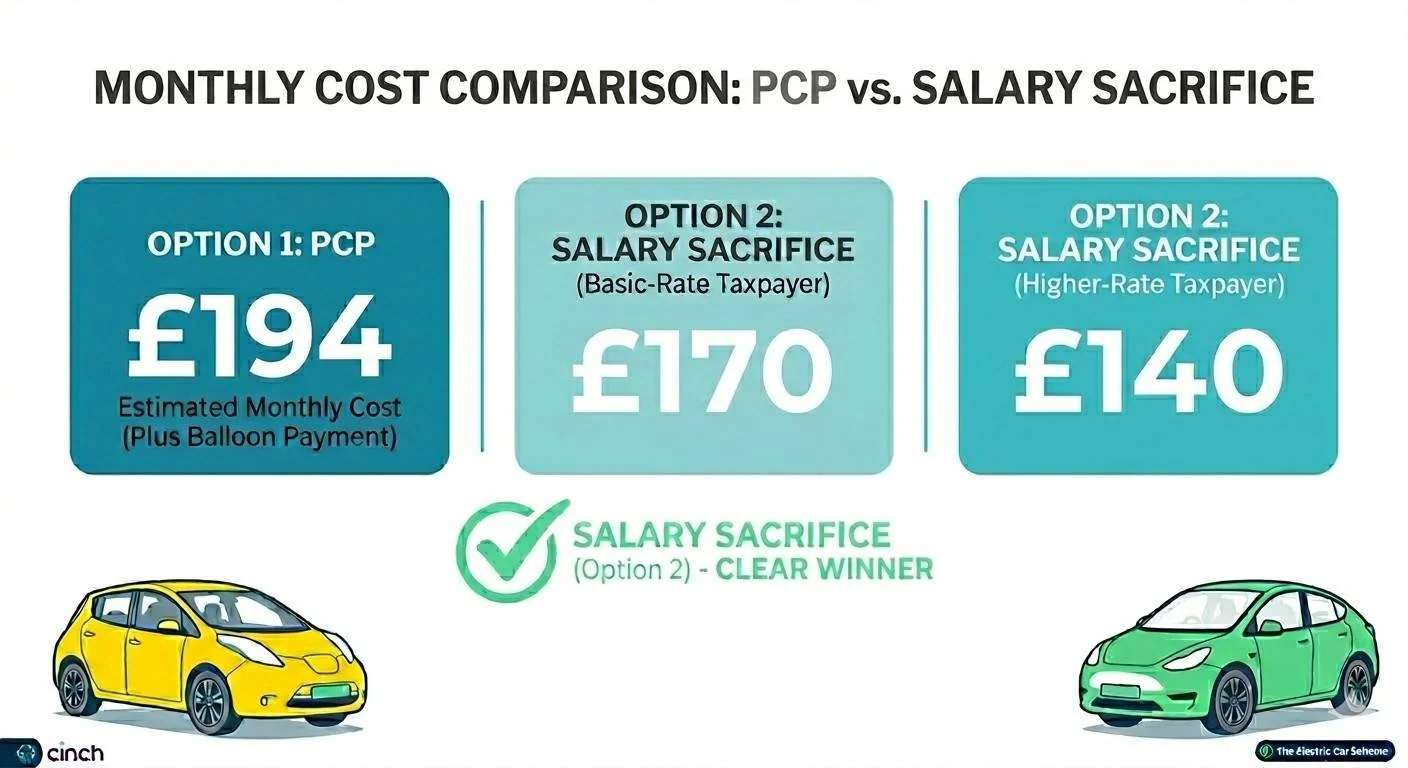
For UK employees, the most financially significant Cinch alternative is electric car salary sacrifice. Cinch is a strong used car retailer, but it can't replicate the Income Tax and National Insurance savings built into the salary sacrifice structure. The salary sacrifice calculator models what you'd pay net of tax on your salary.
The numbers demonstrate the substantial difference between retail purchase and salary sacrifice:
A used electric car with a £20,000 retail price bought on a 48-month PCP at APR is 12.4% (representative example from Cinch's website).
A comparable used EV through salary sacrifice at a similar monthly gross cost of £250 would cost a basic-rate taxpayer around £170 net per month, or a higher-rate taxpayer around £140 net per month.
The package is also fully all-inclusive - insurance, servicing, maintenance, tyre replacements, breakdown cover, and road tax are bundled into a single monthly salary deduction. There is nothing equivalent to this structure on Cinch or any other retail platform.
Key Takeaways
Salary sacrifice delivers Income Tax and National Insurance savings
Basic-rate taxpayers typically save £80+ monthly vs retail purchase
All-inclusive package covers insurance, servicing, maintenance, and breakdown cover
Retail platforms can't replicate salary sacrifice tax advantages
The Electric Car Scheme: The Specialist Alternative to Cinch
Where Cinch operates as a retail car platform, salary sacrifice for electric vehicles demands a different order of expertise: tax structuring, employer risk management, payroll integration, and HMRC compliance. The Electric Car Scheme was purpose-built for this, and has spent years refining a product that a general automotive retailer has neither the structure nor the incentive to replicate. For HR Directors and Finance teams evaluating the options, the distinctions are commercially significant.
What Happens When an Employee Leaves?
The question most HR and Finance Directors ask first is: what happens if an employee leaves before the lease ends? With most providers, that risk sits with the employer. With The Electric Car Scheme, it doesn’t.
Complete Employer Protection covers redundancy, dismissal, long-term sickness, loss of licence on medical grounds, and death from the first day of every lease, with resignation covered after an initial three-month period. There's no excess, no usage limit, and no claim process that erodes the value of the protection. No other salary sacrifice provider offers the same scope of cover from day one.
Charging Costs, Covered Pre-Tax
Salary sacrifice reduces the cost of an electric car by moving payments into pre-tax salary. The Charge Scheme applies the same logic to the ongoing cost of charging.
Employees typically save 20–50% on every charge, at home, at work, and across 76,000+ public charge points, because charging costs are met from gross salary before Income Tax and National Insurance are applied.
It's a saving with no retail equivalent: no consumer finance arrangement, no personal lease, and no car retail platform has a mechanism to deliver pre-tax charging savings of this kind.
New, Used, and Available Fast
Not every employee needs or wants a brand-new vehicle, and The Electric Car Scheme is structured to reflect that.
Over 200 electric cars are available, spanning new models and a used EV range that can be delivered in as little as 14 days. More than half of scheme drivers choose a used electric car, partly for the lower monthly sacrifice figure, and partly because a reduced P11D value lowers the Benefit-in-Kind tax liability. At 4% for 2026/27, that liability's already modest against the 37% maximum BiK rate applied to high-emission petrol cars, but on a used vehicle it's lower still.
A Benefit That Funds Itself
Setting up The Electric Car Scheme carries no cost to the employer. Employer National Insurance savings, accrued on the value of each employee's reduced gross salary at the current 15% rate, typically average around £1,920 per car per year. For businesses with meaningful scheme uptake that return sufficient to make the benefit self-funding or net positive, without redirecting NI savings back into the employee offering.
Built to Pass Procurement
A 4.8 Trustpilot TrustScore draws on thousands of independently verified reviews from both employers and employees, but for procurement and risk teams, the more relevant credentials are structural.
The Electric Car Scheme holds ISO 9001 and ISO 14001 certification, and we were the first B Corp certified. Those accreditations exist because enterprise clients require them during supplier approval, and they represent a standard of governance that consumer retail platforms aren't designed to achieve.
Key Takeaways
Employer financial risk on early leavers is fully removed from day one
Pre-tax charging savings aren't available through any retail or finance platform
Used EVs available within 14 days, with lower BiK liability than new
Employer NI savings typically make the scheme cost-neutral to run
Frequently Asked Questions
-
Cinch is a direct-to-consumer used car retailer that buys, refurbishes and sells cars entirely online. Owned by Constellation Automotive Group (which also owns WeBuyAnyCar), the company handles every vehicle through comprehensive multi-point inspections before listing. Cars are delivered to your door or collected from over 100 UK locations.
The company owns every vehicle it sells, providing direct warranty coverage rather than third-party protection. All purchases include a 90-day warranty and 14-day money-back guarantee as standard. Finance options include HP and PCP arrangements for buyers requiring monthly payment plans.
-
Cinch doesn't offer salary sacrifice, leasing, or any employer benefit scheme. The company operates as a direct-to-consumer used car retailer, focusing on outright purchase and consumer finance options. For salary sacrifice, you need a dedicated provider such as The Electric Car Scheme.
-
For employed drivers, salary sacrifice is typically cheaper on a net monthly basis. Payments come from gross salary before Income Tax and National Insurance are applied, effectively paying with pre-tax earnings.
A used EV through The Electric Car Scheme also includes insurance, servicing, maintenance, and breakdown cover in the monthly payment.
None of these services are included in a cinch purchase. The all-in cost comparison therefore favours salary sacrifice significantly for most employed drivers earning above the basic rate tax threshold.
-
For employed drivers, electric car salary sacrifice is typically the lowest-cost monthly route to a new or used EV. With BiK tax at 4% for 2026/27 and payments coming from pre-tax income, most employees save 20-50% compared to a personal lease or retail purchase on the same vehicle.
Self-employed drivers and business owners may find personal leasing or outright purchase more cost-effective depending on their tax position.
-
Yes, employees can access used electric vehicles through salary sacrifice schemes. The Electric Car Scheme offers used electric cars with delivery within 14 days, extending the full tax benefits to employees at lower salary levels or those preferring pre-owned vehicles.
This option maintains the same BIK tax rate of 4% for 2026/27 as new electric cars, ensuring identical tax savings.
Used electric car salary sacrifice provides the same comprehensive benefits as new vehicle schemes. Employees typically save 20-50% compared to personal leasing, while accessing The Electric Car Scheme's all-inclusive package covering insurance, servicing, maintenance, breakdown cover, and road tax. The arrangement remains cost-neutral for employers through Employer NIC savings averaging £1,920 per car per year.
-
The Benefit-in-Kind rate for electric vehicles is 4% for 2026/27. It increases incrementally, reaching 9% by 2029/30, still far below the maximum 37% rate for high-emission petrol and diesel cars.
This makes salary sacrifice highly cost-effective for EV drivers throughout this period.
-
The Electric Car Scheme provides a comprehensive all-inclusive package covering the vehicle, fully comprehensive insurance, servicing, maintenance, planned tyre replacements, breakdown cover, and road tax in one pre-tax monthly payment. Cinch's purchase model includes a 90-day warranty and 14-day return policy, but requires separate arrangements for insurance, servicing, tyres, and breakdown cover, all paid from after-tax income.
The pre-tax structure of salary sacrifice delivers material cost advantages for employed drivers. Employees typically save 20-50% compared to personal financing options, while avoiding the complexity of managing multiple vehicle-related contracts and payments.
-
Yes, your employer must have a salary sacrifice scheme in place before you can access these benefits. The Electric Car Scheme is free for employers to set up and cost-neutral to run. Employer NIC savings on reduced gross salaries average £1,920 per car per year, which typically offset all operating costs. If your employer doesn't yet offer a scheme, you can refer them directly to The Electric Car Scheme.
Which Alternative Is Right For You?
Cinch is a strong choice for private buyers purchasing a used electric car outright or through personal HP or PCP finance. Its inspection process, 90-day warranty, 14-day money-back guarantee, and home delivery make it one of the more consumer-friendly used car retailers in the UK. Autotrader and Cazoo cover similar ground with broader dealer listings, while LeaseLoco and Lease Fetcher are useful for comparing personal lease deals on new electric vehicles.
None of those options, however, can replicate the structural advantage of salary sacrifice. If you're an employed driver paying 20% or 40% Income Tax, The Electric Car Scheme means you're funding your electric car with money that would otherwise go to HMRC. That's a saving no retail platform is built to offer. Learn more about our salary sacrifice car scheme here.
Are you an employer?
BOOK A DEMOAre you an employee?
SEE AVAILABLE CARSYou Might Also Like…




Last updated: 27/03/2026
Our lease pricing is based on data collected from The Electric Car Scheme quote tool. All final pricing is inclusive of VAT. All prices above are based on the following lease terms; 10,000 miles pa, 36 months, and are inclusive of Maintenance and Breakdown Cover. The Electric Car Scheme’s terms and conditions apply. All deals are subject to credit approval and availability. All deals are subject to excess mileage and damage charges. Prices are calculated based on the following tax saving assumptions; England & Wales, 40% tax rate. The above prices were calculated using a flat payment profile. The Electric Car Scheme Limited provides services for the administration of your salary sacrifice employee benefits. The Electric Car Scheme Holdings Limited is a member of the BVRLA (10608), is authorised and regulated by the FCA under FRN 968270, is an Appointed Representative of Marshall Management Services Ltd under FRN 667174, and is a credit broker and not a lender or insurance provider.
Copyright and Image Usage: All images used on this website are either licensed for commercial use or used with express permission from the copyright holders, in compliance with UK and EU copyright law. We are committed to respecting intellectual property rights and maintaining full compliance with applicable regulations. If you have any questions or concerns regarding image usage or copyright matters, please contact us at marketing@electriccarscheme.com and we will address them promptly.