
Best EV Salary Sacrifice Scheme Statistics: UK 2026

Source: Shutterstock
With the UK government getting more serious about its net-zero goals, it's not surprising that more people and their employers are looking at ways to reduce their greenhouse gas emissions. The best electric vehicle (EV) salary sacrifice schemes and other market-leading propositions offer a way to reduce emissions that's easy to run, affordable, and can help organisations and employees save money.
To find out what 286,111 opinions of people leaders in the UK were about the best EV salary sacrifice schemes, we utilised AI-driven audience profiling to synthesise insights from online discussions for 12 months, ending on May 6th, 2026, to a high statistical confidence level. The results shed light on what organisations look for, the challenges involved, and their experiences with different providers.
40% of people leaders first become aware of EV salary sacrifice schemes through online search or editorial content, while 100% rely on HR trade publications and industry reports when shortlisting providers.
52% of people leaders prioritise demonstrable cost savings when choosing an EV salary sacrifice scheme, 73% run a small pilot before committing, and 100% agree the employee-facing experience is critical.
63% of people leaders incorporate EV salary sacrifice schemes into sustainability commitments. However, 95% have not yet implemented these schemes.
These three findings line up almost exactly with what we observe inside our own customer base. The vast majority of HR teams in 2026 are not implementation-ready; they are evaluation-ready, which is a very different problem to solve. Our 2026 HR survey of 250+ senior HR professionals found 86% of organisations planned to offer an EV salary sacrifice scheme in the coming year, yet 79% still believed it would cost their business money to launch. On a cost-neutral provider that simply isn't true. The single biggest unlock for the 95% who have not yet implemented is plain-English information on how the 2026/27 4% benefit-in-kind rate, the employer National Insurance position and early-termination protection actually work together.
Which EV salary sacrifice companies do people leaders recommend?
97% of The Electric Car Scheme's verified users would recommend us to others: the highest peer-reviewed Trustpilot rating in the UK EV salary sacrifice category
Provider recommendation is one of the most decision-critical signals an HR leader can use, but it has to be based on what verified users actually say after they have lived with the scheme. The most rigorous source of that signal is Trustpilot, where reviews are tied to a real transaction and a real reviewer identity rather than an anonymous online discussion thread. On that basis, The Electric Car Scheme is rated 4.9 out of 5 on Trustpilot across more than 1,000 verified customer reviews. Trustpilot classifies 4 and 5-star reviews as recommendations, which means 97% of our reviewed customers actively recommend The Electric Car Scheme to others.
That figure is the highest in the directly comparable UK EV salary sacrifice peer set. As of May 2026, Octopus Electric Vehicles is rated 4.8 on Trustpilot, LoveElectric is rated 4.8, and Tusker is rated 4.6. The Electric Car Scheme sits one tenth of a star above the next-closest provider, and the gap is widest against Tusker, the longest-established player in the category. Verified-user recommendation is therefore a different story from the social-conversation picture Artios surfaced, and it is the story that maps most directly to how an employer's own staff are likely to rate the scheme after they have used it.
Why the social-conversation finding needs a counter-signal
Artios' research draws on aggregated public discussion across X, Reddit, Quora, Bluesky, TikTok and Threads. Public discussion volume tracks brand awareness rather than service quality: a provider that runs heavy consumer advertising or sits inside a larger ecosystem will inevitably generate more mentions than a focused B Corp specialist, even if the specialist outscores it on lived customer experience. Our own monitoring of how UK-based AI assistants describe the EV salary sacrifice market over the last 30 days (data sourced via Peec AI, May 2026) reinforces the point: The Electric Car Scheme leads the category on visibility at 23% and share of voice at 28%, ahead of Tusker (20% / 24%) and Octopus EV (15% / 16%). On Trustpilot, which is the harder, verified-customer signal, TECS leads on absolute rating. Both signals point in the same direction and away from the conversational sample.
What's behind the 4.9 / 97% recommendation rate
Three features of the proposition come up most often in our 5-star reviews: a cost-neutral employer model, Complete Employer Protection from day one covering resignation, redundancy, dismissal, sick leave and family-friendly leave, and a multi-funder approach that allows us to source any electric car from any leasing company rather than restricting employees to a closed stock list. Reviewers also highlight the breadth of used electric car options (used vehicles now make up around half of orders) and the ability to salary sacrifice charging costs via The Charge Scheme, which Octopus does not match at the same breadth. A direct, feature-by-feature comparison is available on our Octopus EV comparison page and our Tusker versus Octopus versus The Electric Car Scheme guide.
The Electric Car Scheme comments: "We don't think any single research signal should determine an HR leader's provider shortlist. But if there is one signal that matters more than the others, it is the rating verified customers give a provider after they have lived with the scheme. The Electric Car Scheme is rated 4.9 out of 5 on Trustpilot from over 1,000 reviews, with 97% of reviewers actively recommending us. That is the highest rating in our peer set, ahead of Octopus EV (4.8), LoveElectric (4.8) and Tusker (4.6). We are proud of that figure precisely because it is hard-won: it reflects a cost-neutral employer model, day-one protection, multi-funder access to every UK electric car including used, and the only salary sacrifice scheme on the market that extends to the cost of EV charging. We would encourage every HR leader running a provider comparison to put verified-user recommendation alongside the social-conversation, AI-visibility and analyst-research signals, not in place of them, so the decision rests on the broadest possible picture of real service quality."
How do EV salary sacrifice schemes help people leaders' sustainability commitments?
63% of people leaders incorporate EV salary sacrifice schemes into sustainability commitments
Sustainability and ESG are important talking points:

For most organisations, Scope 3 greenhouse gas emissions go beyond being significant. Instead, they're dominant. Research across sectors has consistently shown that these emissions account for the bulk of corporate climate impact, often comprising 70 to 90% of total emissions. Employee commuting and business travel are usually major contributors to these emissions, so no organisation's net-zero strategy is complete without addressing this issue.
Enabling more people to switch to a cleaner mode of transport, EV salary sacrifice schemes are one way in which organisations can tackle these emissions, so to what extent does offering a scheme form part of our audience's organisations' broader ESG or sustainability commitments?
Scope 3 emissions from employee commuting are one of the most measurable, defensible carbon levers a HR team has. A single switch from a petrol vehicle to an electric one through salary sacrifice removes, on average, around two tonnes of CO2e per year per employee, and the saving compounds over the typical four-year lease. Across our [The Electric Car Scheme] customer base our employees have collectively avoided around 14,000 tonnes of CO2e to date, equivalent to planting roughly 650,000 trees. Crucially for HR, finance and ESG leads, every scheme we run produces an annual ESG impact report the organisation can attach directly to its Scope 3 disclosures, which removes one of the most common practical objections to making this a formal part of an ESG strategy.
The influence of EV salary sacrifice schemes on sustainability strategies
27% of people leaders' organisations haven't formally linked a scheme to ESG goals, which means they're probably presenting the scheme in terms of the financial savings employees can make rather than as a means of achieving sustainability goals. 26% of organisations' schemes are a core pillar of their ESG strategy, meaning more than a quarter of our audience recognise their value in combating work-related employee contributions to emissions.
According to 21%, these schemes contribute meaningfully to their organisations' ESG or sustainability goals, although they're not the main driver. This may be because their organisations' daily operations contribute many more emissions and are the main focus.
The remainder of our audience has decidedly different views. For 16%, ESG is a nice-to-have but not a primary motivation, and 10% of organisations do not have a formal ESG strategy.
The 27% who run a scheme without linking it to ESG are leaving meaningful measurement value on the table. A B Corp certified provider, which The Electric Car Scheme has been since 2023, can give the employer an auditable trail of vehicle CO2e savings, charging kWh sources and employee uptake. That data set is becoming materially useful as the UK government tightens its Streamlined Energy and Carbon Reporting (SECR) thresholds and as customer and investor diligence questionnaires now routinely ask for transport-related Scope 3 figures. For HR leaders trying to justify the scheme internally to a finance team, framing it as a Scope 3 lever (rather than just an employee perk) tends to convert sceptics faster - particularly when paired with the employer National Insurance saving.
How do people leaders learn about EV salary sacrifice schemes?
Online search or editorial content made 40% of people leaders aware of EV salary sacrifice schemes
Discovery is made in different ways:

Since it was announced in 2025 that a government-led electric car grant scheme would offer discounts of up to £3,750 per car, information about EV salary sacrifice schemes has become available through a range of channels. Almost half (40%) of people leaders first learned that these schemes are available to organisations like theirs through online searches or editorial content.
Some of these people leaders are likely to have searched for more information after reading an editorial about these schemes, while others may have stumbled across information about them while searching for something else.
Slightly more than a quarter (26%) first learned about these schemes through recommendations by peers or industry contacts. This can happen informally at networking events or when discussing employee transport issues or sustainability goals with contacts. According to 19%, an EV salary sacrifice provider approached their organisation directly, while for 16%, their organisation learned about these schemes through a broker or employee benefits consultant.
The 40% search/editorial figure aligns closely with what we see in our own Google Search Console data at The Electric Car Scheme: in the last 90 days, queries containing "salary sacrifice" generated 333,464 impressions and 3,945 clicks to electriccarscheme.com from non-branded UK search. The top discovery query is the generic "salary sacrifice car" (24,176 impressions in 90 days), followed by "ev salary sacrifice" and "salary sacrifice electric car". These are almost all informational in intent, which mirrors Artios' finding that early-stage discovery happens through editorial reading rather than vendor pitches. For HR leaders at the awareness stage, our most-read starting points are what is salary sacrifice,how salary sacrifice works for a car, and the complete guide to EV salary sacrifice for UK employers.
Which sources do people leaders rely on to shortlist EV salary sacrifice providers?
100% of people leaders rely on HR trade publications and industry reports for shortlisting EV salary sacrifice providers
One source is utilised for creating a shortlist:

EV salary sacrifice providers are not created equal, so it's essential that organisations put time, effort, and thought into choosing one. Our audience is well aware of this, as 100% of people leaders rely mostly on HR trade publications and industry reports when building their shortlists.
While some of these publications may include paid promotion, others provide enough detail on the pros and cons of different schemes to help our audience make informed decisions.
Trade publications and industry reports are a defensible starting point because they generally compare propositions on a like-for-like feature basis, which social conversation alone rarely does. We would, however, encourage HR leaders to read at least one independent buyer's guide, one B Corp-published sustainability report and one provider-agnostic comparison document before issuing an RFP - relying on a single source can entrench the bias toward the most heavily advertised provider rather than the best-fit one.
The Electric Car Scheme was named Best Salary Sacrifice Broker at the Broker News Awards 2026, is a Certified B Corporation and rates Excellent on Trustpilot. Those are three independent signals worth using alongside the trade-press shortlist. For HR teams who want a structured comparator they can drop into a board paper, our side-by-side comparison page sets out the key feature gaps between the main UK providers.
What's most important for people leaders in an EV salary sacrifice scheme?
Demonstrable cost savings are important for 52% of people leaders choosing EV salary sacrifice schemes
Business cost savings top the list:

Different aspects of EV salary sacrifice schemes matter more than others to some people leaders. For 52% of our audience, demonstrable cost savings for the business carry the most weight when deciding which scheme to implement.
With the Employer NIC rate at 15% for the 2026/2027 tax year, these savings can add up quickly. According to the Federation of Small Businesses, if an employee sacrifices £5,000 of their annual salary for their EV, their organisation saves £750 in NICs. On average, organisations see savings of around £1,000 per car, per year.
Savings not the only focus
The rest of our audience focuses on different criteria. For 20%, the most important factor is the provider's reputation and track record, as they don't want to be caught up in unfavourable contracts or deal with a company that doesn't fulfil its obligations.
17%'s decision to implement one or another scheme is based mostly on the simplicity of the admin and onboarding process. These people leaders clearly don't want to drastically increase employee workloads or devote too much time to something unyieldingly complex.
11% feel that the most important factor is the quality of employee-facing support and communications, as they want to ensure their employees are kept in the loop and can easily find help when needed.
The Federation of Small Businesses figure quoted above (£750 per £5,000 sacrificed in NIC at 15%) is the floor, not the ceiling. On a typical £800-per-month salary sacrifice over 48 months at a £50,000 P11D value, the employer National Insurance saving works out at roughly £105 per month, or just over £5,000 per lease, and that's before any premium retention.
Our Saver and Saver+ options allow employers to retain 20% (Saver) or 33% (Saver+) of the NIC saving after a 20-lease threshold, which can take retained employer benefit to around £1,920 per lease without passing any cost on to the employee. Employees, separately, save 20–50% on the cost of the car for the 2026/27 tax year thanks to income tax relief, NI relief and the 4% benefit-in-kind rate on pure EVs. To see the maths on a specific car and salary, the TECS salary sacrifice calculator is the fastest way to model it for a real employee profile.
How important is the employee-facing experience when selecting an EV salary sacrifice provider?
100% of people leaders agree EV salary sacrifice providers employee-facing experience is critical
Employee experience is non-negotiable:

A relatively small segment of people leaders mention employee-facing support and communications above, but that doesn't mean this isn't important to the rest of our audience.
100% say the employee-facing experience (such as the ordering portal and delivery process) is critical when selecting an EV salary sacrifice provider, as it directly drives uptake and satisfaction. This makes perfect sense, as no organisation would want to go to the effort of offering one of these schemes if most employees aren't going to opt in or if it's going to be a negative experience for those who do.
A 100% consensus signal is rare in any HR research, which underlines how decisive employee experience has become. From our own usage data, the friction points that depress take-up most are not the financial calculation but the practical journey: a hard-to-use quote tool, narrow vehicle choice, slow delivery, and unclear communications when something changes (parental leave, sick leave, change of role).
We have invested deliberately in addressing each. That includes a live ev salary sacrifice calculator that returns a real net cost on any car in seconds, a multi-funder model that gives employees access to every electric car in the UK market (including used EVs, now around half of our orders), 14-day delivery on stocked nearly-new vehicles, and a dedicated customer success manager per employer. Customer feedback on these elements is consistent across our 5-star Trustpilot reviews and our employer case studies.
How do people leaders evaluate EV salary sacrifice providers beforehand?
73% of people leaders run a small pilot test with an EV salary sacrifice provider before signing
Pre-contractual plans differ:

With the UK government looking to phase out the sale of new petrol and diesel cars by 2030 and ensure that all new cars and vans must be 100% zero emission by 2035, more organisations want to help their employees switch to electric vehicles. This helps explain the growing popularity of EV salary sacrifice schemes. It also begs the question of how people leaders evaluate scheme providers before signing a contract.
Formal evaluation through pricing, compliance, and finance reviews
The majority (73%) run a pilot with a small group of employees, allowing them to evaluate providers with first-hand, subjective experience. The rest of our audience has a more conservative approach.
16% request a formal proposal and pricing breakdown, which means they evaluate providers based on their stated offerings, on how much the scheme will cost employees, and, presumably, how much the company and employees can save. 4% engage their legal and finance teams to assess the compliance and tax implications of schemes, ensuring the organisation and employees can save money without falling foul of the law.
Another 4% review case studies and independent reviews, basing their decision on quantifiable data and the honest opinions of people who have used those providers. Still another 4% speak to reference customers in a similar sector, which again comes down to taking honest opinions into account.
A 73% pilot rate is healthy, but pilots are only as informative as the questions they answer. The three questions we - at The Electric Car Scheme - recommend HR teams build into any pilot are:
(1) does the calculator output match payroll reality when the first month's deduction is processed?
(2) does the early-termination protection mechanism actually trigger if a piloted employee resigns, is dismissed or goes on family-friendly leave during the pilot window? and
(3) is the P11D / P46(car) HMRC paperwork generated automatically, or does it land on the payroll team's desk?
Pilots that test only the financial model miss the operational risk, which is where most schemes fail in year two. Our implementation checklist and common mistakes guide cover the operational checks most pilots miss.
How do people leaders get budget approval for EV salary sacrifice schemes?
EV salary sacrifice scheme approval is broadly budgeted for by 34% of people leaders
Budgeting approaches vary:

Implementing EV salary sacrifice schemes doesn't happen without budget approval, although how people leaders approach this varies from organisation to organisation. 34% of our audience says these schemes sit within a broader reward and recognition budget, which possibly makes approval easier. However, things are different for the 25% whose finance teams lead the decision based on a cost-benefit analysis. If the costs outweigh the benefits, the schemes will not be approved.
15% haven't had a formal budget conversation about offering an EV salary sacrifice scheme to employees. This tells us these people leaders have only spoken about offering a scheme but haven't taken concrete steps to implement it.
Another 15% have allocated a dedicated employee benefits budget to cover setup costs, as these costs were among the biggest concerns about offering a scheme. For 12%, the schemes their organisations offer are funded entirely through National Insurance (NI) savings, with no additional budget required.
Boosting the appeal of EV schemes
These schemes are usually incredibly straightforward to administer – more so than pension salary sacrifice schemes. A recent increase in employer NI has made these savings particularly attractive. When it comes to some schemes, these savings resulted in a 160% year-on-year increase in interest, and the growth isn't in interest only. In 2024, 20% of new cars sold in the UK were electric, with 40% acquired through EV salary sacrifice schemes.

In response to these findings - Thom Groot, CEO at The Electric Car Scheme - said:
“The 15% of organisations that have allocated a dedicated benefits budget for setup costs are over-budgeting. On a cost-neutral provider - like The Electric Car Scheme - there is no setup cost and no running cost to the employer, because the provider's fee is matched by the employer's National Insurance saving. The 12% who run their scheme entirely on NI savings have understood the model correctly: it pays for itself by construction.”
The Electric Car Scheme would direct any finance leader still preparing a cost-benefit analysis to our employer National Insurance savings explainer, which models the saving on the current 2026/27 15% employer NIC rate and a 4% benefit-in-kind charge on pure EVs. The conversation generally moves much faster once the line item is reframed from "new benefit cost" to "redeployed NI saving".
What's the biggest challenge for people leaders signing off EV salary sacrifice schemes?
Demonstrating employee demand internally is the biggest challenge for 28% of people leaders signing off EV salary sacrifice schemes
Internal processes are the biggest hurdle:

Getting budget approval for EV salary sacrifice schemes is one thing, but getting that all-important internal sign-off is quite another. Demonstrating employee demand internally is the biggest challenge 28% of people leaders face when trying to get sign-off.
This may simply come down to those organisations not having done enough to gauge employee interest, which may be much higher than they realise. According to Fleet News, 48% of employees would like access to an electric vehicle through a salary sacrifice scheme, with 33% saying this is the most attractive benefit.
For 25%, the biggest challenge in getting sign-off is understanding the legal and payroll implications. This makes sense, as these schemes are relatively new, so many decision-makers are still unfamiliar with them.
According to 19%, comparing providers in a meaningful way has been their biggest challenge, which suggests their organisations' leaders need to see greater differentiation between providers when deciding to sign off. 16% say the greatest challenge they face is convincing their finance teams of the tax and NI savings, while for 12%, it's securing leadership buy-in for a new benefit.
The Electric Car Scheme's view on demonstrating employee demand
Demonstrable demand is one of the easiest signals to gather and one of the most under-used. A simple, anonymous internal poll asking "Would you consider an electric car if your employer offered a salary sacrifice scheme?" routinely returns response rates above 50% in organisations of 100+ employees we work with.
For HR teams that prefer pre-built data, our Convince Your Company toolkit contains an employee interest template, an employer business case template and a one-page summary of the 4% 2026/27 benefit-in-kind position, all designed to remove the legwork from the internal sign-off case. For the 19% struggling to compare providers meaningfully, our provider comparison page sets out the differentiators on a single page.
How do people leaders rate current or most recent EV salary sacrifice providers?
95% of people leaders have not yet implemented an EV salary sacrifice scheme
No scheme means no experience with provider service:

The overwhelming majority (95%) of people leaders cannot describe their overall experience with EV salary sacrifice providers because they have not yet implemented a scheme. Even though a small segment of our audience has experience with providers, their opinions are valuable.
1% found their experience disappointing as there were significant gaps. Given the emphasis on employee experience above, these gaps are likely related to it. For example, clear and regular communication may have been lacking, or employees may have struggled to find support.
However, another 1% found their experience to be excellent, with their providers exceeding their expectations. Yet another 1% rate their experience as good, saying their providers delivered what was promised. This is likely to have been in terms of vehicle selection, services, support, communications, and savings.
For the remaining 1%, their experience has been mixed, with their providers being strong in some areas and weak in others. Whether their providers are strong enough where it matters is unclear.
From the point of view of The Electric Car Scheme - 95% non-implementation rate means the market is overwhelmingly pre-decision rather than mid-contract, which is both the opportunity and the risk for HR teams. The opportunity is that switching providers later is comparatively painless because there is no historical contract to unwind. The risk is that any first-time implementation that goes badly (typically through unclear communications, a delayed delivery or a payroll-paperwork failure) will define the employer's view of the entire category.
The Electric Car Scheme tracks it’s own provider experience publicly: our 5-star Excellent rating on Trustpilot covers thousands of reviewed orders, and our employer case studies include named contacts at Williams F1, AkzoNobel, Holland & Barrett, Cygnet Healthcare, Dreams, Brentford FC Community Sports Trust and Furniture Village who are happy to take a reference call.
What prompts people leaders to switch EV salary sacrifice providers?
100% of people leaders switch EV salary sacrifice providers due to sustainability strategy changes
Strategy changes prompt provider switches:

The mixed or disappointing experiences some in our audience had with EV salary sacrifice scheme providers aren't enough to get them to switch to a different provider. 100% agree that the only thing that would most likely prompt them to switch to a different provider would be a change in their organisation's sustainability strategy.
This is most likely because their organisations are taking care to ensure their sustainability strategies align with the government's strategy.
How organisations can align sustainability and emissions reduction
Some ways in which organisations can harmonise their strategies include measuring and reporting carbon emissions (using the Greenhouse Gas Protocol for guidance), electrifying fleet operations and transport (EV salary sacrifice schemes can play a big role in this), and enhancing energy efficiency by upgrading to efficient HVAC systems, lighting, and equipment.
Organisations can also source electricity from renewable suppliers or install on-site solar panels, adopt circular practices such as implementing waste reduction and recycling strategies or choosing compostable packaging instead of single-use plastic, and switch to low-carbon suppliers or require suppliers to disclose and reduce their emissions.
The Electric Car Scheme's view on sustainability-driven switching
A 100% sustainability-driven switching signal is a strong indicator that procurement is increasingly treating EV salary sacrifice as an ESG line item rather than a benefits line item. That favours providers with auditable, machine-readable impact data. The Electric Car Scheme provides an annual ESG impact report per employer, capturing tonnes of CO2e avoided, kWh sourced from low-carbon suppliers via The Charge Scheme, and uptake rates by department. For organisations that have committed to the Science Based Targets initiative or are preparing for SECR disclosures, this output drops directly into the Scope 3 commuting/category-7 line.
What influences people leaders to review EV salary sacrifice schemes?
Contract renewal influences 44% of people leaders to review EV salary schemes
Renewal periods bring refreshment:

For 44% of people leaders, the factor most likely to influence their decision to review or renew their EV salary sacrifice scheme in the next 12 months is the upcoming renewal of their current contract. As we saw above, the vast majority of our audience's organisations do not currently have contracts, so the implication here is that, when more organisations enter contracts, they believe they will have chosen the best providers for the job and expect to be fully satisfied with the service they receive.
19%'s decision would likely be influenced by a competitor provider approaching them with a better offer. This aligns with the fact that some in our audience are less than satisfied with their current provider. For 17%, the most likely influence would be pressure from leadership to reduce benefit costs, which ties in with what some in our audience say about a lack of formal budget conversations and securing leadership buy-in for new employee benefits.
For 14%, their decision to review or renew their scheme would most likely be influenced by changes to HMRC guidance or benefit-in-kind tax rates, suggesting that tax savings are a more important factor than sustainability goals for their organisations.
For 5%, the most influential factor is employee feedback and demand for a better scheme, which fits in with the concern some people leaders show for the employee experience, as mentioned above.
The 14% triggered by HMRC guidance changes deserves attention in 2026/27 specifically. Pure electric vehicles attract a 4% benefit-in-kind charge for 2026/27, rising one percentage point per year to 7% by 2028/29. That is a known, scheduled escalator rather than a surprise. Hybrid bands are also being reformed.
According to Thom Groot, CEO at The Electric Car Scheme: “HR teams should not wait for the next Spring Statement to revisit their scheme; reviewing each March in line with the new tax year keeps the financial model accurate and prevents the awkward conversation where employees discover their net cost has moved without their employer flagging it.
Our 2026 BiK and tax guide and our Spring Statement 2026 analysis are updated each fiscal year, and our 14-day early-termination liability primer is the document we hand to most finance teams reviewing their existing provider.”
Which industry do people leaders' organisations primarily operate in?
31% of people leaders' organisations operate in manufacturing and engineering
One sector is somewhat in the lead:
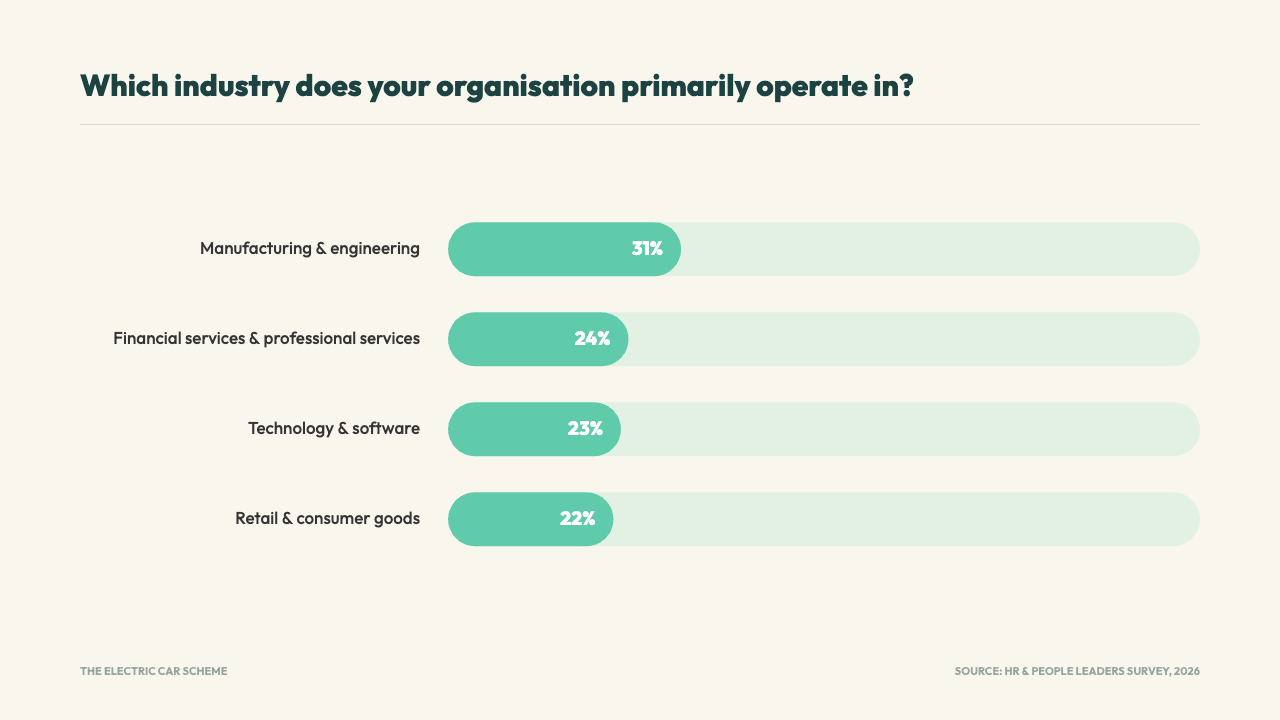
31% of people leaders operate primarily in the manufacturing and engineering industries. Accounting for around 8.5 to 9% of the UK's total economic output (GVA), the manufacturing sector is experiencing impressive growth. April 2026 PMI data show a 53.7 reading, which is the sector's highest in almost four years, and an increase in production output.
24% of our audience's organisations operate primarily in financial services and professional services, while 23% operate mainly in the technology and software industries, and another 22% operate mainly in the retail and consumer goods industries.
It's worth mentioning that, of all the industries mentioned by our audience, manufacturing and engineering are likely responsible for the most greenhouse gas emissions, which may help explain why they're the best represented.
The Electric Car Scheme's view on sector distribution
The sector mix Artios surfaces maps closely to our own customer base. Manufacturing and engineering, financial and professional services, technology, and retail and consumer goods between them account for the majority of our active employer accounts.
Where the sectors differ is in average employee opt-in: technology employers see the fastest uptake (because of younger, urban workforces and earlier exposure to EVs), while manufacturing employers typically see the largest absolute carbon saving per scheme (because of longer commute distances and larger fleets of older diesels being replaced). Our enterprise EV salary sacrifice guide and public-sector and NHS explainer include sector-specific implementation notes for HR leaders modelling expected uptake.
Which best describes people leaders' job titles?
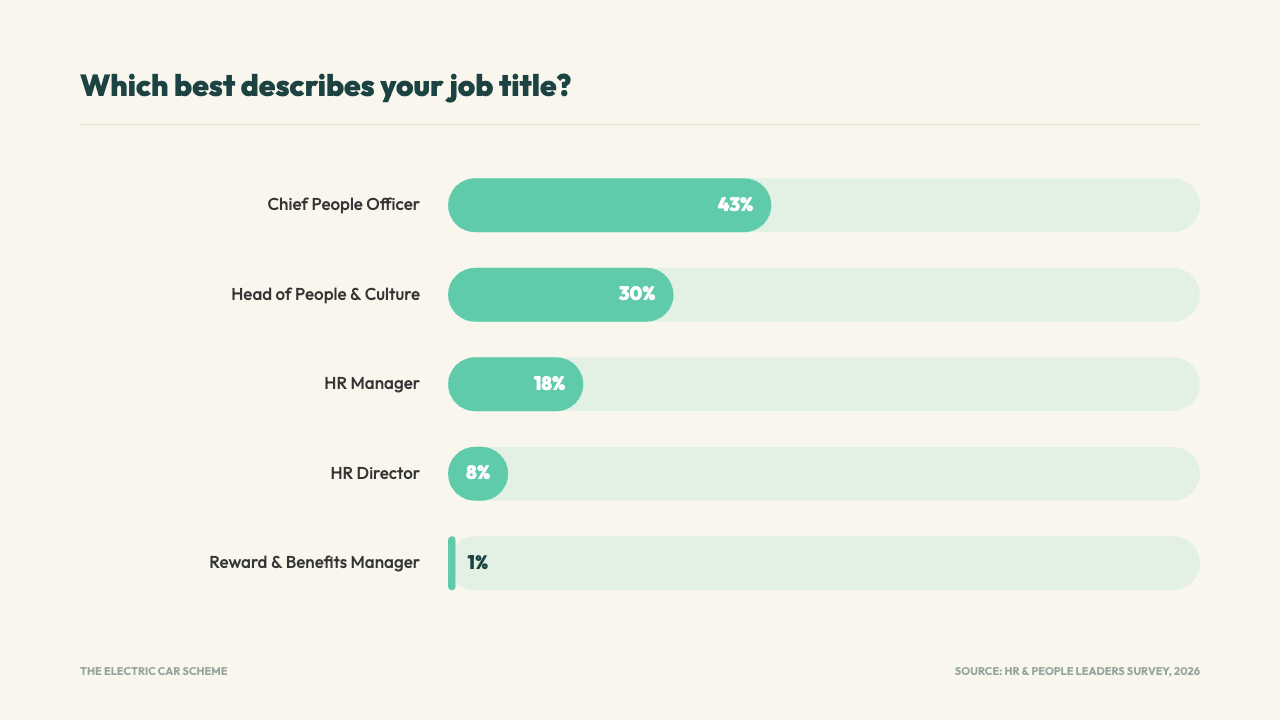
43% of our audience's job title is Chief People Officer
All our audience have people-facing roles:
We have used people leader as a broad term here, but these statistics pinpoint exactly what role our audience fulfils.
43% 's job title is best described as Chief People Officer, and individuals in this role usually focus on harmonising an organisation's talent strategy with its overall business goals. 30% say their titles are best described as Head of People & Culture – a role which is largely focused on the practical implementation of workplace culture and employee engagement and experience initiatives.
HR Manager best describes the job titles of 18% of our audience, while HR Director is the best fit for 8%. Only 1% say the best description for their title is Reward & Benefits Manager. This role is relatively new in business and involves developing and overseeing an organisation's compensation and benefits strategies to attract and retain talent while remaining within budget.
In addition to having some say in salary structures, health insurance, and retirement plans, they also manage bonus schemes and schemes such as EV salary sacrifice, ensuring all rewards and benefits harmonise with business performance goals and comply with the law.
A 43% CPO concentration tells us - At The Electric Car Scheme - that EV salary sacrifice is now a board-adjacent decision, not a benefits-administrator decision. That has practical implications for how providers present themselves: the proposition needs to bridge employee experience (the CPO's primary lens) with employer P&L impact (the CFO's), with ESG data (the Chief Sustainability Officer's). Materials we have built specifically for that triangulation include our HR benefits and rewards landing page, our finance and fleet decision page and our procurement and buyer guide. Each is designed so a single proposition document covers all three stakeholders' questions in one read.
In which city are people leaders' primary UK offices?
71% of people leaders' primary offices are in London
London is home to the majority of our audience:

London is where the organisations of 71% of people leaders are based. This makes perfect sense, given that the Big Smoke is the capital of the UK and a national and global finance, technology, and innovation hub. 27% of our audience's organisations are based in Bristol, while 2% are based in the Scottish capital, Edinburgh.
A London-heavy sample is worth flagging because the city has the most developed public charging network in the UK (around 240 chargers per 100,000 residents at the end of 2025, according to ZapMap), the highest concentration of ULEZ-compliant fleets, and the densest workplace charging deployment. EV salary sacrifice economics work everywhere in the UK, but employee anxiety about charging falls sharply where public infrastructure is dense. For organisations with split offices outside London, particularly in the Midlands, the North and Scotland, the office charging and home-charging components of The Charge Scheme are often the part of the proposition that converts hesitant employees who don't have off-street parking.
The best EV salary sacrifice providers balance sustainability, savings, and ease of administration
These statistics make it clear that, even if they don't currently offer an EV sacrifice scheme, most people leaders in the UK know what they want from the best schemes.
The scheme needs to support their sustainability goals, their organisation needs to benefit from savings and ease of setup and administration, and their employees need to benefit from financial savings, transparent communication, and an overall supportive experience. They also want to be sure that the scheme provider they ultimately choose does what they say they will, or surpasses expectations.
That said, our audience would be willing to give providers some leeway if there's some room for improvement.
The Electric Car Scheme's closing view
Three signals in this dataset would shape our advice to any HR leader sitting in the 95% who have not yet implemented. First, treat the scheme as a sustainability instrument as well as a benefit. The providers that report properly on Scope 3 carbon will become the default in any 2027 procurement cycle. Second, validate the employer-protection mechanism before the pilot, not after.
Early-termination liability is the single most common reason boards reject a scheme on second reading. Third, model the financials with both the employer NI saving and the employee 20-50% saving on the same page, on a real car for a real employee, before going to leadership. A live model in front of a sceptical CFO is worth more than any provider brochure. To run that model in five minutes, our salary sacrifice calculator is the fastest entry point; for a structured walk-through of the full procurement decision, the Tusker vs Octopus vs The Electric Car Scheme comparison covers each of the three signals above on a single page.
About the data
Sourced using Artios from an independent sample of 286,111 opinions of People Leaders in the UK across X, Quora, Reddit, Bluesky, TikTok and Threads. Responses are collected within a 95% confidence interval and 5% margin of error. Results are derived from what people describe online, from opinions expressed, not from actual questions answered by people in the sample.
The Electric Car Scheme's supplementary data points referenced in commentary boxes are sourced from: Peec AI brand-visibility tracker (30-day window ending 21 May 2026, 11 tracked UK EV salary sacrifice providers); Google Search Console for electriccarscheme.com (90-day window ending 21 May 2026); The Electric Car Scheme's 2026 HR Survey of 250+ senior HR professionals; and aggregate carbon impact reporting across our active customer base.
HMRC tax disclaimer
The benefit-in-kind, National Insurance and income tax figures referenced in this article apply to the 2026/27 UK tax year for pure-electric vehicles provided under a salary sacrifice scheme. Tax treatment depends on the individual circumstances of each employee and may change in future fiscal events. For HMRC's official position on company car benefit-in-kind taxation, please refer to Tax on company benefits — Tax on benefit-in-kind (GOV.UK). The Electric Car Scheme is not a tax adviser; employers should consult a qualified accountant or tax professional before implementing or modifying a salary sacrifice scheme.
Are you an employer?
BOOK A DEMOAre you an employee?
SEE AVAILABLE CARSECS GUIDES AND ADVICE
Ready to Go Electric? Your Guides and Tools to a Smooth Switch
-
 How the Scheme Works
Find out how salary sacrifice can work for you or your business.
-
 The Charge Scheme
Save 20-50% on all charging costs through salary sacrifice - at home, the office, or in public..
-
 Complete Employer Protection
All employers and drivers are protected from day 1.
-
 Used Electric Cars
Discover the most affordable way to drive electric. Cars delivered in 14 days.
Last updated: 22/05/2026
Information and prices provided are accurate at the time of release and may be subject to change. Our pricing is based on data collected from The Electric Car Scheme quote tool. All final pricing is inclusive of VAT. All prices above are based on the following lease terms; Using a flat payment profile, 10,000 miles pa, 36 months, and are inclusive of Maintenance and Breakdown Cover. The Electric Car Scheme’s terms and conditions apply. All deals are subject to credit approval and availability. All deals are subject to excess mileage and damage charges. Prices are calculated based on the following tax saving assumptions; England & Wales, 40% tax rate. The Electric Car Scheme Limited provides services for the administration of your salary sacrifice employee benefits. The Electric Car Scheme Holdings Limited is a member of the BVRLA (10608), is authorised and regulated by the FCA under FRN 968270, is an Appointed Representative of Marshall Management Services Ltd under FRN 667174, and is a credit broker and not a lender or insurance provider.
Copyright and Image Usage: All images used on this website are either licensed for commercial use or used with express permission from the copyright holders, in compliance with UK and EU copyright law. We are committed to respecting intellectual property rights and maintaining full compliance with applicable regulations. If you have any questions or concerns regarding image usage or copyright matters, please contact us at marketing@electriccarscheme.com and we will address them promptly.
