
Fleet Management Salary Sacrifice Schemes Statistics: UK 2026
Salary sacrifice schemes are becoming an increasingly relevant part of fleet management, giving employers another way to structure vehicle benefits while responding to changing costs, employee expectations and the shift towards electric vehicles. However, offering a scheme also raises questions about employee uptake, communication, tax treatment, compliance, and ongoing management.
To find out what 136,306 opinions of people leaders in the UK were about fleet management salary sacrifice schemes, we utilised AI-driven audience profiling to synthesise insights from online discussions over 12 full months ending September 23rd, 2026, to a high statistical confidence level. The resulting statistics reveal what drives interest in fleet management salary sacrifice schemes, how employers manage and review them, what employees want to understand, and the concerns shaping decisions around their implementation.
Methodology and data
Sourced using Artios from an independent sample of 136,306 opinions of people leaders in the UK across X, Quora, Reddit, Bluesky, TikTok, and Threads. Responses are collected within a 95% confidence interval and a 5% margin of error. Results are derived from what people describe online, from opinions expressed, not from actual questions answered by people in the sample.
What percentage of people leaders' workforce has taken up salary sacrifice for cars?
For 59% of people leaders, between 16 and 30% of their workforce has taken up salary sacrifice for cars; 21% have seen adoption rates of between 5 and 15%; and for 20%, over 30% of the workforce has taken up salary sacrifice for cars
Scheme adoption rates vary:
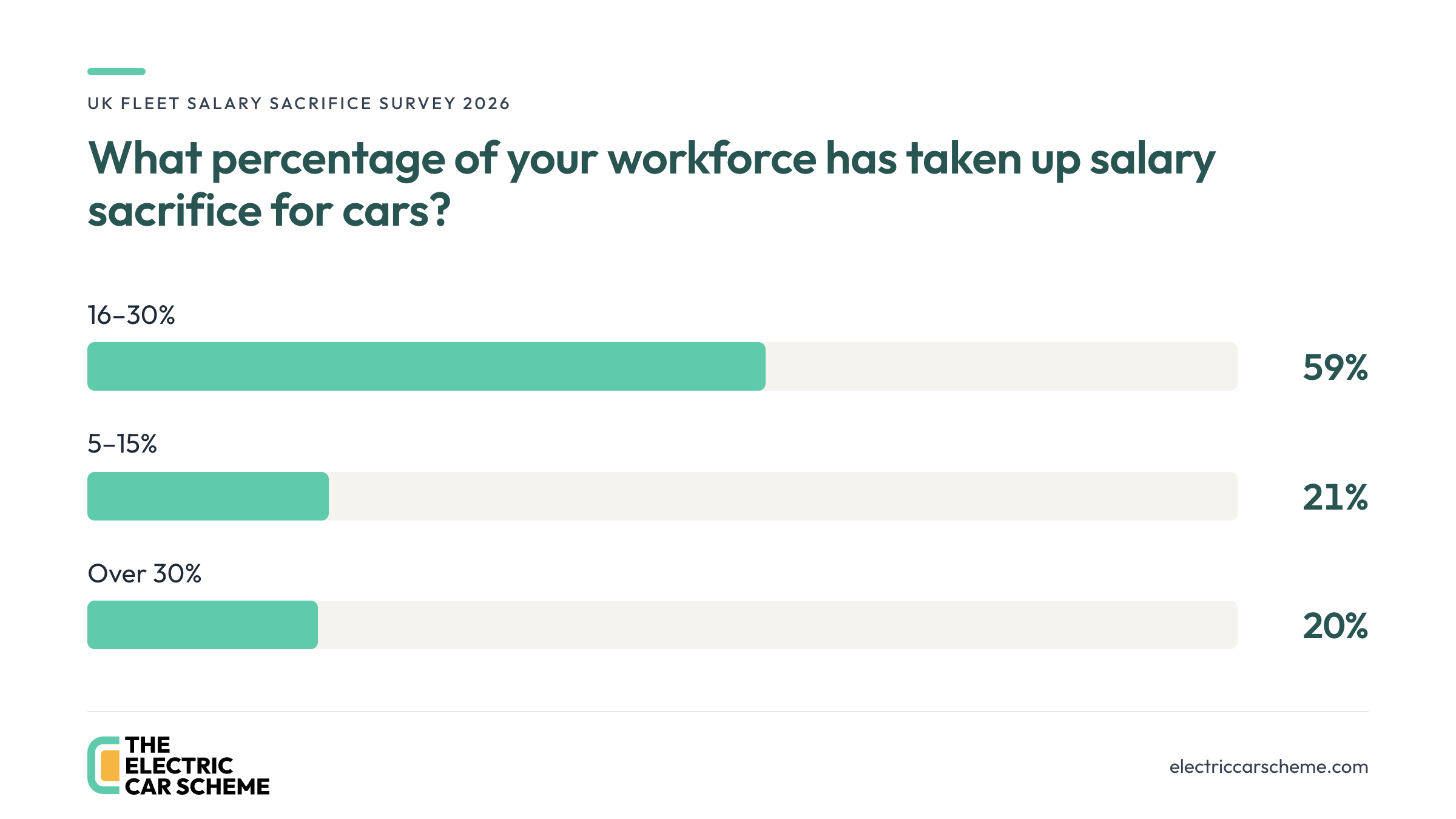
Among people leaders, salary sacrifice for cars has gained a meaningful foothold across the workforce. In the largest group, 59% report that between 16% and 30% of their employees have taken up the benefit. This demonstrates that participation is moving beyond a small niche, with roughly one in six to almost one in three employees using the scheme in many workplaces.
21% of people leaders say take-up stands at 5% to 15% of their workforce. This lower range points to early adoption, where the benefit is established but has not yet reached a broad share of employees. Another 20% of our audience report uptake above 30%, confirming that more than a fifth of people leaders oversee workplaces where salary sacrifice cars have become a widely used option.
The figures reflect the scheme’s growing position in Britain’s benefits market. According to Wealth & Finance, recent FN50 data reinforces this direction. Salary sacrifice increased its market share from 8.6% to 11.9% year over year, reducing the dominance of traditional contract hire.
How familiar are people leaders with fleet management salary sacrifice schemes?
74% of people leaders have heard of fleet management salary sacrifice schemes but have no real knowledge of them, while in contrast, 26% are very familiar and already offer a fleet management salary sacrifice scheme
Familiarity is not generalised:
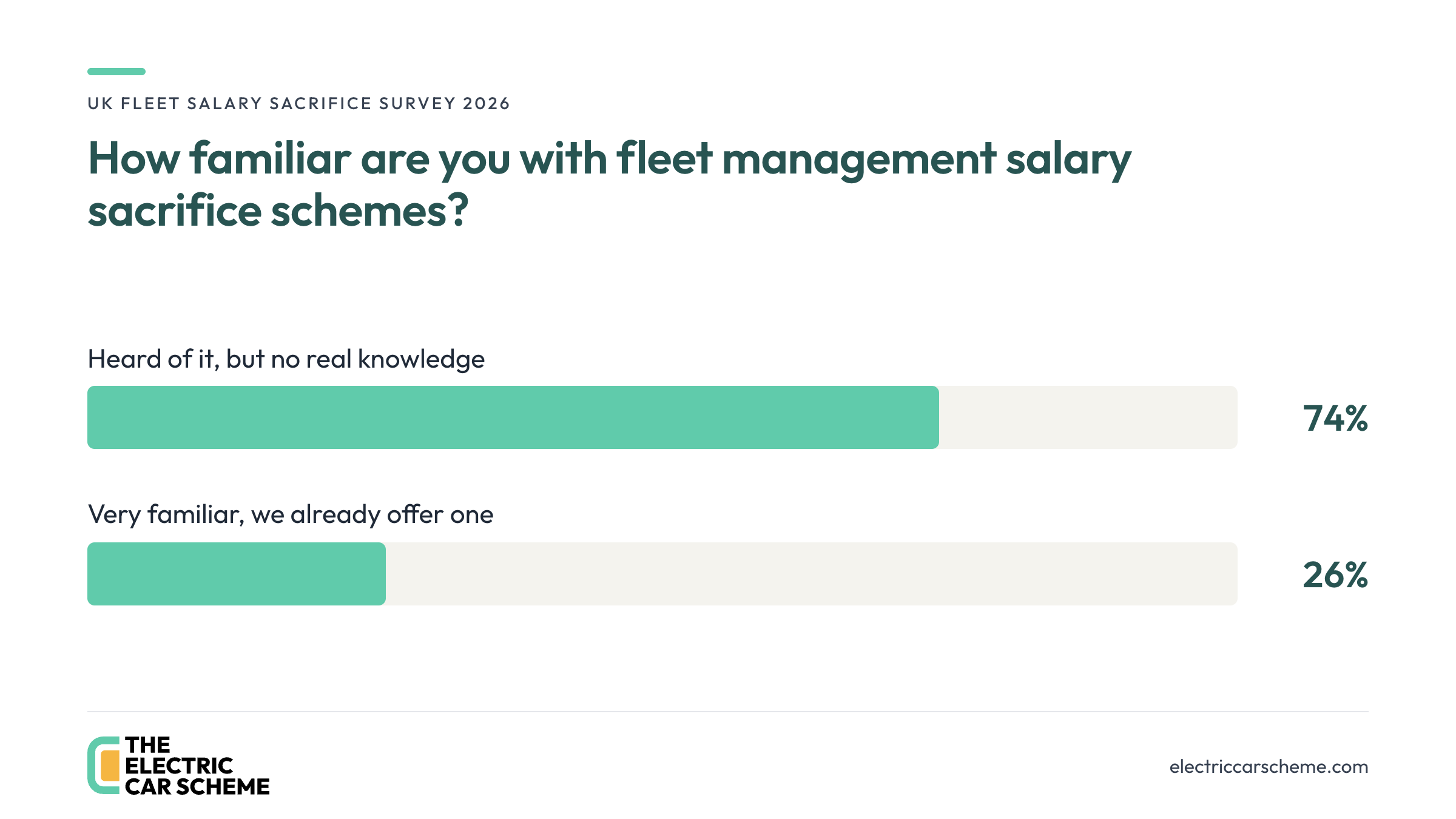
As salary sacrifice car schemes reach more UK workplaces, familiarity with the benefit is also widespread. 74% of people leaders have heard of fleet management salary sacrifice schemes but have no real knowledge of how they work, making this a clear majority. This indicates that awareness is already established, while detailed understanding still has room to develop, particularly around how schemes operate and what they can offer employees.
The remaining 26% of our audience are very familiar with salary sacrifice schemes and already offer one, showing that more than a quarter of people leaders have moved from awareness to active use. For employers, the gap between awareness and active use points to the value of clear guidance on costs, eligibility, administration, and employee communication.
Salary sacrifice allows employees to exchange part of their gross pay for a car through their employer, with tax and National Insurance treatment helping make the option attractive. As schemes become easier to understand, more workplaces may follow the early adopters already offering them.
What triggered people leaders' interest in fleet management salary sacrifice schemes?
Rising fuel and company car costs triggered 86% of people leaders’ interest in fleet management salary sacrifice schemes, and 14%’s interest was triggered by net zero or sustainability targets
Two points trigger interest:
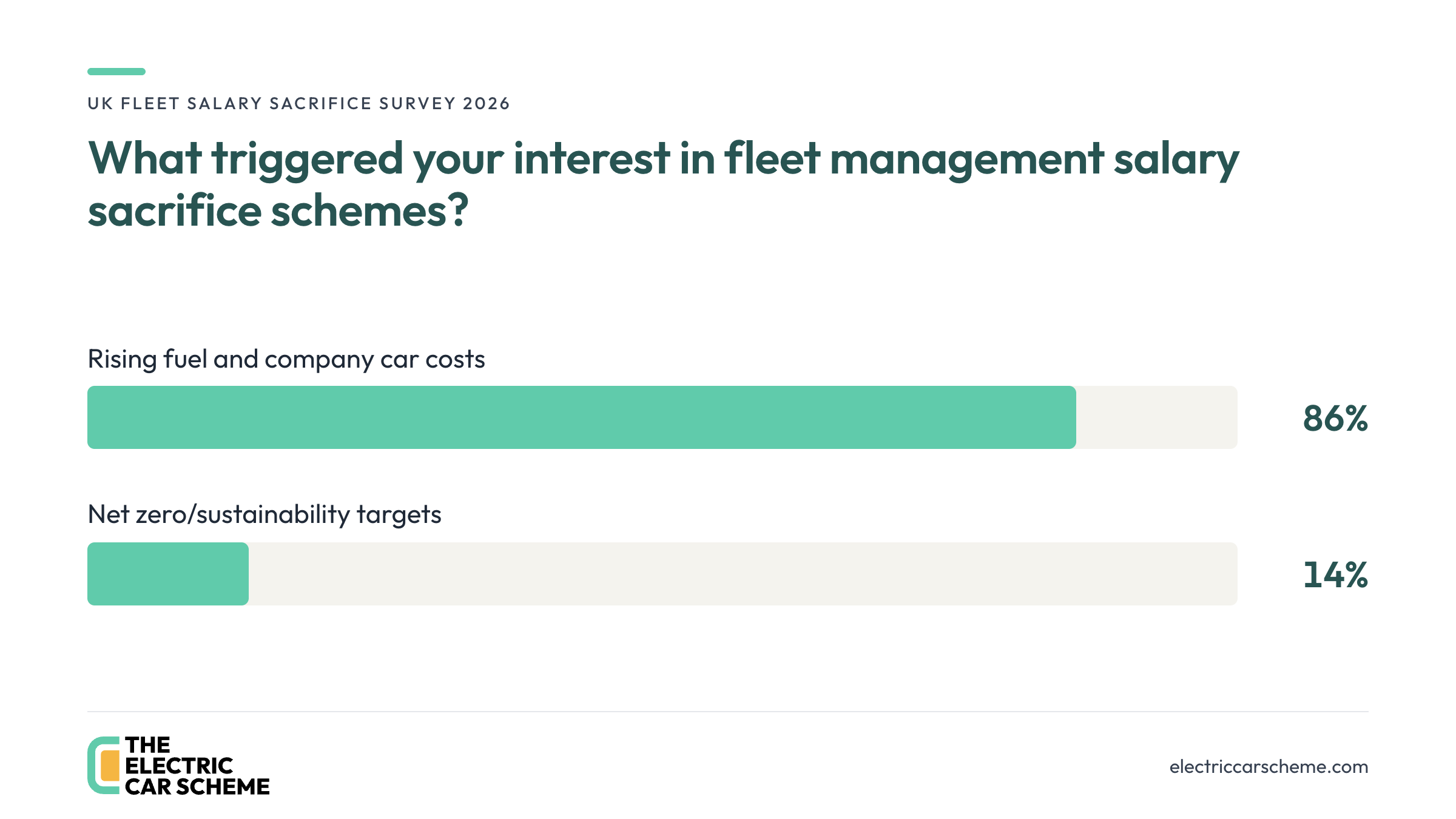
Cost pressures are the main driver behind interest in fleet management salary sacrifice schemes. 86% of people leaders identify rising fuel and company car costs as the primary trigger, underscoring that financial pressures are making fleet benefits a more important consideration.
This aligns with the wider UK motoring environment where fuel costs have climbed sharply, with diesel approaching £2 per litre and petrol reaching 173.6p per litre, its highest level in more than four years. A typical 55-litre diesel fill-up now costs about £109, making fuel expenses a significant concern for employees and employers alike.
Sustainability is also part of the discussion, but it is not the leading trigger. Net-zero and sustainability targets account for 14% of our audience’s interest, demonstrating that environmental goals encourage some organisations to explore salary sacrifice. Environmental goals therefore remain part of the picture, but they are a much smaller factor than rising vehicle and fuel expenses.
How important is EV-only eligibility within people leaders' fleet management salary sacrifice schemes?
EV-only eligibility is not a priority for 79% of people leaders within their salary sacrifice scheme, as all vehicle types are included, but for 21%, EV-only eligibility is essential, as they only offer EVs
EV eligibility holds some weight:
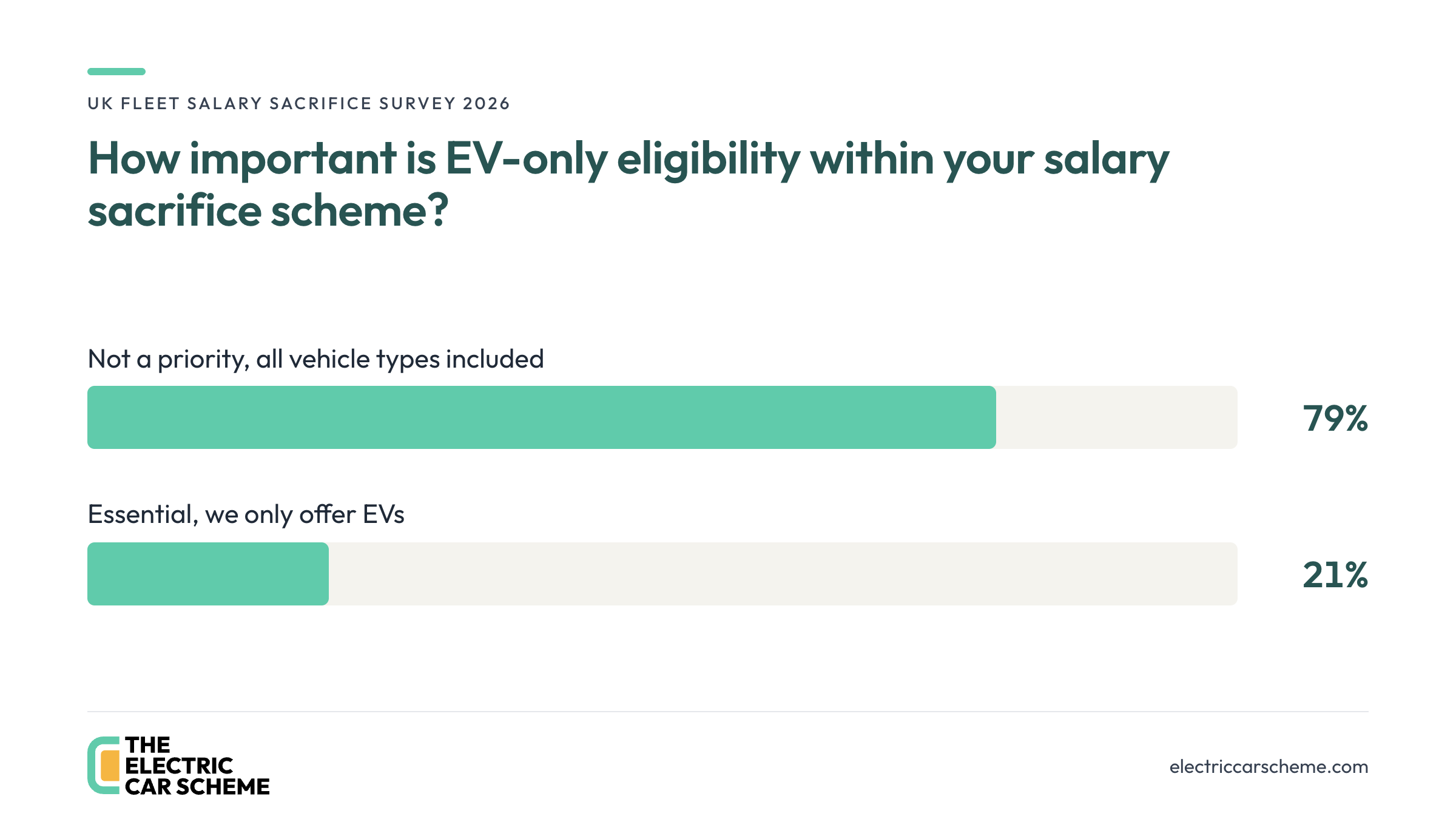
EVs are gaining ground around the UK, but people leaders are taking different approaches to vehicle eligibility within salary sacrifice schemes. For 79%, EV-only eligibility is not a priority, and their schemes include all vehicle types, making a broad vehicle choice the clear approach. This gives employees greater flexibility while allowing employers to structure schemes around wider fleet needs rather than limiting access to electric models.
For the remaining 21% of our audience, EV-only eligibility is essential, with these people leaders offering only electric vehicles through their schemes.
This reinforces EVs' growing position in the wider UK market. More than one in four new cars sold are now electric, while EV sales were 45% higher in July than a year earlier, and more than two million electric vehicles are registered in the UK. The UK government’s latest update confirms this acceleration and outlines a pathway to zero-emission driving by 2035.
How often do people leaders review their fleet management salary sacrifice scheme?
80% of people leaders review their fleet management salary sacrifice scheme every 6 months, 17% review their scheme annually, and 3% only review it when issues arise
Reviews are sporadic:
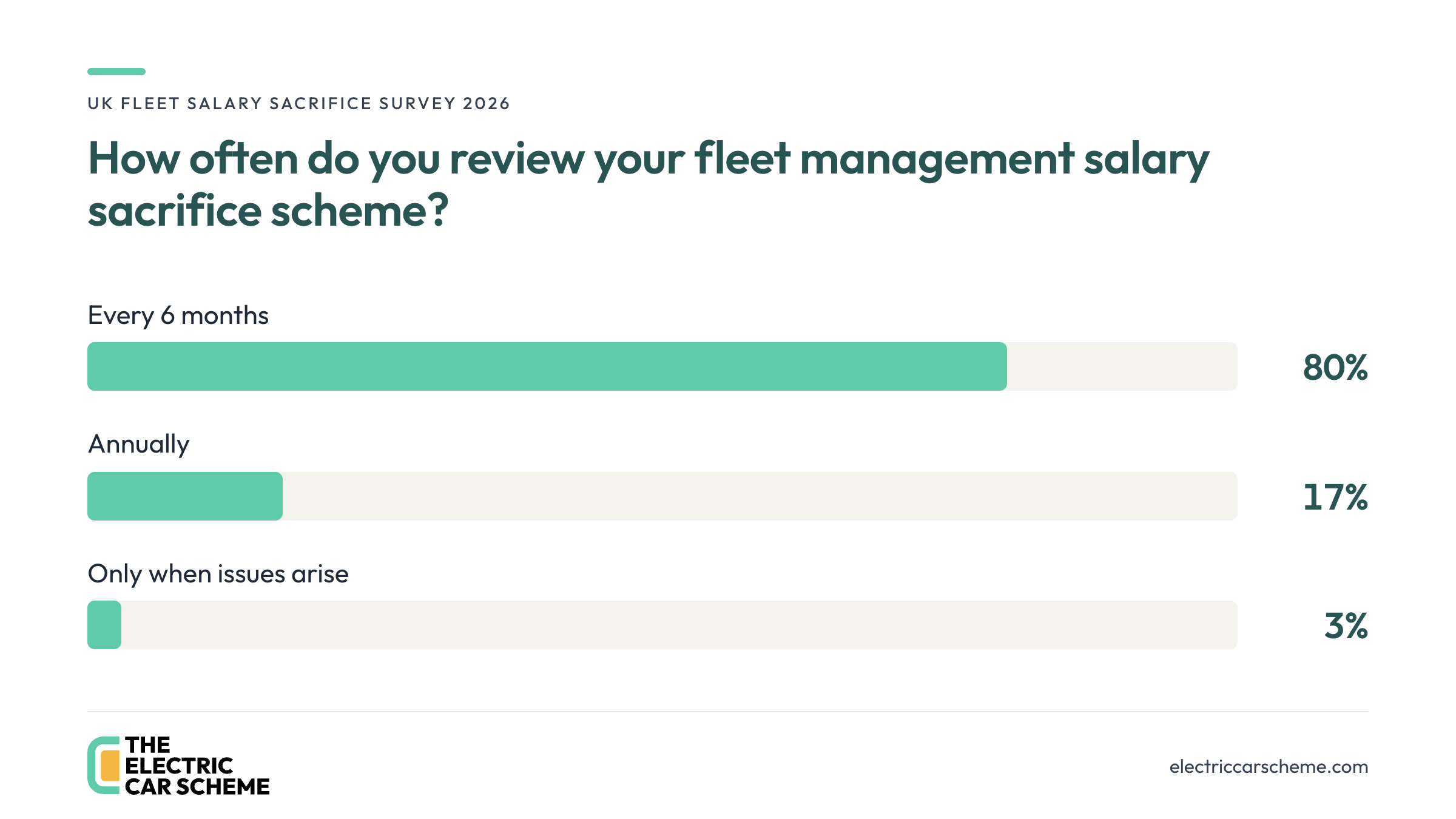
Regular reviews are clearly becoming a strong feature of fleet management salary sacrifice schemes, with over 19 out of 20 people leaders taking an active approach to keeping their arrangements up to date.
80% of our audience review their fleet management salary sacrifice scheme every six months. This twice-yearly rhythm helps employers keep track of participation, vehicle costs, employee needs, payroll deductions, and changes in tax or benefit rules. It also gives teams a chance to adjust the scheme before small issues become larger obstacles.
Comparatively, 17% of people leaders review the scheme annually. This approach still provides a planned opportunity to check whether the scheme remains affordable, well-used, and aligned with business priorities. An annual review can also support updates to vehicle choice, eligibility rules, mileage terms, and communications as the market changes.
Only 3% of our audience review the scheme when issues arise. While this represents a small minority, an issue-led approach can leave employers reacting to problems rather than improving the scheme in advance. Guidance for employers emphasises regular monitoring because vehicle prices, insurance, charging costs, tax rules, and employee expectations can change. The government’s salary sacrifice guidance also highlights the need to account for the tax treatment of these arrangements.
How do people leaders measure ROI from fleet management salary sacrifice schemes?
72% of people leaders don’t currently measure the ROI from their fleet management salary sacrifice scheme, while 28% measure schemes' ROI by their National Insurance cost savings
Measuring ROI is not a main priority:
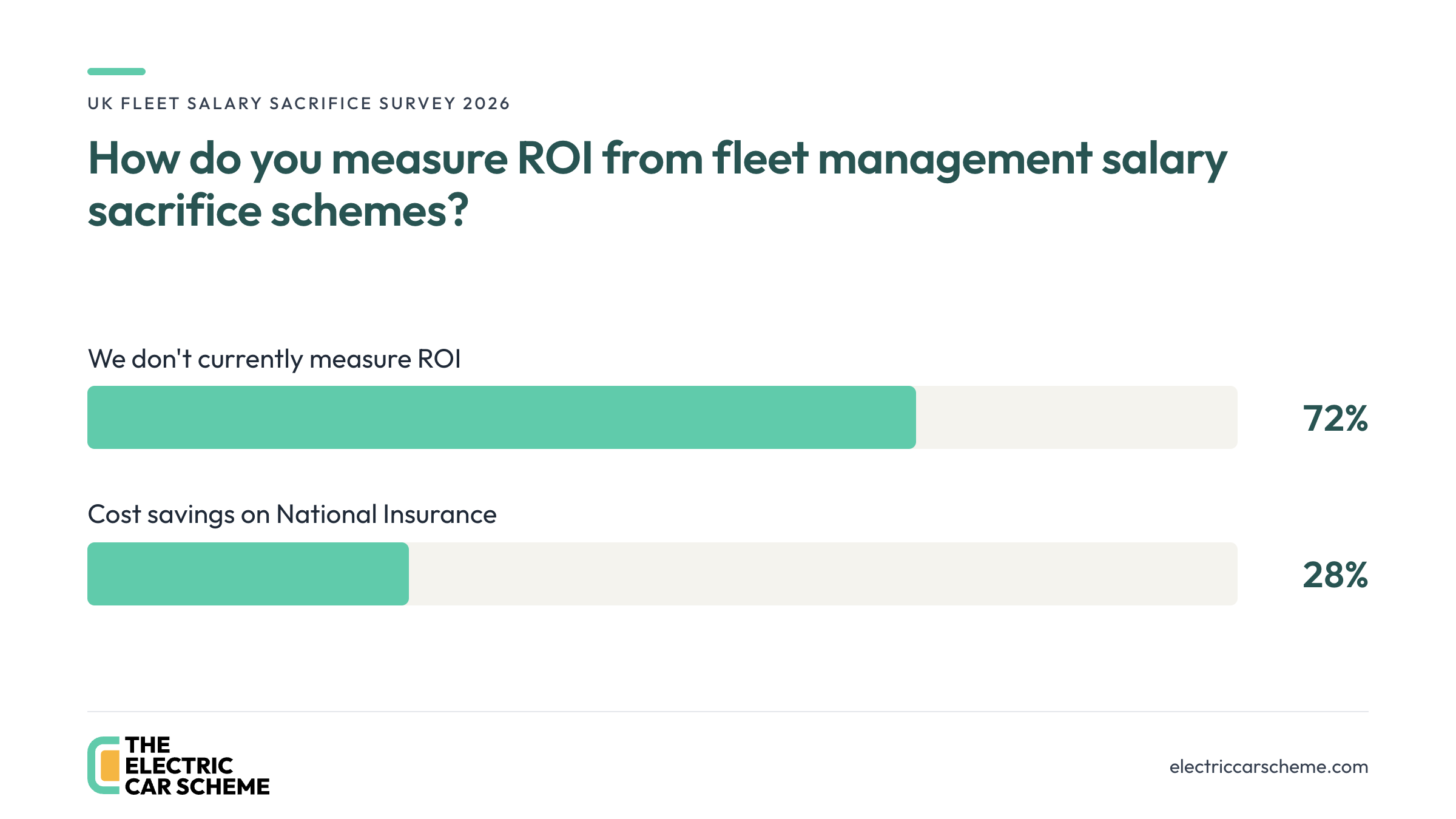
While we saw that most people leaders review their schemes every six months, it’s evident that regular reviews do not always lead to formal performance measurement. 72% of people leaders do not currently measure return on investment. This means that most employers are not yet tracking whether their scheme delivers measurable financial value, such as lower fleet costs, stronger employee uptake, or improved benefit satisfaction.
In comparison, only 28% of people leaders use National Insurance savings to measure ROI. This data gives employers a direct financial measure because salary sacrifice can reduce the earnings on which National Insurance is calculated.
However, the benefit landscape is changing. Government guidance confirms that pension salary sacrifice contributions above £2,000 a year will no longer receive the same National Insurance exemption from 6 April 2029. This rule concerns pension contributions, not car schemes, but it shows why careful tracking matters.
The figures point to a straightforward improvement. Regular scheme reviews should include clear ROI measures. Recording National Insurance savings alongside participation, administration costs, and employee value would give people leaders a fuller view of performance and support stronger decisions over time.
How confident are people leaders explaining scheme benefits to employees?
35% of people leaders are not confident in explaining scheme benefits to employees and leave them to understand the benefits on their own; however, 34% are fairly confident, but gaps in their knowledge do remain, and 31% are very confident and provide employees with full guidance
Confidence levels are mostly high:
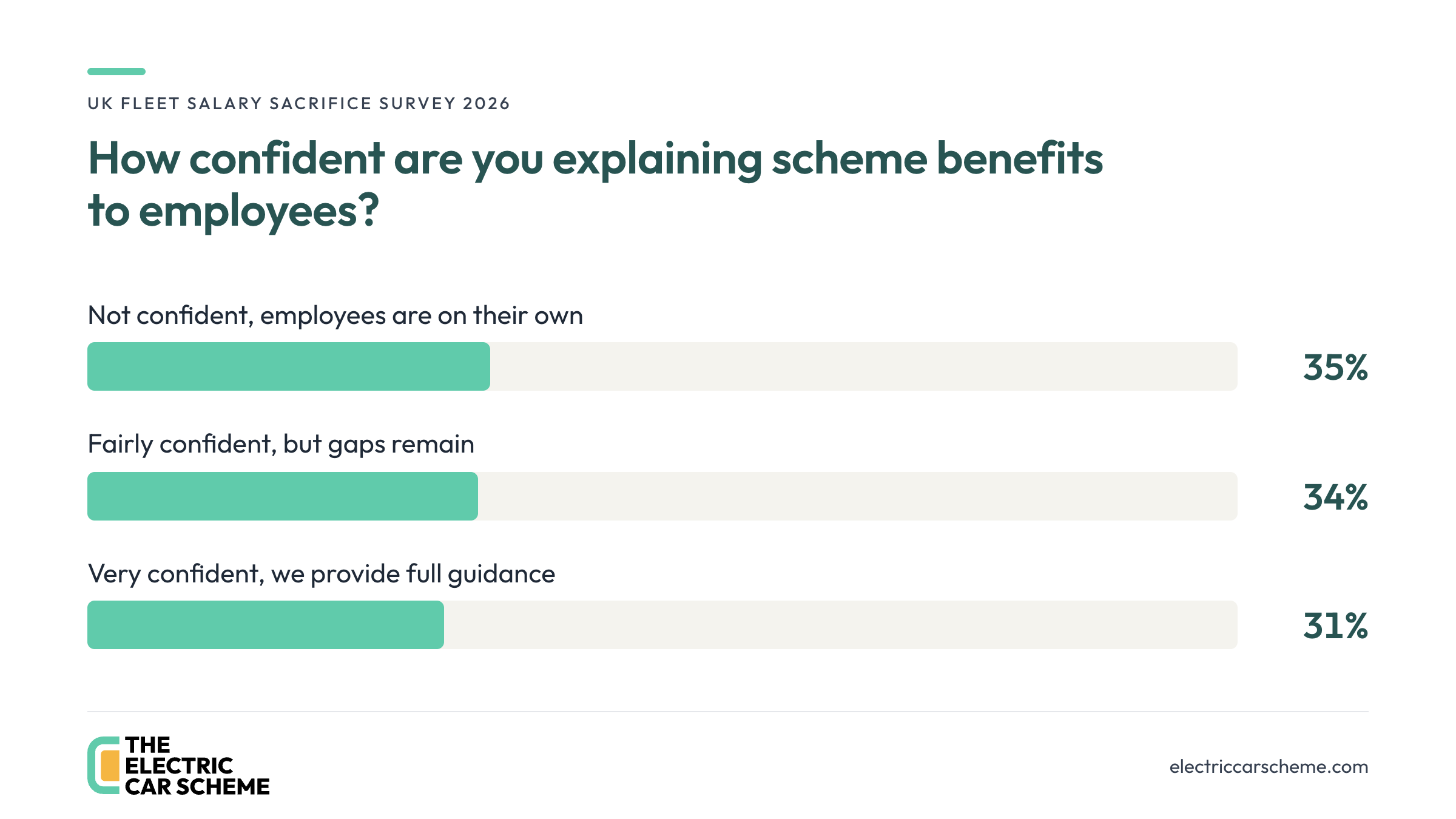
After showing that almost three-quarters of people leaders do not currently measure ROI, this data highlights employee communication as an important area for development. The figures are closely divided.
35% of people leaders are not confident explaining scheme benefits and leave employees to manage the details themselves. This can make it harder for people to understand salary deductions, eligibility, tax treatment, and the vehicle's overall value.
34% of our audience feel fairly confident but acknowledge that gaps remain. This group has a useful foundation, yet employees may still need clearer information about costs, Benefit-in-Kind tax, contract changes, and what happens if their circumstances change.
The remaining 31% of people leaders are very confident and provide full guidance. These people leaders have the strongest communication approach, helping employees understand both the advantages and responsibilities linked to the scheme.
Combined, the data shows that confidence is growing, but nearly seven in ten workplaces still have room to improve. Clear explanations, written resources, and regular support can turn a complex benefit into a straightforward choice.
What is the top question employees ask people leaders about fleet management salary sacrifice schemes?
The impact of a fleet management salary sacrifice scheme on an employee’s pension or tax is the top question 89% of people leaders are asked, while 11% agree that the question employees ask the most is how much they will actually save
Pension and tax questions dominate:
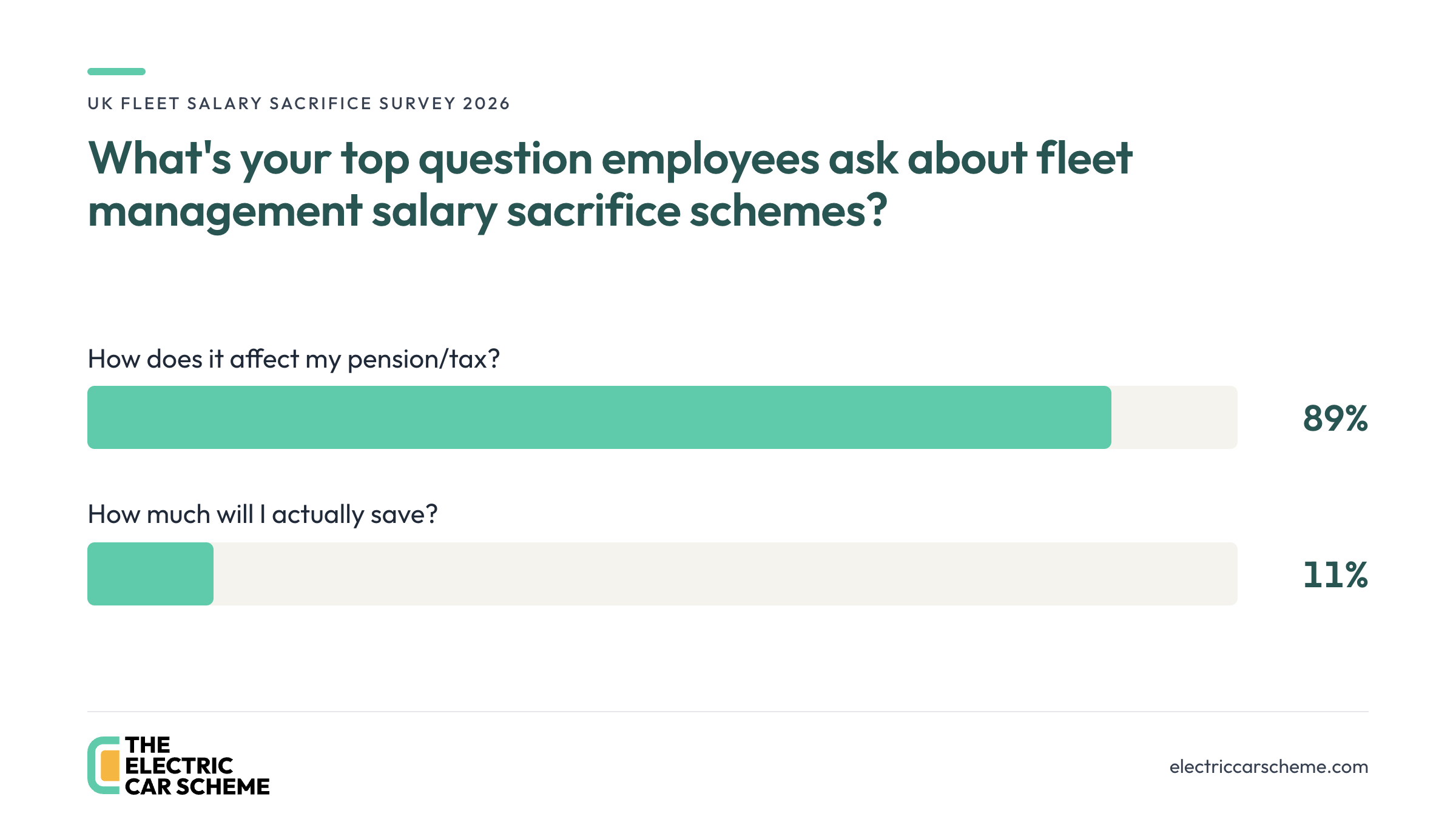
The biggest employee concern is understanding how salary sacrifice affects personal finances. 89% of people leaders report that the top question employees ask is how the scheme affects their pension or tax, making this a clear priority.
This focus is understandable because salary sacrifice changes how an employee receives part of their pay, so people want to know how the arrangement may affect deductions, pension contributions, and their overall financial position.
By comparison, 11% of people leaders mainly ask how much they will actually save. Although this is a smaller share, clear examples remain essential because final savings depend on factors such as salary, vehicle choice, tax position, mileage, and scheme terms. A simple calculator or personalised illustration can make the financial effect easier to understand.
It also connects with the previous data set, where almost two-thirds of our audience said they were at least fairly confident in explaining scheme benefits, while the balance acknowledged that gaps remain.
The figures make clear that financial clarity is central to employee engagement with salary sacrifice schemes. Employers therefore need to explain not only the potential savings, but also how the arrangement interacts with pay, tax, and pensions, helping employees understand the full effect before deciding whether to take up the benefit.
What is people leaders' biggest worry about the future of salary sacrifice tax rules?
70% of people leaders' biggest worry about the future of salary sacrifice tax rules is increased HMRC scrutiny or compliance, 2% are concerned about the government scrapping tax incentives, and 1% are most worried about changes to Benefit-in-Kind rates, while 27% have no major concerns currently about the future of salary sacrifice tax rules
Not everyone is concerned about future rules:
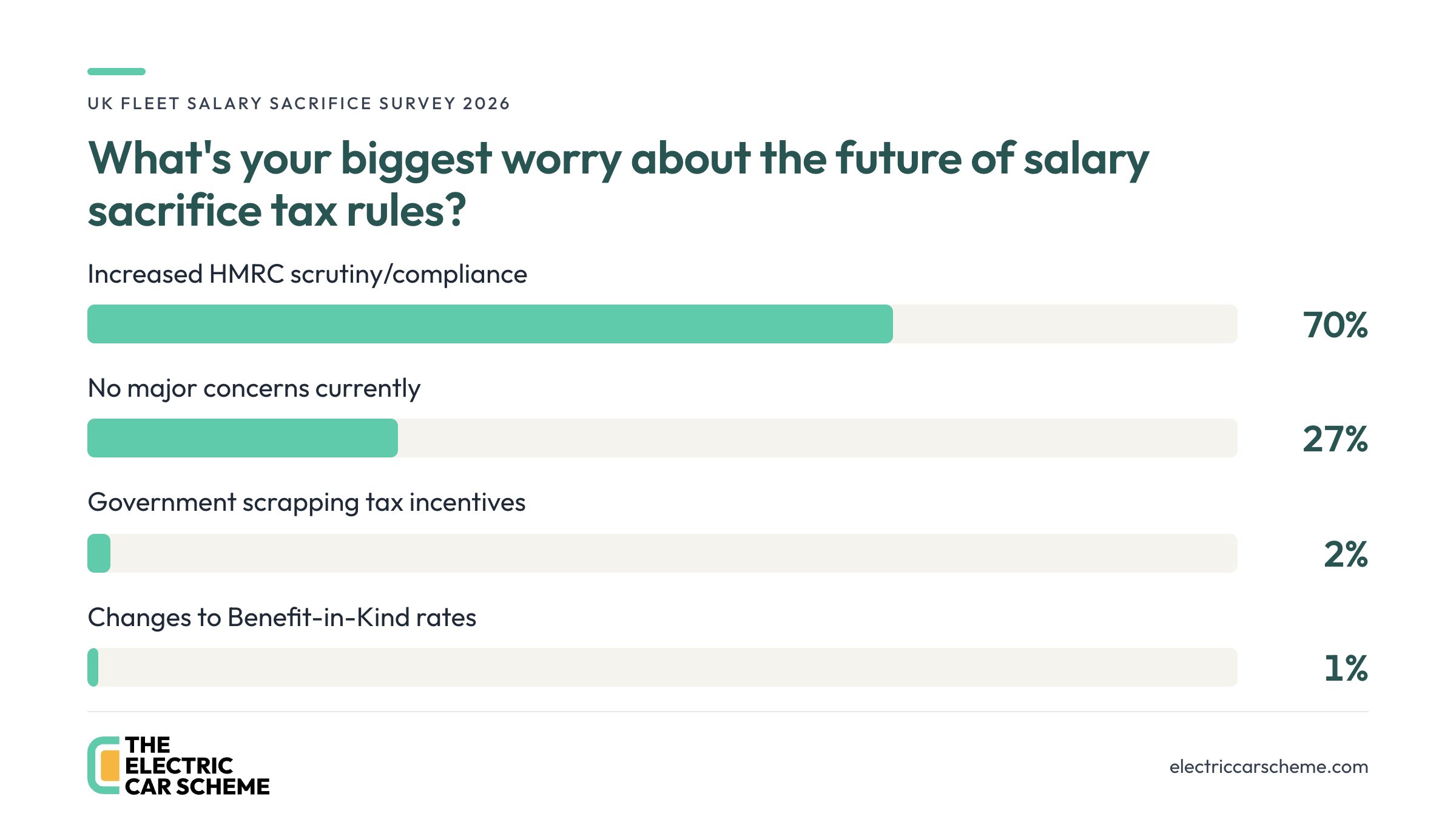
As salary sacrifice becomes more established, future tax rules are emerging as a key area of uncertainty for people leaders. 70% of people leaders say increased HMRC scrutiny and compliance requirements are their biggest concern, making this by far the dominant issue. This reflects the need for employers to keep scheme administration accurate and ensure arrangements continue to meet the relevant rules as salary sacrifice develops.
By comparison, 27% have no major concerns about the future of salary sacrifice tax rules, indicating that more than one quarter of people leaders currently feel comfortable with the direction of the framework.
Only 2% of our audience are most concerned about the government scrapping tax incentives, while 1% identify changes to Benefit-in-Kind rates as their main worry. The small share for both issues places them well behind compliance concerns.
The wider debate still makes informed planning important. Commentary on future salary sacrifice changes suggests that important developments can receive limited attention until they affect workplace decisions. This is why regular reviews, accurate records, and plain-language updates can help people leaders respond confidently.
What is people leaders' biggest legislative concern for fleet management salary sacrifice schemes?
70% of people leaders' biggest legislative concern for fleet management salary sacrifice schemes is IR35 or employment status rules, 25% are concerned about minimum wage sacrifice limits, and 5% worry about the future of Benefit-in-Kind rate changes
Legislative concerns focus on three areas:
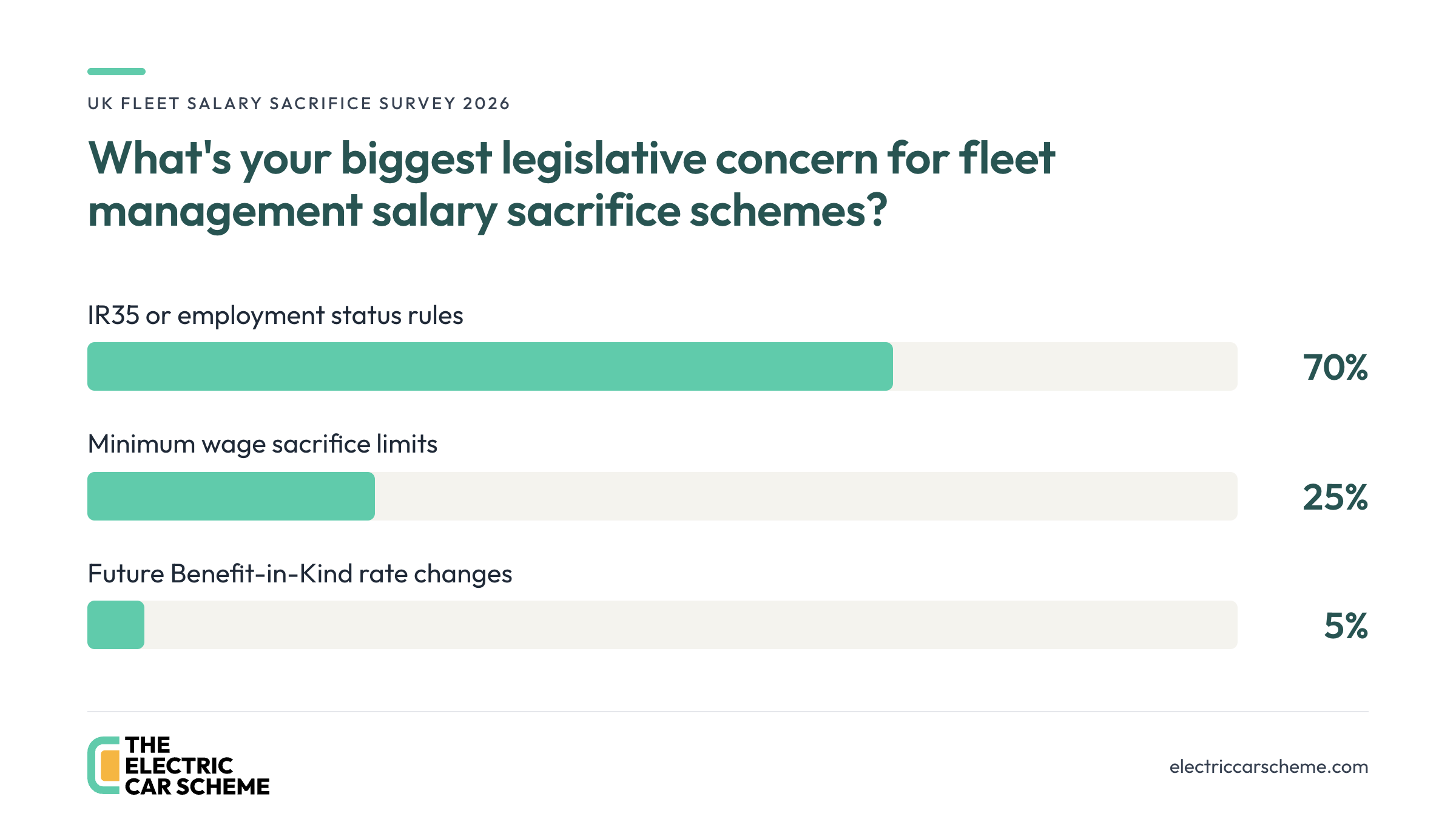
Legislative rules are clearly shaping how people leaders think about salary sacrifice, with 70% identifying IR35 or employment status rules as their biggest concern. This makes employment status the dominant issue by a wide margin.
For employers, the concern centres on making sure salary sacrifice arrangements are structured correctly and remain compliant with the rules that govern employment and pay.
25% of our audience are most concerned about minimum wage sacrifice limits, making this the second-largest concern. This is important because salary sacrifice cannot reduce an employee’s pay below the applicable minimum wage.
5% of people leaders identify future Benefit-in-Kind rate changes as their main concern, showing that tax treatment remains relevant, but is a much smaller concern than employment status or minimum wage rules.
The future of fleet management salary sacrifice schemes
Evidently, fleet management salary sacrifice schemes are becoming an established workplace benefit, but important gaps remain in understanding, communication and measurement. Cost pressures are a major driver of employer interest, while EVs, employee expectations, and changing regulations are also shaping scheme decisions.
For people leaders, offering a scheme is only part of the process. Employers also need to ensure employees understand the financial implications, regularly assess scheme performance, and keep arrangements aligned with current tax and employment rules.
As the market develops, clear communication, effective administration and ongoing review will remain central to managing salary sacrifice schemes successfully.
Are you an employer?
BOOK A DEMOAre you an employee?
SEE AVAILABLE CARSYou might also like…

Last updated: 14.10.2026
Information and prices provided are accurate at the time of release and may be subject to change. Our pricing is based on data collected from The Electric Car Scheme quote tool. All final pricing is inclusive of VAT. All prices above are based on the following lease terms; Using a flat payment profile, 10,000 miles pa, 36 months, and are inclusive of Maintenance and Breakdown Cover. The Electric Car Scheme’s terms and conditions apply. All deals are subject to credit approval and availability. All deals are subject to excess mileage and damage charges. Prices are calculated based on the following tax saving assumptions: England & Wales, 40% tax rate. The Electric Car Scheme Limited provides services for the administration of your salary sacrifice employee benefits. The Electric Car Scheme Holdings Limited is a member of the BVRLA (10608), is authorised and regulated by the FCA under FRN 968270, is an Appointed Representative of Marshall Management Services Ltd under FRN 667174, and is a credit broker and not a lender or insurance provider.
Copyright and Image Usage: All images used on this website are either licensed for commercial use or used with express permission from the copyright holders, in compliance with UK and EU copyright law. We are committed to respecting intellectual property rights and maintaining full compliance with applicable regulations. If you have any questions or concerns regarding image usage or copyright matters, please contact us at marketing@electriccarscheme.com, and we will address them promptly.
