
Childcare Salary Sacrifice Schemes Statistics: UK 2026
Childcare salary sacrifice schemes are one way UK employers can help working parents manage childcare costs while structuring employee benefits more effectively. These arrangements allow eligible employees to use salary sacrifice for qualifying childcare costs. Like EV salary sacrifice and other similar schemes, the potential tax and National Insurance advantages depend on how the scheme is structured.
To find out what 33,594 opinions of people leaders in the UK were about childcare salary sacrifice schemes, we utilised AI-driven audience profiling to synthesise insights from online discussions over 12 full months ending on the 23rd of September, 2026, to a high statistical confidence level. The resulting statistics illustrate current sentiments about these schemes for both employers and employees.
Methodology and data
Sourced using Artios from an independent sample of 33,594 opinions of people leaders in the UK across X, Quora, Reddit, Bluesky, TikTok, and Threads. Responses are collected within a 95% confidence interval and a 5% margin of error. Results are derived from what people describe online and from opinions expressed, not from actual questions answered by people in the sample.
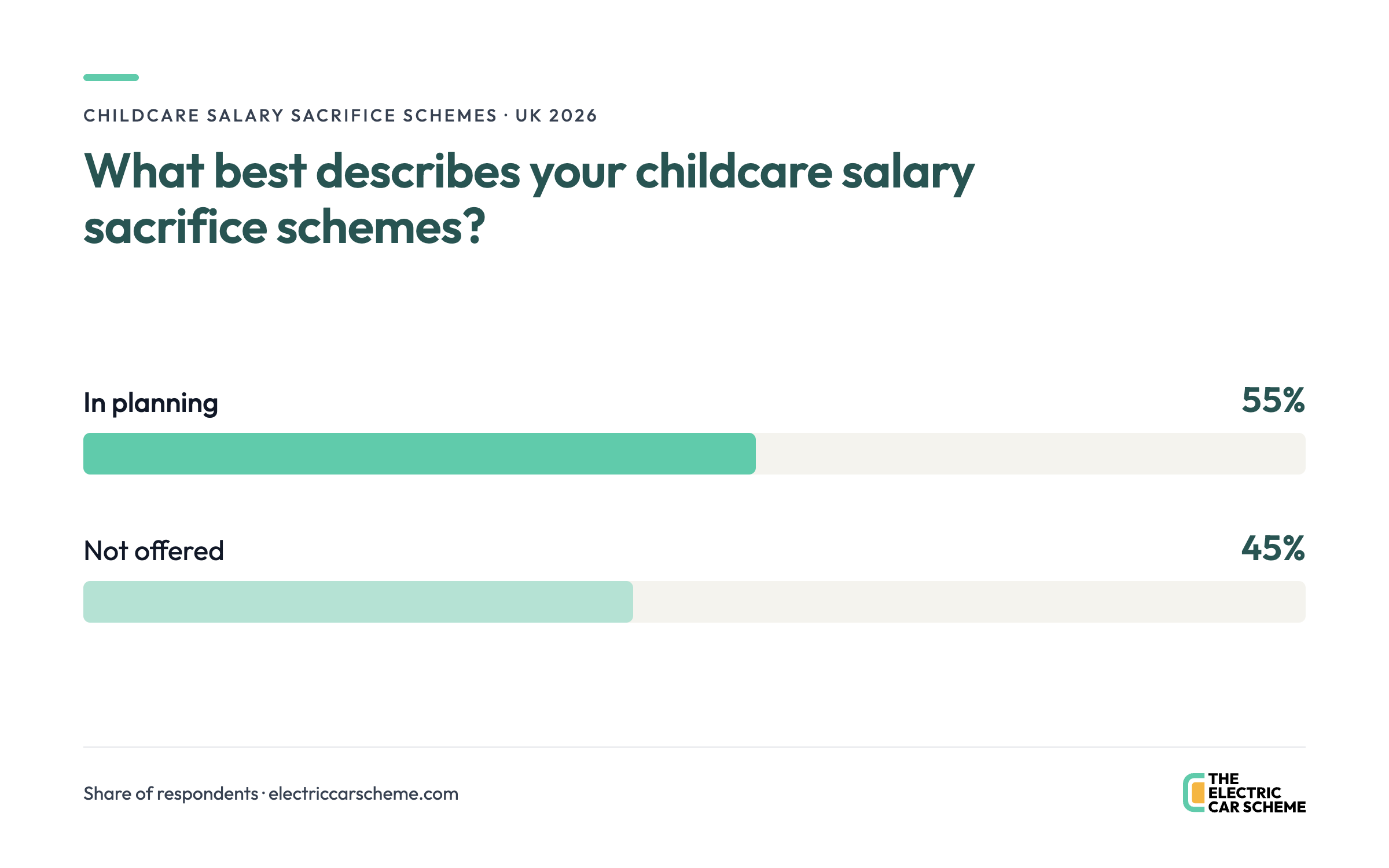
What best describes childcare salary sacrifice schemes at people leaders' organisations?
At 55% of people leaders’ organisations, childcare salary sacrifice schemes are in planning, but at 45% of leaders’organisations, these schemes are not offered
Schemes are either in planning or not on offer:
Childcare salary sacrifice schemes are entirely voluntary for employers, who can offer them as part of their employee benefits packages to secure and retain talent.
A workplace nursery benefit is also available under specific provisions. Under this salary sacrifice plan, which is linked to an applicable nursery partnership, employees can opt to cover their children’s nursery fees from their gross salaries before NI and income tax are deducted.
This specific benefit is uncapped and scales proportionately with employees’ actual expenses. However, it is essential to note that tax-free childcare schemes and the workplace nursery benefit can’t be used at the same time for any one child. Employees and their families must choose the benefit that best fits their needs after carefully evaluating the available options.
While childcare salary sacrifice schemes can provide valuable support for workers and their families, these schemes do not seem to be widely available just yet. 45% of people leaders’ organisations do not offer any such programmes at present. In contrast, 55% of these organisations’ schemes are currently in their planning phases, and will be made available at some point in the foreseeable future.
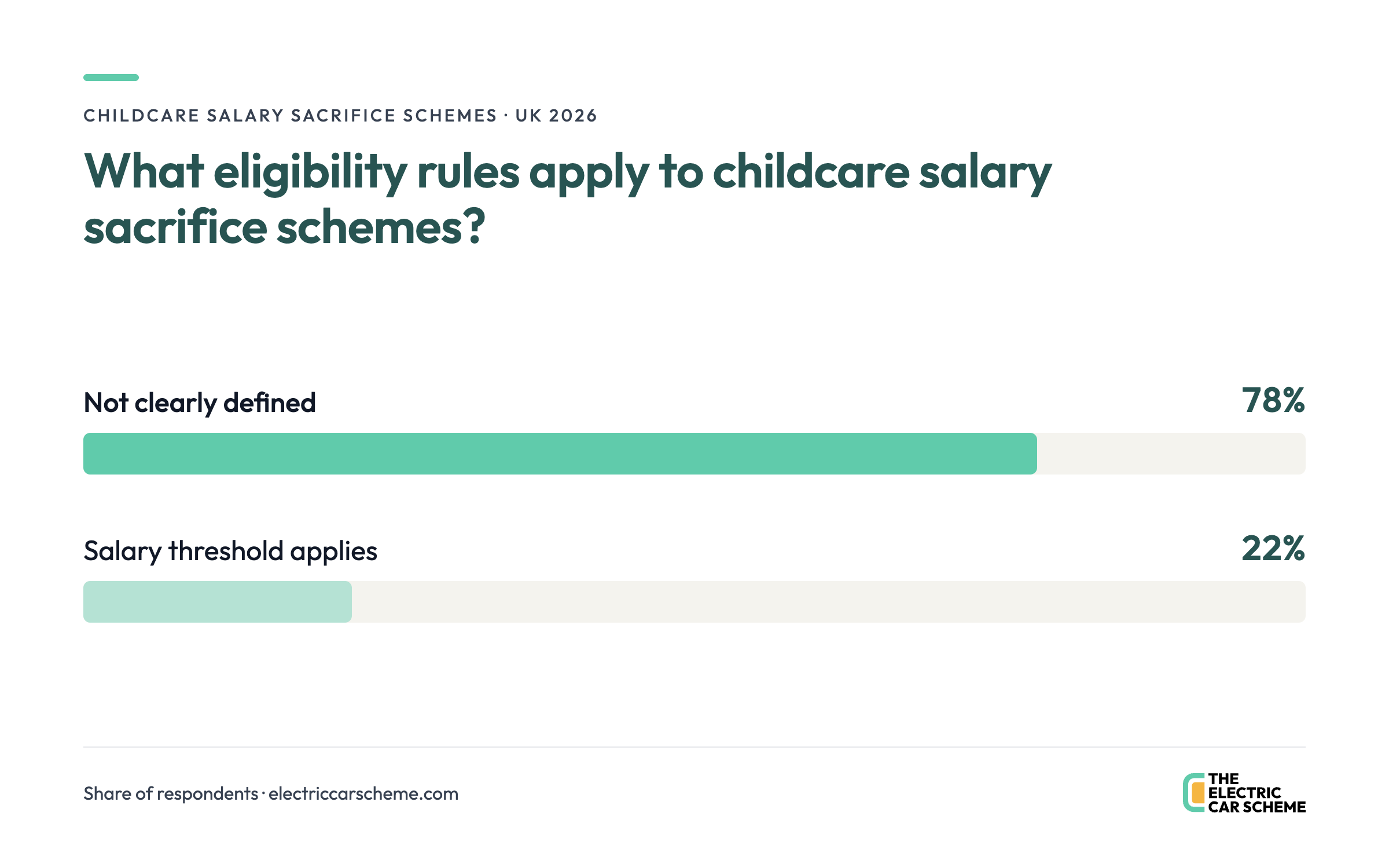
What eligibility rules apply to childcare salary sacrifice schemes at people leaders' organisations
78% of people leaders have no clearly defined eligibility rules that apply to their salary sacrifice schemes, but for 22%, a salary threshold applies
Barriers to entry are minimal:
Salary sacrifice schemes for general childcare vouchers were officially closed to new applicants in October 2018, although members of schemes whose employers joined before this date can still access them. The current system offered to new applicants is the Tax-Free Childcare scheme, through which the UK government matches every £8 a parent adds to an online childcare account with £2, adding up to £2,000 for every child each year. Additionally, workplace nursery schemes and the use of salary sacrifice to manage income thresholds are still active.
Many eligibility rules apply to salary sacrifice schemes and newer tax-free childcare programmes, including minimum thresholds for hours worked per week and set contribution limits per child. But according to 78% of our audience, eligibility rules for childcare salary sacrifice schemes at their organisations are not clearly defined. This could create confusion among scheme members, potentially causing frustration and limiting employees’ uptake of company benefits.
Only 22% of our audience have clear salary thresholds, pointing to significant discrepancies in policy transparency. These discrepancies may leave many employees uncertain about the financial support they are entitled to, which could reduce trust and leave organisations and their talent prone to costly misunderstandings.
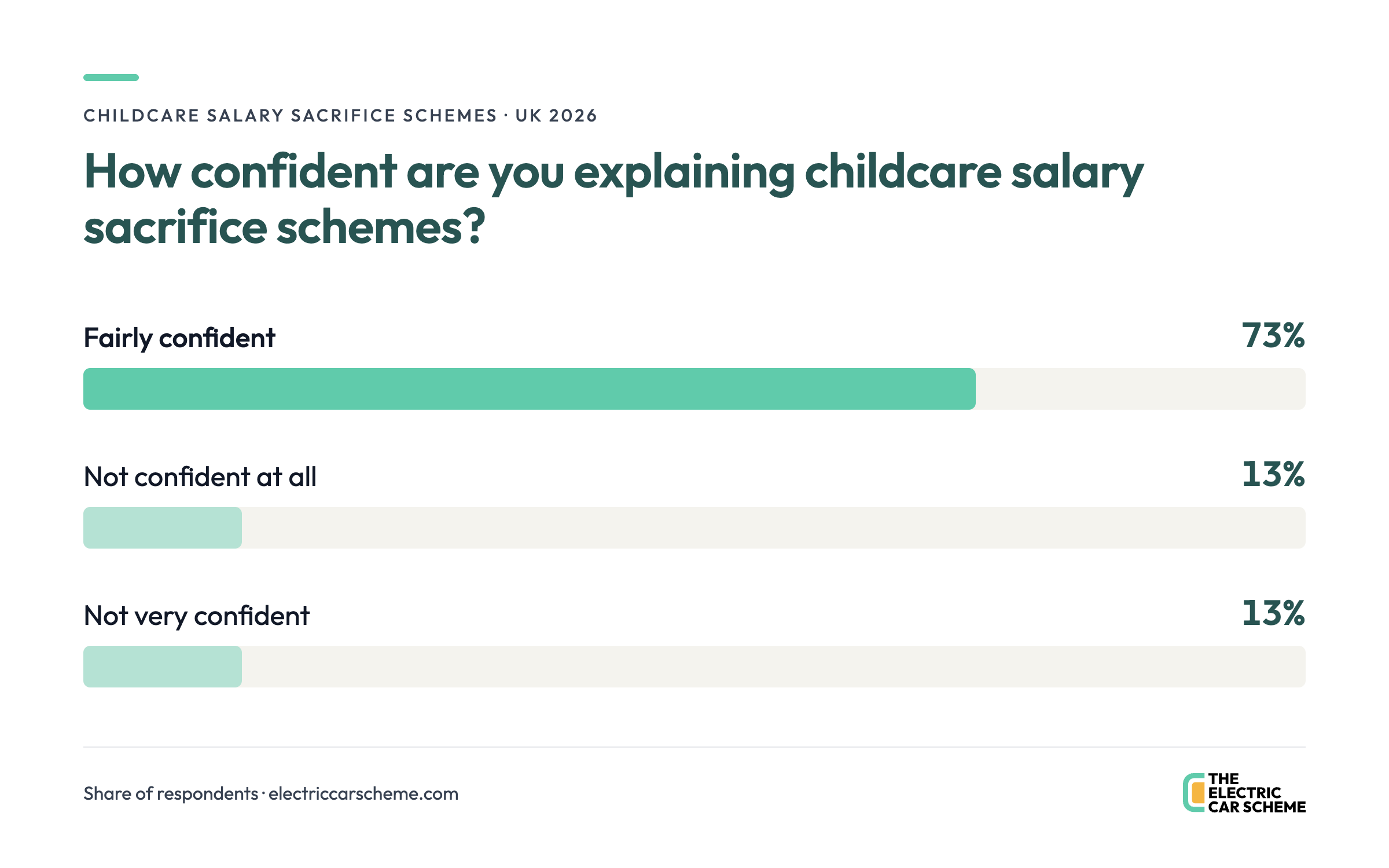
How confident are people leaders explaining childcare salary sacrifice schemes?
73% of people leaders are fairly confident in explaining childcare salary sacrifice schemes; however, 13% are not very confident, and another 13% are not confident at all
Confidence levels are varied:
People leaders who are confident explaining childcare salary sacrifice schemes to their employees can provide their workforces and their organisations with notable long-term benefits. By clearly explaining these benefits, they can translate complex HR policies into tangible, real-world value, helping working parents get the most from the available benefits.
Providing clarity also reduces the risk of administrative and payroll errors and helps organisations stay compliant with National Minimum Wage (NMW) laws, tax allowances, and key statutory benefit requirements.
Given this importance, most people leaders seem at least somewhat confident in their ability to explain the details of these schemes to their employees. 73% feel fairly confident doing so, compared with 13% who do not feel confident and another 13% who don’t feel confident at all. For those who feel uncertain, working closely with payroll and HR teams to simplify scheme rules into straightforward, jargon-free facts and real-world guides may help them to outline eligibility, tax obligations, and other key details with more conviction.
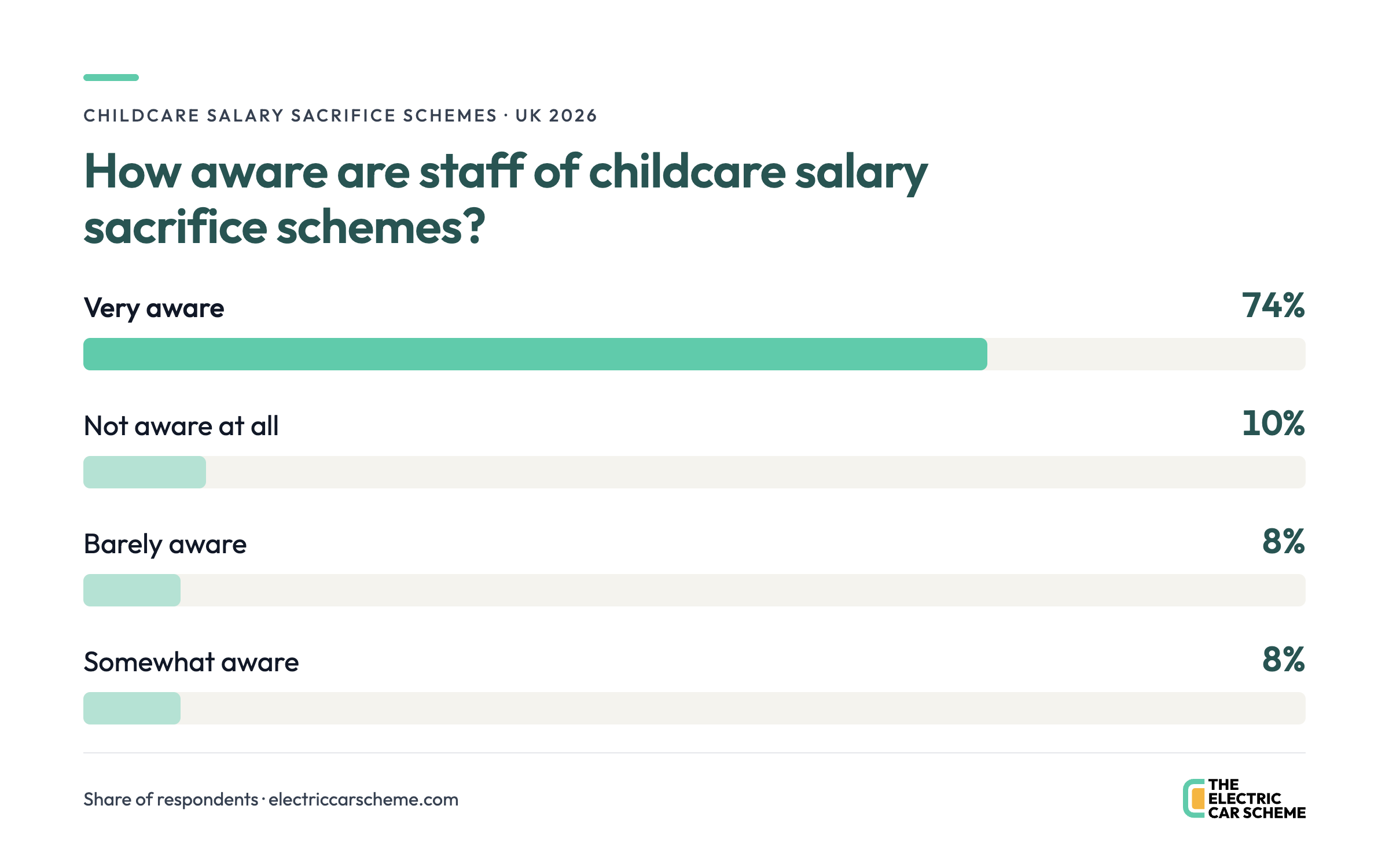
How aware are staff of childcare salary sacrifice schemes at people leaders' organisations?
74% of people leaders agree that their staff are very aware of childcare salary sacrifice schemes, yet 8% say their staff are only somewhat aware, and another 8% are barely aware, while 10% of leaders’ staff are not aware at all
Awareness is high but not absolute:
Since the UK’s childcare voucher schemes were closed in 2018, employer-supported childcare schemes have become increasingly more complex. When the Tax-Free Childcare scheme was introduced, existing participants were allowed to retain access to the old voucher schemes, but the newer options available for employers looking to support working parents have become considerably limited.
Tax-Free Childcare provides support to parents directly from the government, but does not involve the employer or any National Insurance contribution (NIC) exemptions. This has reduced employers’ incentive to offer and promote childcare support schemes within their benefits packages, which has in turn limited employees’ awareness of them to some extent.
Amongst our audience, employee awareness of childcare salary sacrifice schemes and their provisions and benefits remains high. 74% of people leaders’ staff are very aware of these schemes, despite the shift in support frameworks outlined above and the impacts they have had. On the other end of the spectrum, 8% are somewhat aware of these programmes, 8% are barely aware, and 10% aren’t at all cognisant of the benefits on offer to themselves and their families.
General awareness seems high, but there is still a notable 26% gap between those who know of and understand their employers’ childcare salary sacrifice schemes and those who do not. This could leave over a quarter of workers missing out on significant financial support and savings, making clear and proactive communication essential for maximising scheme engagement and staff satisfaction as a whole.
What format works best for childcare salary sacrifice schemes according to people leaders?
For 33% of people leaders, a flexible benefits platform is the best format for childcare salary sacrifice schemes, 8% prefer a voucher-based scheme, and 59% are not yet sure what format is best
Format preferences remain largely uncertain:
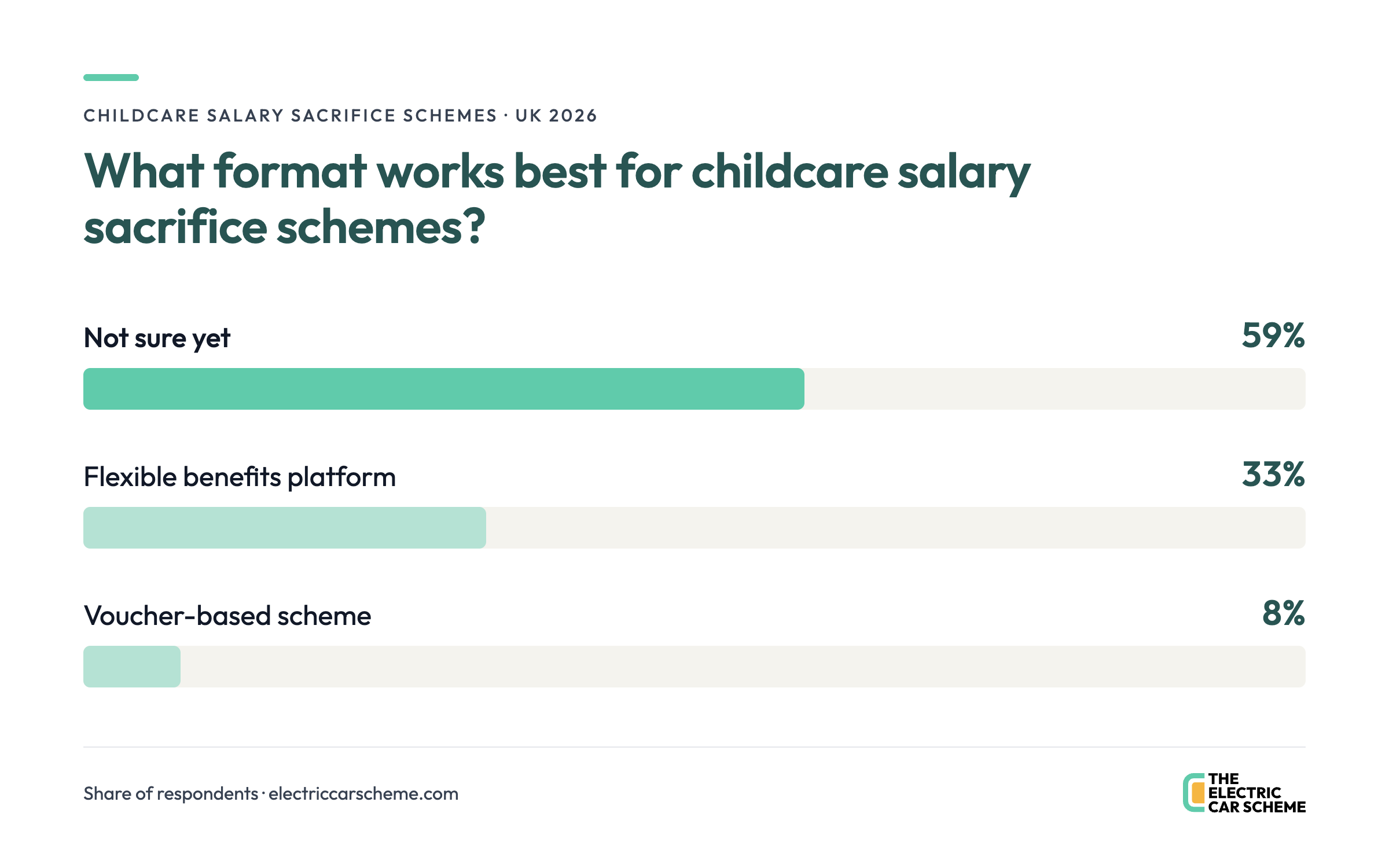
Although voucher-based childcare schemes have officially been closed to new applicants for years, 8% of people leaders still feel that this format was the most effective way to deliver childcare salary sacrifice benefits to their staff.
While this contingent prefers the past structure, many other leaders believe that newer, flexible benefits platforms are the best option for their organisations. 33% of people leaders share this sentiment. This may be because these platforms address administrative challenges by automating eligibility and compliance, offering personalised, modifiable options to employees, and streamlining enrolments and access through functional online portals.
However, most people leaders still aren’t sure which format is most practical for childcare salary sacrifice schemes. With 59% of leaders expressing uncertainty, there seems to be a clear need for simple, actionable guidance to help organisations choose scheme structures that fully support parents in their employment.
What's the uptake rate for childcare salary sacrifice schemes among people leaders' organisations?
The uptake rate for childcare salary sacrifice schemes at 42% of people leaders’ organisations is between 10 and 25%; at another 42% of organisations, it’s between 26 and 50%, and at 15% of organisations, uptake is under 10%
Uptake sits at a middle-ground maximum:
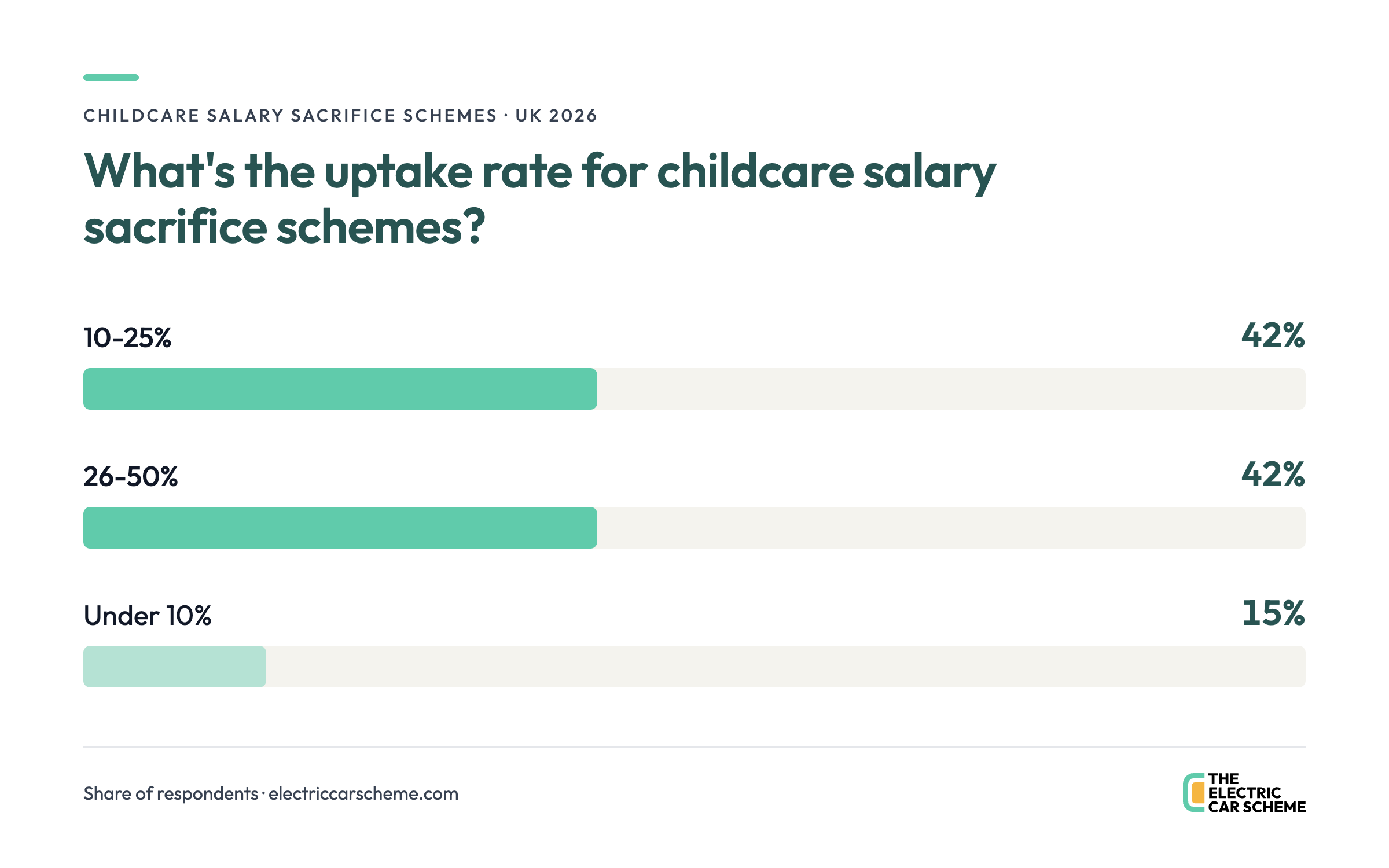
Childcare salary sacrifice schemes can reduce pressure on working parents by cutting their tax bills and boosting their take-home savings, while providing their children with quality care at the same time. However, issues such as low awareness of these schemes, confusion about eligibility and benefits, and strict administrative demands can create persistent concerns. These challenges leave many employees worried about the implications of joining these schemes, which can weaken uptake rates.
The uptake rates shared by our audience show considerable variability in how many working parents have joined their employers’ schemes. While 42% of people leaders say between 26% and 50% of their staff have joined their childcare salary sacrifice programs, just as many (42%) report far lower uptake rates between 10% and 25%. Additionally, 15% of leaders admit that their uptake rates are under 10%.
By increasing the uptake of these schemes, organisations may ultimately be able to reduce staff turnover, enhance employee retention, and offer genuinely meaningful benefits to the parents in their teams. At the same time, boosting participation may also facilitate tax savings through reductions in employers’ National Insurance contributions, providing dual financial benefits to companies and their talent alike.
How do employees rate childcare salary sacrifice schemes at people leaders' organisations?
43% of employees rate childcare salary sacrifice schemes as excellent at people leaders’ organisations, 15% rate them as good and another 15% as average, while 27% of employees rate these schemes as poor
Not every scheme is rated highly:
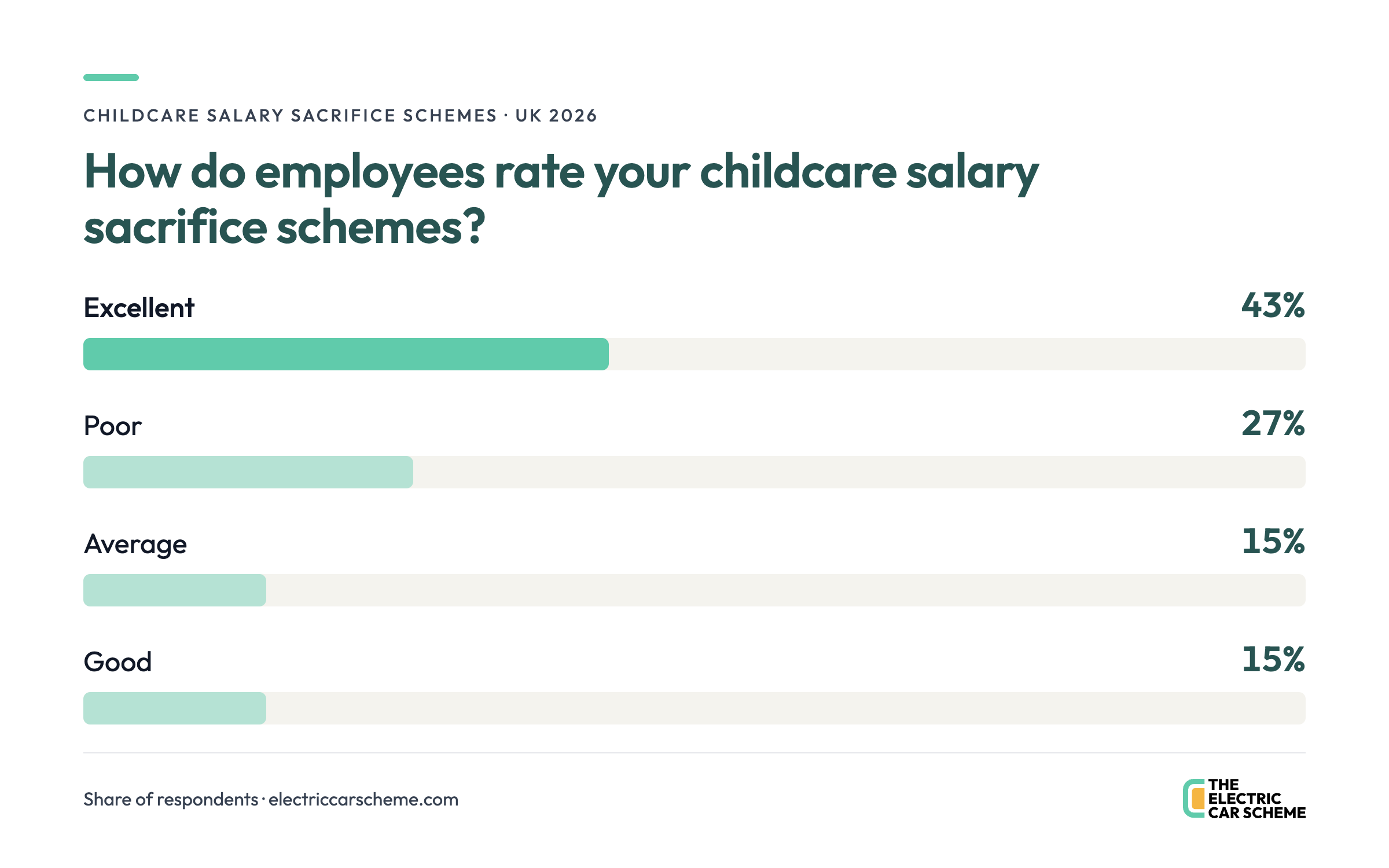
Employees’ sentiments on the quality of their organisations’ childcare salary sacrifice schemes seem to vary considerably, but overall, 58% feel positively towards the programmes and benefits on offer. 43% rate these schemes as excellent, and 15% as good, suggesting they provide sufficient benefits to support their families’ needs.
On the other hand, 15% rate their employers’ salary sacrifice schemes as average, and 27% rate them as poor. These ratings may stem from complicated eligibility rules, limited childcare options, and unclear communication from employers about how reducing gross salaries may affect minimum wage thresholds and other key earnings-based benefits.
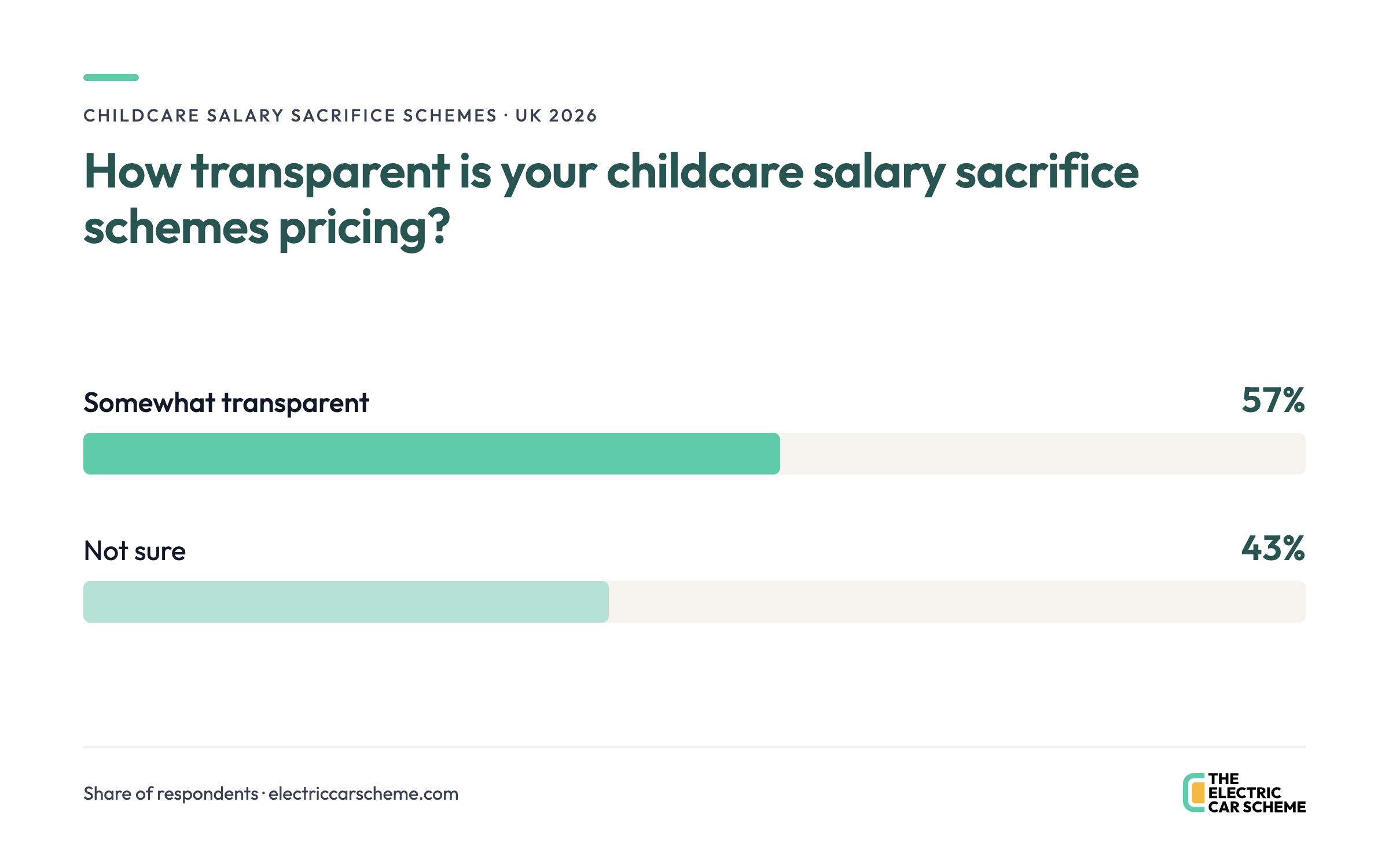
How transparent is childcare salary sacrifice scheme pricing at people leaders' organisations?
At 57% of people leaders’ organisations, childcare salary sacrifice scheme pricing is somewhat transparent, but 43% are not sure how transparent their pricing is
Pricing transparency raises questions:
The growth of commercially marketed, off-site partnership schemes and incorrect application of government benefits by employers have increased the frequency of HMRC compliance checks regarding genuine employer-nursery management responsibilities. For employers to be eligible for childcare salary sacrifice schemes, they need to be partly or completely responsible for the financing and management of childcare provision, according to HMRC’s regulations.
Transparent scheme pricing is also essential to maintain consistent tax compliance, as companies that fail to declare and pay the appropriate taxes for nursery schemes may face HMRC compliance checks going back up to six years. If they are found to have claimed tax exemptions where they did not apply, employers may also face significant interest and penalties.
Based on our audience’s views, there's widespread lack of clarity, which could pose substantial risks for regulatory oversight and compliance. 43% of people leaders aren’t sure how transparent their scheme pricing is, and 57% say it’s only somewhat transparent, leaving clear room for improvement.
Importantly, none of the leaders in our audience expresses full confidence in the transparency of their schemes’ price structures. This emphasises how essential thorough due diligence and clear fee structures are to avoid costly violations and back-tax penalties.
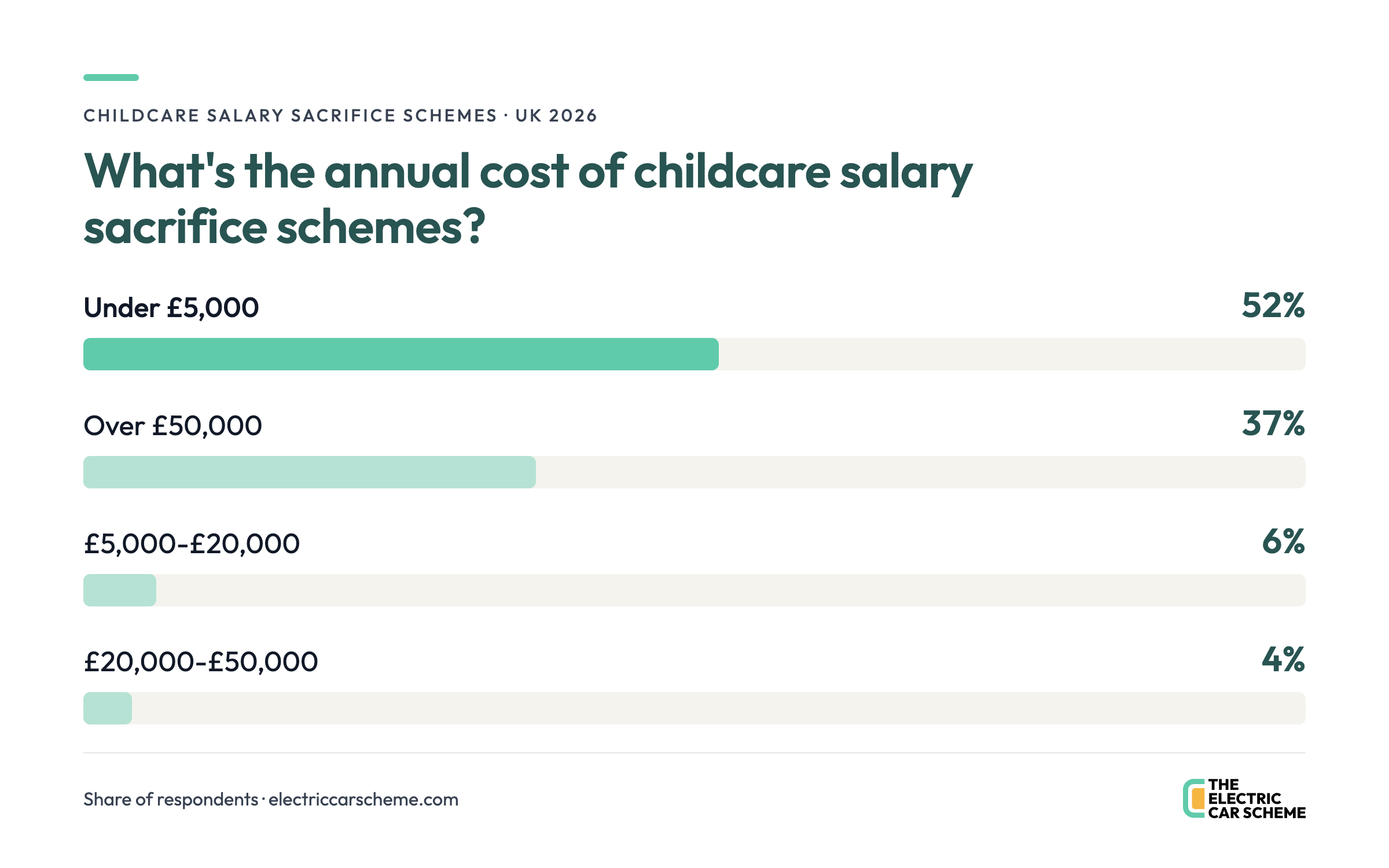
What's the annual cost of childcare salary sacrifice schemes for people leaders' organisations?
For 52% of people leaders’ organisations, the annual cost of childcare salary sacrifice schemes is under £5,000, but at 37% of organisations, it is over £50,000; at 6%, it is between £5,000 and £20,000; and at 4% of organisations, the annual cost is between £20,000 and £50,000
Higher costs are the norm:
In England, full-time nursery placement for a child under the age of two averages at approximately £12,425 a year, or around £1,035 per month, after government-funded hours have been included. The Workplace Nursery Benefit can substantially reduce these costs. Childcare salary sacrifice schemes can effectively reduce nursery fees by as much as 32% for basic rate taxpayers (and more for those in higher brackets), saving the average family roughly £5,000 each year.
On the employer’s side, these schemes tend to be affordable or cost-neutral as well, as they produce savings on employer NICs and transfer required arrangements to their partnered nurseries. This allows these programmes to deliver tangible relief for working parents, while keeping employers’ associated costs to a minimum.
Despite these benefits remaining largely mutual for employers and their staff, the financial investments required from the companies offering childcare salary sacrifice schemes can vary widely in real-world contexts. 52% of people leaders’ organisations pay less than £5,000 each year to keep their schemes running, but for 37% of organisations, the true costs exceed £50,000 per annum. A further 6% pay between £5,000 and £20,000 each year, and the smallest number, 4%, spend between £20,000 and £50,000 annually to provide their staff with the financial support that they need.
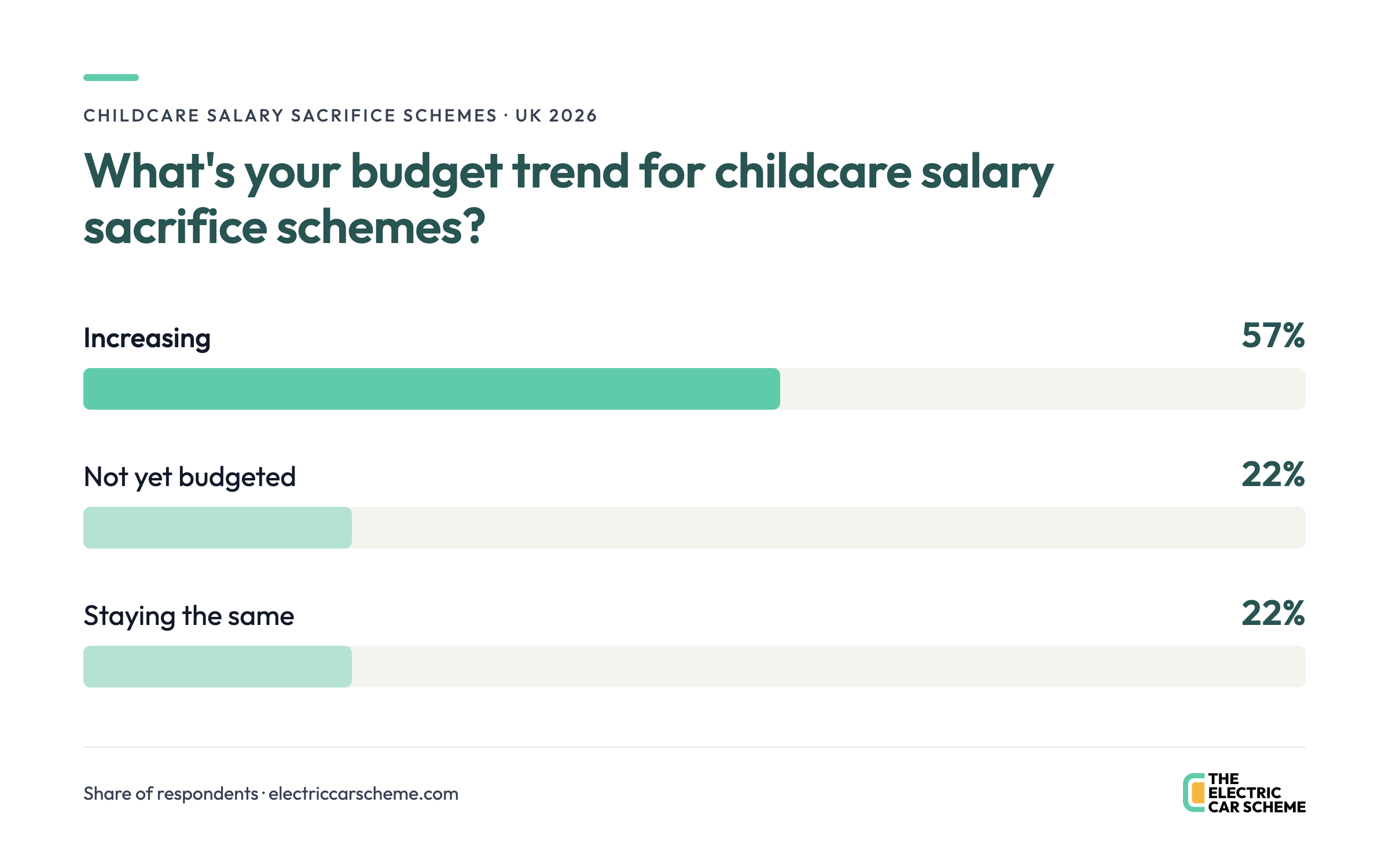
What's the budget trend for childcare salary sacrifice schemes among people leaders?
57% of people leaders are increasing their budget for childcare salary sacrifice schemes, 22% are keeping their budgets the same, and the remaining 22% have not yet budgeted for these schemes
Increasing budgets top trends lists:
In 2022, the Department for the Economy unveiled the Employers Guide to Childcare. The document offers extensive advice to employers and employees on how to access available support for families, the labour market, and the economy. With full-time childcare expenses, costs of living, and inflation continuing to rise, many working parents are barred from full-time work, and the Guide aims to address this by ensuring that all parties understand the potential benefits of childcare salary sacrifice schemes and other forms of assistance.
This guide, along with improvements in how schemes are structured, explained, and delivered, may be driving the upward budget trends evident today. 57% of the people leaders in our audience report that their organisations’ budgets for childcare salary sacrifice schemes are on the rise, compared to just 22% who say that their budgets are currently stable, and are neither increasing nor decreasing. Just as many - 22% - note that they have not yet budgeted for their schemes, so it will still take time before these schemes’ respective trends become clear.
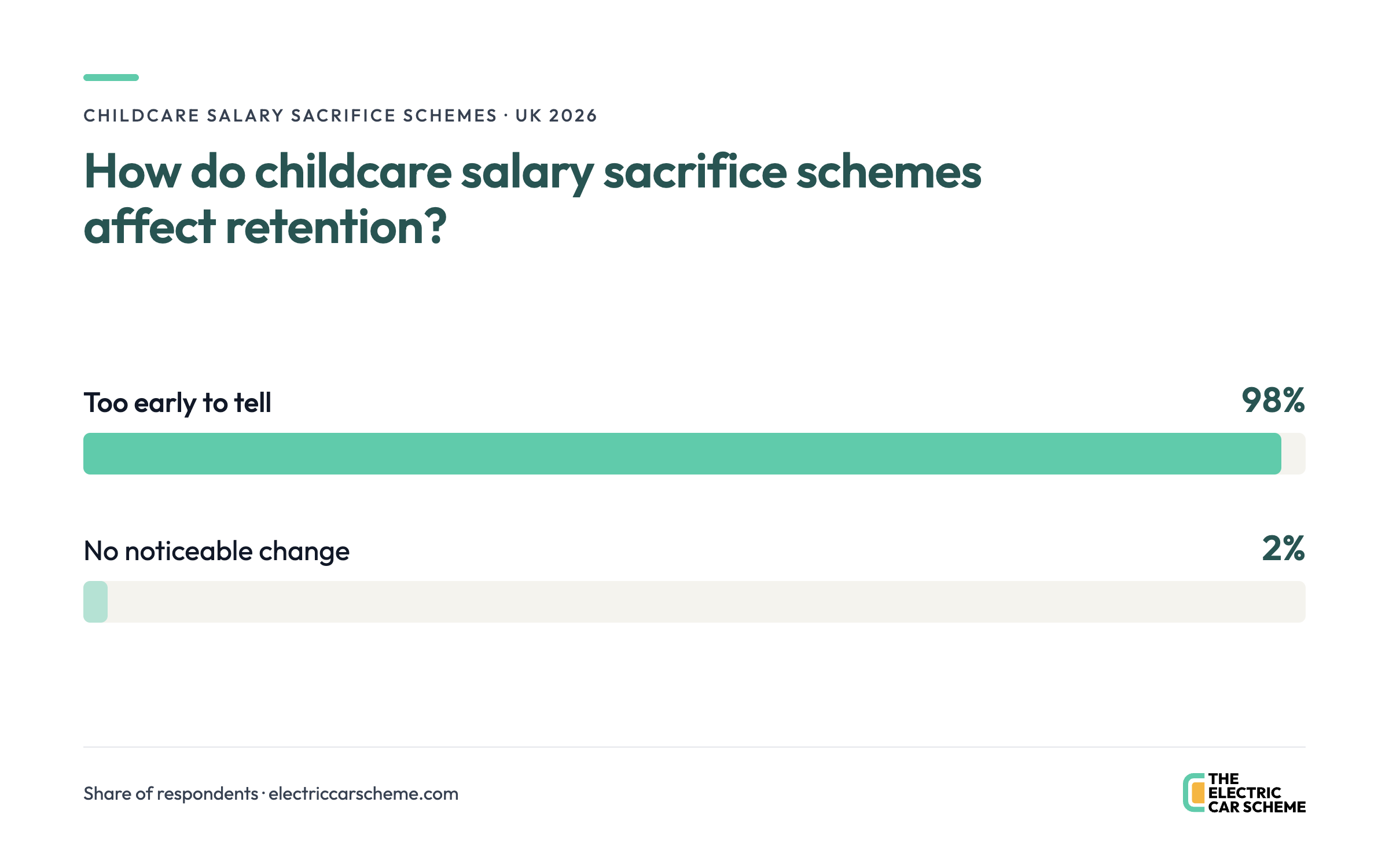
How do childcare salary sacrifice schemes affect retention for people leaders?
98% of people leaders agree that it is too early to tell how childcare salary sacrifice schemes affect retention, and for the 2% who have noticed, they see no noticeable change
Retention may not feel the ripple effect:
Beyond their obvious financial benefits, childcare salary sacrifice schemes can also help companies attract and retain talent. Recent research has found that 73% of working parents in the UK would consider potential employers’ family support programmes before applying for a new job or accepting a role or promotion. This clearly shows how family-oriented benefits such as childcare salary sacrifice schemes can serve as powerful recruitment and retention tools, while offering equal benefits and support to parents in need.
Yet our audience’s perspectives on how these schemes affect retention reveal that more time is needed before the scope of these benefits becomes clear. 98% of people leaders agree that it is still too early to tell whether their organisations’ childcare salary sacrifice schemes are having any impact on their employee retention rates. The remaining 2% note that they have not noticed any significant changes as yet.
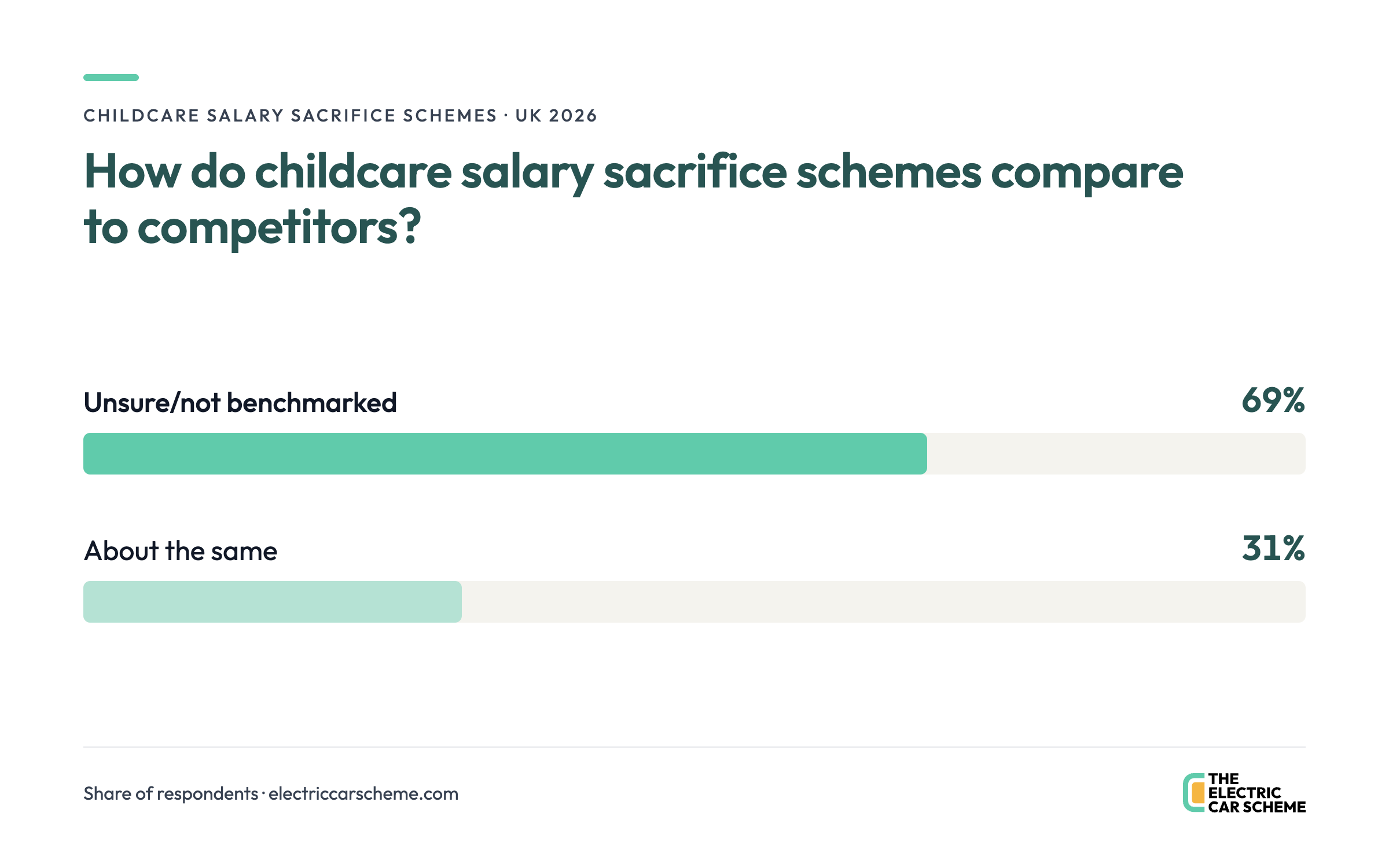
How do childcare salary sacrifice schemes compare to competitors according to people leaders?
69% of people leaders are unsure how their childcare salary sacrifice schemes compare to competitors as they are not benchmarked, but 31% who have benchmarked their schemes find them much the same
No competitive advantage is evident:
People leaders who compare their childcare salary sacrifice schemes to those of their competitors may be better positioned to strengthen their benefits packages, address existing gaps, and keep the benefits they offer their employees competitive and aligned with market standards. The comparison process can also provide a wealth of data, which can be used to enhance the structures of existing schemes with consequent benefits for talent attraction, retention, and satisfaction.
But the majority of our audience is unsure of how their schemes measure up to competitors. 69% admit that they haven’t benchmarked their schemes at all and can’t make meaningful comparisons as a result.
On the other end of the spectrum, 31% of leaders who have made these comparisons say that their childcare salary sacrifice schemes more or less match those of their rivals. Regularly benchmarking these schemes against those offered by other employers may be the key to improving their appeal and gaining an edge in an increasingly competitive labour market.
What's people leaders' plan for childcare salary sacrifice schemes next year?
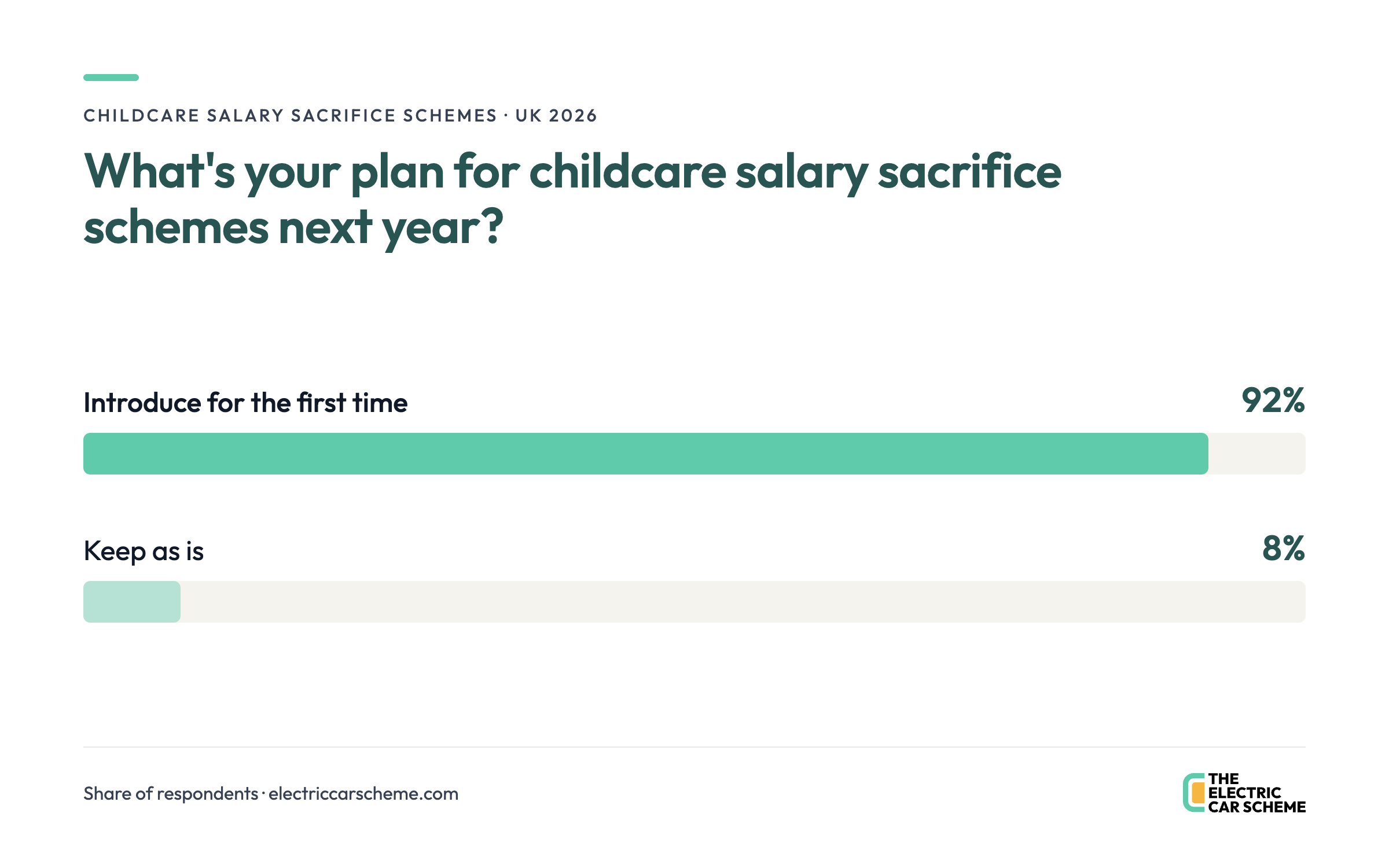
92% of people leaders’ plan for the next year is to introduce a childcare salary sacrifice scheme for the first time, and 8% plan to keep theirs as is
Future planning is a priority:
Three-quarters of employers in the UK feel they are already providing working parents with meaningful support in 2026, but just 14% of these employees feel the same.
These statistics reveal a stark gap between what employers believe is sufficient and the support working caregivers truly need to do their best. It also emphasises the need to regularly review, update, and improve benefits packages to ensure they align with real-world needs and deliver maximum value for both organisations and their staff.
However, despite the importance of these benefits for all parties involved, people leaders’ childcare salary sacrifice scheme plans still seem to be largely in their early stages. 92% of the leaders in our audience only plan to roll out their schemes for the first time next year. The remaining 8% plan to keep them exactly as they are, with no reviews or adjustments scheduled in the foreseeable future.
Key takeaways for people leaders and employees
These findings show that childcare salary sacrifice schemes remain an evolving area for UK employers. Awareness among employees is relatively strong, but many organisations are still developing their approach, with uncertainty around eligibility, pricing, scheme formats and how benefits compare with those offered elsewhere.
There are also signs of growing employer interest and investment, although it is too early to determine the longer-term impact on retention. For employers, the findings reinforce the importance of clear scheme structures, transparent communication and regular reviews to ensure childcare benefits provide wholly adequate support for working parents.
Are you an employer?
BOOK A DEMOAre you an employee?
SEE AVAILABLE CARSYou might also like…

Last updated: 14.10.2026
Information and prices provided are accurate at the time of release and may be subject to change. Our pricing is based on data collected from The Electric Car Scheme quote tool. All final pricing is inclusive of VAT. All prices above are based on the following lease terms; Using a flat payment profile, 10,000 miles pa, 36 months, and are inclusive of Maintenance and Breakdown Cover. The Electric Car Scheme’s terms and conditions apply. All deals are subject to credit approval and availability. All deals are subject to excess mileage and damage charges. Prices are calculated based on the following tax saving assumptions: England & Wales, 40% tax rate. The Electric Car Scheme Limited provides services for the administration of your salary sacrifice employee benefits. The Electric Car Scheme Holdings Limited is a member of the BVRLA (10608), is authorised and regulated by the FCA under FRN 968270, is an Appointed Representative of Marshall Management Services Ltd under FRN 667174, and is a credit broker and not a lender or insurance provider.
Copyright and Image Usage: All images used on this website are either licensed for commercial use or used with express permission from the copyright holders, in compliance with UK and EU copyright law. We are committed to respecting intellectual property rights and maintaining full compliance with applicable regulations. If you have any questions or concerns regarding image usage or copyright matters, please contact us at marketing@electriccarscheme.com, and we will address them promptly.
