
Tax Benefits Salary Sacrifice Schemes Statistics: UK 2026
Methodology and data
Sourced using Artios from an independent sample of 428,109 opinions of people leaders in the UK across X, Quora, Reddit, Bluesky, TikTok, and Threads. Responses are collected within a 95% confidence interval and a 5% margin of error. Results are derived from what people describe online, from opinions expressed, not from actual questions answered by people in the sample.
Which tax benefits salary sacrifice schemes do people leaders offer?
61% of people leaders currently offer cycle to work salary sacrifice schemes, 30% offer pension salary sacrifice, 7% offer electric car schemes, and 2% currently provide childcare vouchers
Cycle to work is the most-offered benefit:
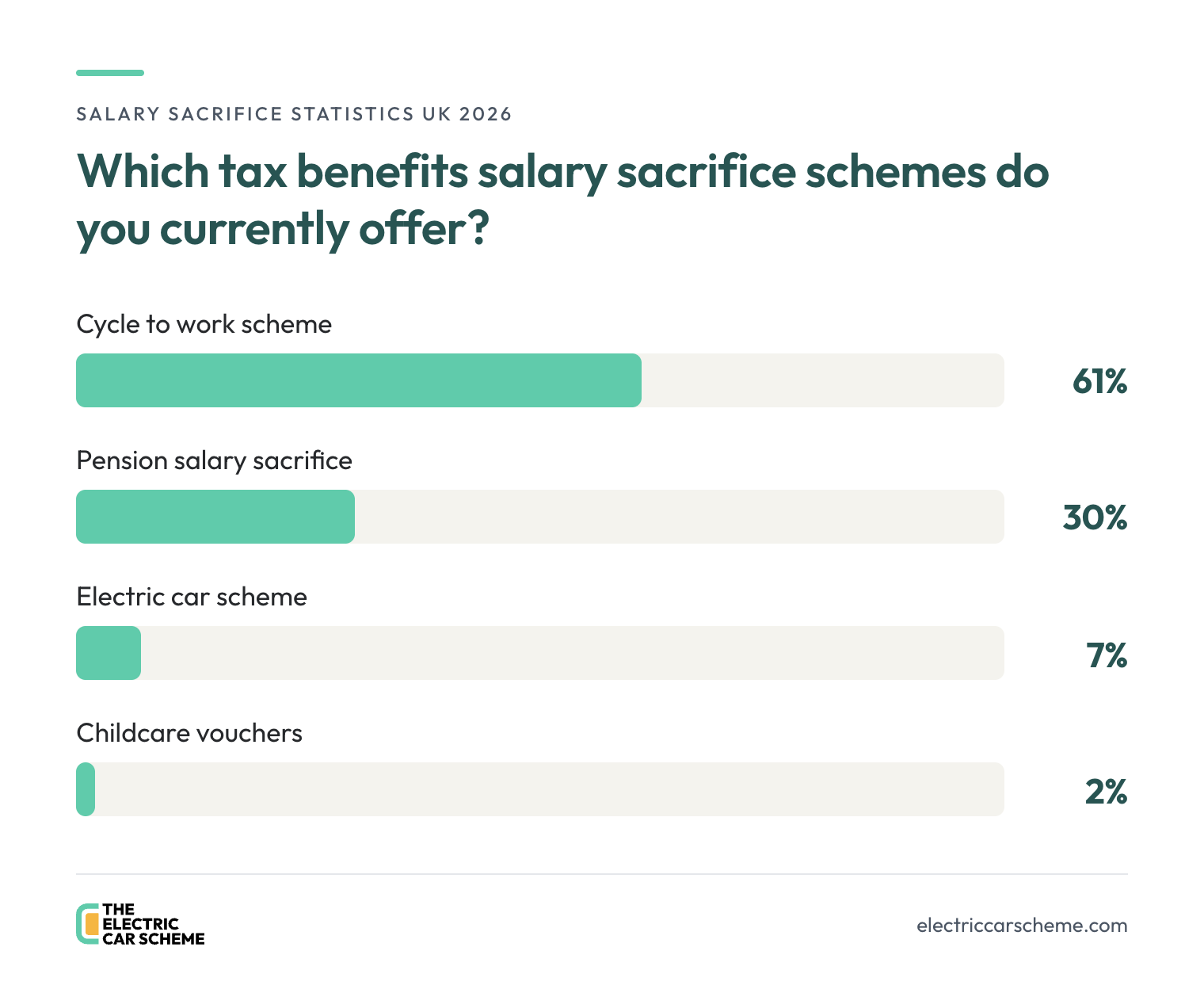
Around 209,000 employees make use of the UK’s Cycle to Work salary sacrifice schemes each year, with more than 2 million people having made use of the scheme in total. The scheme’s popularity is evident amongst our audience too, with 61% of people leaders currently offering this tax benefits salary sacrifice scheme in their workplaces. This gives workers the opportunity to save up to 47% on bicycles, electric bicycles, and cycling gear.
30% of people leaders also offer pension salary sacrifice schemes to their workers, allowing them to sacrifice a portion of their salaries in exchange for employers diverting the same amount into their workplace pensions. By lowering employees’ gross pay, this system reduces National Insurance contributions (NICs) for both employees and employers, while contributions remain shielded from income tax.
In contrast, only 7% of leaders currently offer workers the opportunity to join an electric car salary sacrifice scheme. While this programme structure is highly valuable due to its low BiK taxation rates, the numbers suggest it may still take time before these schemes are widely available.
The smallest minority, 2%, currently offers childcare vouchers to working parents in their employ. This low rate of provision may likely be due to the fact that the childcare voucher scheme was closed to new applications in October 2018, with only applicants who adopted the scheme before that date still able to claim. Today, childcare salary sacrifice benefits are instead distributed through the Workplace Nursery and Tax-Free Childcare schemes, which save parents on both nursery fees and taxes.
How mature are the tax benefits salary sacrifice schemes offering for people leaders?
92% of people leaders have not yet offered a tax benefits salary sacrifice scheme, so they cannot comment on how mature their offering is, while 6% have an established but evolving scheme, 2% have a scheme under review, and 0% commented on having a mature and well-embedded scheme
Maturation is minimal:
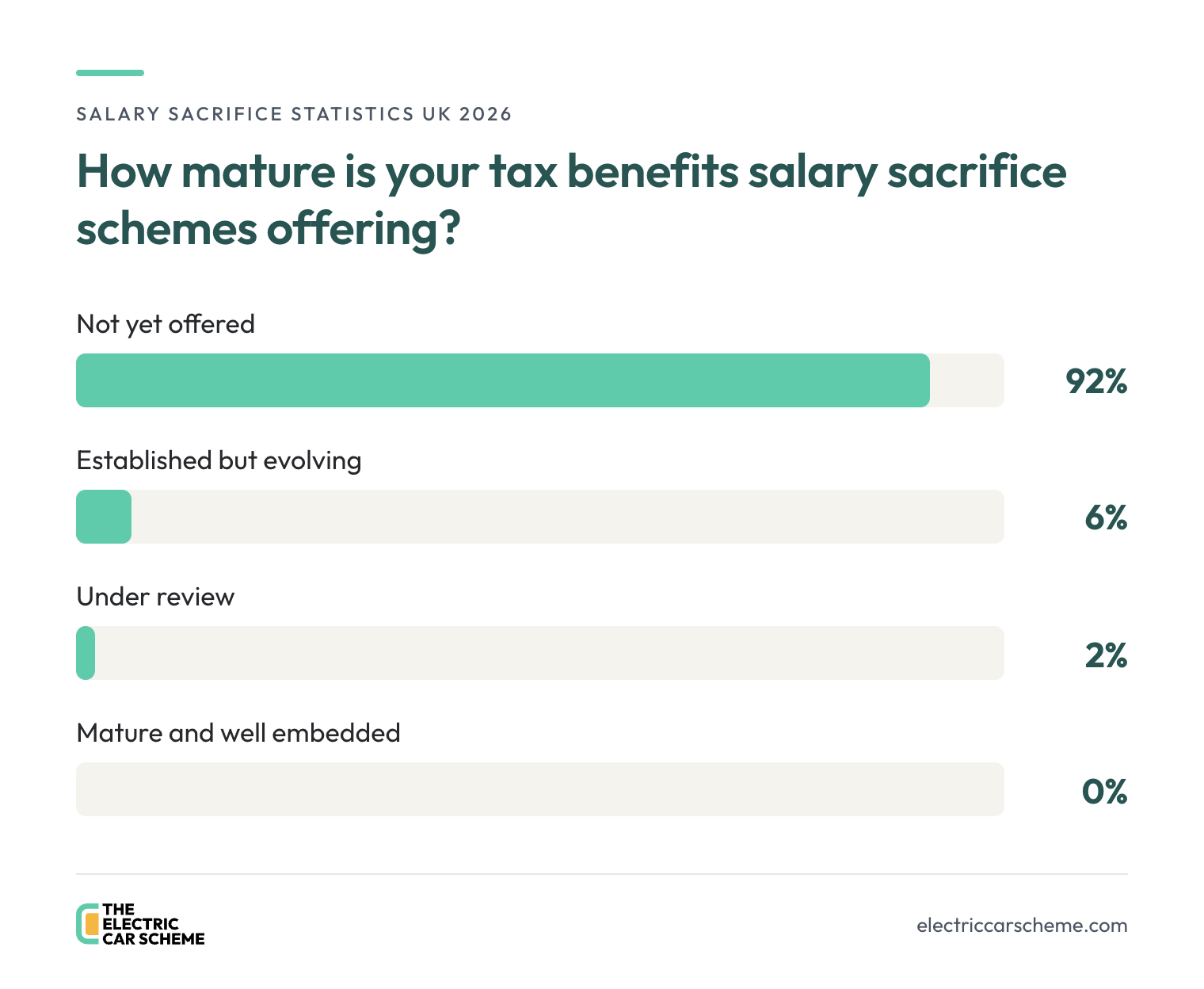
The tax benefits salary sacrifice schemes offered at UK workplaces still seem to be largely in their infancy, as 92% of people leaders do not yet offer any such schemes to their employees. That said, recent research shows the number of companies using salary sacrifice schemes grew from 77% in 2023 to 83% in 2025, indicating that the number of organisations that don’t yet offer them could begin to decrease in the near future.
On the other end of the spectrum, 6% of leaders’ salary sacrifice scheme offerings are currently established but still in the process of evolution and refinement. A further 2% have schemes that are under review. The reasons for this could range from optimising tax efficiency for both employers and their workers to enhancing their benefits packages to better attract and retain top talent.
None of our audience claims that their salary sacrifice schemes are fully developed, mature, and comprehensively embedded into their benefits structures, showing further room for growth.
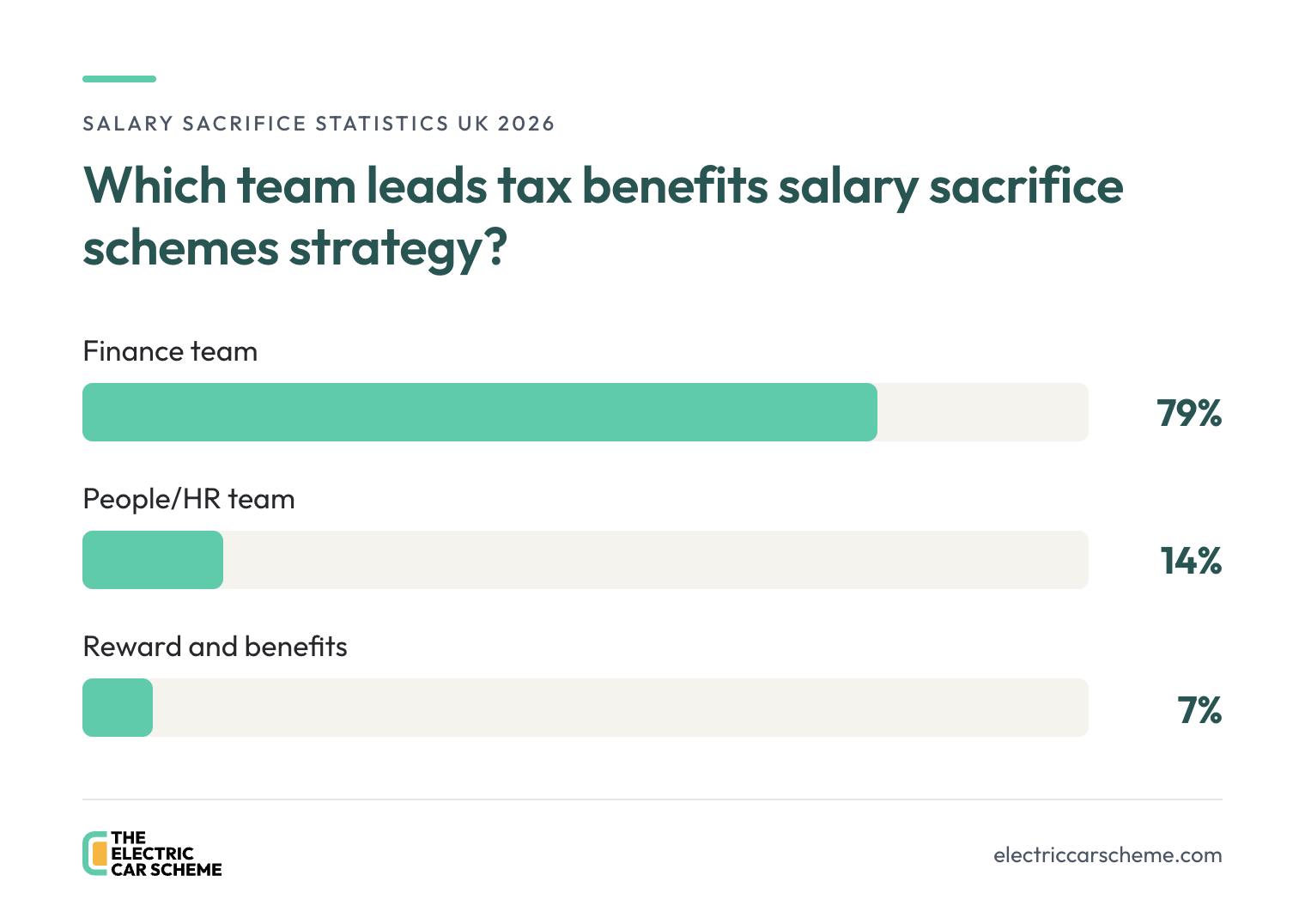
Which team leads tax benefits salary sacrifice schemes strategy for people leaders?
79% of people leaders’ finance team leads tax benefits salary scheme strategies, people or HR teams lead 14%, and rewards and benefits teams are in charge of strategy for 7%
Finance has the greatest control:
Developing clear, structured tax-benefits salary sacrifice strategies is essential to maximise employees’ pension contributions or take-home pay and reduce taxable income and tax obligations, while staying compliant with National Minimum Wage (NMW) thresholds and other statutory rules.
In 79% of people leaders’ organisations, finance teams handle the strategic process. This makes sense, since these schemes are financial in nature and require ongoing alignment with payroll systems, tax laws, and corporate budgets.
Some leaders also outsource their tax benefits salary sacrifice scheme strategising to their people and HR teams. 14% of our audience notes that their human resources and people professionals handle these responsibilities, which may carry the benefit of providing employees with more concise, easily digestible information on tax benefits salary sacrifice rules.
Although tax benefits salary sacrifice programmes are part of organisations’ remuneration and benefits packages, only 7% of people leaders rely on their reward and benefits teams to develop strategies for providing them. Considering that many smaller businesses may not have dedicated rewards teams on staff, it’s understandable that the majority of leaders turn to their finance and HR teams more frequently instead.
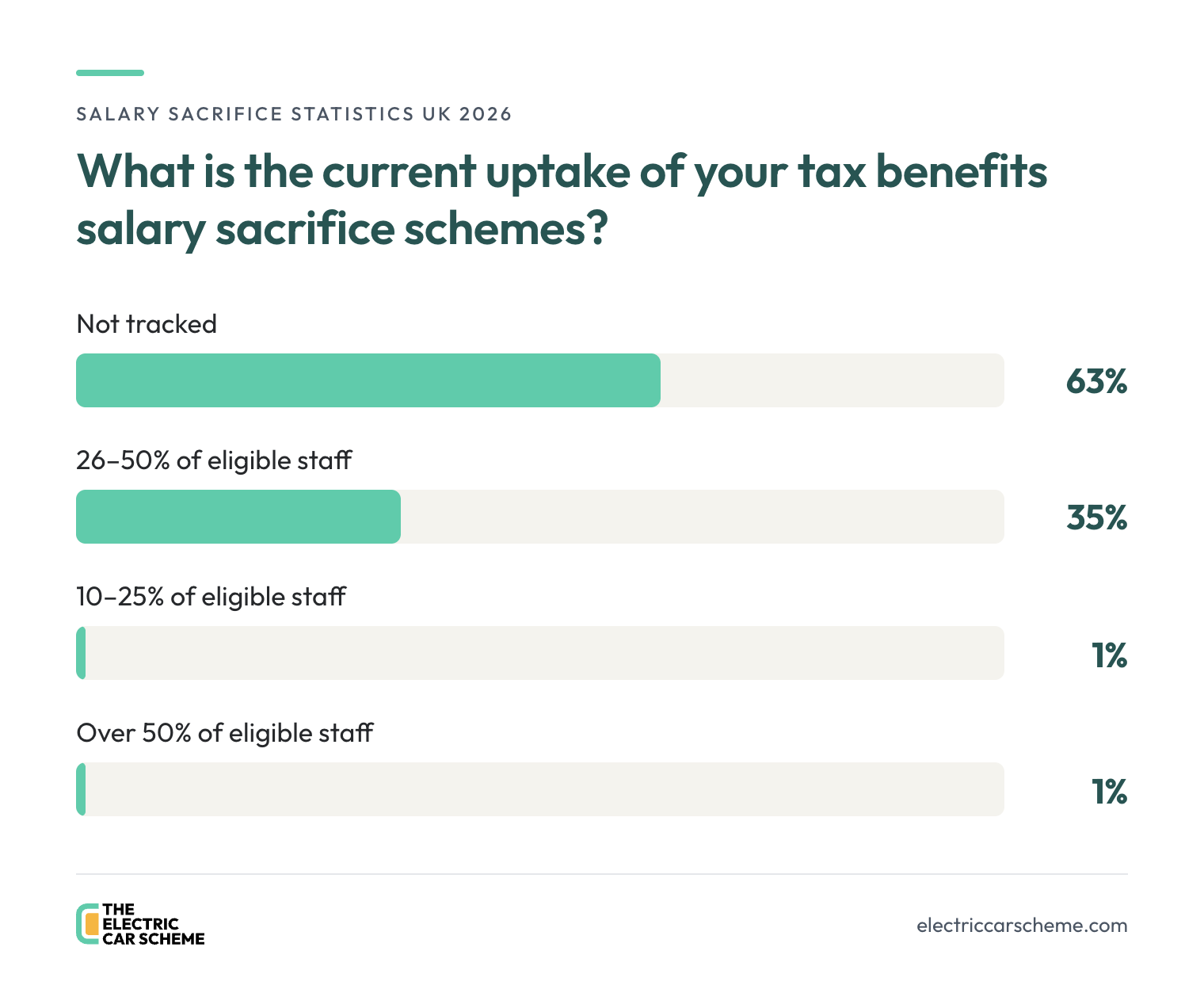
What is the uptake of people leaders' tax benefits salary sacrifice schemes?
While 63% of people leaders do not track the current uptake of their tax benefits salary sacrifice schemes, 35% track 26-50% of eligible staff, 1% track 10-25% of eligible staff, and another 1% track uptake of over 50 of their eligible staff
Tracking uptake could be increased:
Recent research from the Institute for Fiscal Studies has assessed how the government’s planned salary sacrifice pension reforms may affect uptake in the foreseeable future. The reform, announced in late 2025, says that salary sacrifice pension contributions exceeding £2,000 per year will no longer be exempt from employee and employer NICs from 2029-30 and beyond.
With changes like this, tracking the uptake of tax benefit salary sacrifice schemes, such as the pension salary sacrifice scheme, is essential to understand current trends and how they will shift once the reform comes into force. However, 63% of people leaders do not currently track this uptake, making it challenging to accurately evaluate employee adoption or to estimate the financial ramifications of upcoming tax shifts.
In contrast, 35% of people leaders say between 26% and 50% of their eligible staff members are actively using their tax benefit salary sacrifice programmes. Just 1% note that only 10% to 25% of their employees have joined their schemes to date.
At the same time, a mere 1% agree that more than 50% of their eligible staff have signed on. Evidently, scheme adoption still has a way to go before all entitled workers have full access to their organisations’ salary sacrifice benefits. This adoption could soon be shaped by tighter contribution thresholds if companies fail to plan accordingly.
How central is pension provision to people leaders' tax benefits salary sacrifice schemes?
For 97% of people leaders, pension provision is core to their tax benefits salary sacrifice scheme strategy; it’s under consideration for 2%, but not part of 1%’s schemes and no one mentions pension provision being phased out
Pension provision is crucial to strategy:
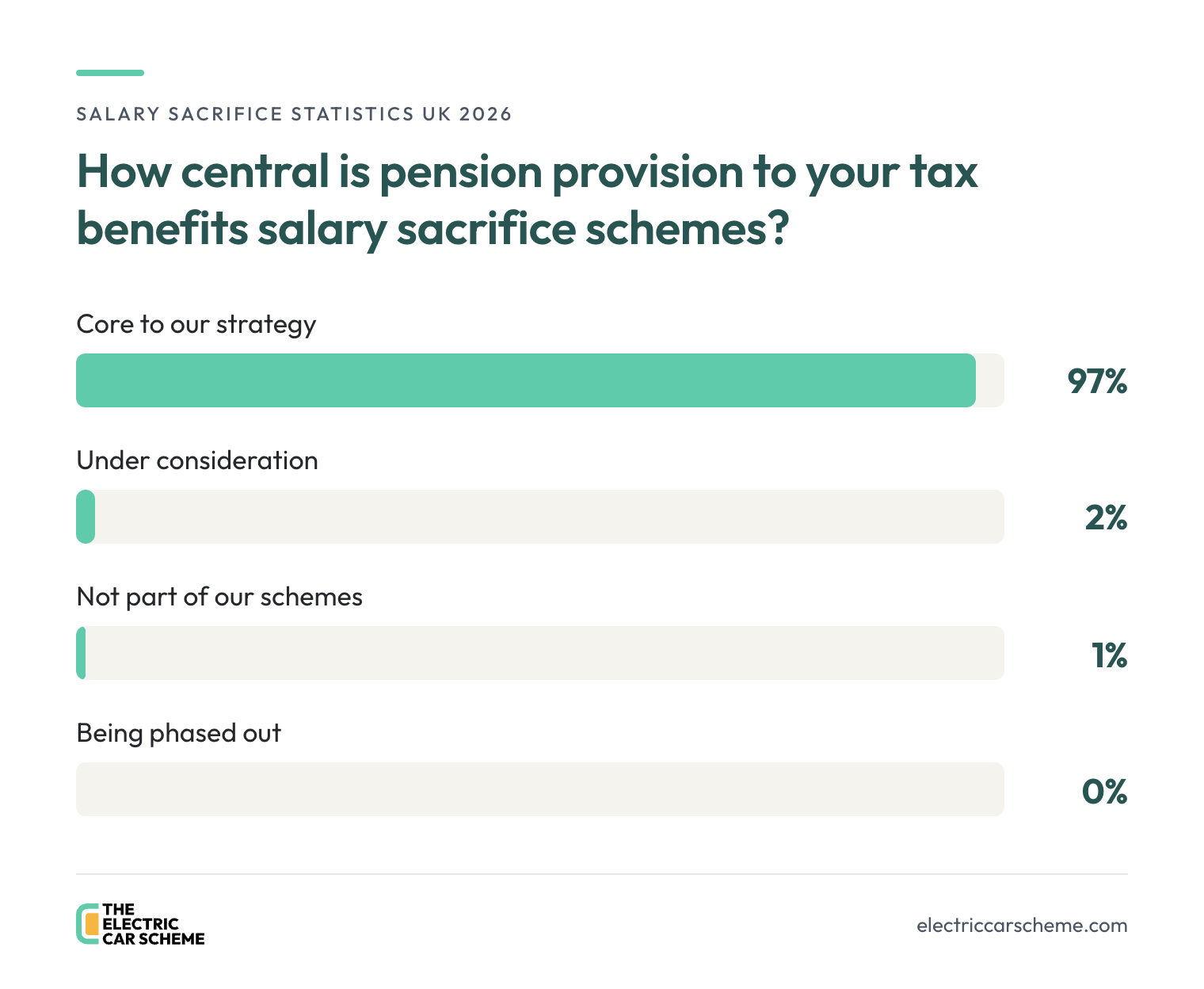
When discussing which tax benefits salary sacrifice schemes are most central to people leaders’ strategies, pension provision stands out, with 97% viewing pension provision as being the very core of their strategies.
This could be for several reasons; for instance, pension salary sacrifice options maximise employees’ retirement contributions while substantially lowering Employer NIC obligations. This combination of factors provides mutual financial benefits, allowing employers to reduce payroll costs while offering an attractive, tax-efficient benefit that supports ongoing employee satisfaction.
Far fewer in our audience hold a different view of the role of pension provision in their tax-benefits salary sacrifice schemes. 2% are currently considering providing pension salary sacrifice as part of their programmes, and 1% agree that pension benefits do not currently feature in their schemes at all.
None of our audience notes that they are actively phasing out their pension provisions, which may point to how compelling these benefits are for maintaining a content and motivated workforce.
How popular is the cycle to work option in people leaders' tax benefits salary sacrifice schemes?
31% of people leaders don’t offer a cycle to work tax benefits salary sacrifice scheme, but 22% do, and the scheme is extremely popular, while it’s fairly popular with another 16%; however, 30% offer a cycle to work scheme, and it is rarely used
Cycle to work popularity fluctuates:
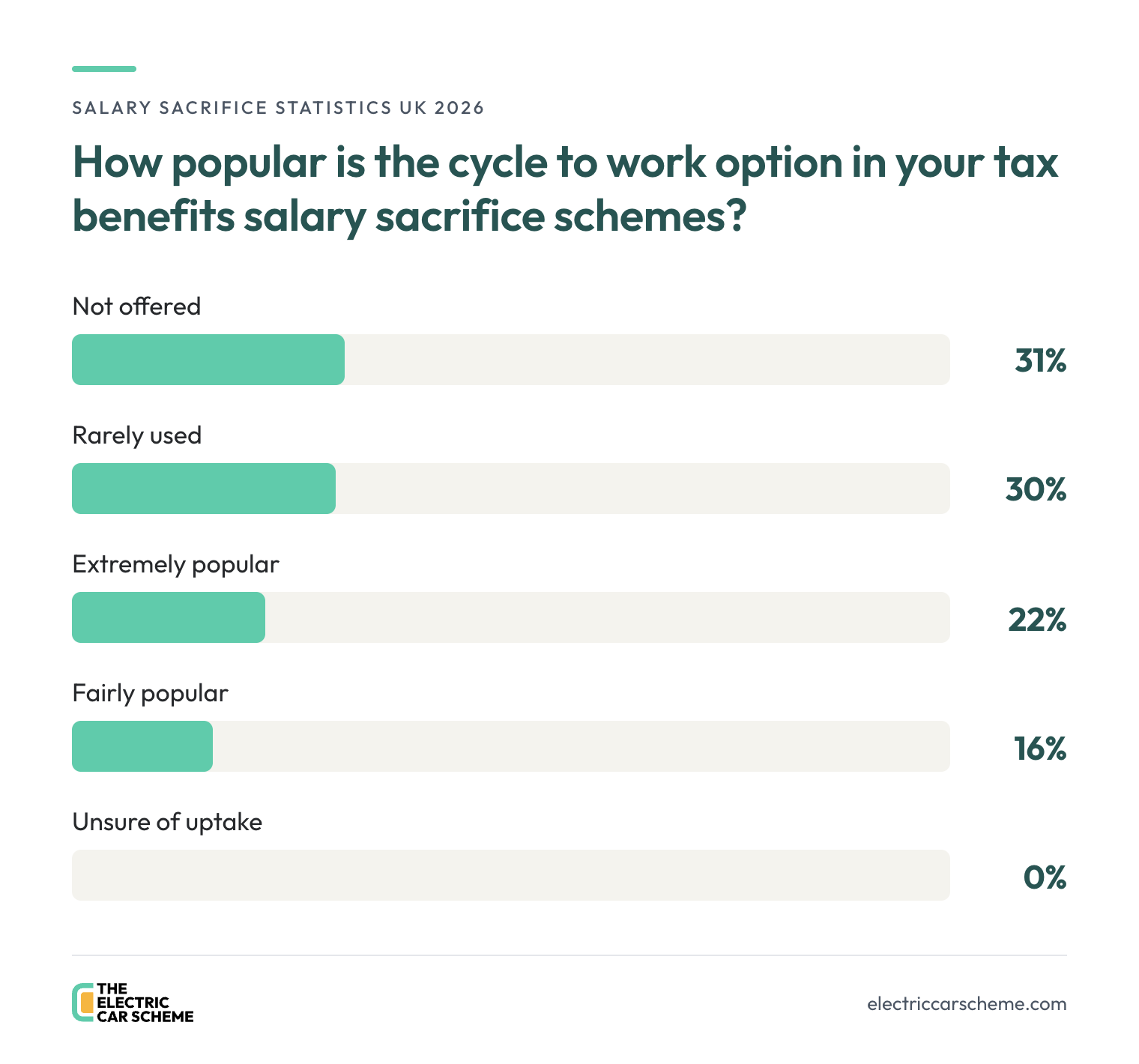
While the highest number of people leaders offered cycle to work schemes, their opinions on the popularity of them are divided. While none are unsure of the uptake rates, 31% do not offer cycle to work provisions in their tax benefits salary sacrifice schemes. Another 30% agree that their employees rarely use these benefits, perhaps preferring other options such as pension provision instead.
However, while just under a third of workers rarely opt for cycle to work benefits, the scheme still holds favour among some. Government data shows that 31% of Cycle to Work scheme users have used the scheme more than once in the past 5 years, and that they have mostly done so by choice rather than because of bicycle or equipment breakages.
In line with this, 16% of our audience finds cycle to work options relatively popular among their employees, and 22% find them extremely popular. Just as the government expects the scheme to increase demand for bicycles, both among employees who do not yet cycle to work and those who do, people leaders who clearly communicate the benefits of cycle to work options may see growth in employee participation and popularity.
How do childcare options fit within people leaders' tax benefits salary sacrifice schemes?
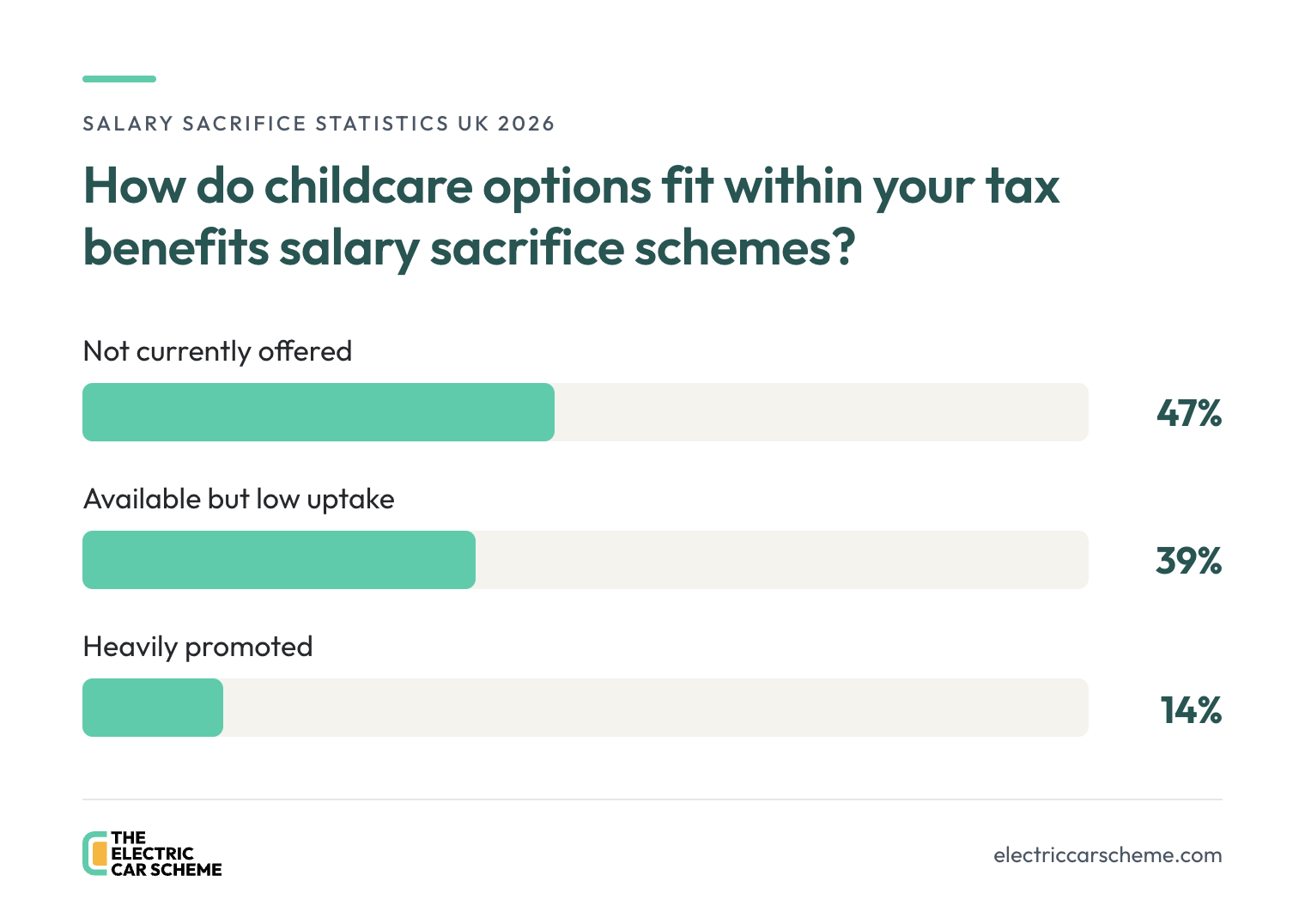
While 14% of people leaders heavily promote the childcare options that fit within their tax benefits salary sacrifice schemes, 39% who offer these schemes have low uptake rates, and a further 47% don’t offer them at all
Childcare options not in huge demand:
Since the government discontinued the Childcare Vouchers programme in 2018, only employees enrolled at the time can continue claiming and using these vouchers. Other working parents may instead benefit from a workplace nursery scheme, which lets them deduct nursery fees from their gross salary to reduce their income tax and NI burdens.
Yet childcare options remain underused in people leaders’ tax benefits and salary sacrifice schemes in 2026. 47% of people leaders do not currently offer childcare options as part of their schemes, while 39% offer these benefits, but uptake remains low. Only 14% report heavily promoting their childcare options.
Overall, while more than half of people leaders’ organisations actively offer childcare options, a clear discrepancy remains between how they are promoted and how widely they are used. One driving factor here could be that workplace nursery benefits only apply to pre-school-aged children, which restricts eligible employees and could account for low uptake in some cases.
Additionally, workplace nursery schemes carry tighter compliance rules and heavier administrative requirements for employers than childcare vouchers, which may help explain why 47% have yet to add them to their benefits programmes.
How satisfied are people leaders with electric car tax benefits salary sacrifice schemes?
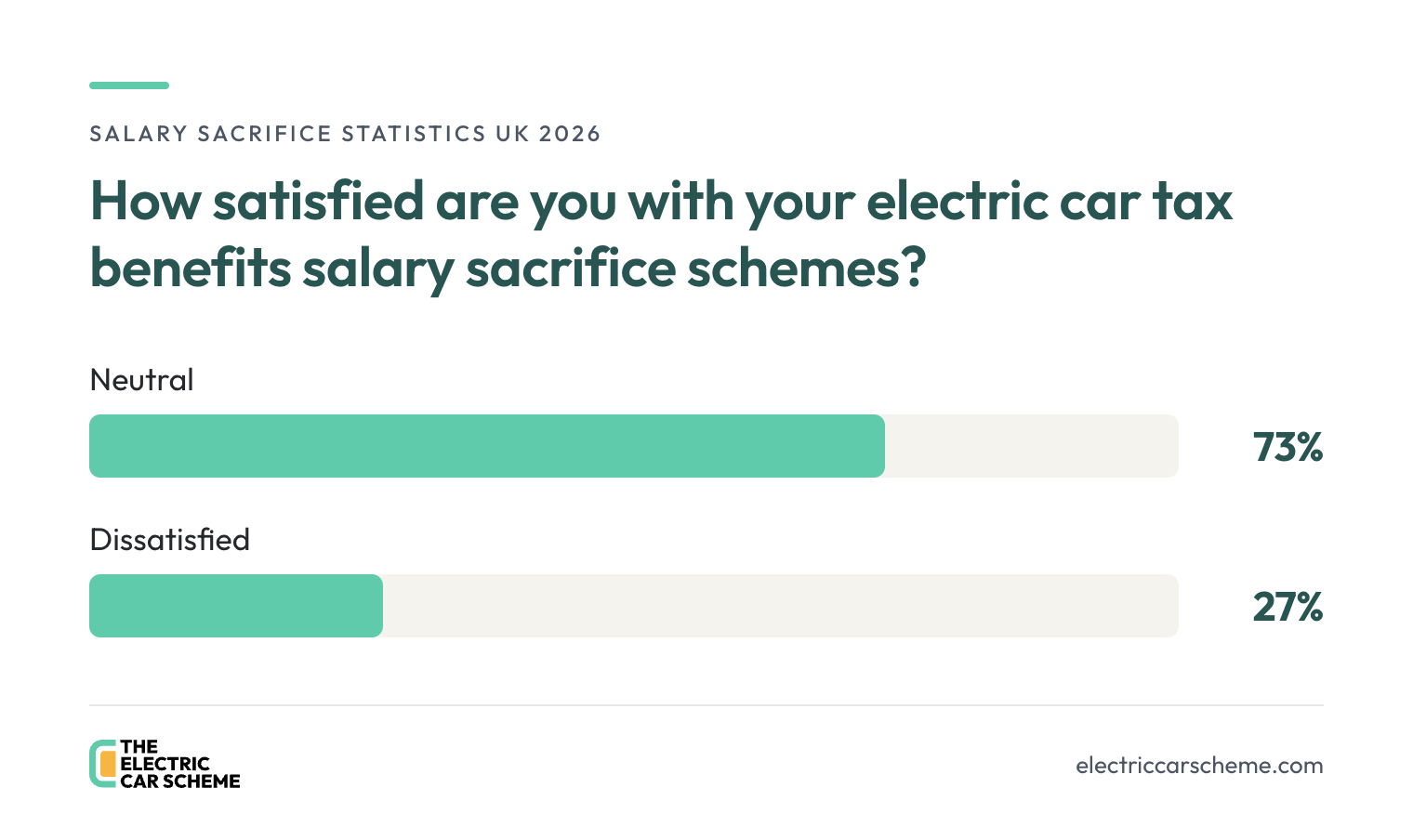
73% of people leaders remain neutral regarding their satisfaction levels with electric car tax benefits salary sacrifice schemes, but 27% are dissatisfied with these schemes
EV schemes need improvement:
According to BVRLA’s latest Leasing Outlook Report, the total fleet of vehicles provided through salary sacrifice schemes has grown 63% year-on-year, with more than 80,000 UK employees now driving electric vehicles through this scheme type.
This fleet growth shows that employees are increasingly leasing vehicles through salary sacrifice programmes with satisfactory results. But amongst our audience, people leaders report varying levels of satisfaction with their organisations’ electric car tax-benefit salary sacrifice schemes. While 73% feel neutral about their schemes, neither strongly approving nor dissatisfied, the remaining 27% say they are currently dissatisfied.
The reasons for this dissatisfaction may be multifactorial. If employees on the scheme are terminated early or take long-term leave, employers may face costly lease payments or early termination fees if Early Termination Protection is not in place. Complex payroll and reporting requirements can also strain HR and finance teams.
Additionally, because EVs generally have high lease costs, NMW laws may bar lower earners, and others may be concerned about rising BiK rates. This may limit both scheme participation rates and the potential benefits for employers and employees, despite the notable effort required to establish an electric car salary sacrifice scheme.
How do people leaders rate employee awareness of tax benefits salary sacrifice schemes?
95% of people leaders are unsure how they would rate employee awareness of tax benefits salary sacrifice schemes, and the remaining 5% rate awareness as very low
Awareness is minimal:
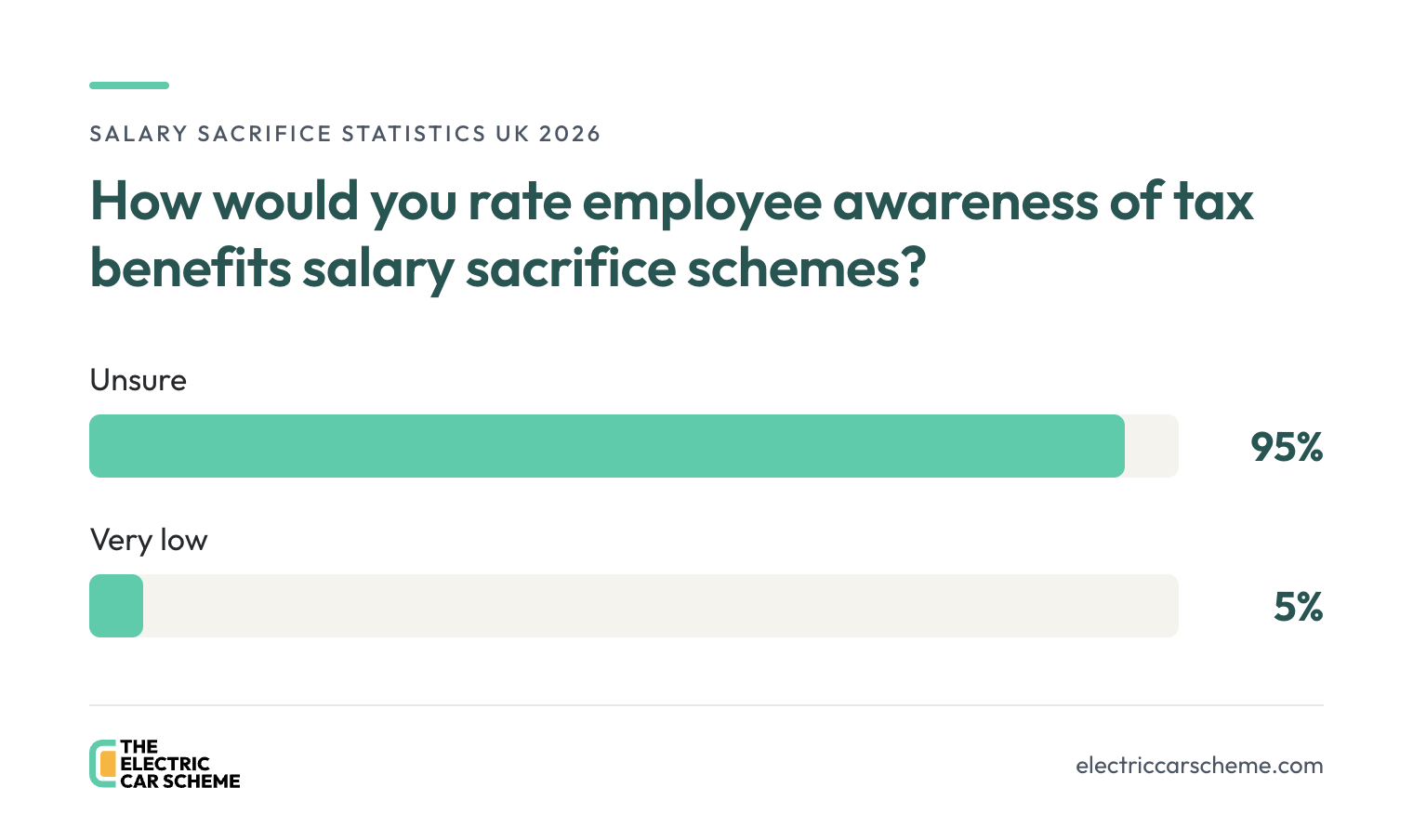
When assessing how people leaders rate their employees’ awareness of tax-benefit salary sacrifice schemes, most express uncertainty. 95% are unsure whether their staff fully understand the schemes and benefits on offer. The remaining 5% report very low awareness, signalling significant room for improvement.
Increasing awareness among employees could benefit leaders’ organisations by increasing scheme uptake, directly increasing Employer NI savings while enhancing job satisfaction and retention.
By sharing clear, easy-to-understand explanations of scheme structures, rules, benefits, and take-home pay details, leaders can secure these advantages. At the same time, they may gain valuable insights into how employees discover and access their salary sacrifice schemes, which they can use to improve adoption rates and employee satisfaction.
How do people leaders communicate tax benefits salary sacrifice schemes internally?
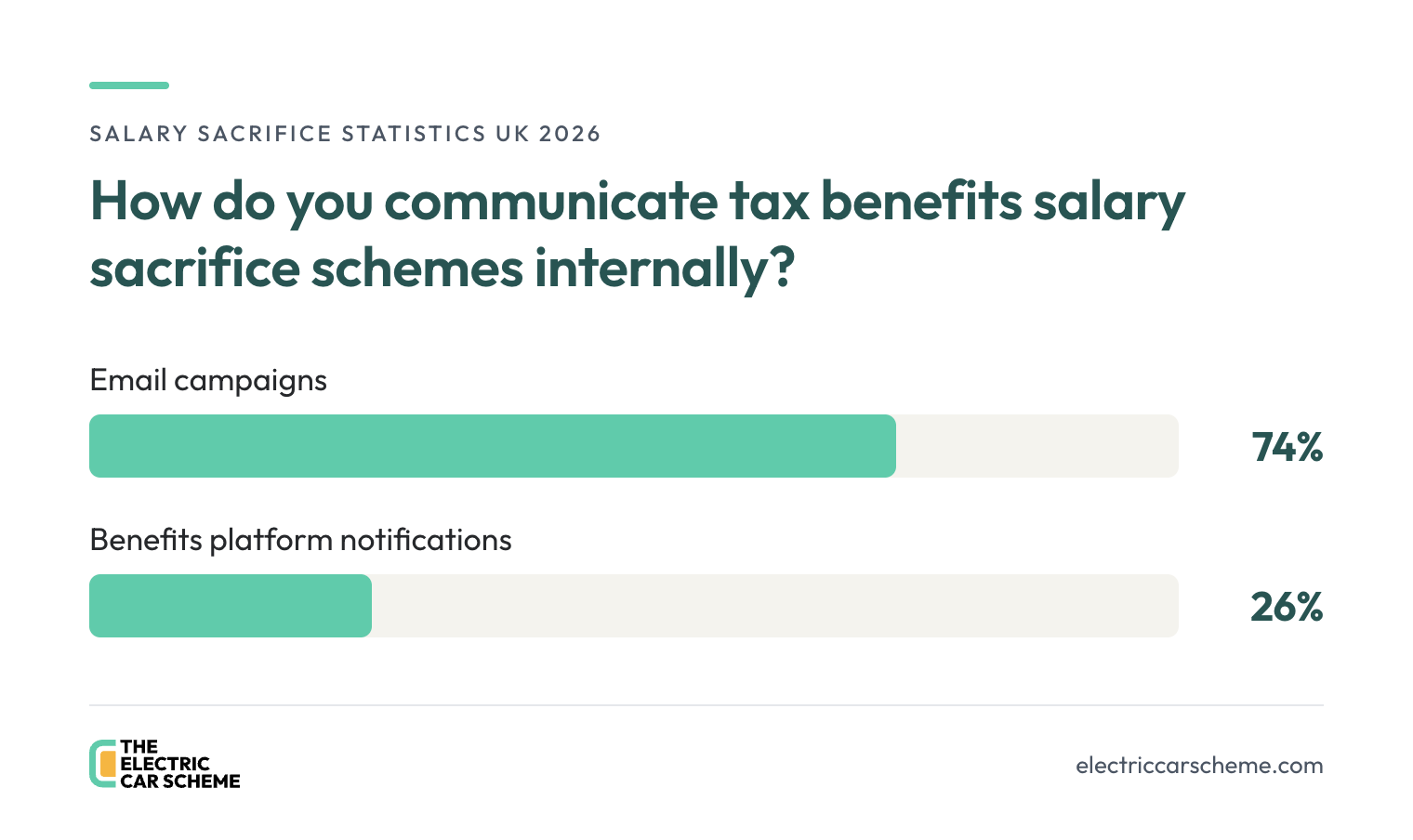
74% of people leaders communicate tax benefits salary sacrifice schemes internally using email campaigns, and 26% rely on communicating via benefits platform notifications
Two channels of communication are utilised:
According to the Exclaimer State of Business Email 2025 report, 48% of IT leaders’ organisations still use direct emails for most of their business communications, both externally and externally. It stands to reason, then, that the majority of people leaders also rely on email campaigns to share information about their tax benefits sacrifice schemes internally.
74% use email campaigns to communicate internally about these schemes. The remaining 26% have opted for a dedicated solution, and now send notifications through their benefits platforms to keep their employees and other key stakeholders up to date.
How often do people leaders review tax benefits salary sacrifice schemes?
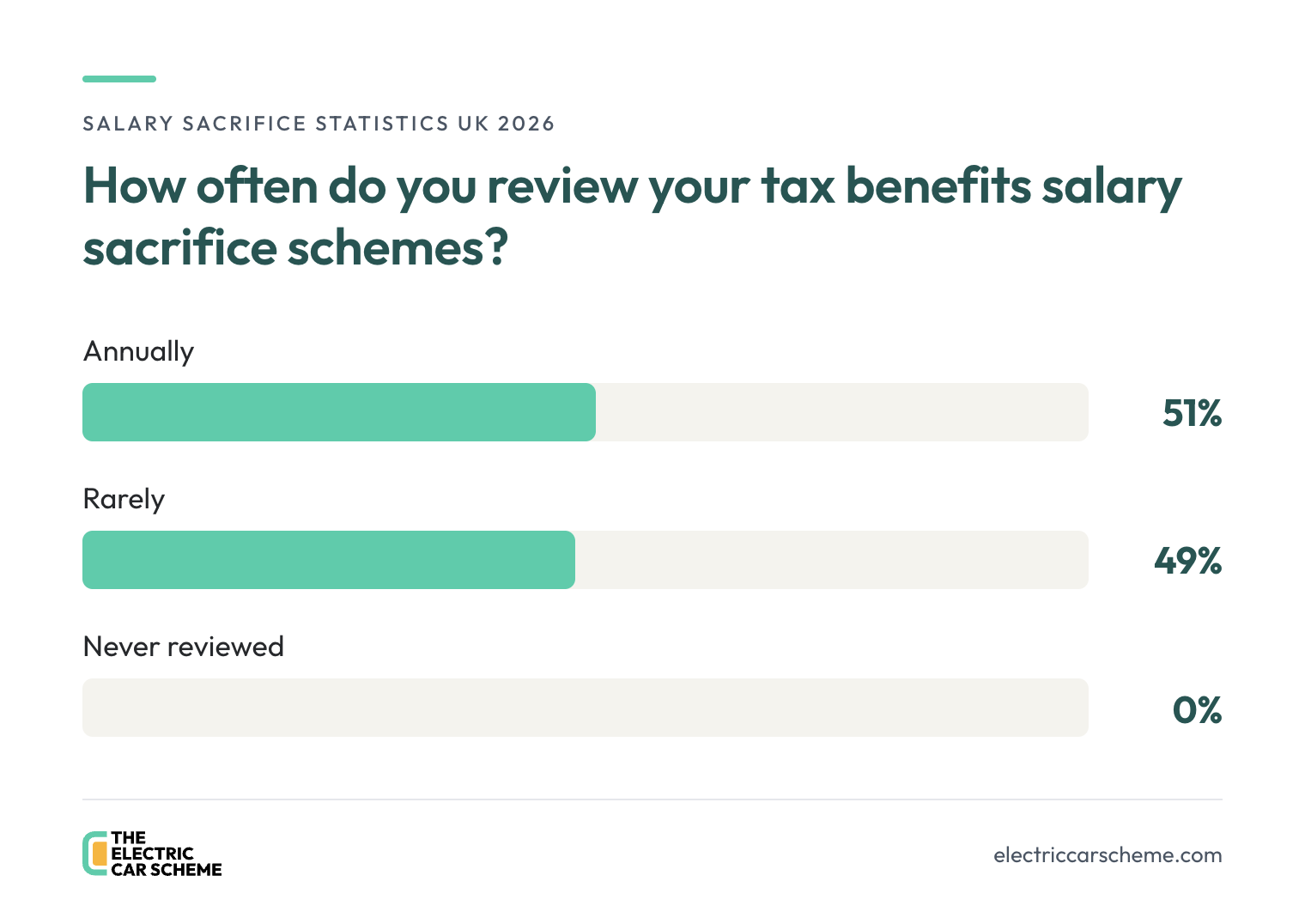
51% of people leaders review their tax benefits salary sacrifice schemes annually, and 49% do so rarely; fortunately, 0% mention never having conducted a review, indicating that reviews are the norm
Reviews occur at two specific periods:
Employers should generally review tax benefits salary sacrifice schemes at least once per year to assess tax compliance and conduct in-depth cost-benefit analyses. However, companies may need to review them more frequently if they undergo restructuring or if the government announces new policies, thresholds, or tax rules.
These timelines are recommended best practice, but people leaders are divided between annual reviews and less frequent evaluations. 51% review schemes on an annual basis, while 49% only rarely perform reviews.
Encouragingly, none of our audience has reviewed their salary sacrifice schemes, showing that most people leaders are committed to maintaining ongoing cost-efficiency, compliance, and employee satisfaction as their organisations and workforces evolve.
What proportion of budget supports tax benefits salary sacrifice schemes for people leaders?
50% of people leaders dedicate 4-6% of their budget to supporting tax benefits salary sacrifice schemes, 49% allocate under 1%, and no one mentions not having a dedicated budget
Budget allocation is divided:
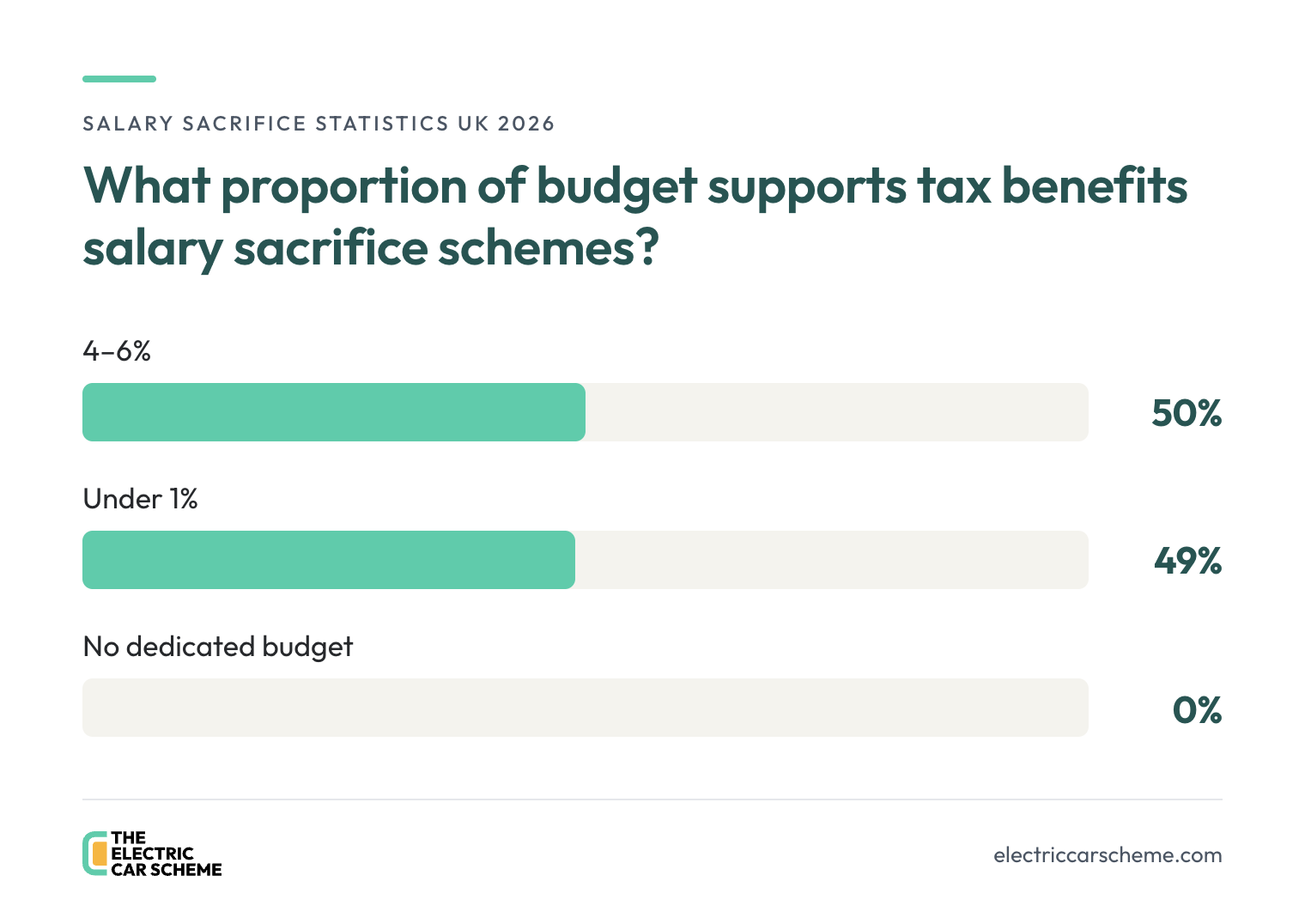
50% of people leaders set aside 4% to 6% of their budget to support tax-benefit salary sacrifice schemes. This signals a mature, well-developed approach to employee benefits, along with a sharp strategic focus on talent acquisition and retention.
The remaining contingent, 49%, allocates under 1% of their total budget to salary sacrifice offerings, and 0% have no dedicated budget for this purpose. If the former increase their budget allocation to tax-efficient schemes, they may significantly reduce payroll overheads through lower Employer NICs.
How significant are employer NI savings from tax benefits salary sacrifice schemes for people leaders?
24% of people leaders agree that NI savings from tax benefits salary sacrifice schemes are highly significant, and 23% agree these savings are moderately significant, but 25% have not yet calculated the benefits, and 28% don’t consider them
Not everyone counts savings:
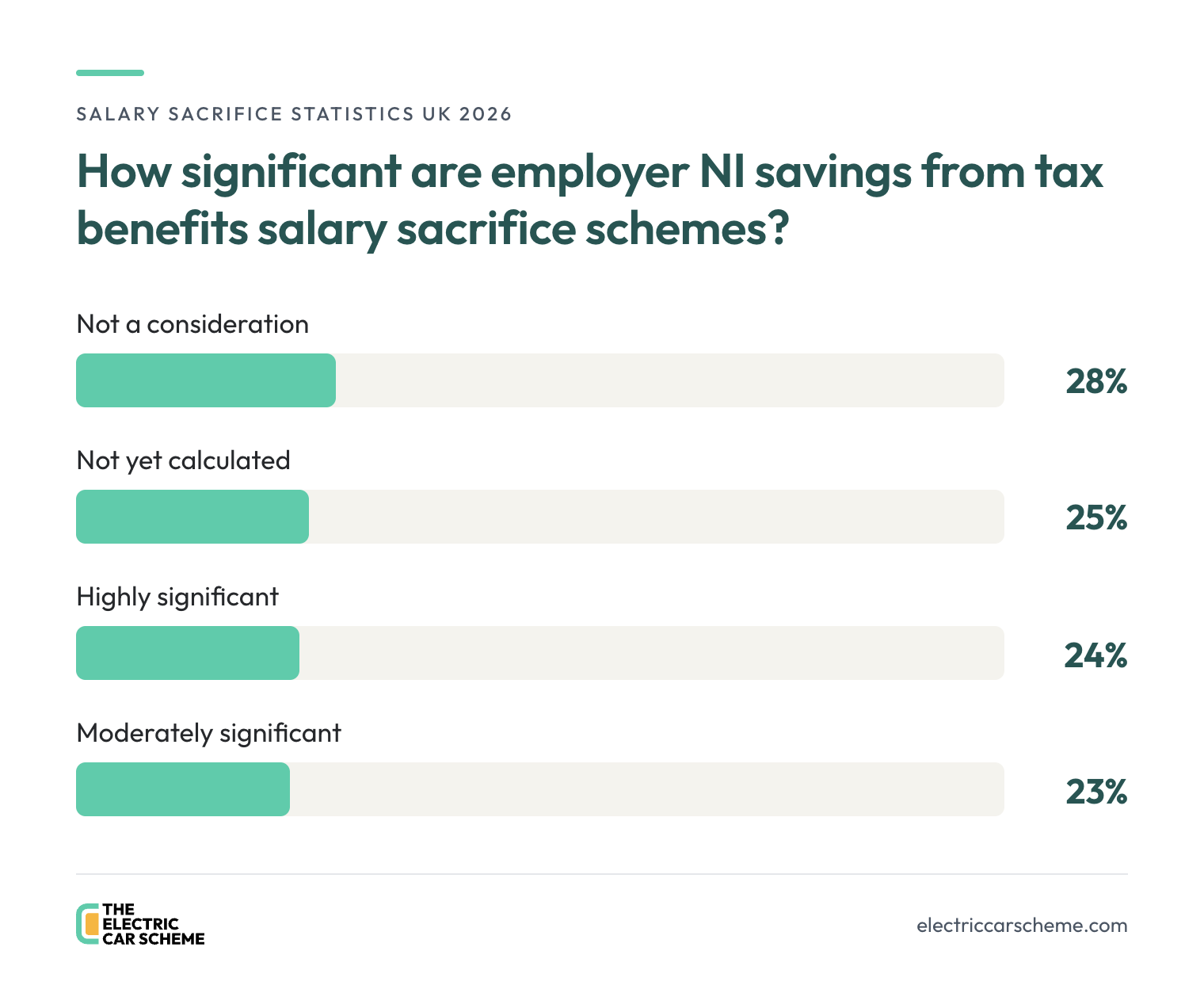
Estimates from BDO show that UK employers could save a collective £10 billion in National Insurance contributions each year through pension salary sacrifice schemes, and their employees may save up to £4.5 billion per annum, too.
These projected savings ahead of the pension salary sacrifice scheme reforms scheduled for April 2029 are certainly significant, and people leaders report varying levels of savings from their tax-benefit salary sacrifice schemes in 2026. While 24% say they have achieved highly significant savings to date, 23% report moderate but noteworthy savings. Yet 28% say savings are not a key consideration when evaluating the benefits of their schemes.
The remaining 25% of people leaders have not yet assessed and calculated their savings. This means it is still unclear whether this group is experiencing notable NI savings, and how impactful those savings are for their organisations’ financial standing.
What mainly drove people leaders' adoption of tax benefits salary sacrifice schemes?
83% of people leaders were mainly driven by the cost savings for the business to adopt tax benefits salary sacrifice schemes, and 17% were driven by environmental, social, and governance goals
Savings and ESG are the main motivators:
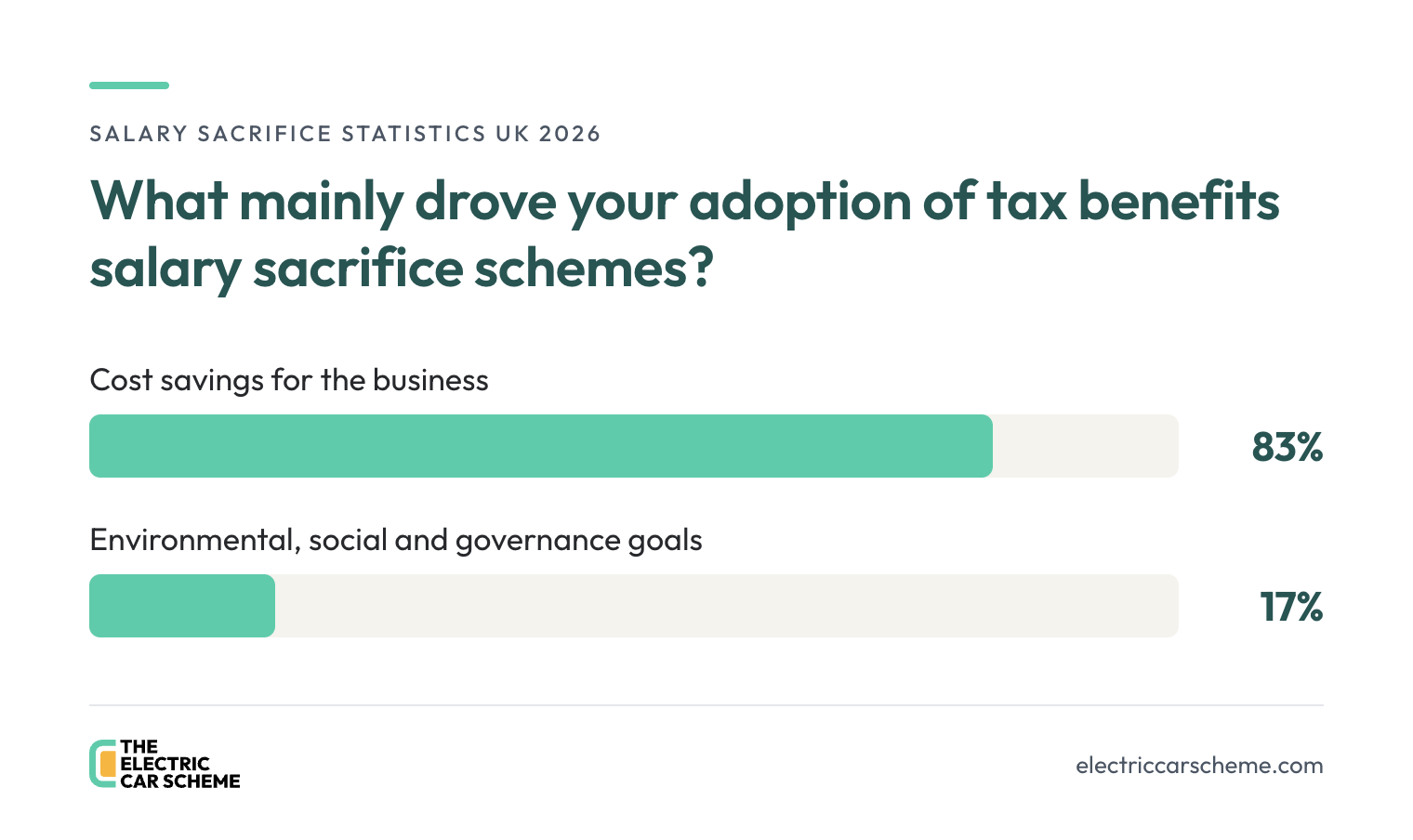
One key driver stands out as the primary motivation for people leaders to adopt tax benefits salary sacrifice schemes: cost savings. 83% agree that cost savings are the main motivator for the implementation of their schemes, compared to 17% primarily driven by environmental, social, and governance goals.
This shows that while ESG goals play a clear role in adopting salary sacrifice schemes, cost and tax savings are by far the top priority for most people leaders. This may be because these savings can reduce overhead expenses through Employer NICs, providing measurable financial benefits that are significantly easier to evidence to stakeholders than longer-term ESG gains.
What is driving demand for tax benefits salary sacrifice schemes among people leaders this year?
Cost of living pressure is driving demand for tax benefits salary sacrifice schemes for 42% of people leaders, 30% are driven by talent attraction, and 28% by net zero commitments
Demand has three main drivers:
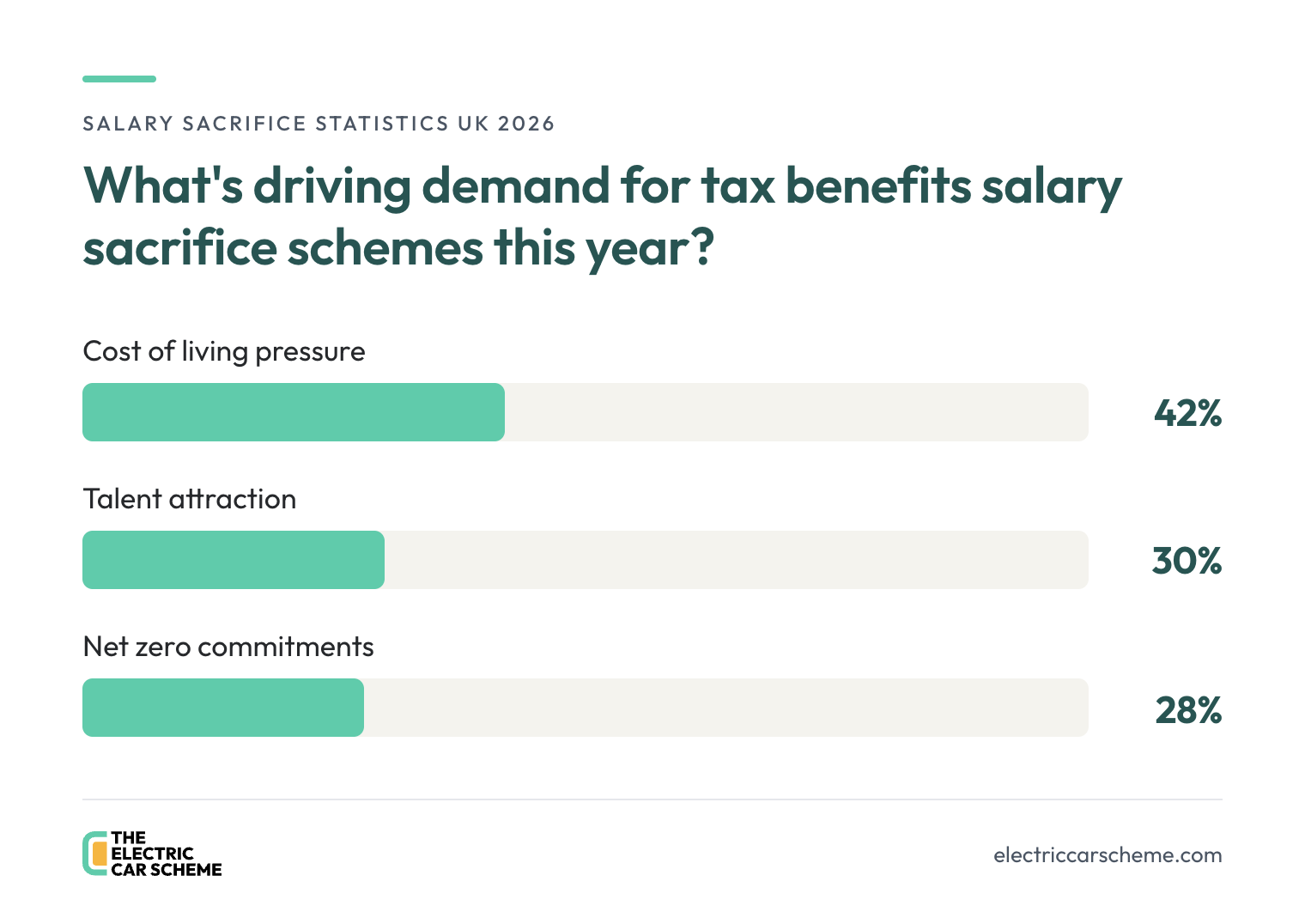
With as many as 55% of British adults reporting rises in their cost of living between July and August of 2026, cost-of-living pressures may be a powerful driver of salary sacrifice uptake. 42% of people leaders agree that this is the primary factor driving demand for tax benefits salary sacrifice schemes this year.
Talent attraction is another key driver. 30% of people leaders report higher demand for salary sacrifice programmes as a key way to attract and retain skilled professionals to their organisations.
Nearly as many leaders (28%) are compelled to explore these schemes to advance their net zero commitments. This also reinforces a notable dedication to making progress on ESG and climate-related obligations.
What is the biggest barrier to uptake of tax benefits salary sacrifice schemes for people leaders?
For 67% of people leaders, the biggest barrier to uptake of tax benefits salary sacrifice schemes is perceived affordability concerns; 27% are hindered by a lack of employee understanding, and 6% struggle with complex enrolment processes
Cost, understanding, and complexity cause hindrances:
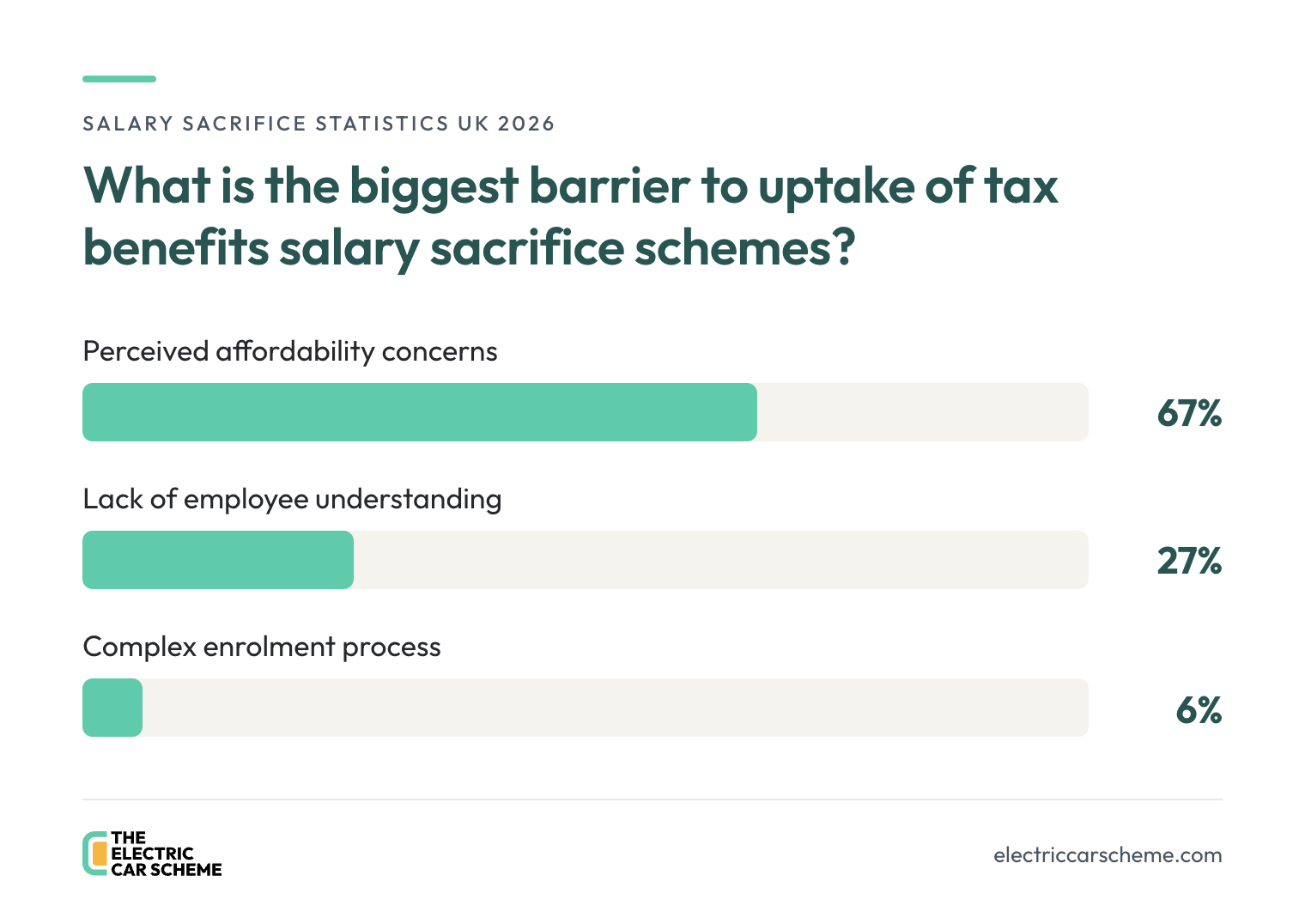
People leaders may face several barriers to successfully implementing tax-benefit salary sacrifice schemes. These barriers include increased administrative and payroll burdens, statutory law and NMW threshold compliance risks, and liability for costs related to statutory leave and early contract terminations. If employees do not fully understand the nature and rules of these schemes, they may also be hesitant to adopt them, further compounding these obstacles.
Perceived affordability concerns are the biggest challenge for 67% of people leaders, preventing widespread uptake of their schemes. A smaller, but still significant, 27% cite a lack of employee understanding as their biggest uptake barrier.
While complex enrollment requirements can also complicate adoption, this factor seems less of a concern for most of our audience. Only 6% of people leaders agree this is their top concern, showing that employees’ perceptions and misunderstandings around salary sacrifice schemes are by far the top obstacle to overcome to maximise scheme uptake rates in the long term.
How concerned are people leaders about minimum wage risk in tax benefits salary sacrifice schemes?
86% of people leaders are somewhat concerned about minimum wage risk in tax benefits salary sacrifice schemes, 8% are unsure of the risk, and 7% are not concerned at all
Risk concerns are moderate to low:
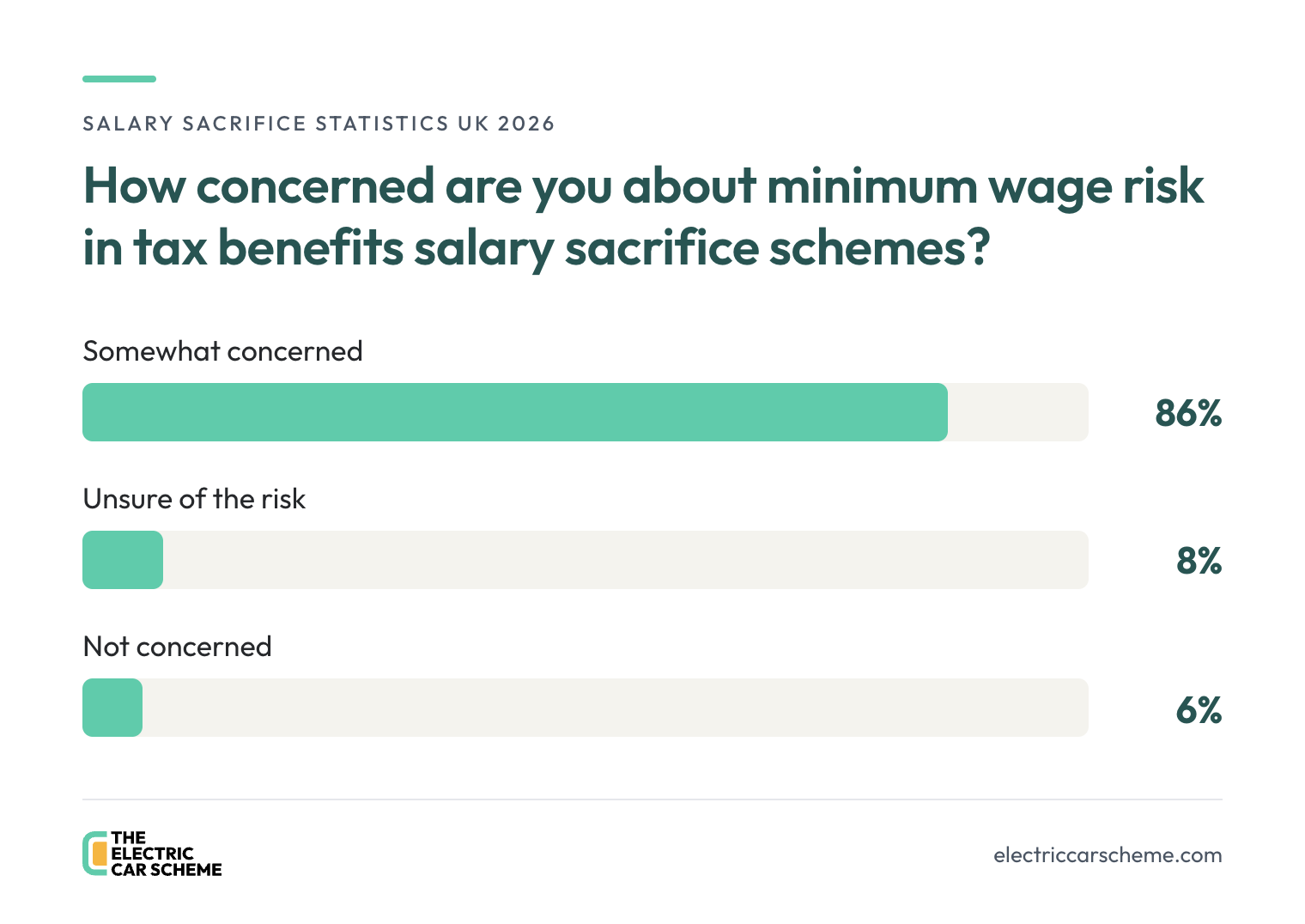
Employers face considerable responsibilities to ensure that their tax benefits salary sacrifice schemes comply with the UK’s National Minimum Wage requirements. They must categorise workers according to the nature of their working hours, make sure that their hourly pay aligns with NMW thresholds, and determine if salaried hours worked provisions apply in each salaried worker’s individual case. Then, workers’ salaries and salary sacrifice deductions must be carefully calculated to ensure that their take-home pay still complies with national thresholds to avoid potential compliance issues.
These responsibilities can be complex, so it stands to reason that many people leaders are concerned about the associated risks of compliance failures. 86% are at least somewhat concerned about these risks, compared to just 6% who are unconcerned.
Another 8% are unsure of the risks involved. This is a major risk in itself, as the consequences of non-compliance can range from costly back pay to financial penalties, and in serious cases, even prosecution.
What is people leaders' top concern with tax benefits salary sacrifice schemes compliance?
65% of people leaders’ top concerns about tax benefits salary sacrifice schemes compliance focus on the minimum wage risk; 23% are most concerned about HMRC rule changes. 8% are worried about benefit-in-kind reporting, and 4% about contract documentation
Compliance concerns focus on risk and rules:
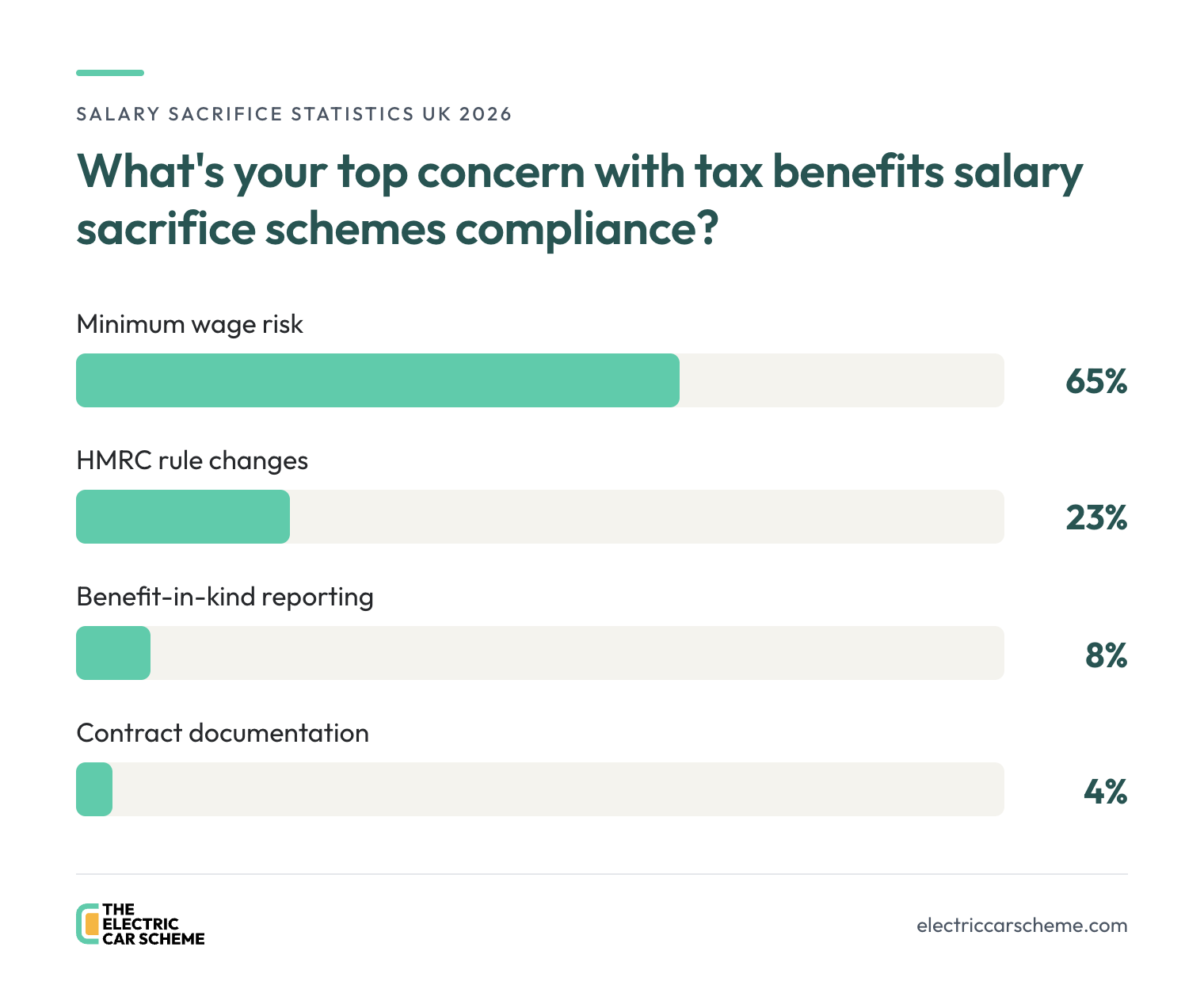
Given the high risks of NMW non-compliance described above, it's not unexpected that 65% of people leaders cite minimum wage risks as their top concern for salary sacrifice scheme compliance.
23% of people leaders also note that HMRC rule changes are their top worry, given that HMRC has the statutory power to closely inspect business premises, payroll systems, and workforces at will. Any breaches - even if accidental in nature - may prompt time-consuming company-wide audits, formal proceedings, and even court orders to continuously monitor future compliance.
Benefit in Kind (BiK) tax reporting is a concern among a small minority, with 8%citing this as their number-one compliance concern. The remaining 4%of people leaders are most concerned about ensuring that their schemes’ contract documentation is accurate and properly maintained at all times.
How well informed are people leaders about legislative changes to tax-benefit salary sacrifice schemes?
54% of people leaders are somewhat informed about legislative changes to tax benefits salary sacrifice schemes, and 45% are not well informed, compared to just 1% who are very well informed
Knowledge gaps are clear:
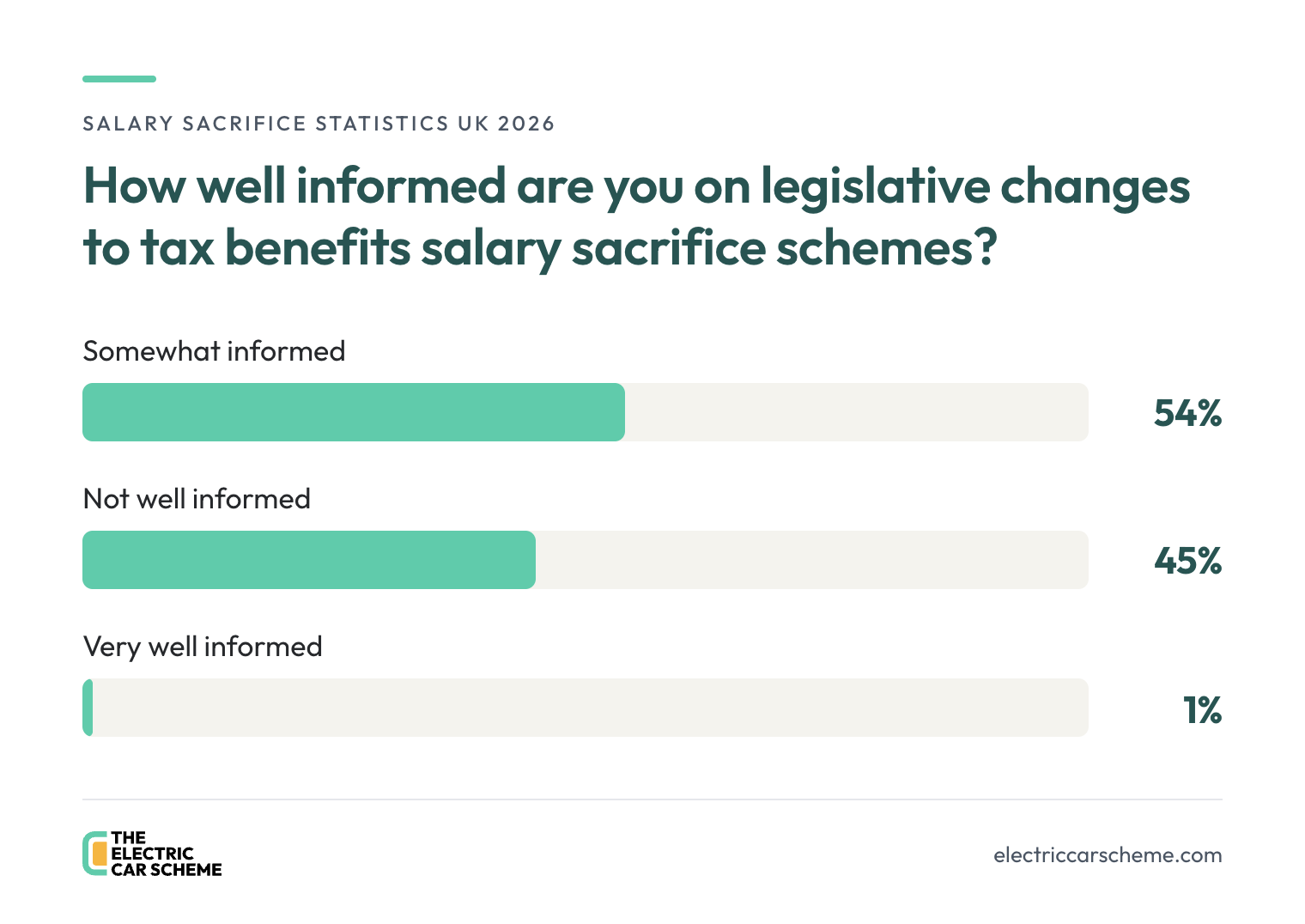
Legislative changes can notably alter how tax benefits salary sacrifice schemes must be operated, managed, and distributed. The Chancellor’s new policy on salary sacrifice pension contributions provides a clear example. New legislation like this is essential to understand in order for organisations to remain compliant and maximise tax savings, both for themselves and for their workforces. However, when it comes to how well-informed people leaders are on the latest legislative changes, just 1% claim with confidence that they are fully informed on all relevant new laws and provisions.
The rest of our audience notes that they are either somewhat informed or not very well informed at all. 54% have some degree of knowledge around legislative changes on tax benefits salary sacrifice schemes, and 45% admit that they still have a way to go before they can consider themselves well-informed on these shifts.
How confident are people leaders using AI to communicate tax benefits salary sacrifice schemes?
75% of people leaders prefer human-led communication over using AI to communicate tax benefits salary sacrifice schemes information, and 25% are not currently using AI for this communication
AI use is not preferred:
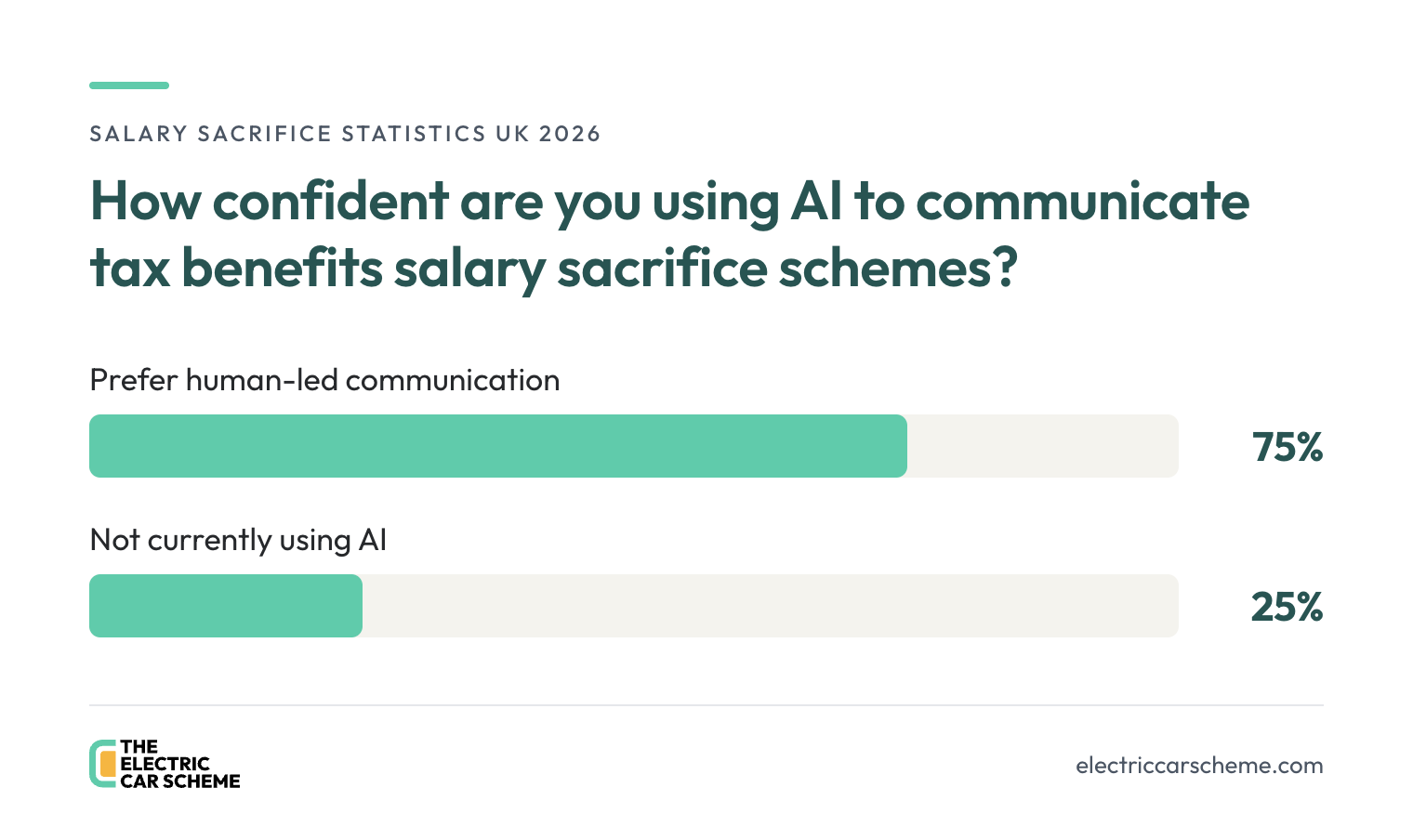
While AI usage varies across industries in the UK, adoption has been relatively slow among local businesses, with the number of businesses with 10 or more employees using AI growing only marginally from 1.4 to 1.6 between late 2023 and 2026. Among those who have adopted it, AI is still used primarily to streamline business operations, while workflows such as internal communications remain largely human-led.
When communicating the details of tax-benefit salary sacrifice schemes to employees, most people leaders in our audience still prefer a human approach. 75% favour human-led communication for this purpose, and the remaining 25% are not currently using AI at all. This aligns with the slow adoption rates, but may well increase as AI use increases.
Key findings on tax benefits salary sacrifice schemes in the UK
Overall, the findings suggest that tax-benefit salary sacrifice schemes remain underdeveloped across many UK workplaces, with gaps in employee awareness, uptake and performance tracking. While cost savings are a key driver, affordability concerns and compliance risks continue to shape employer decisions. Greater attention to scheme design, communication and regular reviews could help people leaders make better use of these benefits.
Are you an employer?
BOOK A DEMOAre you an employee?
SEE AVAILABLE CARSYou might also like…

Last updated: 14.10.2026
Information and prices provided are accurate at the time of release and may be subject to change. Our pricing is based on data collected from The Electric Car Scheme quote tool. All final pricing is inclusive of VAT. All prices above are based on the following lease terms; Using a flat payment profile, 10,000 miles pa, 36 months, and are inclusive of Maintenance and Breakdown Cover. The Electric Car Scheme’s terms and conditions apply. All deals are subject to credit approval and availability. All deals are subject to excess mileage and damage charges. Prices are calculated based on the following tax saving assumptions: England & Wales, 40% tax rate. The Electric Car Scheme Limited provides services for the administration of your salary sacrifice employee benefits. The Electric Car Scheme Holdings Limited is a member of the BVRLA (10608), is authorised and regulated by the FCA under FRN 968270, is an Appointed Representative of Marshall Management Services Ltd under FRN 667174, and is a credit broker and not a lender or insurance provider.
Copyright and Image Usage: All images used on this website are either licensed for commercial use or used with express permission from the copyright holders, in compliance with UK and EU copyright law. We are committed to respecting intellectual property rights and maintaining full compliance with applicable regulations. If you have any questions or concerns regarding image usage or copyright matters, please contact us at marketing@electriccarscheme.com, and we will address them promptly.
