
The Last Barriers to EV Salary Sacrifice, Removed: Day 1 Joining and Penalty-Free Exit

Image source: Shutterstock
For most UK employees, EV salary sacrifice has carried two practical barriers that had nothing to do with the tax mechanics of the scheme. The first stopped people from joining: a probation period, typically six to twelve months, that locked new hires out of the benefit during the period when an EV purchase decision is most often made. The second stopped people from staying: an early termination liability that could reach 50% of remaining rentals if a partner lost an income, a divorce came through, or long-term sickness arrived. From 29 April 2026, The Electric Car Scheme has removed both barriers in a single product update. New starters can now join from Day 1 of employment. Existing drivers can exit without penalty if life changes. Neither change carries an additional cost to the employer.
This piece walks through what each barrier was, who was affected, and what the access expansion looks like in practice.
Barrier one: probation periods locked out 5.5 million workers
The standard requirement across most UK EV salary sacrifice schemes has been that an employee must have completed probation, or six to twelve months of tenure, before they can take a car. The reasoning was protective: a provider running on a single-leasing book, without comprehensive employer cover, did not want the financial exposure of a probation-stage exit. The effect, in aggregate, was to exclude every new hire across the UK economy during their first year with an employer.
That window covers a significant share of the workforce. According to ONS labour market data, around 5.5 million UK workers are within their first 12 months of employment at any given time, including a disproportionate share of younger, mobile and lower-paid employees. For HR teams trying to position EV salary sacrifice as a benefit that lands across the whole workforce, the probation rule was awkward. New starters were told the scheme existed but they could not yet use it. The employees most likely to be making a fresh car-buying decision, and most likely to share their experience with the rest of the team, were the ones told to wait.
From today, that requirement is gone for Electric Car Scheme agreements. Employees can join from day one of employment, regardless of probation status, with the same Complete Employer Protection from Day 1 as anyone else on the scheme. The protection is what makes Day 1 joining commercially viable: because the employer is fully covered against early termination from the moment the car is on the driveway, the historical reason for a probation barrier has been removed at source.
For employers, this changes how the benefit can be communicated at offer stage. EV salary sacrifice can now sit alongside private medical, pension matching and holiday allowance in the offer letter, available from Day 1, rather than as a benefit that vests at month six or twelve. The HR teams we have spoken with about the change report that this matters most in industries with high churn, seasonal hiring or competitive entry-level recruitment, including retail, hospitality, logistics, and parts of healthcare and the public sector.
Barrier two: life changes were the employee's problem to absorb
The second barrier sat on the other end of the lease. Most UK EV salary sacrifice schemes treat the employer as the protected party in the event of an early termination but leave the employee responsible if their personal circumstances change. If a partner lost their job, if a divorce came through, or if a household income dropped by a meaningful amount, the lease payment that was comfortable on two salaries had to compete with a mortgage, childcare and bills that two salaries used to share. Early termination fees of up to 50% of remaining rentals arrived at exactly the wrong moment.
The events that trigger this kind of squeeze are not rare. The UK redundancy rate climbed to 5.3 per 1,000 employees in late 2025 (ONS). Long-term sickness peaked at 2.82 million economically inactive adults in early 2024 (ONS). Some 102,678 divorces were granted in England and Wales in 2023 (ONS), and Legal & General research found that almost half of divorcees see their household income fall by 31%. Across a workforce of any size, the maths means several life events per year will hit lease drivers. Until today, every one of them was a hardship problem for the employee, the employer, or both.
Employee Life Event Support, included as standard from 29 April 2026, removes the early termination liability when one of the following occurs: a partner's redundancy, family-friendly leave, long-term sickness, dismissal or death; an involuntary salary reduction of 20% or more; a divorce; or an intra-company transfer abroad. The employee returns the car. The lease ends. There is no penalty. The employer carries no incremental cost. Coverage extends to a partner's circumstances, not just the employee's, which is the part of the design that matters most to anyone working through a household income shock.
What the access expansion looks like in practice
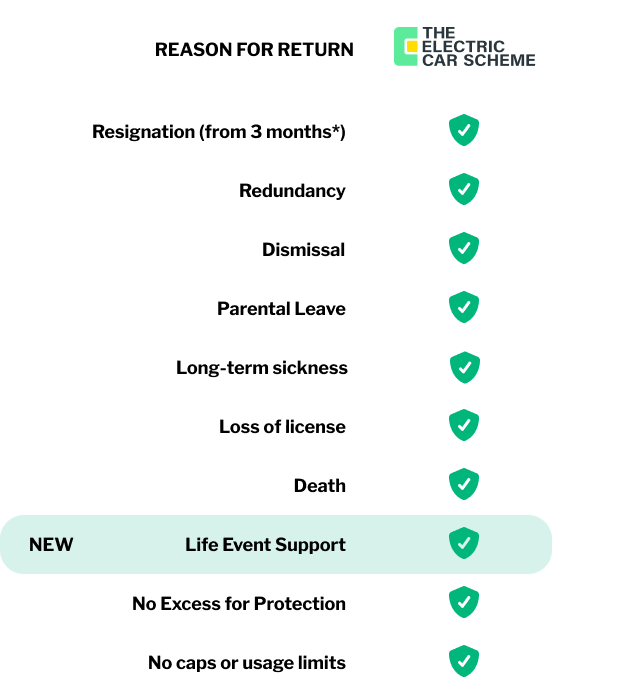
For an employer with 1,000 employees and a typical UK turnover profile, the practical effect of these two changes lands in three places.
It opens the addressable workforce. Employees on probation, who under the old model were typically excluded for six to twelve months, are now eligible from day one. For an organisation with 200 new joiners a year, that is up to 200 incremental candidates for the scheme each year, none of whom were previously in the funnel.
It reduces the friction in launch communications. The old "available after probation" caveat is gone, which makes the launch narrative cleaner. HR and benefits teams who have run employer-side rollouts will recognise how much campaign air-time gets eaten by probation FAQs. That overhead disappears.
It strengthens the retention argument. An employee who joins the scheme on a 36-month lease has a stronger reason to remain with the employer through that term, particularly if they have already factored the post-tax saving into their household budget. With Employee Life Event Support sitting underneath the lease, the contract becomes safer to commit to: if a major life change does land, the lease is no longer a financial trap. Confidence in the scheme tends to lift uptake at launch and in years two and three.
The access expansion sits inside the same scheme economics that already applied. Set-up cost remains £0. Employer Class 1 National Insurance savings on the sacrificed salary cover the running cost of the scheme. Employers retain full control of Class 1A NIC savings, averaging around £1,920 per car per year, and choose whether to retain them or recycle them into employee pricing.
How this lands against the wider market
The changes do not exist in a vacuum. Tusker and Octopus EV, the two providers UK employers most often shortlist, both still operate three-month protection exclusion windows on every new lease and apply tenure or probation rules consistent with that exposure. Neither currently offers a comparable Employee Life Event Support product. For a fuller side-by-side, see the Tusker vs Octopus vs The Electric Car Scheme comparison and the employer comparison page on our site.
The point is not that those providers are unsafe. They are credible operators with long track records. The point is that, on the access dimension specifically, the gap has now widened materially. An employer who wants the benefit to land across the whole workforce, including new starters, employees on lower salary bands and employees navigating a major personal change, has a different choice available today than they had on 27 April.

What the founder said

Thom Groot, Co-Founder and CEO at The Electric Car Scheme, framed the change this way:
"Until today, an employee going through a divorce or losing a partner's income could find themselves locked into a car lease they could no longer afford. That was a problem with salary sacrifice as a benefit, not just with our scheme. We've fixed it for our customers. We've also removed the probation barrier that was quietly locking 5.5 million UK workers out of the benefit. For an employer trying to offer EV salary sacrifice to the whole workforce, that's not a product tweak. It's a different scheme."
That framing is the one we would put to any HR or benefits team weighing up whether the update changes their evaluation. Day 1 in plus penalty-free out means the scheme genuinely works for employees across the full range of life circumstances, rather than a tidy subset of them.
Bottom line
EV salary sacrifice has spent the past five years becoming the most tax-efficient route to a new electric car in the UK. The next chapter is making it accessible across the full range of employees and resilient to the full range of life events. From 28 April 2026, on Electric Car Scheme agreements, both barriers are gone. The economics still hold: cost-neutral to the employer, 20-50% net saving for the employee, Benefit-in-Kind at 4% for 2026/27. What has changed is who can join and what happens when life shifts under their feet.
To map the changes to your workforce, book a call with our team or calculate savings on a specific car for a personalised view of the net monthly cost. For deeper context on how the scheme runs day-to-day for HR and finance teams, see how salary sacrifice works for companies.
Are you an employer?
BOOK A DEMOAre you an employee?
SEE AVAILABLE CARSYou Might Also Like…




Last updated: 30/04/2026
Our lease pricing is based on data collected from The Electric Car Scheme quote tool. All final pricing is inclusive of VAT. All prices above are based on the following lease terms; 10,000 miles pa, 36 months, and are inclusive of Maintenance and Breakdown Cover. The Electric Car Scheme’s terms and conditions apply. All deals are subject to credit approval and availability. All deals are subject to excess mileage and damage charges. Prices are calculated based on the following tax saving assumptions; England & Wales, 40% tax rate. The above prices were calculated using a flat payment profile. The Electric Car Scheme Limited provides services for the administration of your salary sacrifice employee benefits. The Electric Car Scheme Holdings Limited is a member of the BVRLA (10608), is authorised and regulated by the FCA under FRN 968270, is an Appointed Representative of Marshall Management Services Ltd under FRN 667174, and is a credit broker and not a lender or insurance provider.
Copyright and Image Usage: All images used on this website are either licensed for commercial use or used with express permission from the copyright holders, in compliance with UK and EU copyright law. We are committed to respecting intellectual property rights and maintaining full compliance with applicable regulations. If you have any questions or concerns regarding image usage or copyright matters, please contact us at marketing@electriccarscheme.com and we will address them promptly.
