
Pension Salary Sacrifice Schemes Statistics: UK 2026
Pension salary sacrifice can offer financial advantages for employers and employees, while also affecting how workplace benefits are managed and communicated. As changes to the rules approach, people leaders need to understand how these schemes are being managed, where employees may need more guidance and which areas could require greater attention. For employees considering multiple salary sacrifice benefits, understanding how one arrangement may affect another is also important.
To find out what 178,324 opinions of people leaders in the UK were about pension salary sacrifice schemes, we utilised AI-driven audience profiling to synthesise insights from online discussions over 12 full months ending on the 23rd of September, 2026, to a high statistical confidence level. The resulting statistics reveal how UK people leaders approach pension salary sacrifice, including how they assess its value, manage schemes, understand employee engagement and prepare for future changes.
Methodology and data
Sourced using Artios from an independent sample of 178,324 opinions of people leaders in the UK across X, Quora, Reddit, Bluesky, TikTok and Threads. Responses are collected within a 95% confidence interval and a 5% margin of error. Results are derived from what people describe online, from opinions expressed, not actual questions answered by people in the sample.
How do people leaders measure ROI on pension salary sacrifice schemes?
76% of people leaders measure ROI on pension salary sacrifice schemes by Employer National Insurance savings, but 24% don’t currently measure the ROI at all
Insurance savings are the best metric:
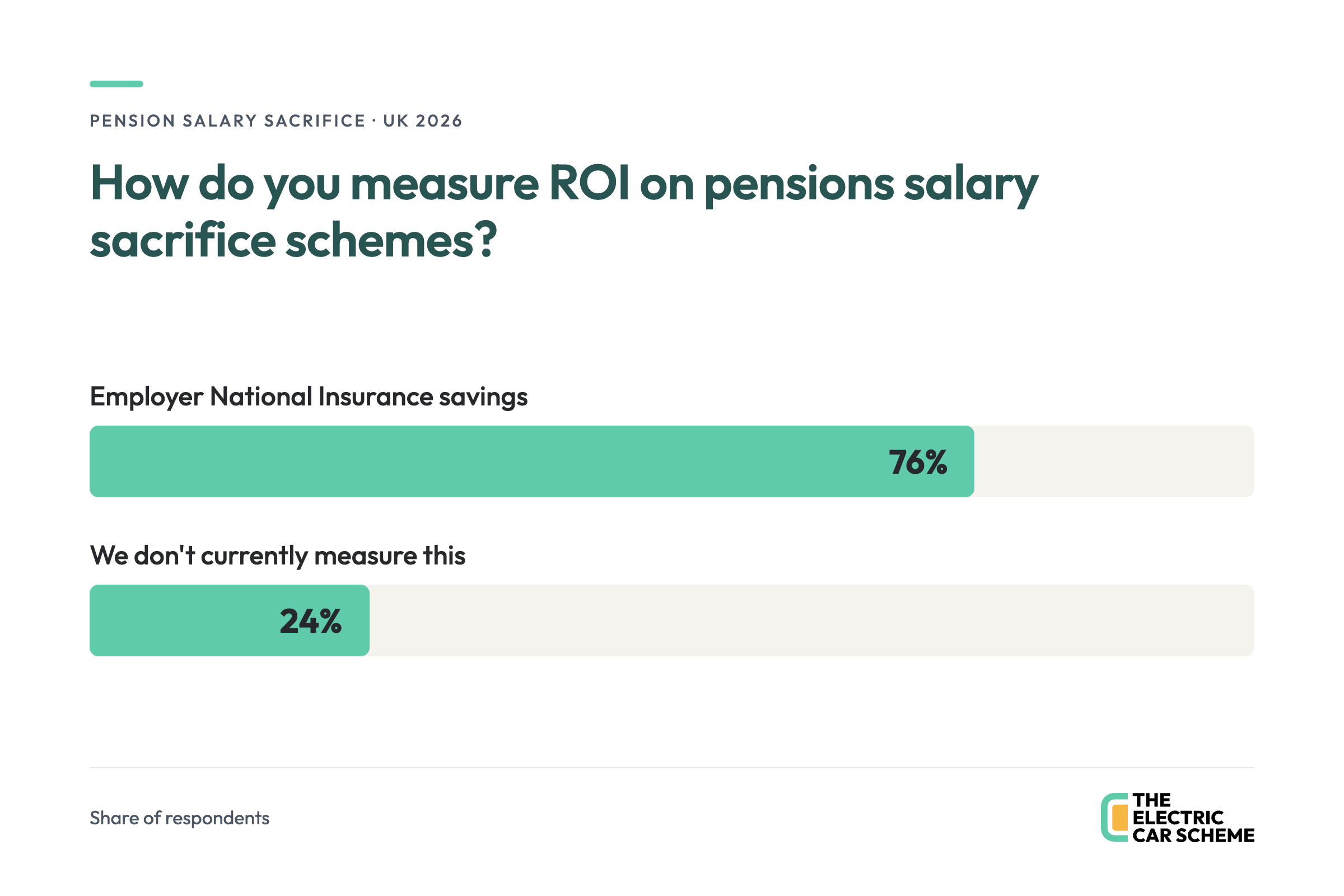
When people leaders assess the return on investment from pension salary sacrifice schemes, the overwhelming majority focus on Employer National Insurance Savings, with 76% citing this as their primary metric.
Given that employers currently save 15% in secondary Class 1 National Insurance contributions plus 0.5% Apprenticeship Levy on the gross salary employees sacrifice for pension contributions, the motivation is clear. For people leaders and HR teams, this represents a clear, quantifiable benefit that directly improves the organisation’s bottom line while simultaneously supporting staff retirement planning.
The remaining 24% of people leaders indicate they don’t currently measure ROI on these schemes at all. This doesn’t necessarily mean the schemes lack value. Instead, some organisations may view pension salary sacrifice as a standard employee benefit whose advantages are already well understood and embedded in payroll operations.
With NIC savings automatically realised through reduced taxable salary, many businesses simply accept the financial gain without formal tracking. However, from 6 April 2029, salary sacrifice pension contributions will be subject to NIC to the extent they exceed £2000 per annum. This makes reviewing the financial impact of salary sacrifice, and its ROI, increasingly relevant for employers ahead of the changes.
What data do people leaders track for pension salary sacrifice schemes?
99% of people leaders don’t track data for pension salary sacrifice schemes, while just 1% track cost savings to the business
Data tracking is not prioritised:

Building on how people leaders measure ROI, the picture becomes even clearer when you look at the specific data they track for pension salary sacrifice schemes. 99% report that they don’t track specific data at all. This proves that for most organisations, these schemes operate as a set-and-forget benefit.
This makes practical sense. Once a salary sacrifice arrangement is in place, the administrative burden is minimal, and the tax advantages flow automatically through payroll. HR teams and people leaders can therefore focus on broader workforce priorities, confident the scheme continues to deliver value without constant oversight.
The remaining 1% of our audience track cost savings to the business, likely because they operate in larger organisations where formal benefit analytics form part of strategic financial planning. For these teams, monitoring exact savings helps justify the scheme’s continuation and supports decisions around expanding employee benefits.
Even without active tracking, businesses still benefit from the underlying mechanics. This automatic gain means even the 99% not tracking data still realise tangible financial advantages every pay cycle.
How do pension salary sacrifice schemes affect employer NI savings?
79% of people leaders have not calculated how pension salary sacrifice schemes have affected employer National Insurance savings, 21% have tracked some savings but not closely, and fewer than 1% are unsure of the exact impact of these schemes on employer NI savings
Calculating NI savings is limited:
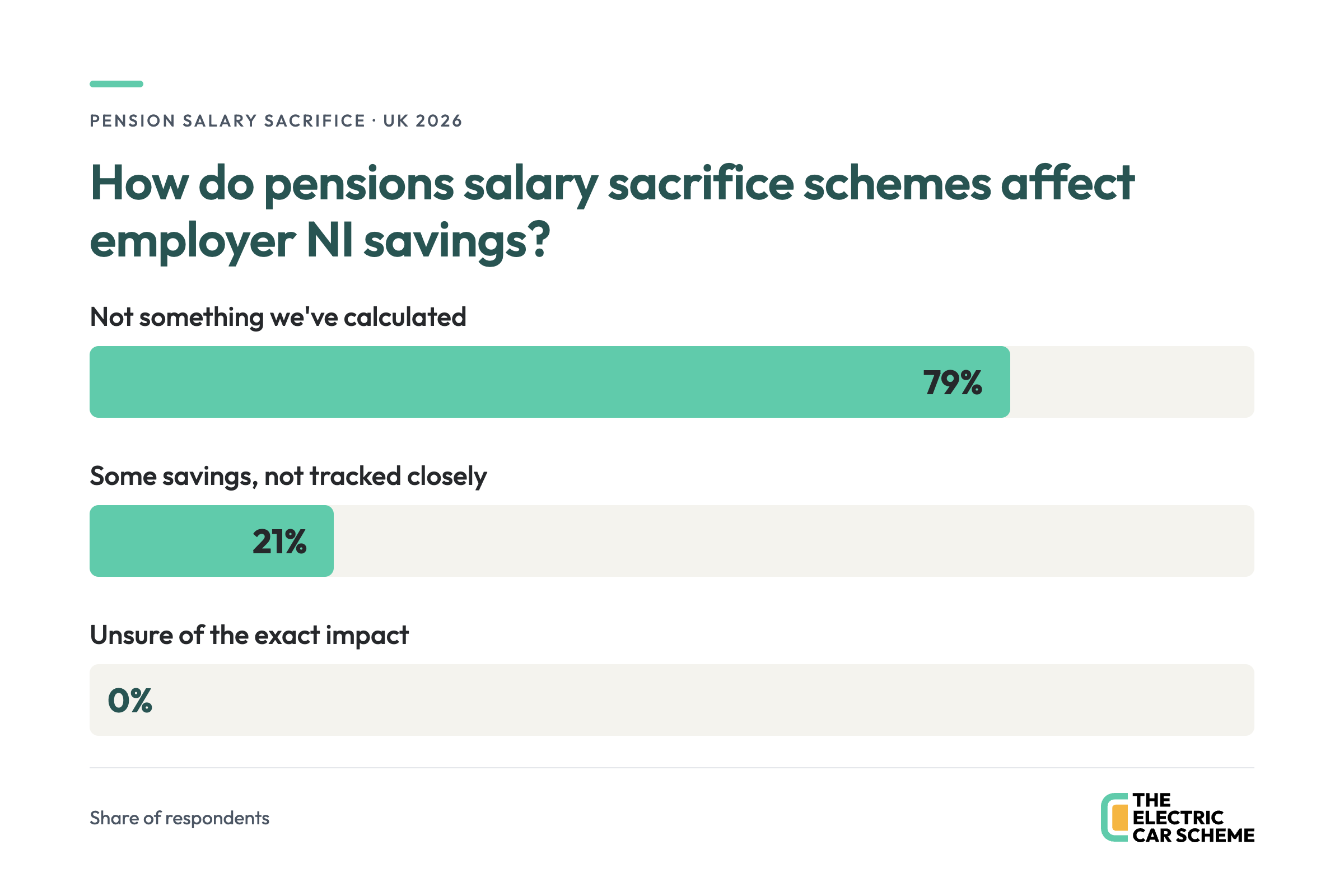
Following the pattern where most organisations don’t actively track detailed metrics, it’s unsurprising that 79% of people leaders haven't calculated employer National Insurance savings from pension salary sacrifice schemes. For many, these schemes run in the background, delivering automatic benefits without manual calculation.
The remaining 21% acknowledge there are some savings, though they’re not tracked closely, which ties in with the earlier finding that 99% don’t monitor specific data. Notably, 0% are unsure of the exact impact, suggesting that even without formal calculations, people understand these schemes generate value.
This confidence is well-founded. Under current rules, employers save in secondary Class 1 National Insurance contributions and the Apprenticeship Levy on every pound of salary sacrificed into pensions. These savings accrue automatically through payroll, which explains why so many businesses don’t feel the need to calculate them separately.
How often do people leaders review pension salary sacrifice schemes?
79% of people leaders review pension salary sacrifice schemes annually; however, 21% have never formally reviewed these schemes
Annual reviews are the only reviews:
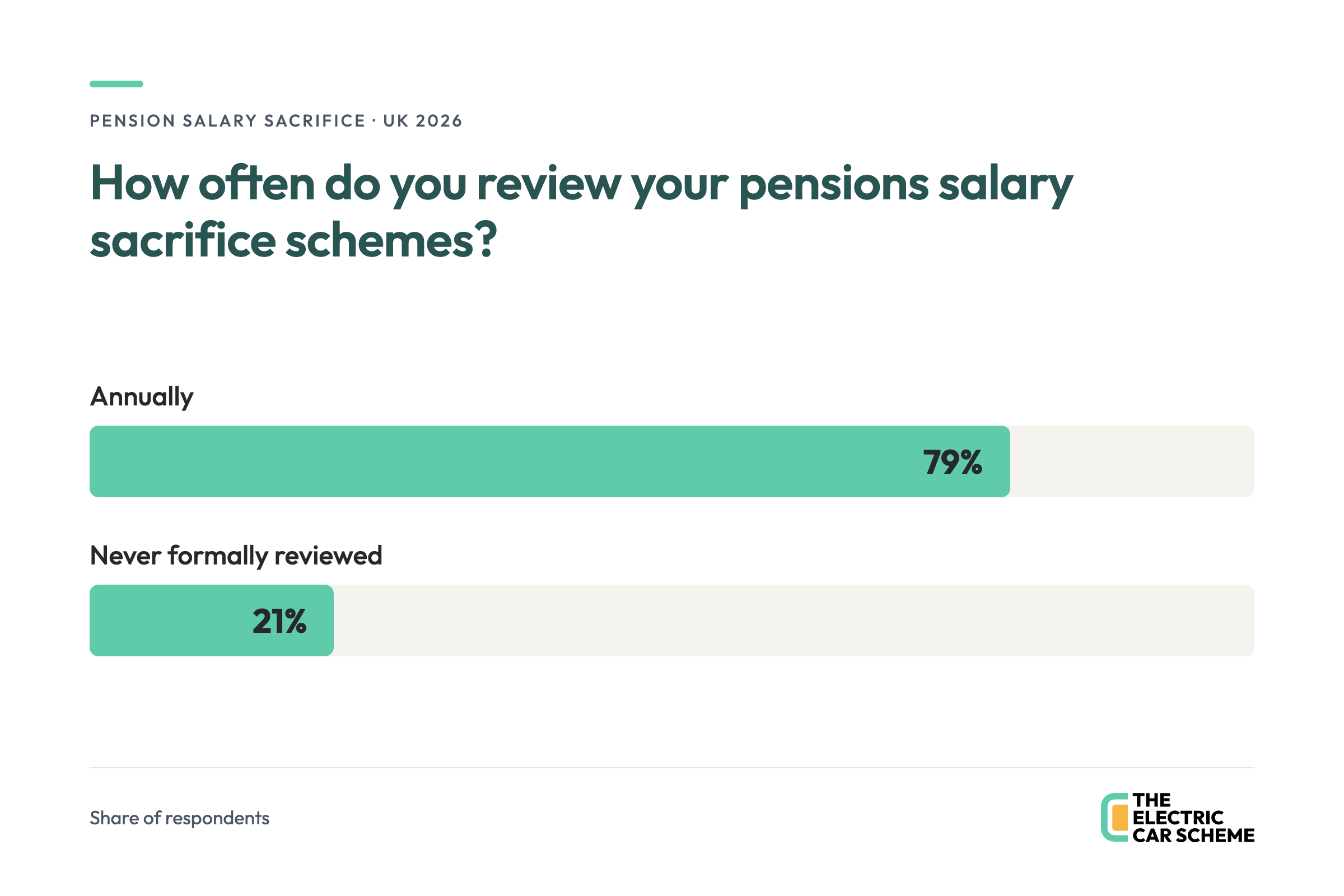
With most organisations not closely tracking the data behind pension salary sacrifice schemes, it follows that formal reviews happen relatively infrequently. Still, 79% of people leaders review these schemes annually, typically as part of broader benefits or payroll audits. This annual check-in allows people leaders and HR teams to confirm the arrangement remains compliant, cost-effective, and aligned with workforce needs without demanding constant attention.
The remaining 21% of our audience have never formally reviewed their schemes, emphasising the hands-off nature of salary sacrifice once it’s embedded in payroll systems. For many, the automatic National Insurance savings and streamlined administration mean there’s little perceived need for deeper scrutiny.
This relaxed approach works well under current rules, but the landscape is shifting. With reforms scheduled for three years’ time, organisations that have never reviewed their schemes may want to start paying closer attention. Annual reviews provide a natural opportunity to assess whether existing arrangements still deliver maximum value ahead of these changes. Even for the 21% who’ve never conducted a formal review, the upcoming reforms offer a timely reason to revisit how salary sacrifice fits into overall benefits strategy. Taking stock now ensures businesses can adapt smoothly and continue offering a scheme that supports both employee retirement goals and organisational cost efficiency.
How confident are staff in pension salary sacrifice schemes according to people leaders?
61% of people leaders have not assessed how confident their staff are on pension salary sacrifice schemes, while 28% agree their staff are somewhat confident but need more training, and 12% don’t think they are confident at all
Confidence rates show room for improvement:
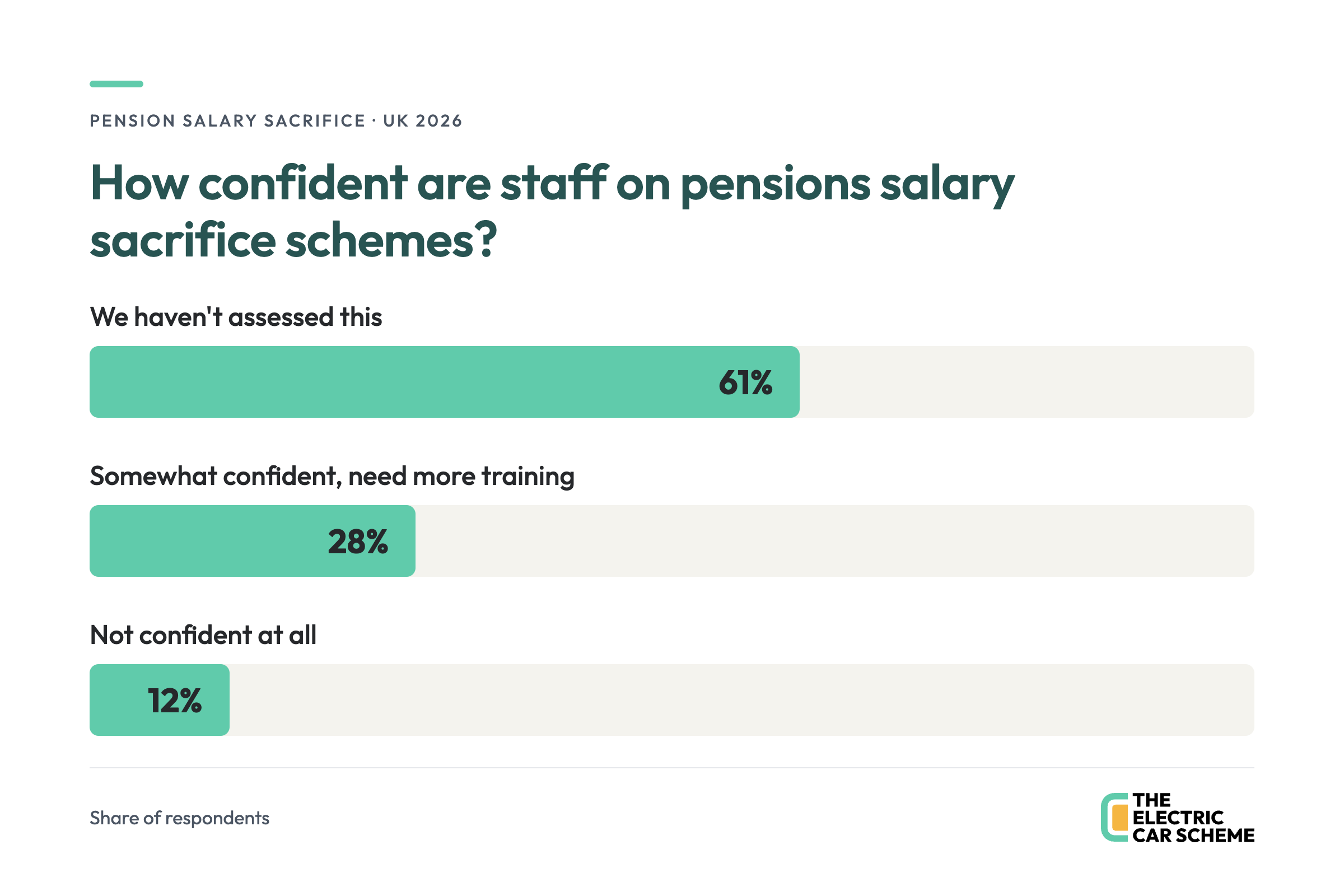
Given that most organisations review their pension salary sacrifice schemes only annually or not at all, it’s not unexpected that people leaders haven’t closely gauged staff confidence levels. 61% of our audience admit they haven’t assessed how confident employees feel about these schemes. This gap is important because understanding drives engagement. When people don’t grasp how salary sacrifice works, they’re less likely to participate fully or maximise their retirement savings.
The remaining responses reveal further room for improvement, with 28% of people leaders describing staff as somewhat confident but needing more training, and 12% saying employees are not confident at all.
This correlates with broader research showing that 50% of the UK workforce feels confused about pension tax relief and salary sacrifice, emphasising a widespread lack of clarity across organisations. For HR teams and people leaders, this is a clear opportunity to provide simple, accessible education that can boost confidence and participation without requiring complex overhauls.
How do high earners engage with pension salary sacrifice schemes according to people leaders?
100% of people leaders have not noticed how high earners engage with pension salary sacrifice schemes, and no-one mentions that higher earners are cautious due to tax allowance limits
High earners do not have any different interactions:
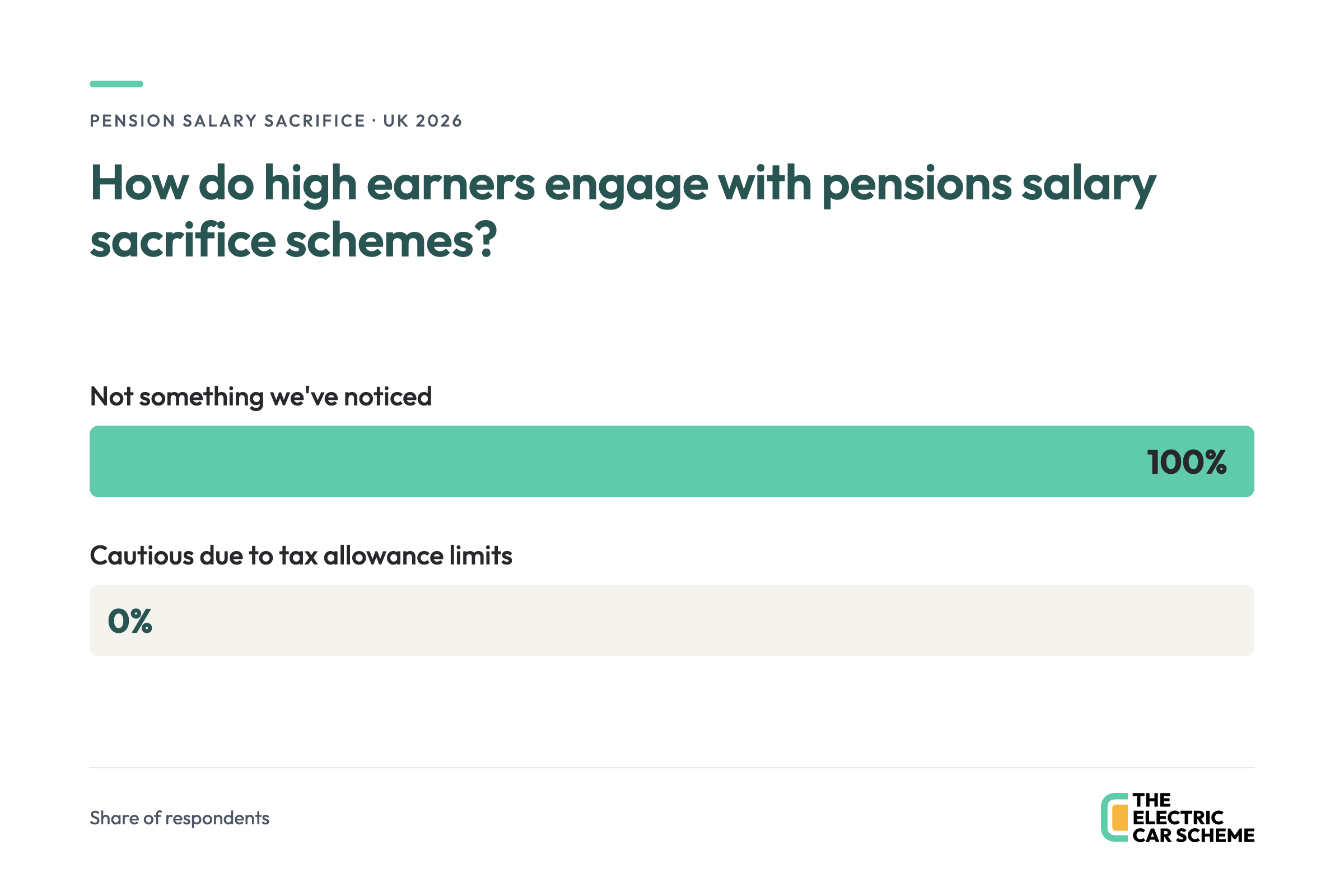
Following the pattern of people leaders not closely assessing staff confidence, it’s perhaps expected that none report noticing distinct engagement trends among high earners using pension salary sacrifice schemes.
100% of our audience haven’t noticed this, while 0% observe high earners being cautious because of tax allowance limits. This uniform response suggests that, in most organisations, salary sacrifice operates as a standard benefit available to all eligible employees without visible differentiation by income level. HR teams typically administer these schemes uniformly through payroll, meaning participation patterns among higher-paid staff don’t stand out as a separate concern.
The lack of observed caution likely stems from how salary sacrifice interacts with pension allowances. While high earners face tighter annual and lifetime allowance constraints, many still benefit from salary sacrifice because it reduces both employee and employer National Insurance contributions on the sacrificed amount.
Those approaching allowance limits may simply cap their contributions rather than avoid the scheme entirely. Additionally, with the upcoming 2029 reforms, even high earners will still receive meaningful relief on the first portion of their contributions.
This structure helps explain why people leaders don’t see pronounced hesitation. The scheme remains advantageous across income bands, and any individual adjustments happen quietly within personal financial planning rather than as a visible organisational trend.
What benefit pairs best with pension salary sacrifice schemes for people leaders?
For 90% of people leaders, cycle to work schemes are the benefits that pair best with pension salary sacrifice schemes, 9% think EV salary sacrificed schemes are the best match, and 1% consider health and dental cover schemes to be the perfect pension pairing
Cycling and pension schemes are the best complement:
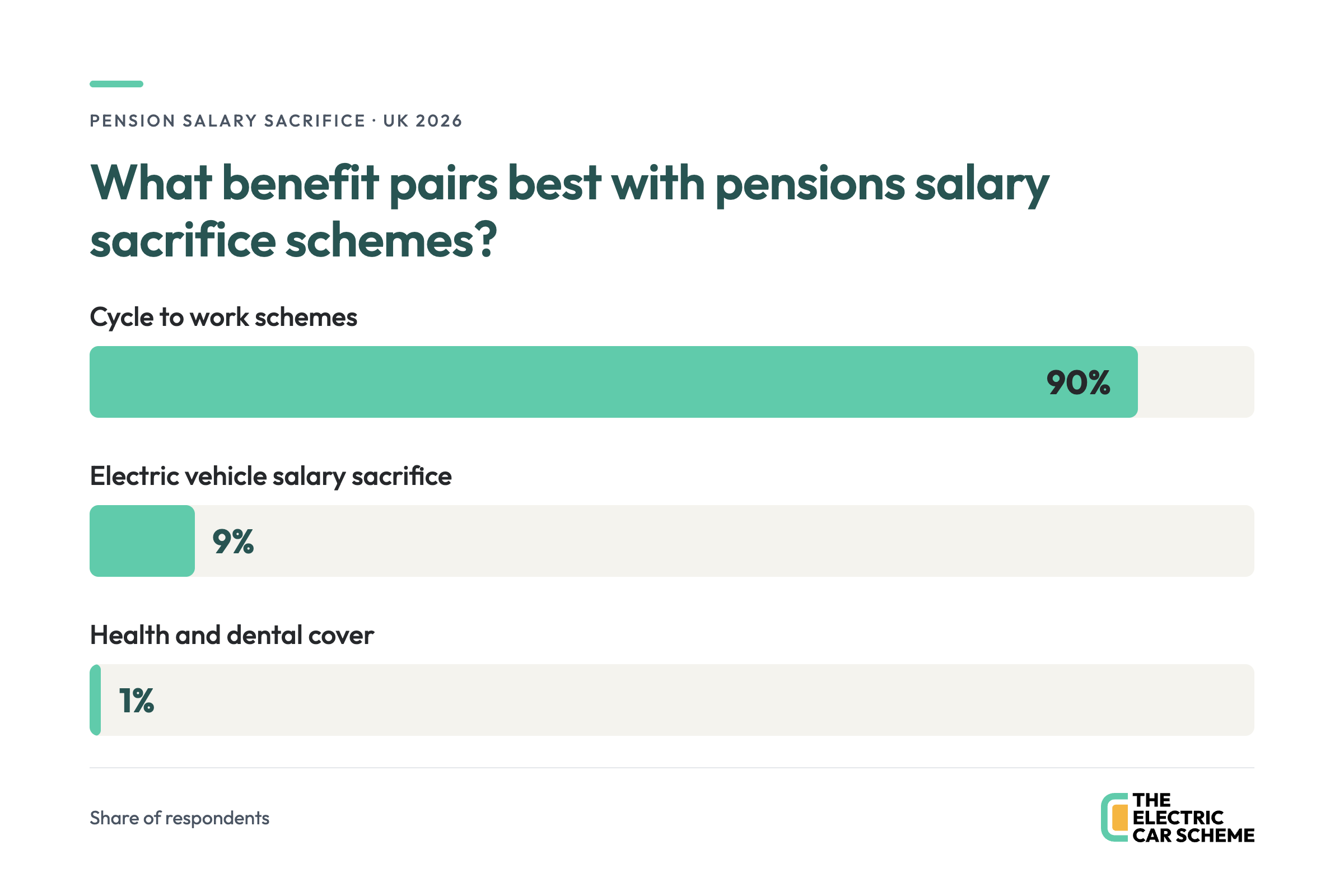
When considering which benefits complement pension salary sacrifice schemes, people leaders clearly prefer cycle-to-work schemes, with 90% identifying this as the best pairing. Both are salary sacrifice arrangements that reduce National Insurance contributions while offering employees tangible, everyday value.
The remaining responses show far less traction, with 9% favouring electric vehicle sacrifice and just 1% pointing to health and dental cover.
The dominance of cycle to work reveals its widespread adoption, straightforward administration, and appeal across income levels, making it a natural companion to pension schemes. Government research shows almost 70% of users participated once in a cycle to work scheme, while a third used the scheme multiple times over five years, often choosing different bicycle types rather than replacements.
Motivation splits evenly between saving money on a bicycle and spreading the cost, mirroring the logic behind pension salary sacrifice where employees gain immediate affordability while building long-term value.
How do pension salary sacrifice schemes interact with EV benefits?
81% of people leaders are unsure how pension salary sacrifice schemes interact with EV benefits, and 19% believe they are combined in one benefits conversation
Uncertainty remains about EV interaction:
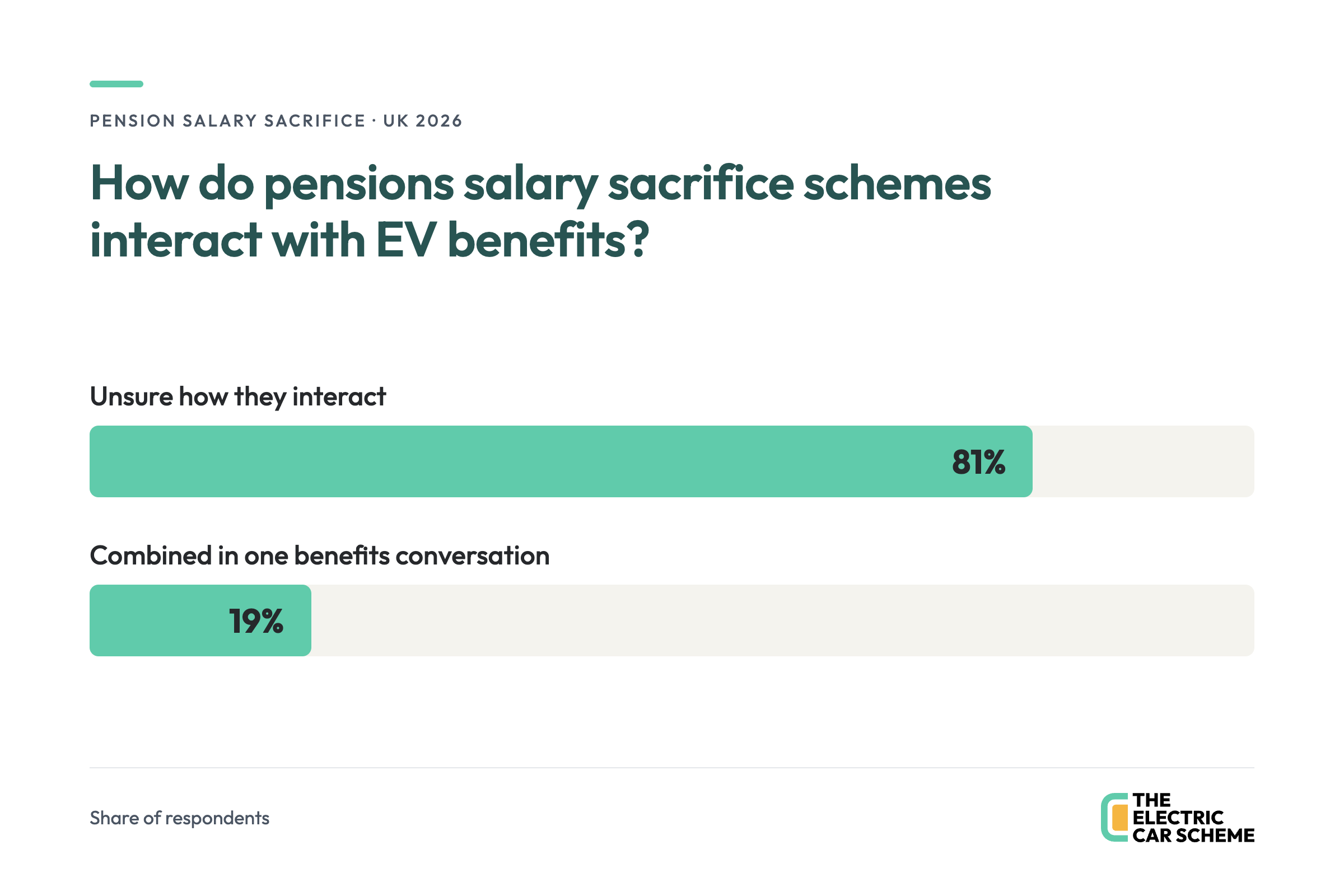
Despite the clear preference for pairing pension salary sacrifice with cycle-to-work schemes, electric vehicle benefits remain far less integrated into everyday benefits discussions. A substantial 81% of people leaders are unsure how pension salary sacrifice schemes interact with EV benefits, pointing to the relative novelty and complexity of electric vehicle sacrifice arrangements.
The remaining 19% report combining both in one benefits conversation, showing a more holistic approach to salary sacrifice offerings. This gap reveals an opportunity. As EV adoption grows and more employees consider greener commuting options, clarifying how these schemes work together could unlock greater participation and satisfaction.
Electric vehicle salary sacrifice operates on similar principles to pension schemes, allowing employees to give up part of their salary in exchange for a fully maintained EV while reducing National Insurance contributions.
When presented alongside pension options, employees can see the full range of tax-efficient benefits available, from retirement savings to sustainable transport. The FSB’s employee guide to EV salary sacrifice schemes explains how these arrangements deliver monthly savings and simplify budgeting for what would otherwise be a high upfront cost.
For people leaders and HR teams, bringing both into a single conversation helps employees make informed choices about maximising their take-home pay while supporting long-term financial and environmental goals.
How do people leaders benchmark pension salary sacrifice schemes externally?
99% of people leaders don’t benchmark pension savings schemes externally, while just 1% rely on provider benchmarking data
Benchmarking is not the norm:
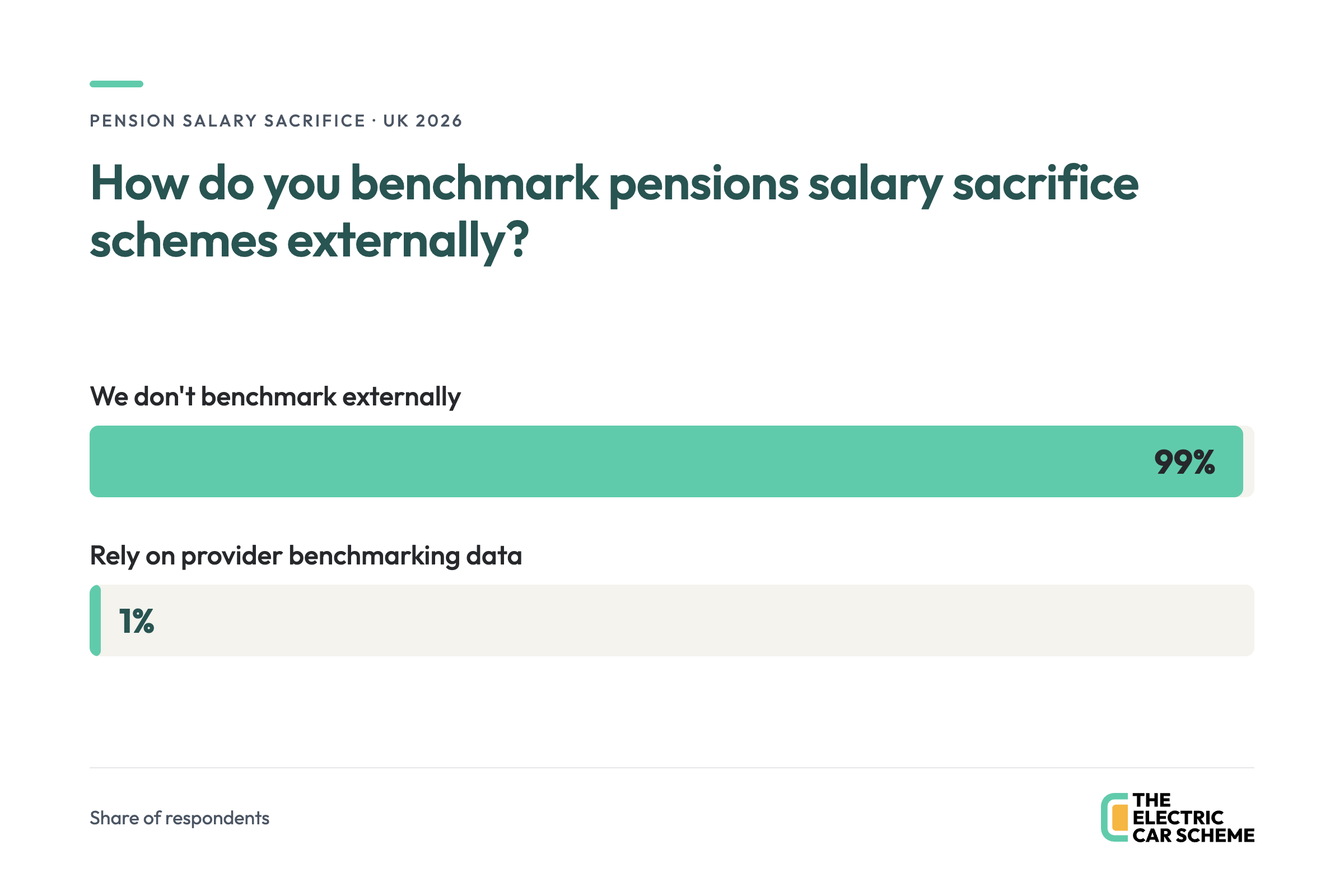
Because most organisations don’t track detailed metrics or conduct frequent formal reviews of their pension salary sacrifice schemes, external benchmarking is similarly rare. 99% of people leaders don’t benchmark externally at all, treating these schemes as standard offerings that require little comparative analysis.
The remaining 1% of our audience rely on provider benchmarking data, typically because they work with larger benefits platforms that supply market insights as part of their service. For the vast majority, however, the automatic National Insurance savings and straightforward payroll integration mean there’s little perceived need to measure their scheme against competitors or industry averages.
This hands-off approach shows the mature, commoditised nature of pension salary sacrifice in the UK. Unlike emerging benefits such as electric vehicle schemes, where uncertainty about interactions and best practice is common, pension salary sacrifice has well-established rules and predictable outcomes.
How transparent are providers on pension salary sacrifice schemes according to people leaders?
99% of people leaders agree that their provider on pension salary sacrifice schemes is somewhat transparent, while 1% are unsure of their provider’s transparency as they have never really tested it
Transparency is evident for most:
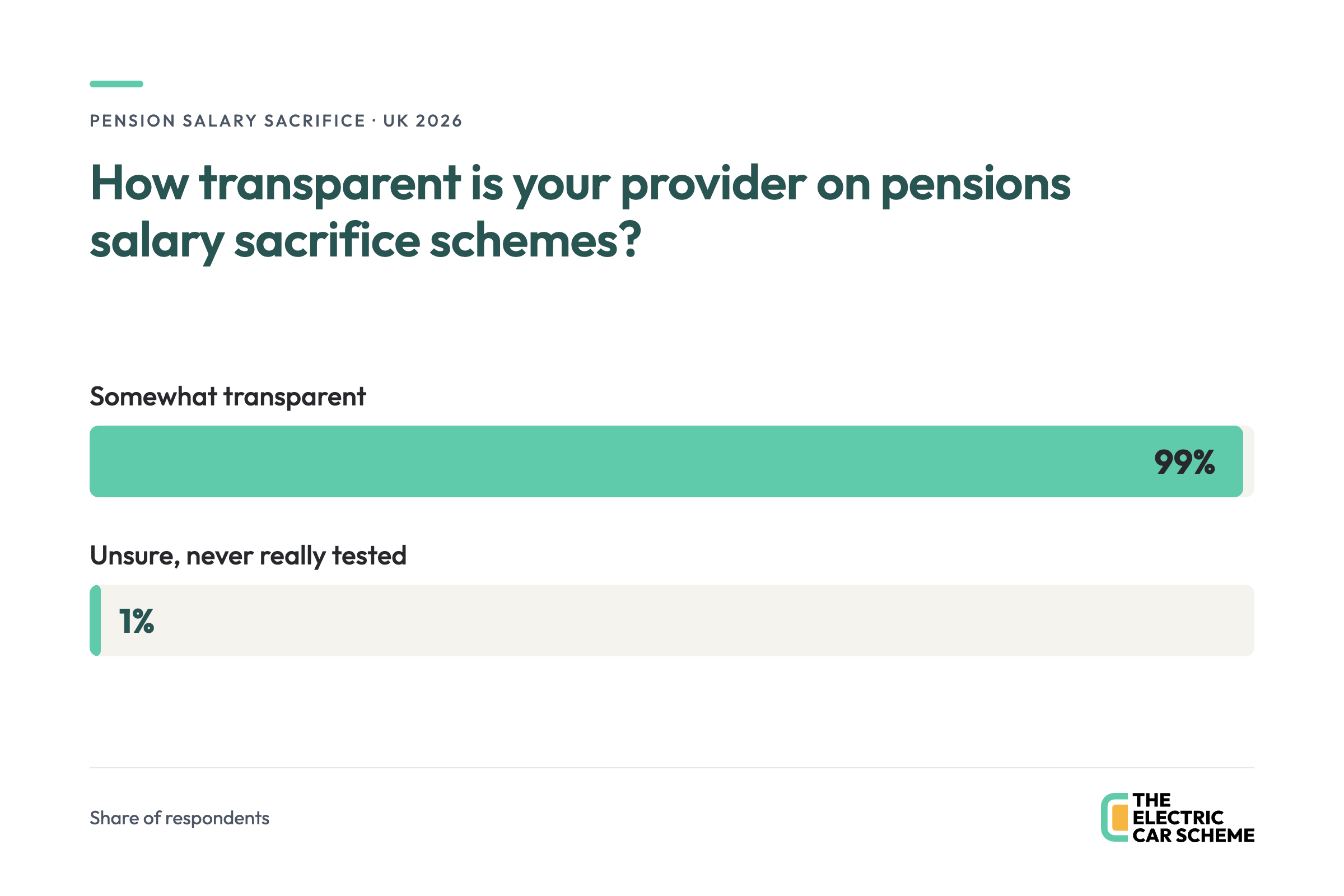
With external benchmarking virtually non-existent and most organisations taking a set-and-forget approach to pension salary sacrifice schemes, provider transparency becomes key to maintaining confidence. 99% of people leaders describe their providers as somewhat transparent, indicating that while information is available, it may not always be presented in the clearest or most accessible way.
This level of transparency is generally sufficient for day-to-day administration, especially since these schemes operate automatically through payroll with minimal intervention required from people leaders or HR teams. The remaining 1% of our audience admit they’re unsure and have never really tested provider transparency, likely because their schemes run smoothly without prompting deeper scrutiny.
This moderate transparency lines up with the broader pattern. Organisations accept pension salary sacrifice as a standard, low-maintenance benefit that delivers automatic National Insurance savings without demanding constant oversight. As long as providers supply the essential data needed for payroll processing and compliance, most people leaders feel adequately supported.
However, as the 2029 reforms approach and the £2000 NIC threshold reshapes how contributions are treated, even the 1% who’ve never questioned provider clarity may find it worth engaging more actively. Clearer communication from providers around upcoming changes could help organisations prepare, ensuring schemes continue to maximise savings for both employers and employees while remaining easy to administer.
What is people leaders’ biggest win from pension salary sacrifice schemes?
98% of people leaders have not identified a clear win from salary sacrifice schemes, but for 2%, lower employer NI costs is the biggest win
Big wins are debatable:
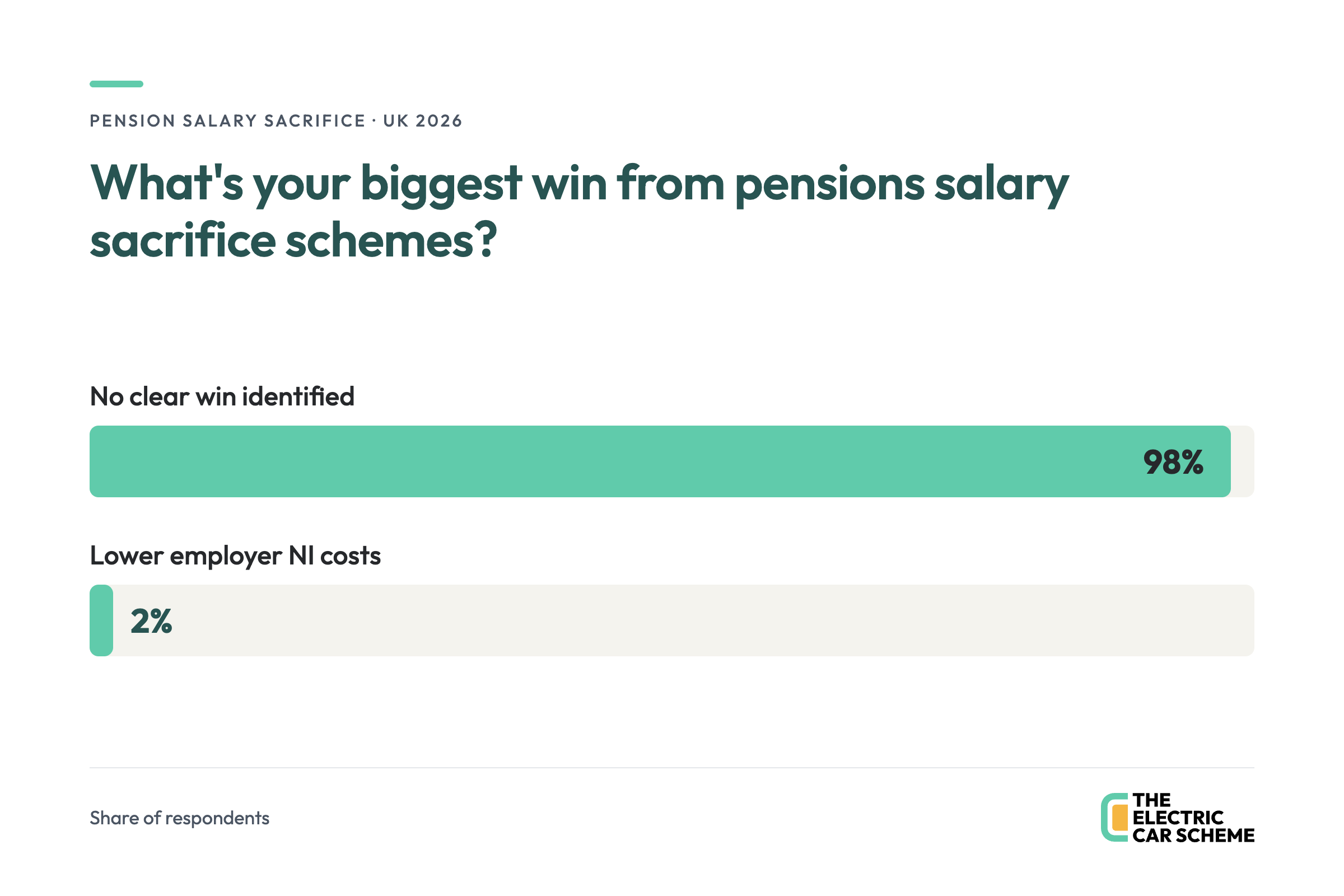
Despite the automatic financial advantages built into pension salary sacrifice schemes, most people leaders don’t point to a single standout benefit. 98% of our audience can't identify a clear win, indicating how these schemes often operate quietly in the background as standard payroll features rather than highlighted achievements.
The remaining 2% identify lower employer NI costs as their biggest win, which aligns with the core mechanic of salary sacrifice. By reducing taxable salary, employers save 15% in secondary Class 1 National Insurance contributions plus 0.5% Apprenticeship Levy on every pound sacrificed.
This modest recognition doesn’t diminish the real value delivered. The biggest win from a UK pension salary sacrifice scheme is saving on National Insurance Contributions for both employees and employers, alongside full Income Tax relief.
What is people leaders’ biggest concern with pension salary sacrifice schemes?
87% of people leaders' biggest concern with pension salary sacrifice schemes is the minimum wage compliance risk, and 13% worry most about employee misunderstanding
Wages and knowledge create concerns:
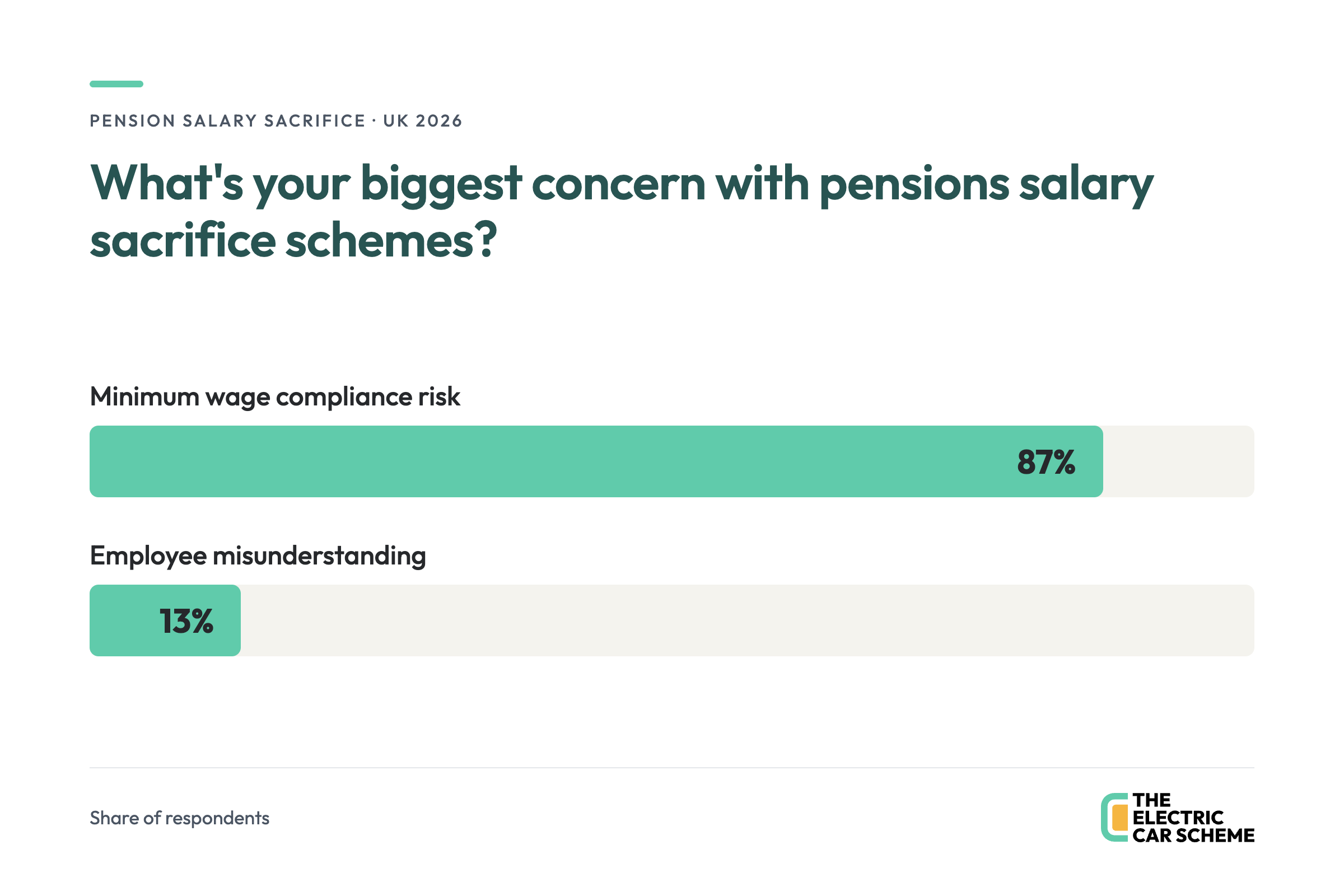
While most people leaders don’t identify a specific win from pension salary sacrifice schemes, they do hold clear views on potential risks. The dominant concern, cited by 87% of our audience, is minimum wage compliance risk.
This reflects a well-understood rule: to comply with the national minimum wage, an employee can’t sacrifice an amount that reduces their gross pay below the NMW.
For people leaders and HR teams, this means payroll systems must automatically check that post-sacrifice earnings stay above the legal threshold, particularly for lower-paid staff or those working variable hours. Getting this right protects both the organisation and employees from unintended breaches.
The remaining 13% of our audience point to employee misunderstanding as their biggest concern, which ties back to earlier data showing low staff confidence and widespread confusion about how salary sacrifice works. When people don’t fully grasp the mechanics, they may hesitate to participate, contribute less than optimal amounts, or make decisions based on incomplete information.
What’s the biggest myth about pension salary sacrifice schemes according to people leaders?
For 78% of people leaders, the biggest myth about pension salary sacrifice schemes is that they reduce state pension entitlement, and for 22%, it’s the myth that these schemes are only for high earners
Entitlement and earnings top the list:
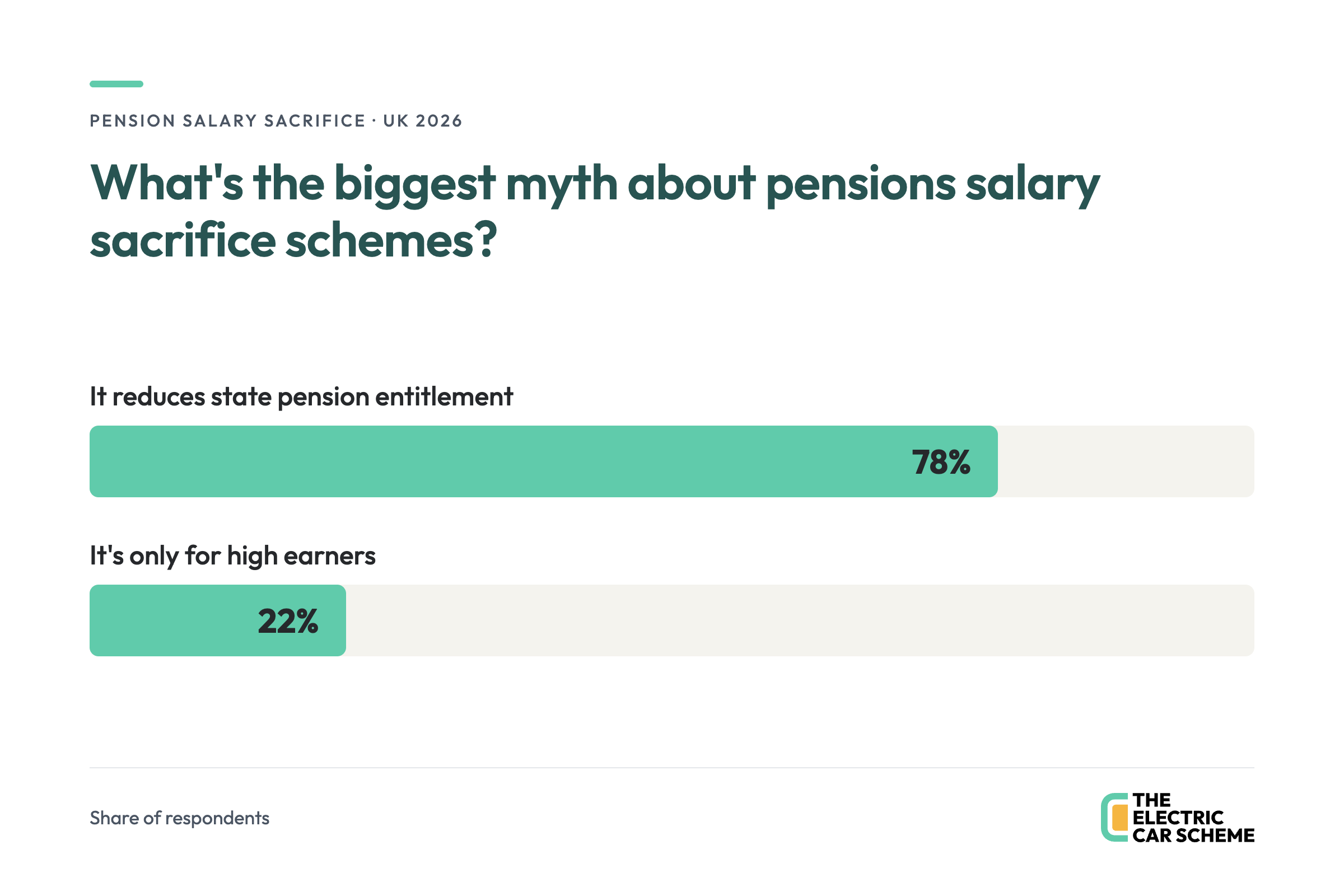
When it comes to misconceptions about pension salary sacrifice schemes, people leaders are clear on which myths cause the most confusion. The largest share, at 78%, is the belief that it reduces state pension entitlement.
This misunderstanding likely stems from the fact that salary sacrifice lowers reported earnings, which some assume affects National Insurance qualifying years. In reality, as long as employees earn above the Lower Earnings Limit and continue paying NI on their reduced salary, their state pension buildup remains unaffected.
The remaining 22% of people leaders identify the myth that salary sacrifice is only for high earners, which overlooks how the scheme benefits anyone eligible, regardless of income level, through automatic NI savings and tax relief.
Straightforward education can dispel both myths. Resources like REBA’s breakdown of salary sacrifice myths explain why these schemes remain a win-win across the workforce, not just for senior staff. For people leaders, clarifying that state pension rights are protected and that lower- and middle-earners gain meaningful NI reductions helps broaden participation.
What’s the biggest gap in pension salary sacrifice scheme guidance according to people leaders?
93% of people leaders cannot identify any gaps in pension salary sacrifice guidance, but 7% find that the government guidance is unclear
Small gaps emerge from the government side:
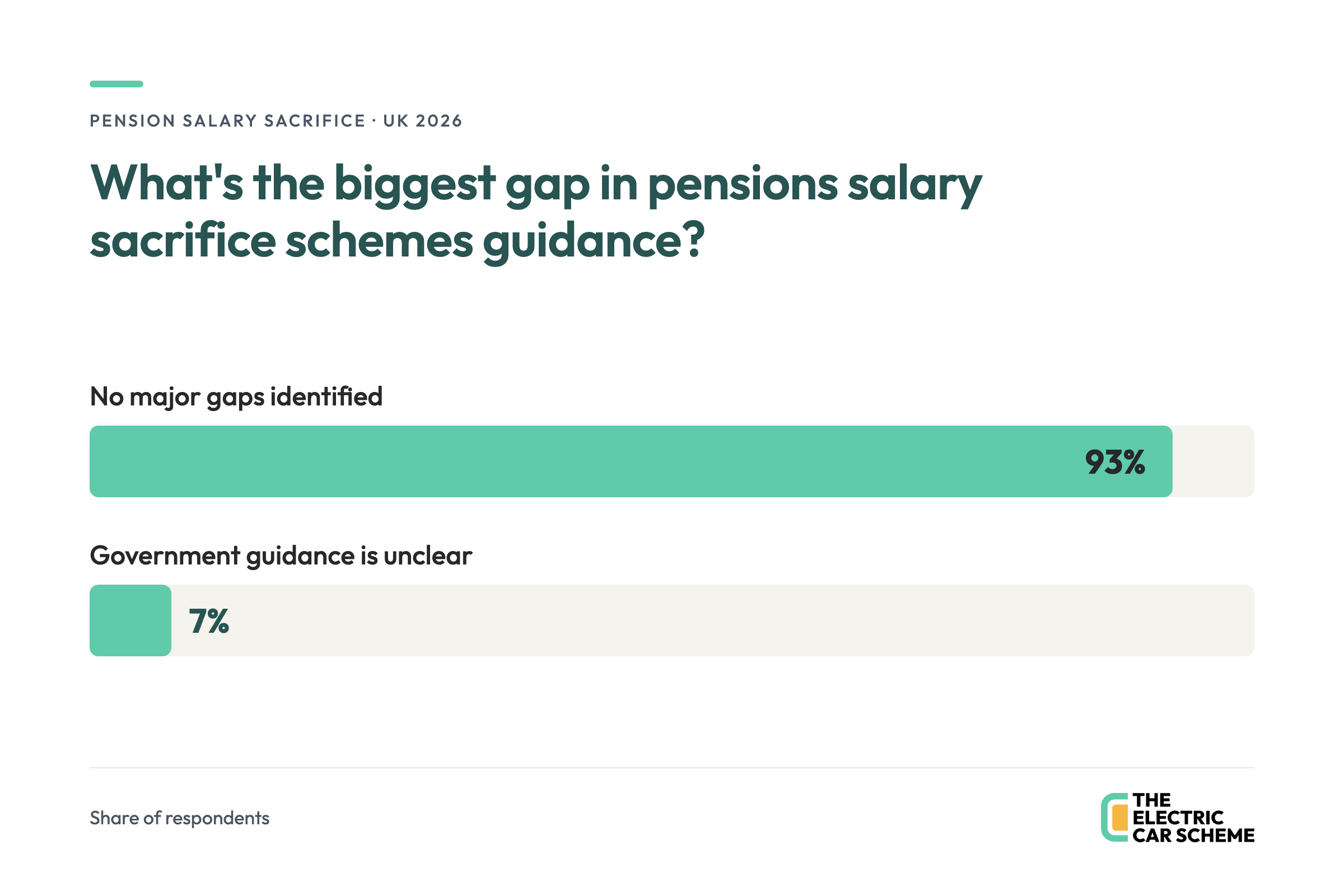
Following the pattern where most people leaders don’t identify clear wins or track detailed metrics, 93% say no major gaps exist in pension salary sacrifice scheme guidance. Clearly, for the vast majority of organisations, current resources from providers, payroll teams, and government sources are sufficient to administer these schemes confidently.
People leaders and HR teams typically rely on well-established processes that have run smoothly for years, so guidance feels adequate even if it isn't exhaustive. The remaining 7% of our audience point to government guidance being unclear, likely reflecting the complexity of tax and NI rules that can be challenging to navigate without specialist support.
This high satisfaction with existing guidance aligns with the broader theme: pension salary sacrifice is treated as a mature, low-maintenance benefit. As long as payroll systems handle compliance checks, such as ensuring post-sacrifice earnings stay above the national minimum wage, most organisations don’t feel the need for deeper or more detailed instruction.
As the 2029 reforms approach and the NIC threshold reshapes how contributions are treated, even the 7% who find government guidance unclear may benefit from updated, plain-language explanations. Clearer official resources around the upcoming changes could help all organisations prepare, ensuring schemes continue delivering maximum value while remaining straightforward to manage.
Employee awareness and scheme engagement
These findings clearly illustrate that pension salary sacrifice is a well-established workplace benefit that often operates with little day-to-day oversight from people leaders. But while the financial and administrative benefits are clear, organisations can still improve employee understanding, scheme reviews, and preparation for upcoming rule changes.
Are you an employer?
BOOK A DEMOAre you an employee?
SEE AVAILABLE CARSYou might also like…



Last updated: 14.10.2026
Information and prices provided are accurate at the time of release and may be subject to change. Our pricing is based on data collected from The Electric Car Scheme quote tool. All final pricing is inclusive of VAT. All prices above are based on the following lease terms; Using a flat payment profile, 10,000 miles pa, 36 months, and are inclusive of Maintenance and Breakdown Cover. The Electric Car Scheme’s terms and conditions apply. All deals are subject to credit approval and availability. All deals are subject to excess mileage and damage charges. Prices are calculated based on the following tax saving assumptions: England & Wales, 40% tax rate. The Electric Car Scheme Limited provides services for the administration of your salary sacrifice employee benefits. The Electric Car Scheme Holdings Limited is a member of the BVRLA (10608), is authorised and regulated by the FCA under FRN 968270, is an Appointed Representative of Marshall Management Services Ltd under FRN 667174, and is a credit broker and not a lender or insurance provider.
Copyright and Image Usage: All images used on this website are either licensed for commercial use or used with express permission from the copyright holders, in compliance with UK and EU copyright law. We are committed to respecting intellectual property rights and maintaining full compliance with applicable regulations. If you have any questions or concerns regarding image usage or copyright matters, please contact us at marketing@electriccarscheme.com, and we will address them promptly.
