
What Happens to Your EV Salary Sacrifice Car If Life Changes? A 2026/27 Guide

Image source: The Electric Car Scheme
The most common worry we hear from employees thinking about an EV salary sacrifice scheme is some version of the same question: what happens if life changes? You sign up to a three-year contract for a car you genuinely want, the household budget works on paper, and then a partner's job ends, a relationship breaks down, an illness arrives, or your own salary drops. The lease that fitted comfortably last summer suddenly does not. The fear, reasonably, is that you are stuck.
This guide answers that question honestly. It covers what the standard salary sacrifice contract has historically said about life changes, what changed on 28 April 2026 on agreements with The Electric Car Scheme, and what to check with your employer or provider before signing anything.
The honest version of how most EV salary sacrifice leases worked
A salary sacrifice scheme is a lease your employer takes out on your behalf, with the monthly payment deducted from your gross salary before Income Tax and National Insurance. That structure is what creates the tax saving, typically 20-50% versus leasing the same car personally. It is also what makes the lease term feel binding: the contract sits between your employer and a leasing company, and ending it early triggers an early termination fee that can reach 50% of the rentals you have not yet paid. On a £500-a-month, 36-month lease, that fee can be £6,000 or more if the lease ends in year one.
For most providers across the UK market, the way that fee is handled depends on why the lease is ending. Employer-side events such as redundancy, dismissal or long-term sickness are typically covered by some form of protection product after a delay, often three months from the start of the lease. Employee-side circumstances, the household-finance kind, have generally not been covered at all. If a partner lost their income, if a divorce came through, or if your own salary dropped, the early termination fee was your problem to absorb. That is the scenario that worries people, and it should.
What changed on 29 April 2026
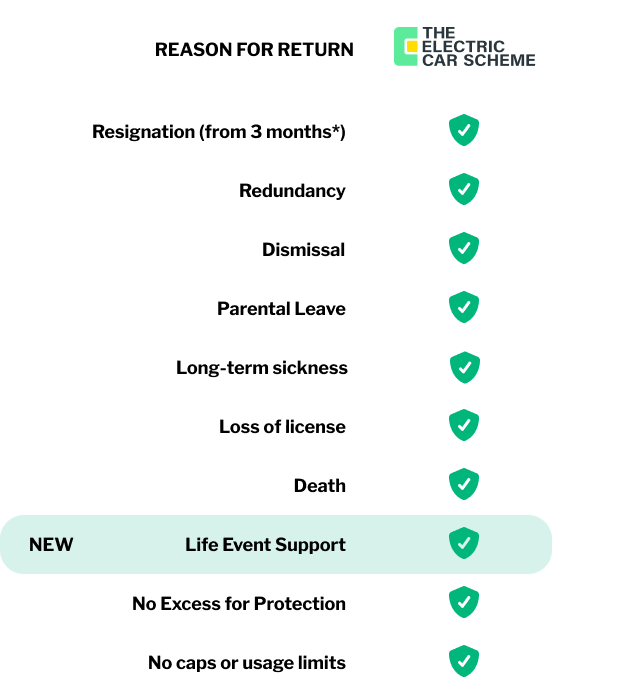
From today, on every new agreement with The Electric Car Scheme, you can return your car without paying an early termination fee if any of the following happens:
Your partner is made redundant, dismissed, or starts long-term sickness leave or family-friendly leave (parental, carer's, adoption, surrogacy or shared parental).
Your partner dies.
You go through a divorce or the legal end of a civil partnership.
Your salary, or your partner's salary, is involuntarily cut by 20% or more.
You are transferred abroad by your employer.
This is called Employee Life Event Support. It sits on top of Complete Employer Protection from Day 1, which has always covered the standard list of employer-side events, including your own redundancy, dismissal, resignation, long-term sickness, parental leave, loss of licence and death, with no excess and no exclusion period. The protection runs from the moment your car is on the driveway, on every Electric Car Scheme agreement, with no additional cost to you or your employer.
The shorthand version, if you are thinking about signing up: if life changes, on either side of the household, in a way that materially affects the affordability of the lease, you can hand the car back without a five-figure penalty.
How returning the car actually works in practice
If a covered life event occurs, the process is straightforward and runs through your employer's HR or benefits team. You contact them, they raise the early return with The Electric Car Scheme, and we coordinate the collection of the car. The early termination fee is absorbed under the protection product. You receive the standard end-of-lease admin (mileage check, vehicle inspection, condition report) but you are not asked to find a lump-sum penalty payment. Your salary returns to its previous gross level the month after the car is returned, and the next Benefit-in-Kind reporting cycle reflects the change.
What we ask, in return, is some evidence of the qualifying event. For redundancy or dismissal, that is the relevant employer letter or settlement agreement. For divorce, the decree absolute or final order. For long-term sickness, a fit note covering the relevant period. For an intra-company transfer abroad, the confirmation letter from HR. The criteria are documented up front, so you know in advance what counts.
Why this matters more than it looks like it might

Life events of the kind covered are not statistical curiosities. ONS recorded 102,678 divorces granted in England and Wales in 2023 alone. Long-term sickness peaked at 2.82 million economically inactive adults in early 2024. The UK redundancy rate climbed to 5.3 per 1,000 employees in late 2025. Legal & General research found that almost half of divorcees see their household income fall by 31%. Across a working life, the chance of running into at least one of these events while on a salary sacrifice lease is higher than most people expect.
The financial impact is not small either. An early termination fee on a £500-a-month, 36-month lease lands at around £6,000 if the lease ends 12 months in. On a higher-value vehicle, it scales up. Without protection, that is the kind of bill that arrives at the moment a household is least equipped to absorb it. Removing that risk is the difference between a scheme that works for "life as planned" and a scheme that works for life as it actually happens.
What is and is not covered
Honesty is the right default here. Employee Life Event Support covers the events listed above. It does not, on its own, cover a voluntary salary reduction (for example, choosing a lower-paid role for non-financial reasons), a discretionary lifestyle change such as buying a house and finding the lease less convenient, or a decision to switch to a different car mid-lease for cosmetic reasons. The product is built around involuntary life changes that materially affect affordability, not around buyer's remorse.
For employer-side events, including your own resignation or end of employment for any reason, Complete Employer Protection handles the early termination on the employer's side. You hand the car back; your employer is covered. From your side, the lease ends without a penalty for the events covered.
Some life events sit outside both products. A serious financial event that does not match the criteria, for example a voluntary career break, a business failure for a self-employed partner who was not in PAYE employment, or an unexpected dependency cost not tied to redundancy, sickness or divorce, may need a conversation with your employer's HR team rather than an automatic exit under the protection product. Where this matters most, it is worth checking the specifics with your HR team before you sign.
How this compares to other UK schemes
Most UK EV salary sacrifice providers operate a 3-month exclusion window on employer protection. None currently offer a comparable Employee Life Event Support product covering partner-side circumstances and household income changes. That is the gap The Electric Car Scheme has filled. For a fuller side-by-side, our Tusker vs Octopus vs The Electric Car Scheme comparison covers the protection terms across the most commonly shortlisted providers.
If your employer already runs a salary sacrifice scheme with a different provider, the simple check is to ask what happens on each of the events listed above. If the answer is "the early termination fee would apply", you have the information you need to weigh the risk. If you are choosing a scheme as part of a new role, the same questions are reasonable to ask at offer stage.

What you can save while you have the car
The protection upgrade does not change the underlying tax mechanics. With pure-EV BiK at 4% for 2026/27, a UK salary sacrifice scheme typically saves 20-50% compared with a personal lease. A 40% taxpayer running a typical mid-range EV at around £584 a month including VAT can see net monthly cost closer to £393 after tax savings, around £191 a month less than a personal lease on the same car. To check your figure on a specific car, run the salary sacrifice calculator. Be wary of any provider quoting a 60% saving in the headline; that figure typically folds employer National Insurance savings into the employee number, which is not money you receive.
The Electric Car Scheme also runs The Charge Scheme, which extends salary sacrifice to home, workplace and public charging across all networks. Depending on your usage and tax position, that adds around £500-£1,000 a year of additional saving on top of the saving on the car. It is not tied to any specific energy supplier, so it works whichever home tariff you have.
Bottom line
The fear of being locked into a lease when life takes a turn is the most common reason employees hesitate over EV salary sacrifice. From 29 April 2026, on every Electric Car Scheme agreement, that scenario is materially different. Day 1 employer protection covers the events that arise from your job. Employee Life Event Support covers the events that arise from your household. If a divorce, a partner's redundancy, long-term sickness, an intra-company transfer abroad or an involuntary salary cut of 20% or more lands during your lease, you can return the car without a penalty.
To run the numbers on a specific car for your circumstances, calculate your savings or talk to your HR team about whether your employer offers The Electric Car Scheme. If you want a more detailed walkthrough of how the scheme works end-to-end, our guide to employee tax savings on electric car schemes covers the mechanics in plain English.
Are you an employer?
BOOK A DEMOAre you an employee?
SEE AVAILABLE CARSYou might also like…




ECS GUIDES AND ADVICE
Ready to Go Electric? Your Guides and Tools to a Smooth Switch
-
 How the Scheme Works
Find out how salary sacrifice can work for you or your business.
-
 The Charge Scheme
Save 20-50% on all charging costs through salary sacrifice - at home, the office, or in public..
-
 Complete Employer Protection
All employers and drivers are protected from day 1.
-
 Used Electric Cars
Discover the most affordable way to drive electric. Cars delivered in 14 days.
Last updated: 29/04/2026
Our pricing is based on data collected from The Electric Car Scheme quote tool. All final pricing is inclusive of VAT. All prices above are based on the following lease terms; 10,000 miles pa, 36 months, and are inclusive of Maintenance and Breakdown Cover. The Electric Car Scheme's terms and conditions apply. All deals are subject to credit approval and availability. All deals are subject to excess mileage and damage charges. Prices are calculated based on the following tax saving assumptions; England & Wales, 40% tax rate. The above prices were calculated using a flat payment profile. The Electric Car Scheme Limited provides services for the administration of your salary sacrifice employee benefits. The Electric Car Scheme Holdings Limited is a member of the BVRLA (10608), is authorised and regulated by the FCA under FRN 968270, is an Appointed Representative of Marshall Management Services Ltd under FRN 667174, and is a credit broker and not a lender or insurance provider.
Copyright and Image Usage: All images used on this website are either licensed for commercial use or used with express permission from the copyright holders, in compliance with UK and EU copyright law. We are committed to respecting intellectual property rights and maintaining full compliance with applicable regulations. If you have any questions or concerns regarding image usage or copyright matters, please contact us at marketing@electriccarscheme.com and we will address them promptly.
