
Salary Sacrifice Car Scheme: Save on Your Next Car
A salary sacrifice car scheme is an HMRC-approved arrangement that lets you lease a brand-new car through your employer by giving up a portion of your gross (pre-tax) salary in exchange.
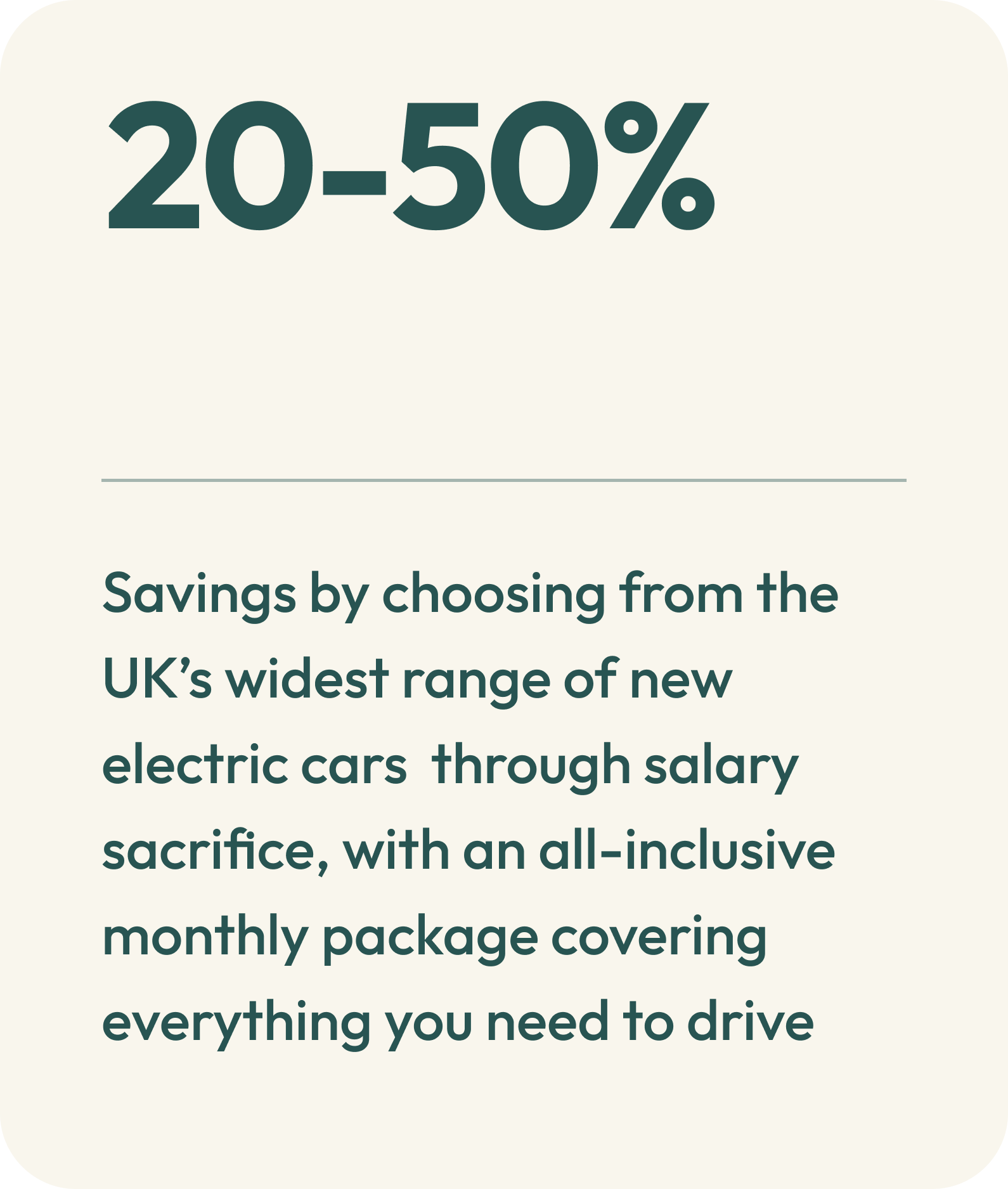
Because the lease cost is taken from your pay before Income Tax and National Insurance are calculated, your overall tax bill drops — and on a fully electric car, where Benefit-in-Kind tax sits at just 4% for the 2026/27 tax year, the combined saving can reach 20–50% versus leasing privately.
✓ Complete Employer Protection
✓ Trusted 5 Star Service
✓ Best Prices Available
How Car Salary Sacrifice Works
Usually, when a lease ends, the car goes back to the leasing company and is often sold at an auction. However, we wanted to do things differently. With our car salary sacrifice scheme, vehicles that reach the end of their lease, or are returned early, are reconditioned and offered to our members at a discounted price.
Whether you choose a used or new car, the process will be the same. Our car scheme will provide the same package, support and service to you and your company. If you're unfamiliar with salary sacrifice and want to understand how it can benefit your business, we suggest checking out our ‘How it Works’ page here.
Why Salary Sacrifice a Car?
Benefits for Employers
Benefits for Employees
Best Prices Available
You’ll access top leasing companies for the best prices, with everything bundled into a simple, all-inclusive, cost-effective package.
Quick Delivery and Wide Range of Cars
Every car listed on our website is ready for quick delivery. Say goodbye to long lead times. You can get a car on your driveway within 14 days of the order!
Trusted 5 Star Service
Serving thousands of customers and rated “Excellent – 5 stars” on Trustpilot, you can rest assured that you are in good hands.
No cost
Car Salary Sacrifice should be affordable for all. There is no net cost to your business to run the scheme.
Straightforward Reporting
Simple to use reporting to make life easy for HR and Finance teams.
Complete Employer Protection
We provide market-leading protection from day 1, to safeguard you from unexpected costs if your car needs to be returned early.
Employers Are Now Fully Protected From Day 1
Complete Employer Protection lets employers help their employees get cars without the worry of facing major financial risks if those employees leave while they're still leasing the vehicle.
No exclusion periods for employers, no excess to pay, no underpayment for maternity, plus protection if your employee doesn’t pay for fees or damage.
Latest Articles From Our Blog
Our blog provides readers with comprehensive information about our Salary Sacrifice Car Scheme, including its benefits, challenges. We cover a range of topics, from the technology behind cars and how they work, to the different models available on the market. Whether you're a seasoned driver, or thinking of getting behind the wheel, this blog is the perfect resource for you.
Trusted By Companies Just Like Yours
Ready to go Ahead with Our Car Scheme?
I’m An Employer
Launch Our Car Scheme with confidence knowing you're getting the best prices, first-rate protection, and a trusted 5* service for you and your team.
I’m An Employee
Salary sacrifice allows you to save between 20-50% on any electric car of your choice. Now is the time to start your personal journey to Net Zero.
Frequently asked questions
-
For most UK employees, yes — and the savings are bigger than people expect. With The Electric Car Scheme, your monthly payment is deducted from your gross salary before Income Tax and National Insurance, and you pay a very low Benefit-in-Kind (BiK) tax on the car: just 4% in 2026/27, rising to 5% in 2027/28 and 7% in 2028/29. The net result is a saving of 20–50% on the lease cost compared with leasing the same car privately.
The maths works best when three things line up:
You're a higher-rate (40%) or additional-rate (45%) taxpayer — bigger income-tax savings
You pick an electric or plug-in hybrid car — they get the lowest BiK rates
You'll keep the car for the full term (2–4 years)
Where it's less worth it: if you're earning close to the National Minimum Wage (deductions can't push you below it), if you'd choose a petrol or diesel car where BiK can climb to 37%, or if you're likely to leave the company very early in the term. We address that last point separately below.
Run the numbers on our EV salary sacrifice calculator — it gives you a personalised savings figure in seconds.
-
Honest answer: there are three real trade-offs to weigh up.
1. Your gross salary is reduced. Because the lease cost comes out before tax, your contractual gross pay drops by the sacrifice amount. That can affect:
Mortgage affordability — some lenders base borrowing on your reduced gross salary, others use the notional (pre-sacrifice) figure. Worth checking with your lender before signing
Statutory benefits — Statutory Maternity Pay, Statutory Sick Pay, and the State Pension are calculated on your reduced earnings, so the figures will be slightly lower
Pension contributions — depends on how your employer structures the scheme; many employers calculate workplace pension on the pre-sacrifice salary so you're unaffected, but confirm with HR
2. You're committed for the term. Salary sacrifice is a contractual change to your employment, not a casual perk you can cancel. Most leases are 24, 36, or 48 months.
3. Early termination usually costs money. If you leave the job, are made redundant, or want to hand the car back early, traditional schemes charge an early-termination fee that can run into thousands of pounds.
How we handle the last one: every car leased through The Electric Car Scheme comes with Complete Employer Protection. If your circumstances change — redundancy, resignation, long-term sickness, or family-friendly leave — we cover the early-termination liability. No surprise bills for you or your employer.
-
It's straightforward — four steps from sign-up to driving away:
Your employer joins the scheme. Sign-up is free and takes about 30 minutes — no setup fees, no minimum employee count. Your HR or finance team can sign up directly via our employer page.
You pick your car. Choose from any electric or plug-in hybrid car in our range — new, ex-demo, or used. We typically deliver within 14 days from a stocked car, longer for factory orders.
We sort the paperwork. A short Employment Contract Amendment Agreement formalises the salary sacrifice. We handle the lease, insurance, and admin — your employer just needs to add the monthly figure to payroll.
You drive — we cover everything. Your monthly amount comes out of your gross salary before tax. It covers the lease, fully comprehensive insurance, road tax, servicing, MOT, breakdown cover, and replacement tyres. No upfront deposit, no credit check.
-
The £40,000 rule is the Vehicle Excise Duty (VED) Expensive Car Supplement — and it's worth understanding before you pick your car.
If a vehicle's list price (the manufacturer's recommended retail price including VAT and any factory options, before discount) is over £40,000, HMRC adds an extra annual supplement to the road tax in years 2 through 6 of the car's registration. For 2025/26, that supplement is £425 per year. It applies to any fuel type — and from April 2025, that includes electric vehicles, which had previously been exempt.
A few things to know about how this works under salary sacrifice:
It's not the same as Benefit-in-Kind tax. BiK is calculated on the car's P11D value and your tax band; the £40k VED supplement is on top of that, paid separately to HMRC by the lessor
It's bundled into your monthly cost. Under The Electric Car Scheme, road tax (including the supplement, where it applies) is included in the all-inclusive monthly figure. No surprise bills — you see the total cost upfront when you get your quote
You can avoid it by choosing a car under £40k. Many of our most popular EVs — MG4, Kia Niro EV, Cupra Born, Renault 5, Vauxhall Mokka Electric — are well under the threshold, and several qualify for the new £3,750 Electric Car Grant that drops their list price further
-
If you resign during your lease, you may incur an Early Termination Fee, which depends on your contract length and time elapsed. If you have Enhanced Resignation Protection, you may not be liable for this fee.
What is an Early Returns Fee?
This fee, typically 50% of the remaining lease cost, is charged by the lessor when returning the car. Additional costs for excess mileage, damage, or missing items may apply.The Enhanced Protection Service:
Enhanced Protection Service will generally cover you in cases where you resign from your role midway through your lease and we will cover the fee. If you don’t have Enhanced Protection Service in place, you may not be covered in any resignation cases, and therefore you are liable for the early termination fee.How long do I have to have had my car before I am covered by your protection?
You can see in the table in your Employee Contract Amendment Agreement how long you have had to have had the car for before you are covered. If you resign within that time, even with Enhanced Protection Service, you may not be covered in the case of resignation. If you resign outside of that time with Enhanced Protection Service in place, you will be covered by this protection and not have to pay the Early Returns Fee.For more information on early returns - see our guide!
-
The Electric Car Scheme is exactly that — electric (and plug-in hybrid) cars only. We've made that choice deliberately, because the salary-sacrifice maths is dramatically better for low-emission vehicles than it is for petrol or diesel.
The reason is Benefit-in-Kind (BiK) tax. When you take a car through salary sacrifice you save on Income Tax and National Insurance — but you also pay a small annual tax on the value of the car as a workplace benefit. The BiK rate depends on the vehicle's emissions - but it is currently 4% for Battery Electric vehicles.
On a £35,000 car, that's roughly £35–£50 a year of BiK for an EV versus £1,500–£3,000 a year for a petrol equivalent. The higher BiK on petrol/diesel typically wipes out the income-tax savings — at which point salary sacrifice isn't worth it.
If you'd specifically like a hybrid, our hybrid salary sacrifice page walks through which models still make financial sense. For petrol or diesel, you'd be better off looking at a personal lease or a traditional car allowance.