
Implementing EV Salary Sacrifice Schemes Statistics: UK 2026
Employee benefits are playing an increasingly important role in attracting and retaining talent, with organisations looking for options that deliver value for both their workforce and the business. EV salary sacrifice schemes have emerged as one way to support employees while advancing broader sustainability and financial objectives.
To find out what 541,040 opinions of people leaders in the UK were about implementing EV salary sacrifice schemes, we utilised AI-driven audience profiling to synthesise insights from online discussions over 12 months, ending on the 7th July 2026, to a high statistical confidence level. These findings explore levels of awareness, implementation priorities, perceived barriers, confidence, and decision-making, providing a detailed picture of how businesses are evaluating EV salary sacrifice schemes as part of their employee benefits strategy.
Index
27% of people leaders are very familiar with EV salary sacrifice schemes as they already have one, 28% are somewhat familiar with these schemes and are researching their options, 31% are aware of them but not yet exploring them, and 15% are not familiar with EV salary sacrifice schemes at all
For 50% of people leaders, implementing an EV salary sacrifice scheme is confusing, and 20% think it’s very confusing, but 11% find the implementation somewhat clear, while 19% agree it’s very clear
Implementing EV salary sacrifice schemes is somewhat popular among 30% of people leaders, and it’s very popular with 12%, while 11% have a low interest, and 42% have no interest in EV salary sacrifice schemes yet
Implementing EV salary sacrifice schemes is highly valued by 31% of people leaders, somewhat valued by 25%, and rarely mentioned by 25%, while 19% don’t put any value in these schemes
Implementing EV salary sacrifice schemes is a top priority for 20% of people leaders, it’s a medium priority for 29%, but a low priority for 30%, and not a priority for 21%
Implementing an EV salary sacrifice scheme is a core part of 39% of people leaders’ benefits offering, and it’s a standalone green or sustainability initiative for 4%; however, it's still only considered but not formalised for 38%, and 19% have a pilot scheme that is not yet embedded in their wider benefits strategy
Employee retention and satisfaction are the primary drivers behind implementing an EV salary sacrifice scheme for 37% of people leaders, 27% are driven by the cost-effective benefit offering, 15% by employee demand or requests, and 12% by competitor benchmarking, while ESG or sustainability commitments are the main drivers for 8%
A lack of budget is the biggest barrier preventing 25% of people leaders from implementing an EV salary sacrifice scheme at their company, 22% are hindered by uncertainty around tax or NI rules, 12% have concerns about affordability for lower earners, and 7% cite limited internal knowledge as a stumbling block, while 33% have no barriers to implementation as a scheme is not currently a priority
While 40% of people leaders are not confident at all in explaining the tax and NI savings of implementing a salary sacrifice scheme, and 22% are not very confident, 24% are fairly confident, and 13% are very much so
25% of people leaders feel that implementing EV salary sacrifice schemes is fair for all earners, but 18% think it’s not fair for lower earners, 25% agree it’s mostly fair, and 32% ar ensure whether the implementation is fair or not
33% of people leaders see a clear ROI from implementing EV salary sacrifice schemes, for 32% there is some evidence in the scheme’s proof, 11% think it’s too early to tell, and 25% have not seen any evidence yet
43% of people leaders think that implementing an EV salary sacrifice scheme is low risk, 29% think there is no risk in implementing these schemes, while 14% feel there is some risk, and 15% feel these schemes are high risk
32% of people leaders agree that implementing an EV salary sacrifice scheme is fairly secure, 13% say it's very secure, and 22% have some concerns about its security; however, 33% don’t think these schemes are secure at all
For 60% of people leaders, implementing an EV salary sacrifice scheme is cost-neutral, for 14%, it’s low cost, it’s moderately costly for 12%, and for 15%, it's very costly
Implementing EV salary sacrifice schemes is fairly easy for 46% of people leaders, very easy for 13%, and 10% are neutral about it, but 11% find implementation very difficult, and 19% say it’s fairly difficult
While 18% of people leaders find implementing an EV salary sacrifice scheme fairly simple, and 20% find it fairly simple to implement, 39% find it fairly complex, and 23% agree it’s a very complex implementation
Implementing an EV salary sacrifice scheme is very scalable for 53% of people leaders, somewhat scalable for 20%, and has limited scalability for 11%, while 17% say it’s not scalable
External advisors or provider recommendations are the reasons behind the decision to begin implementing an internal EV salary sacrifice scheme for 37% of people leaders, for 23% it’s a joint decision across departments, finance teams own the decision for 23%, HR or people teams for 15%, and C-suite or executive leadership are the owners for 1%
Ease of payroll integration is the factor that matters most for 43% of people leaders when selecting a provider for implementing an EV salary sacrifice scheme, cor and pricing transparency ae a top priority for 25%, 18% cite employee-facing app or experience as most crucial, and 13% look for customer support and account management, while no one is discussing vehicle choice and availability
For 31% of people leaders, fewer than 50 employees would be eligible for EV salary sacrifice scheme when they were implemented; however, 28% would have more than 5,000 eligible employees, 23% between 50 and 250, 9% between 251 and 1,000 employees, and 8% between 1,001 and 5,000 employees
The biggest concern when implementing EV salary sacrifice schemes for 40% of people leaders is what happens when an employee leaves the company, 37% are concerned about employees understanding how the scheme works, 14% about the impact on employee take-home pay, and 8% about vehicle delivery times, while 0% are discussing concerns about charging access at home or at work as this is easily implemented
62% of people leaders don’t yet have a formal communication plan in place for staff for the launch of implementing an EV salary sacrifice scheme, 16% have planned one-to-one HR consultations, 9% will host a company-wide town hall or webinar, 8% will use manager-led briefings, and 4% will communicate with staff via email and intranet updates
When leaving a company, 27% of people leaders handle the matter of an EV salary sacrifice scheme by letting the employee take on the lease personally, 25% let their provider manage the process end-to-end, and for 5%, the employee returns or re-leases the vehicle; however, 24% are not yet decided what happens when an employee leaves, and 19% are unclear on this process
20% of people leaders are using AI for data and reporting when implementing EV salary sacrifice schemes, 19% are considering using AI but are not doing so yet, and 61% are not using AI currently for this purpose
Moving from awareness to action
Methodology and data
Sourced using Artios from an independent sample of 541,040 opinions of people leaders in the UK across X, Quora, Reddit, Bluesky, TikTok, and Threads. Responses are collected within a 95% confidence interval and 5% margin of error. Results are derived from what people describe online, from opinions expressed, and not actual questions answered by people in the sample.
How familiar are people leaders with implementing EV salary sacrifice schemes for their workforce?
27% of people leaders are very familiar with EV salary sacrifice schemes as they already have one, 28% are somewhat familiar with these schemes and are researching their options, 31% are aware of them but not yet exploring them, and 15% are not familiar with EV salary sacrifice schemes at all
Familiarity is the first step to implementation:
A growing number of people leaders already understand how EV salary sacrifice schemes work, while many others are building their knowledge. An EV salary sacrifice scheme allows employees to lease an electric vehicle through their employer by giving up part of their pre-tax salary, often making EV ownership more affordable.
The largest group, at 31%, is aware of these programmes but has yet to explore them in detail. Another 28% is somewhat familiar and actively researching available options, showing that interest continues to grow.
Another 27% are very familiar with EV salary sacrifice schemes, because their organisation already runs one, demonstrating that many workplaces have moved from planning to implementation. Only 15% of our audience are not at all familiar with EV salary sacrifice schemes.
The steady level of awareness matches strong employee interest in the benefit. According to FleetNews, nearly half of employees (48%) would like access to an EV through a salary sacrifice scheme, while 33% view it as the most attractive eco-friendly workplace benefit.
With the majority of people leaders already aware of, researching, or operating these programmes, UK businesses are well positioned to meet employee interest while supporting workplace sustainability goals and expanding their employee benefits.
How clear is implementing EV salary sacrifice schemes to people leaders?
For 50% of people leaders, implementing an EV salary sacrifice scheme is confusing, and 20% think it’s very confusing, but 11% find the implementation somewhat clear, while 19% agree it’s very clear
Clarity isn’t a given:
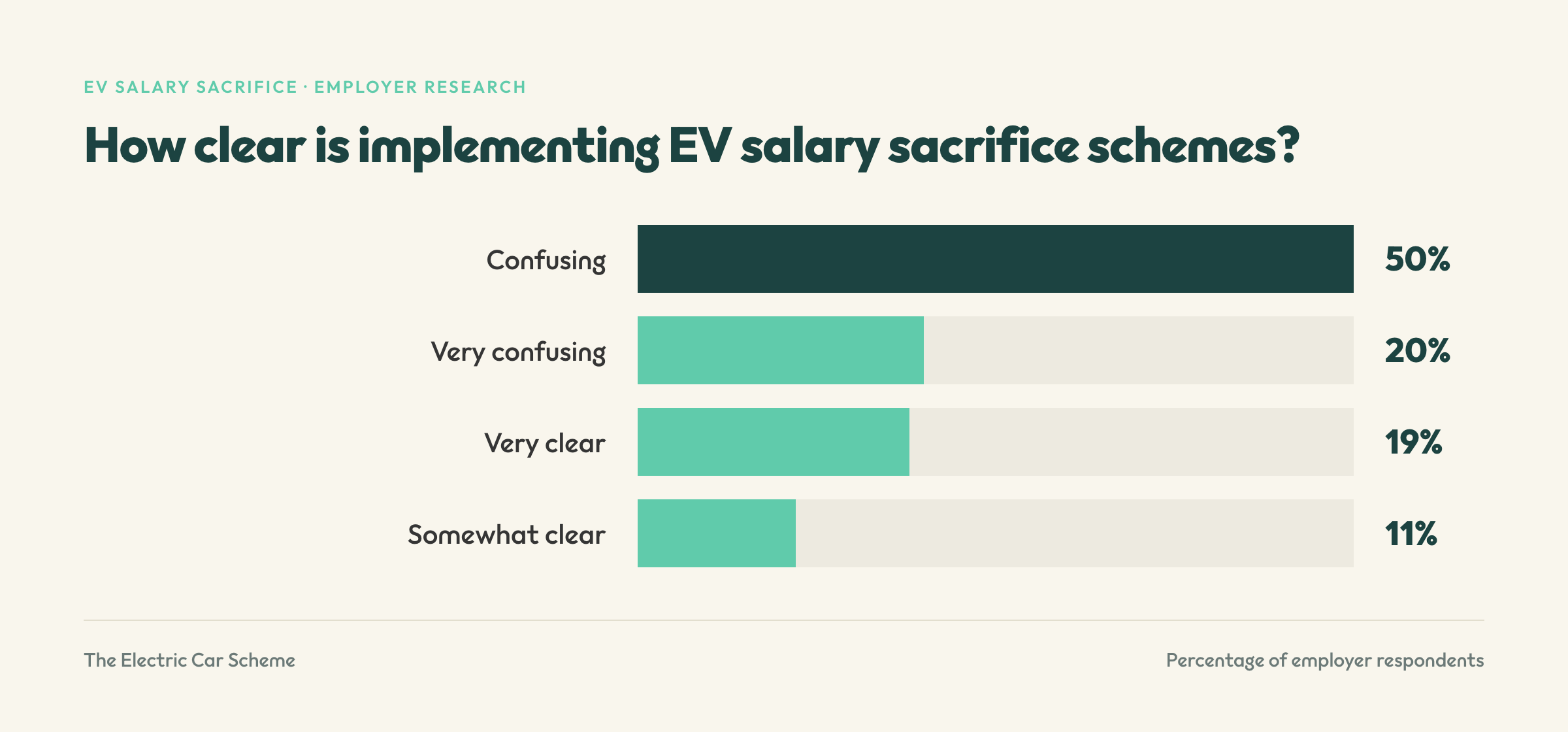
Although awareness of EV salary sacrifice schemes is growing, understanding how to implement them remains a challenge. 50% of people leaders find the process confusing, making this the most common experience. Another 20% consider it very confusing, meaning that together, more than two-thirds face at least some difficulty with implementation.
On the other hand, 19% find the implementation process very clear, reflecting organisations that have already built confidence or gained practical experience. A further 11% describe implementation as somewhat clear, showing that a smaller group has a basic understanding but may still have questions.
This pattern emphasises the practical nature of introducing an EV salary sacrifice scheme. Employers need to understand tax rules, payroll changes, vehicle leasing arrangements, and employee eligibility before launching a programme. Clear information and expert support can help people leaders overcome uncertainty, making these increasingly popular workplace benefits easier to introduce.
How popular is implementing EV salary sacrifice schemes among people leaders?
Implementing EV salary sacrifice schemes is somewhat popular among 30% of people leaders, and it’s very popular with 12%, while 11% have a low interest, and 42% have no interest in EV salary sacrifice schemes yet
Popularity is not a measure of success:
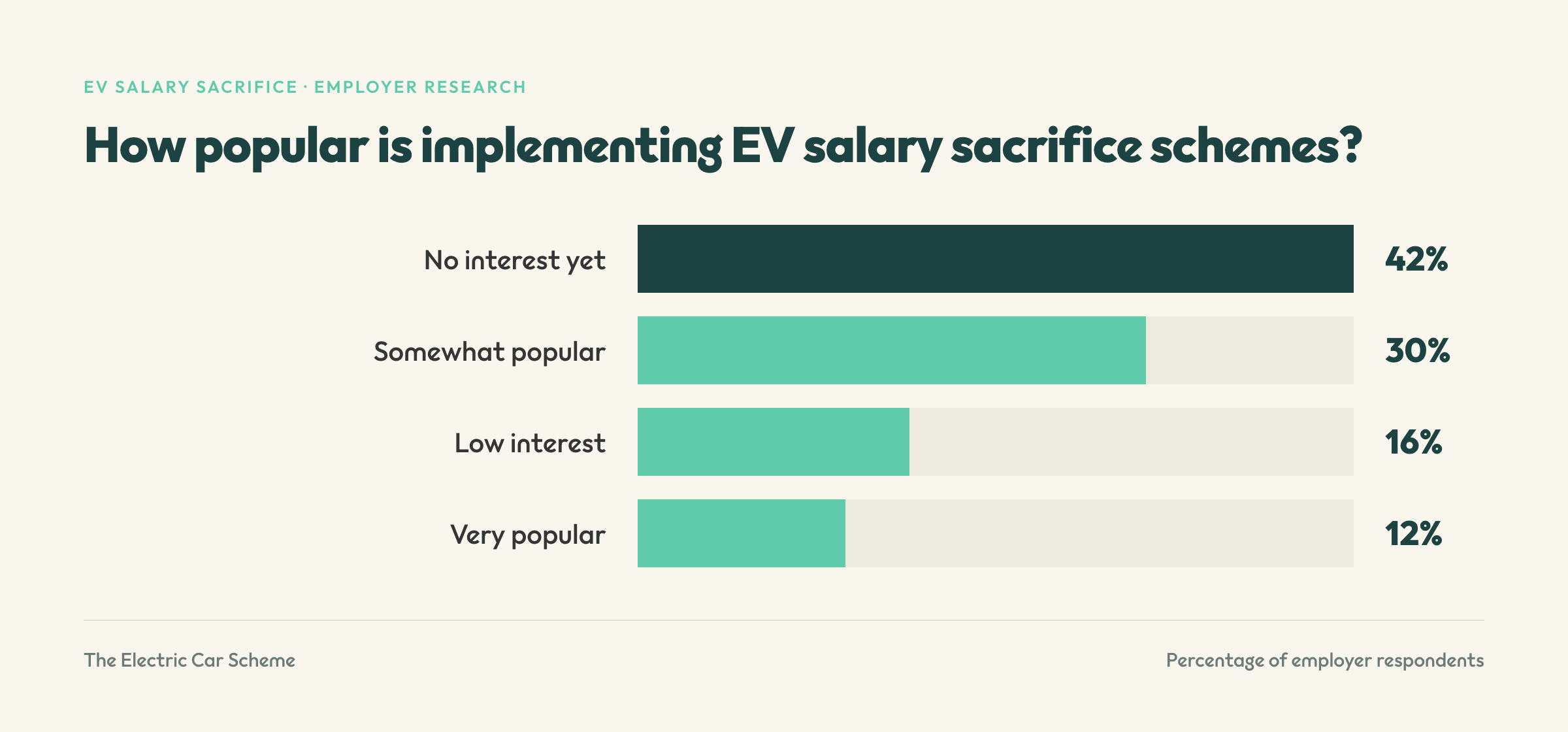
Interest in implementing EV salary sacrifice schemes remains mixed, even as people leaders’ awareness grows and more organisations become familiar with the process. The largest group in our audience, 42%, has no interest in introducing a scheme yet, indicating that many employers are still focused on other priorities or are waiting until the timing feels right.
Another 16% report low interest, meaning that more than half have not yet embraced the idea. At the same time, 30% views these schemes as somewhat popular, showing they are gaining traction across almost a third of workplaces. A further 12% consider EV salary sacrifice schemes as very popular, supporting strong enthusiasm within a smaller but established group.
The range of views mirrors broader employer attitudes towards sustainable commuting initiatives in the United Kingdom. Government research found that employers often support greener travel options but may face practical barriers, such as cost, administration, or competing business priorities, when introducing new benefits. As familiarity with EV salary sacrifice schemes continues to improve, organisations may feel more confident exploring them as part of a wider employee benefits strategy.
How valued is implementing EV salary sacrifice schemes among people leaders?
Implementing EV salary sacrifice schemes is highly valued by 31% of people leaders, somewhat valued by 25%, and rarely mentioned by 25%, while 19% don’t put any value in these schemes
Value is variable:
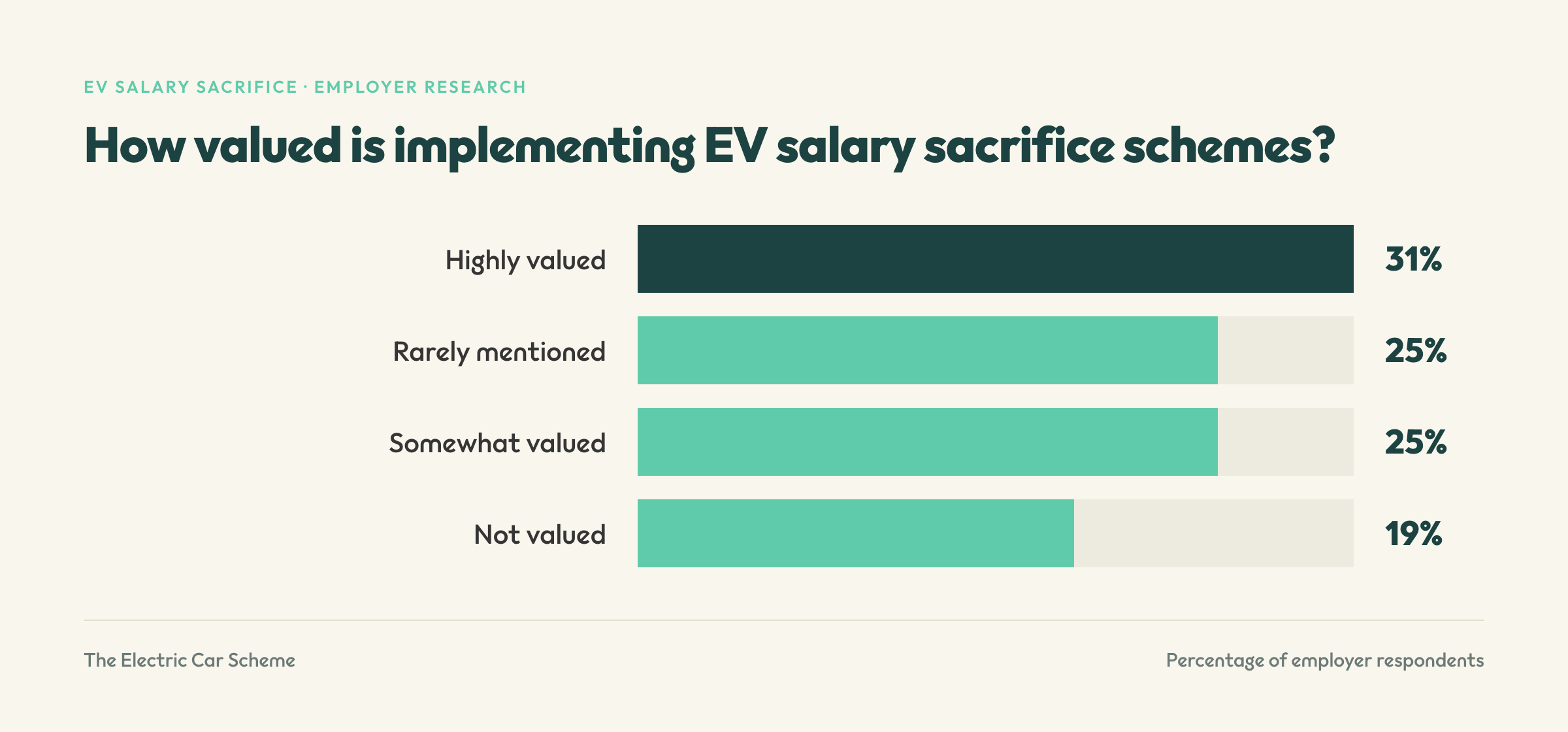
Perceived value varies among people leaders, reinforcing the different stages organisations are at when considering EV salary sacrifice schemes. 31% regard these programmes as highly valued, making this the largest group and indicating that many employers see their potential as a workplace benefit. Another 25% consider these schemes as somewhat valued, adding to the share of people who see clear advantages, even if the schemes are not yet a top priority.
However, not every organisation places the same emphasis on EV salary sacrifice schemes. 25% of people leaders report that they’re rarely mentioned, indicating that the topic has yet to become part of regular workplace discussions. Meanwhile, 19% do not value these schemes, representing the smallest group.
The opinions, ranging from strong support to limited interest, show different priorities, budgets, and readiness levels across workplaces.
Is implementing EV salary sacrifice schemes a priority for people leaders?
Implementing EV salary sacrifice schemes is a top priority for 20% of people leaders, it’s a medium priority for 29%, but a low priority for 30%, and not a priority for 21%
Priorities are not all aligned with sustainability:
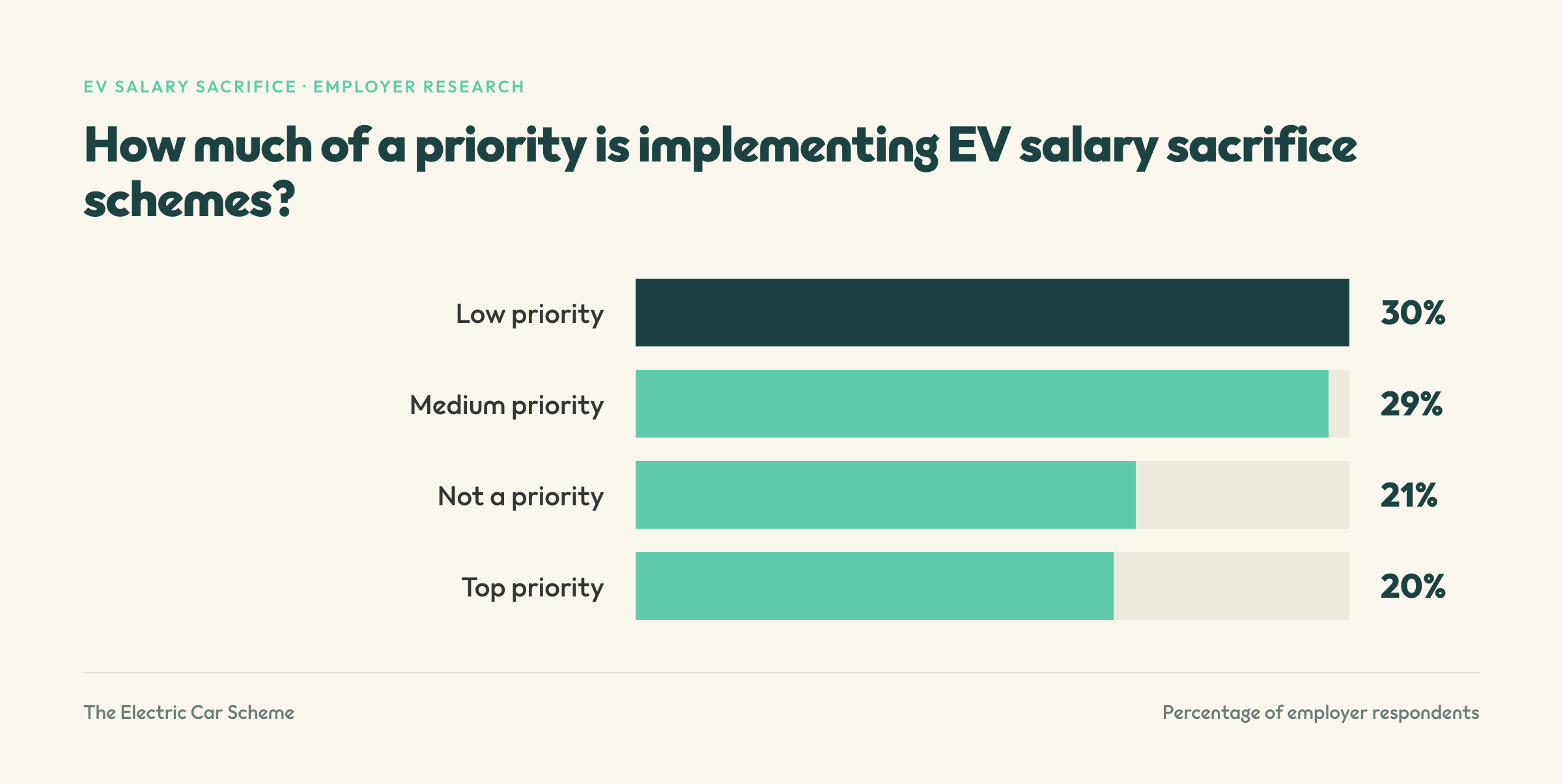
The level of priority that people leaders assign to EV salary sacrifice schemes reflects the varied pace of adoption across workplaces. 30% consider implementing a scheme a low priority, while a very similar 29% rate it as medium priority. These two figures show that many organisations recognise the potential benefits, but are balancing them alongside other business goals.
21% of people leaders don’t view EV salary sacrifice schemes as a priority at all, indicating that some employers have yet to see a strong business case for introducing them. At the other end of the scale, 20% regard implementation as a top priority, demonstrating a clear commitment to expanding employee benefits and supporting the transition to electric vehicles.
These priorities exist alongside strong employee demand. Almost half of UK employees (48%) would welcome access to an electric vehicle through a salary sacrifice scheme as a workplace benefit. While many organisations are still weighing up when to introduce these programmes, the strong level of employee interest suggests EV salary sacrifice schemes could become a more prominent workplace benefit as priorities evolve.
How does implementing EV salary sacrifice schemes fit people leaders' wider benefits strategy?
Implementing an EV salary sacrifice scheme is a core part of 39% of people leaders’ benefits offering, and it’s a standalone green or sustainability initiative for 4%; however, it's still only considered but not formalised for 38%, and 19% have a pilot scheme that is not yet embedded in their wider benefits strategy
Implementation is not yet across the board:
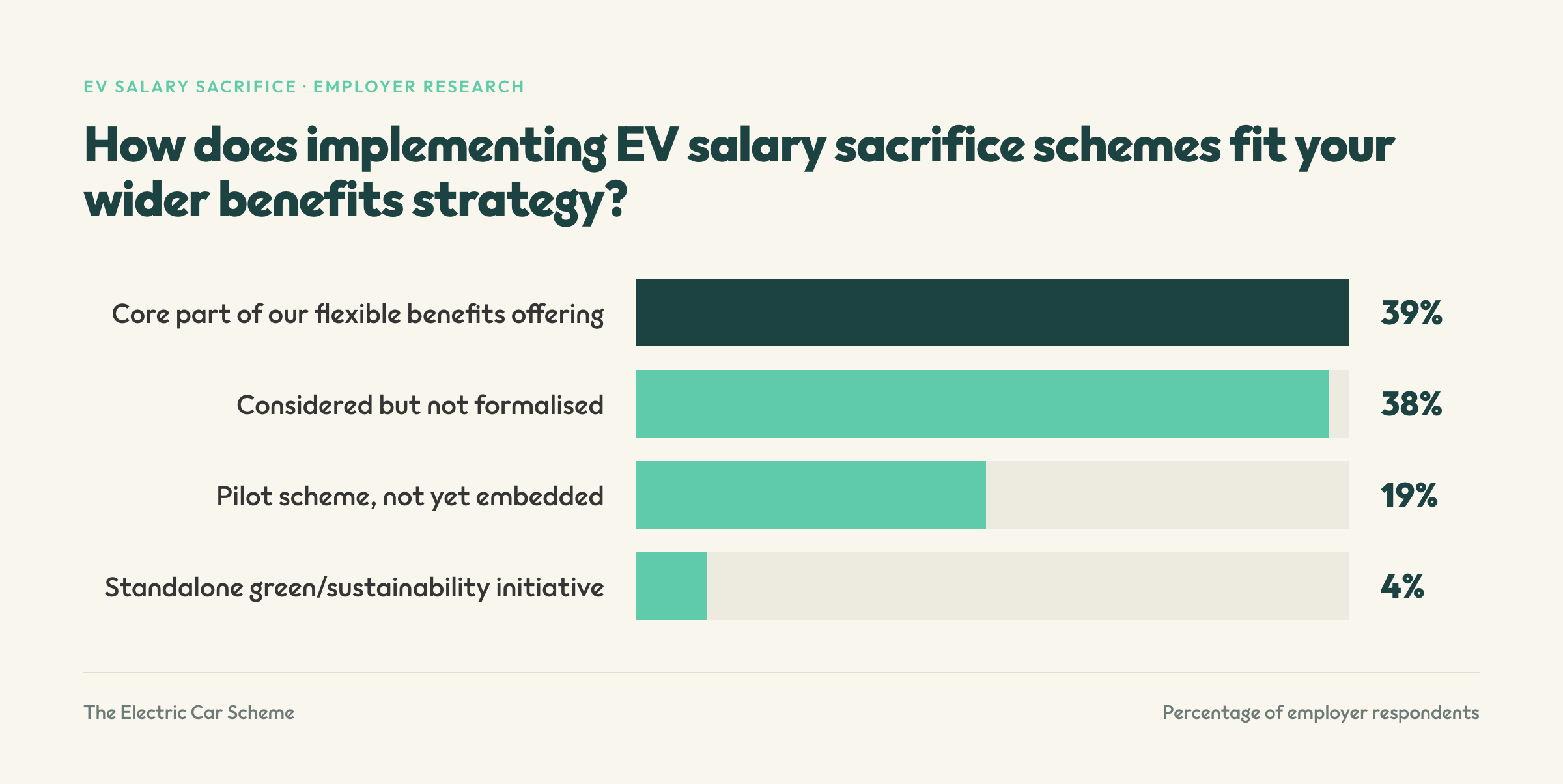
The way organisations position EV salary sacrifice schemes within their wider benefits strategy varies, although most view them as more than a standalone initiative. 39% of people leaders have made these schemes a core part of their organisation’s flexible benefits offering, showing that many employers have fully integrated them into their employee value proposition.
Close behind, 38% have considered introducing an EV salary sacrifice scheme, but the approach has not yet been formalised. This narrow difference indicates that many organisations are actively evaluating how the benefit fits alongside their existing rewards package.
Other employers remain at the earlier stages of implementation. 19% are running a pilot scheme that has not yet been fully embedded into their benefits strategy, allowing organisations to assess employee interest and operational requirements before making a longer-term commitment.
Just 4% of our audience treats an EV salary sacrifice scheme as a standalone green or sustainability initiative, making this the smallest group.
What is the primary driver behind why people leaders’ organisations implement EV salary sacrifice schemes?
Employee retention and satisfaction are the primary drivers behind implementing an EV salary sacrifice scheme for 37% of people leaders, 27% are driven by the cost-effective benefit offering, 15% by employee demand or requests, and 12% by competitor benchmarking, while ESG or sustainability commitments are the main drivers for 8%
Drivers differ but are all persuasive:
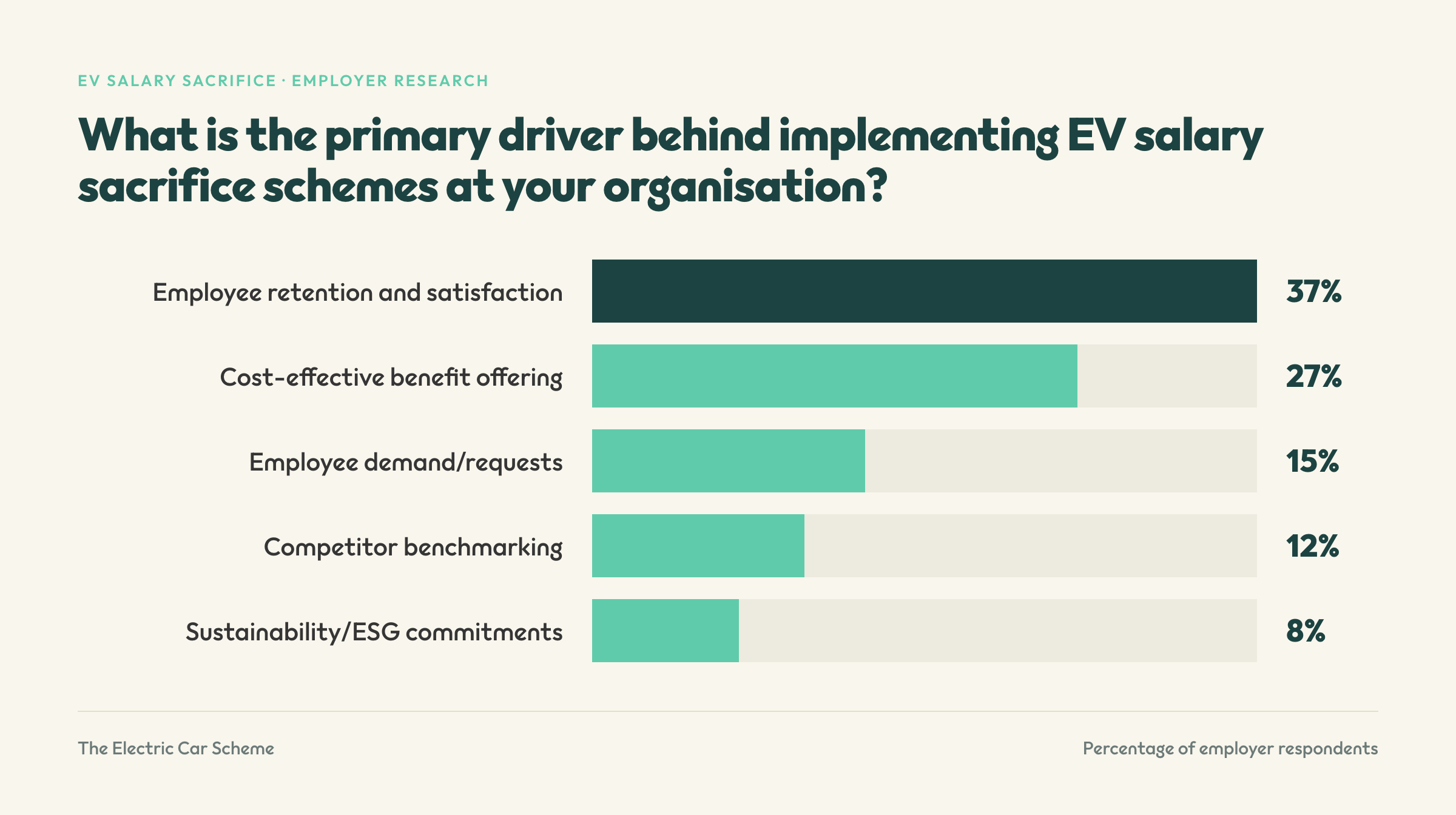
Once organisations decide where EV salary sacrifice schemes fit within their benefits strategy, the reasons for introducing them become clear. The leading driver is employee retention and satisfaction, with 37% of people leaders placing this at the top of the list.
This reinforces the growing importance of offering meaningful workplace benefits that help attract and keep talented employees. Especially considering that replacing an employee can cost between 30% and 200% of their annual salary, making retention a practical business priority, as well as a people-focused one.
Cost-effectiveness ranks second as a driver, with 27% of people leaders viewing EV salary sacrifice schemes as an affordable way to strengthen their benefits offering. Another 15% of our audience introduces these programmes in response to employee demand, confirming that workplace expectations continue to influence benefit decisions.
Another 12% turn to competitor benchmarking, demonstrating that some organisations want to remain competitive in their industry. Sustainability and ESG commitments account for 8%, making this the least common primary driver. While environmental goals remain part of the picture, employee experience and business value are the main factors shaping implementation decisions.
What is the biggest barrier for people leaders implementing EV salary sacrifice schemes at their company?
A lack of budget is the biggest barrier preventing 25% of people leaders from implementing an EV salary sacrifice scheme at their company, 22% are hindered by uncertainty around tax or NI rules, 12% have concerns about affordability for lower earners, and 7% cite limited internal knowledge as a stumbling block, while 33% have no barriers to implementation as a scheme is not currently a priority
Barriers to entry pose challenges:
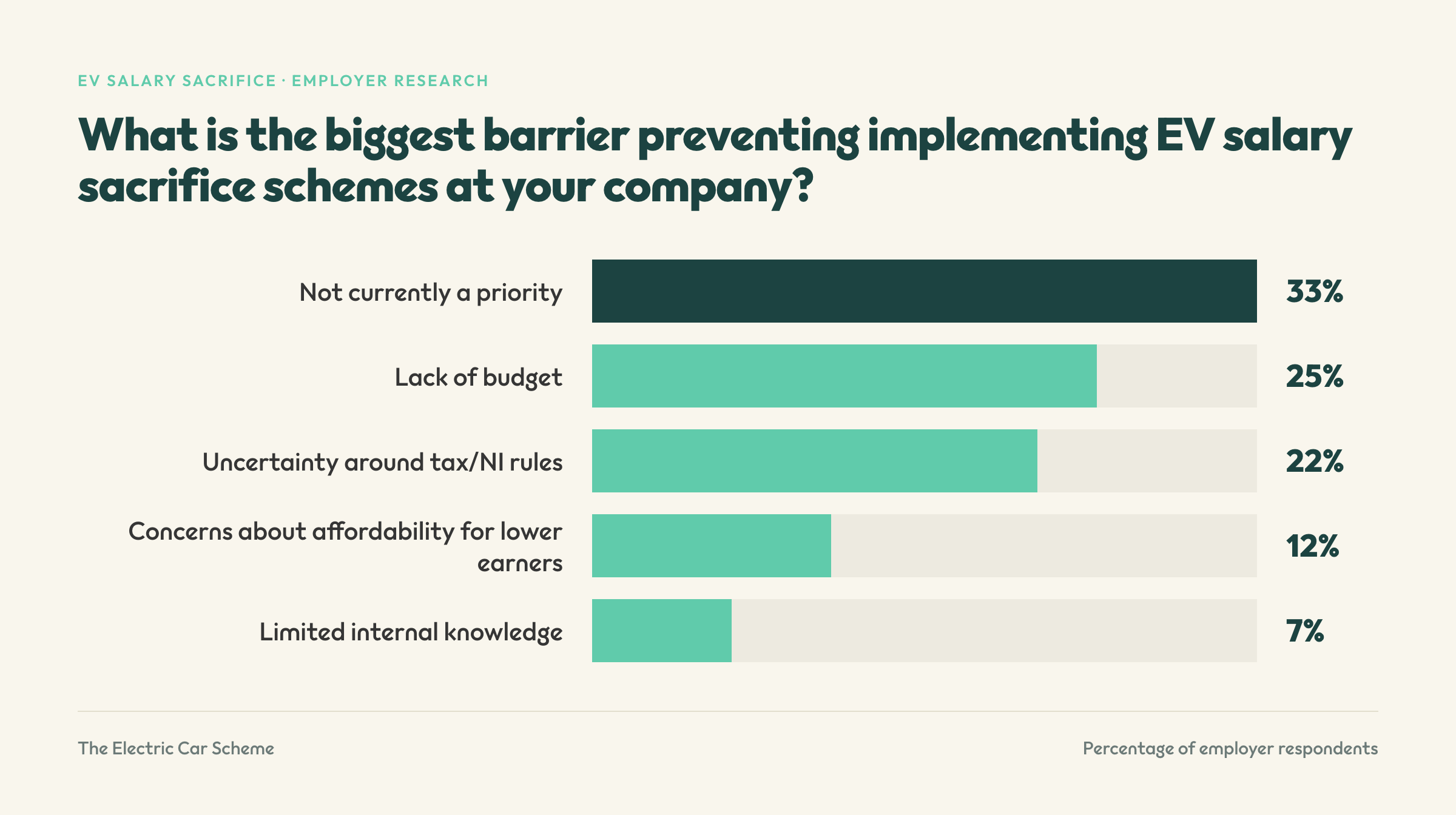
While organisations identify different reasons for introducing EV salary sacrifice schemes, they also face a range of barriers that can delay implementation. The biggest challenge is that these programmes are not currently a priority for 33%, making competing business objectives the most common obstacle.
Budget constraints follow closely, with 25% of people leaders identifying a lack of funding as the main barrier to implementation. 22% cite uncertainty around tax and National Insurance (NI) rules, indicating that navigating the financial and regulatory requirements remains a concern for many employers.
Affordability for lower earners is the primary challenge for 12%, reflecting concerns about ensuring the benefit is accessible across the workforce. The remaining 7% identifies limited internal knowledge as the biggest barrier to implementation, making it the least common issue.
How confident are people leaders in explaining EV salary sacrifice schemes tax and NI savings?
While 40% of people leaders are not confident at all in explaining the tax and NI savings of implementing a salary sacrifice scheme, and 22% are not very confident, 24% are fairly confident, and 13% are very much so
Confidence in explanations is divided:
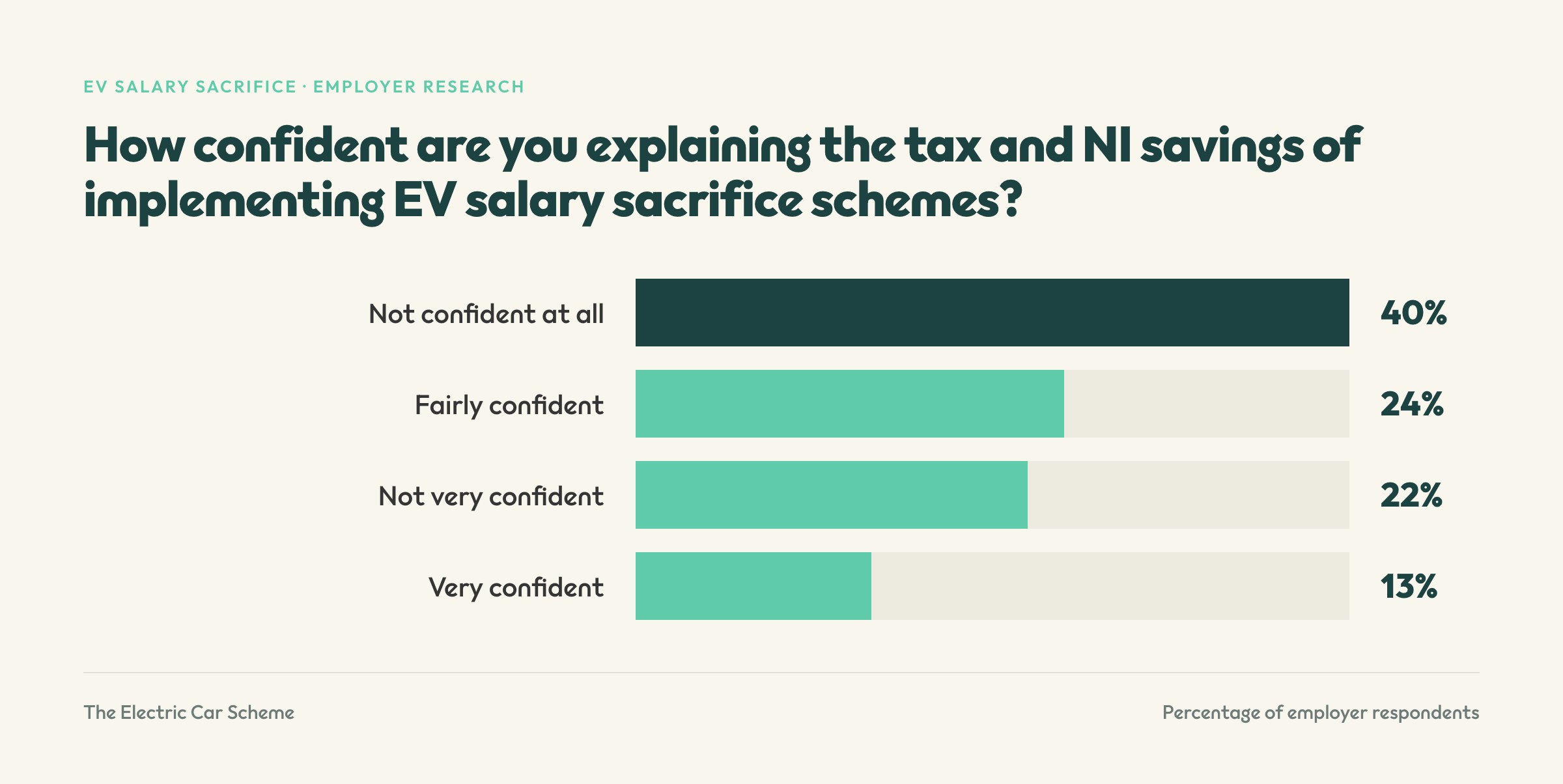
Confidence in explaining the tax and National Insurance savings associated with EV salary sacrifice schemes remains uneven among people leaders. 40% are not at all confident, making this the most common opinion. Another 22% are not very confident, meaning that more than six in ten lack confidence when discussing one of the scheme’s key financial benefits.
By comparison, 24% feel fairly confident explaining the tax and NI advantages, showing that a sizeable group has a working understanding of how the schemes operate. Only 13% are very confident about explaining the tax and insurance advantages, making this the smallest group and indicating that in-depth knowledge is still relatively uncommon.
This pattern reflects the complexity of the tax rules surrounding salary sacrifice arrangements. While EV salary sacrifice schemes can provide tax and National Insurance savings for both employees and employers, they must be structured correctly and comply with current legislation.
Do people leaders think implementing EV salary sacrifice schemes is fair?
25% of people leaders feel that implementing EV salary sacrifice schemes is fair for all earners, but 18% think it’s not fair for lower earners, 25% agree it’s mostly fair, and 32% ar ensure whether the implementation is fair or not
Whether schemes are fair for everyone is debated:
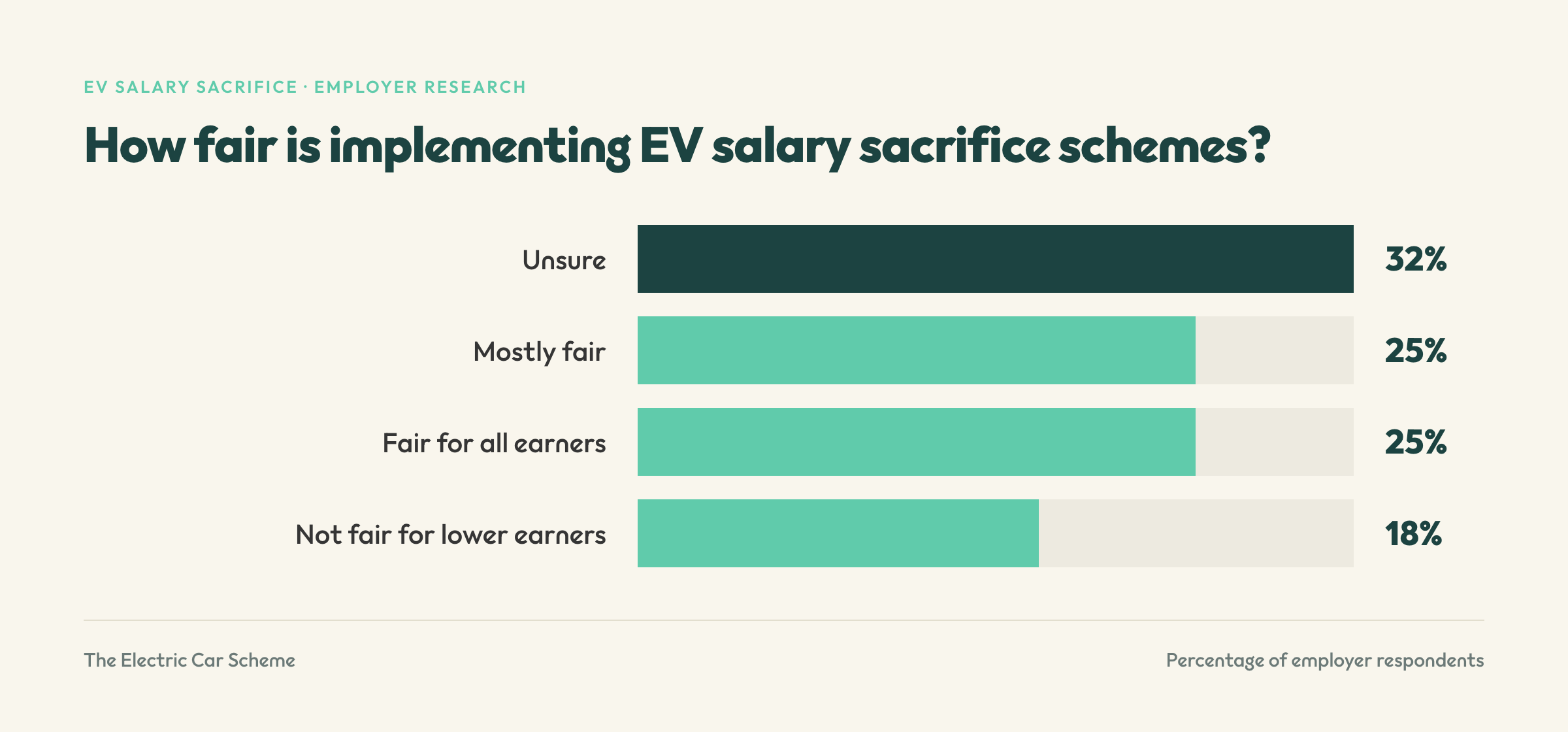
A total of 32% of people leaders are unsure how fair these schemes are, suggesting many are still weighing their impact across different income groups. 25% believe the schemes are mostly fair, indicating confidence that they provide worthwhile benefits, even if they are not perfect in every situation.
Another 25% believes EV salary sacrifice schemes are fair for all earners, reflecting the view that the opportunity can be shared across the workforce without favouring one income group over another.
In contrast, 18% of people leaders believe the schemes are not fair for lower learners, raising concerns that some employees may find it harder to benefit because of their financial circumstances.
How proven is implementing EV salary sacrifice schemes according to people leaders?
33% of people leaders see a clear ROI from implementing EV salary sacrifice schemes, for 32% there is some evidence in the scheme’s proof, 11% think it’s too early to tell, and 25% have not seen any evidence yet
Proof is still undecided:
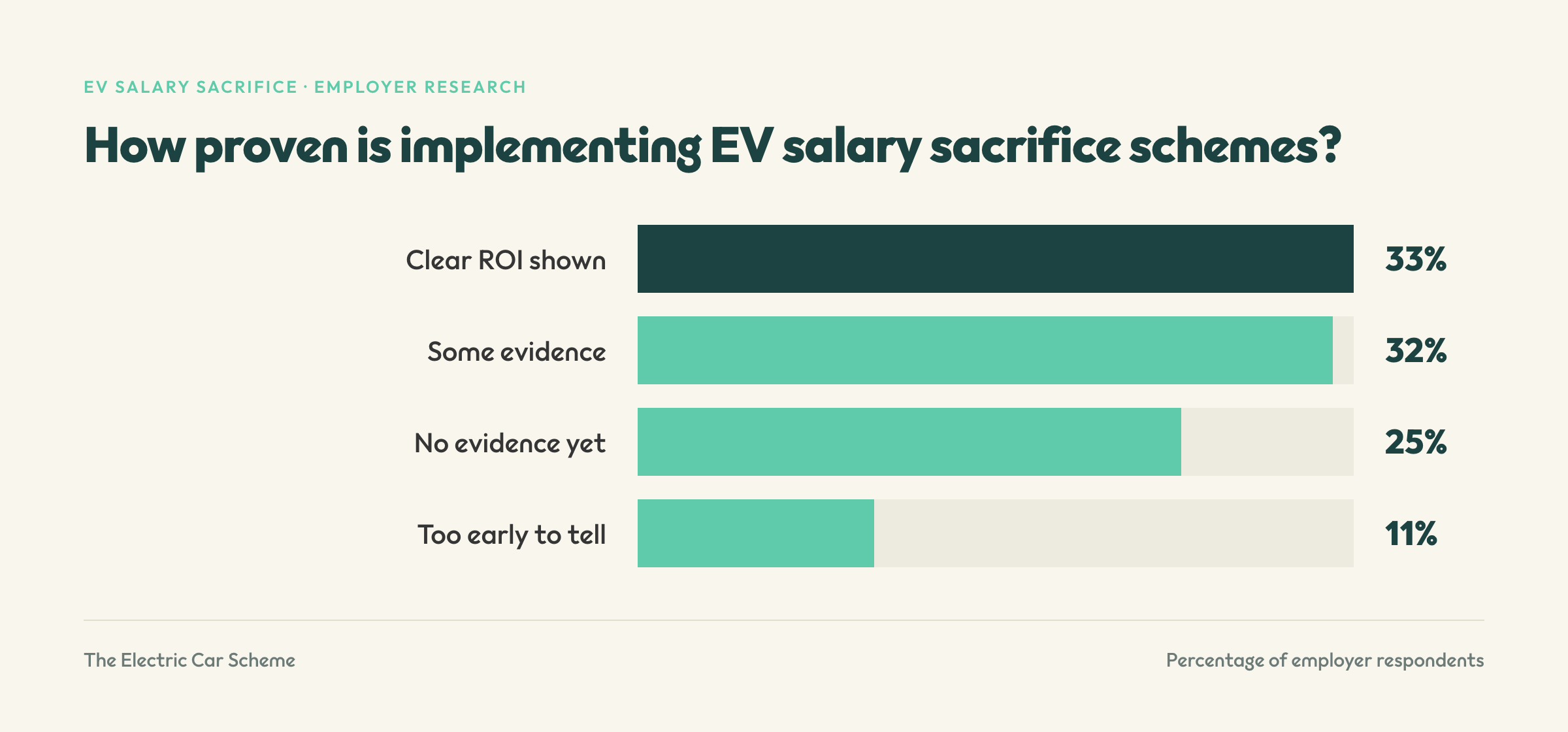
As discussion around the fairness of EV salary sacrifice schemes continues, opinions of their proven value are becoming increasingly positive. Interest in electric vehicles is growing as the United Kingdom moves towards the Government’s 2030 ban on the sales of new petrol and diesel cars, making workplace EV schemes more relevant for employers and employees alike. The largest share of people leaders, at 33%, believe these schemes already demonstrate a clear return on investment, showing confidence in the value they can deliver.
32% see some evidence of positive results, indicating that many organisations are already seeing encouraging outcomes, even if the full benefits are still developing. 25% of our audience believes there is no evidence yet, demonstrating that measurable results have not been established in every workplace. Another 11% feel that it is still too early to tell, acknowledging that some schemes may need more time before their impact becomes clear.
How risky do people leaders think implementing EV salary sacrifice schemes is?
43% of people leaders think that implementing an EV salary sacrifice scheme is low risk, 29% think there is no risk in implementing these schemes, while 14% feel there is some risk, and 15% feel these schemes are high risk
Risk ratios are not standardised:
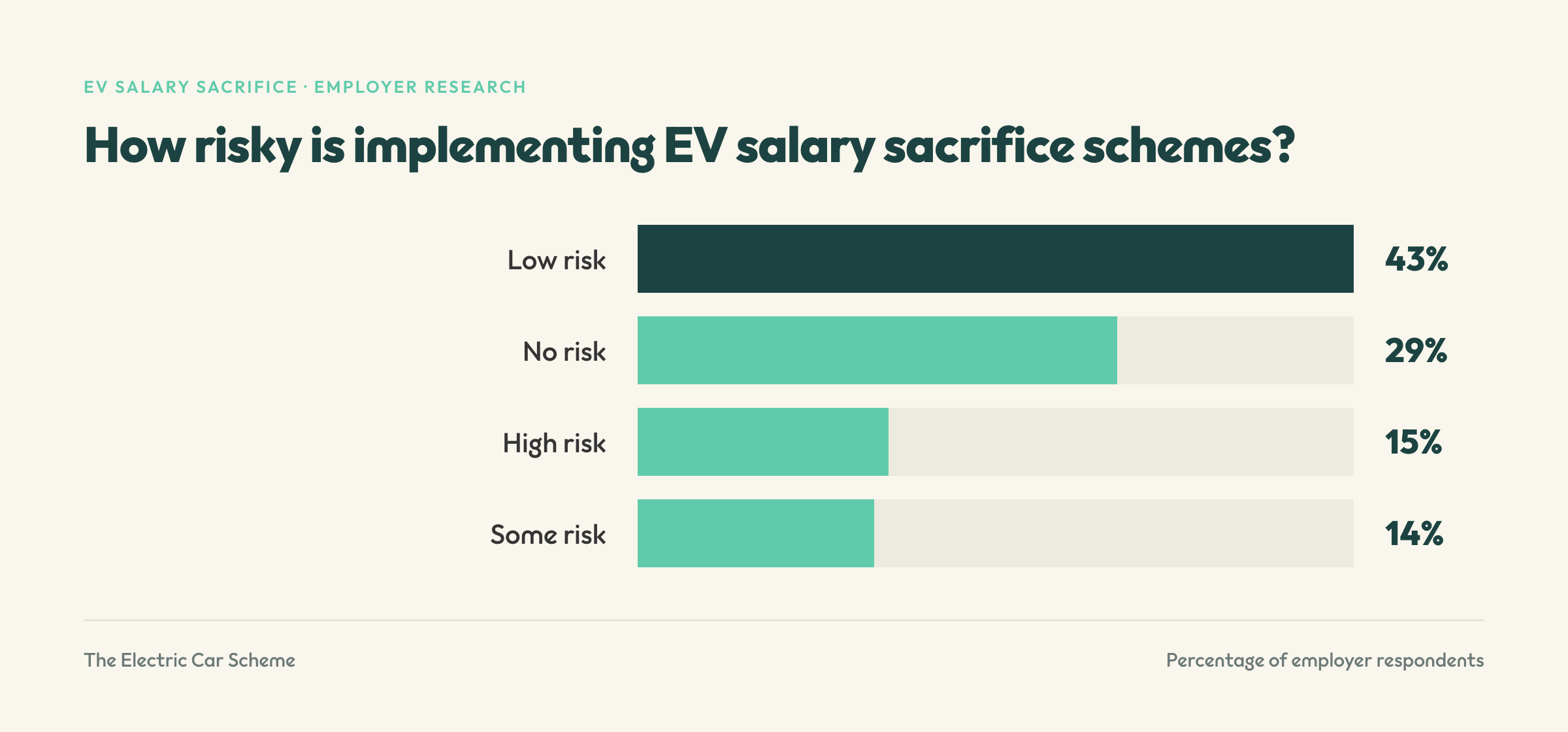
As many organisations assess the value of EV salary sacrifice schemes, perceptions of their risk remain largely positive. 43% of people leaders view implementing these schemes as low risk. This reveals the confidence that any challenges involved are manageable and do not outweigh the potential benefits. 29% see no risk at all, reflecting strong assurance in the structure and operation of EV salary sacrifice programmes.
At the same time, some caution remains. A total of 15% of our audience considers implementation to be high risk, emphasising that concerns remain about introducing and managing these schemes in certain workplaces. 14% identify some risk, acknowledging that there may be obstacles or uncertainties to address without viewing them as major barriers. Overall, the results show that EV salary sacrifice schemes are a relatively low-risk option for many organisations.
How secure do people leaders think implementing EV salary sacrifice schemes is?
32% of people leaders agree that implementing an EV salary sacrifice scheme is fairly secure, 13% say it's very secure, and 22% have some concerns about its security; however, 33% don’t think these schemes are secure at all
Scheme security is a talking point:
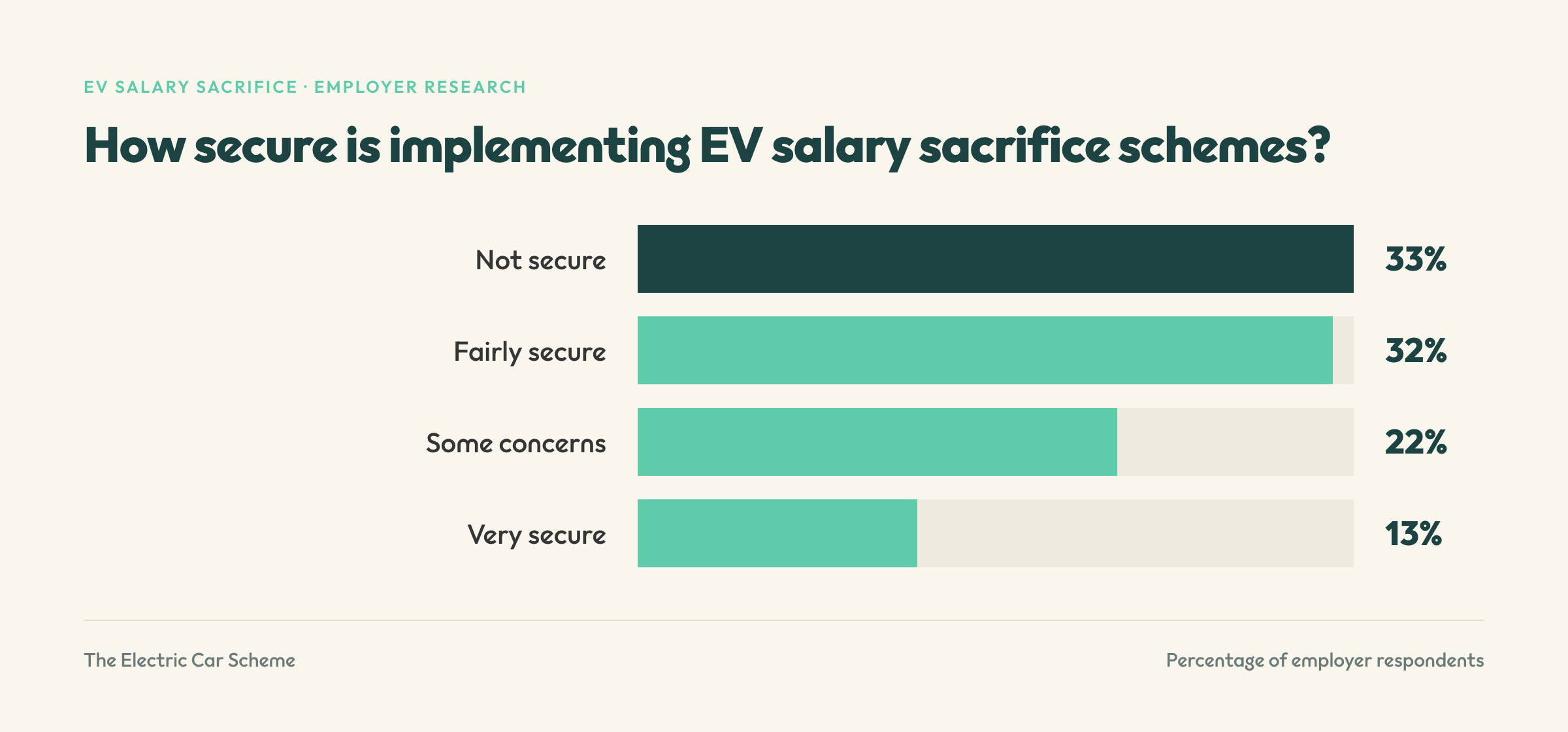
Views on the security of implementing EV salary sacrifice schemes are mixed, showing that organisations are balancing confidence with practical considerations. Guidance on these schemes often explains that, when carefully designed and managed, they can benefit both employers and employees.
Against this backdrop, 33% of people leaders consider the schemes not secure, making this the largest single view and proving that security remains an important area for evaluation before implementation.
Close behind, 32% regard EV salary sacrifice schemes as fairly secure, showing that many believe they offer a dependable option despite requiring ongoing oversight. Another 22% have some concerns, recognising that certain aspects may need careful management without dismissing the schemes entirely.
Lastly, 13% view the schemes as very secure, representing the group with the highest level of confidence in their reliability.
How costly is implementing EV salary sacrifice schemes, according to people leaders?
For 60% of people leaders, implementing an EV salary sacrifice scheme is cost-neutral, for 14%, it’s low cost, it’s moderately costly for 12%, and for 15%, it's very costly
Costs are a consideration:
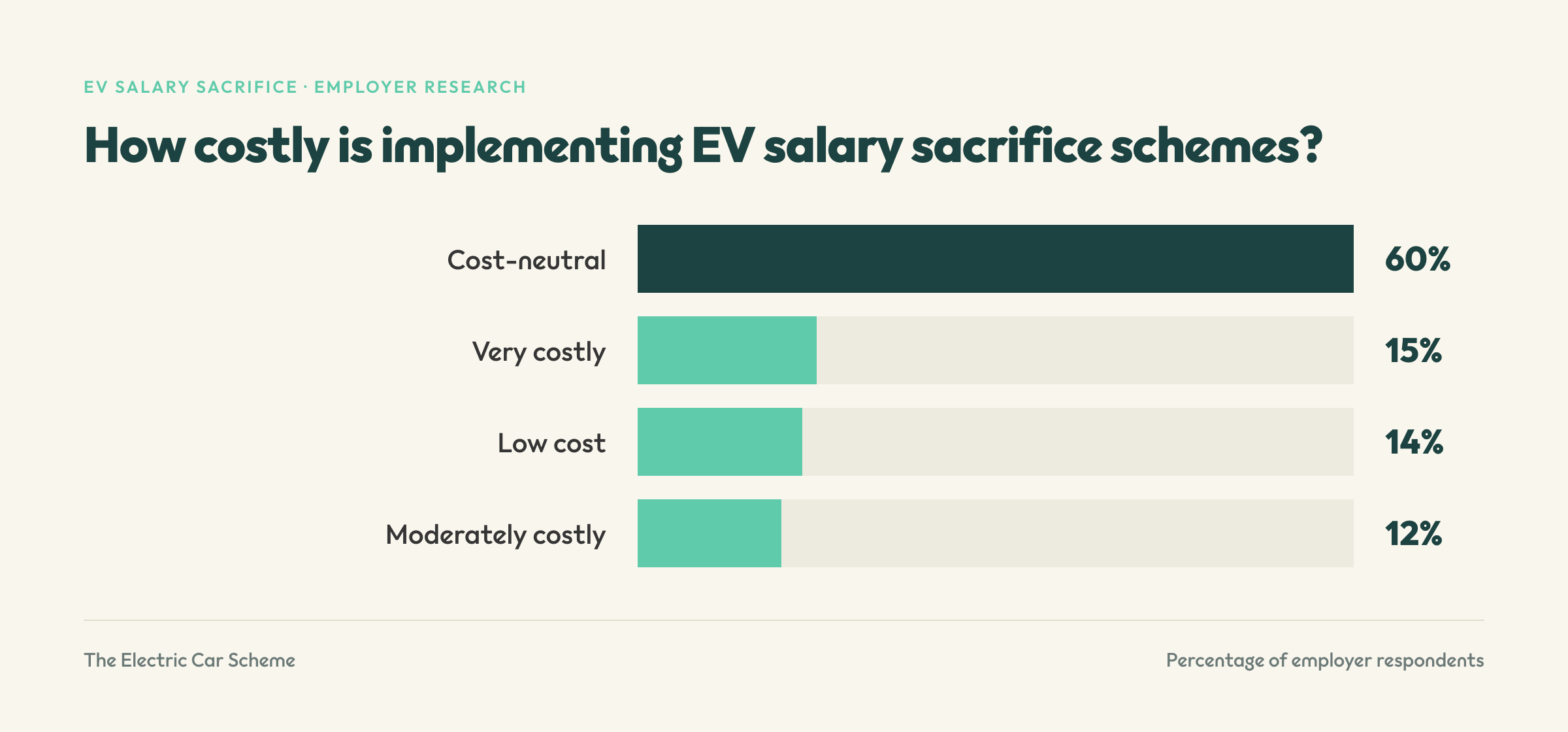
Perceptions of the cost of implementing EV salary sacrifice schemes are largely favourable, with most viewing them as financially manageable. The true cost of these schemes depends on factors such as administration, employer processes, and participation, meaning costs can vary between organisations. Even so, 60% of people leaders consider EV salary sacrifice schemes to be cost-neutral, making this by far the most common opinion and reflecting confidence that the financial impact can be balanced over time.
Smaller groups hold different views on the level of cost involved. 15% believe the schemes are very costly, suggesting that some organisations anticipate higher financial commitments or implementation expenses. Meanwhile, 14% of our audience regards them as low cost, demonstrating that many expect only limited expenditure to introduce and manage the scheme.
Another 12% of people leaders describe implementation as moderately costly, noting that some investment may be required without viewing it as excessive.
How easy is implementing EV salary sacrifice schemes for people leaders?
Implementing EV salary sacrifice schemes is fairly easy for 46% of people leaders, very easy for 13%, and 10% are neutral about it, but 11% find implementation very difficult, and 19% say it’s fairly difficult
Ease of use takes the majority:
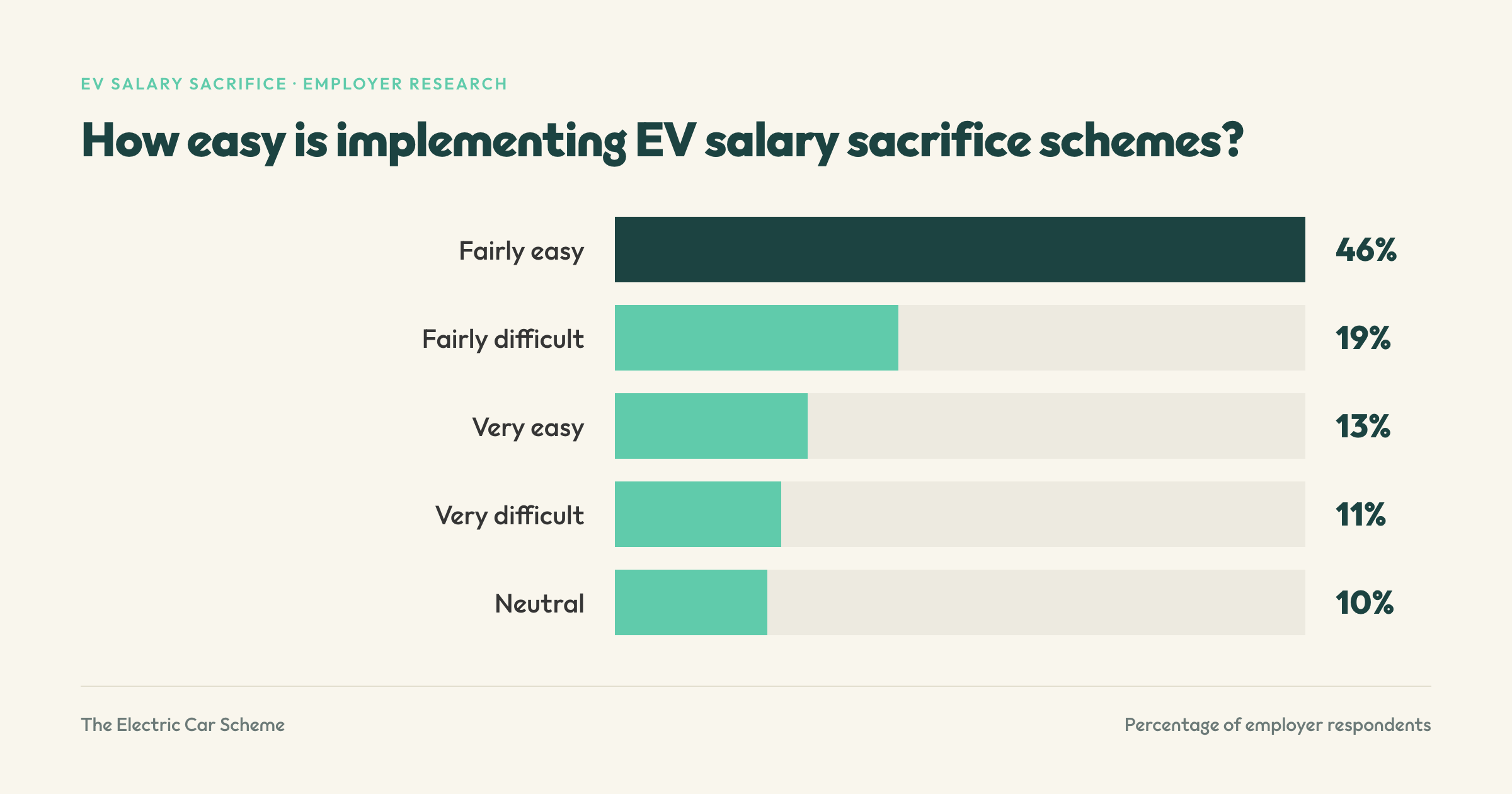
People leaders generally view the implementation of EV salary sacrifice schemes as a manageable process, with positive opinions outweighing more challenging experiences. 46% describe implementation as fairly easy, indicating that many organisations can introduce these schemes without major difficulties.
A further 13% consider the process very easy, reflecting strong confidence in setting up and managing an EV salary sacrifice programme. These figures combined reveal that about six out of ten leaders experience a straightforward implementation process.
Not every organisation finds implementation equally simple: 19% of people leaders regard the process as fairly difficult, knowing that certain administrative, financial, or operational factors can create additional work. 11% describes implementation as very difficult, representing the smallest group with the strongest concerns about complexity. Another 10% remain neutral, revealing a balanced view that neither favours ease nor difficulty.
How simple is implementing EV salary sacrifice schemes for people leaders?
While 18% of people leaders find implementing an EV salary sacrifice scheme fairly simple, and 20% find it fairly simple to implement, 39% find it fairly complex, and 23% agree it’s a very complex implementation
Complexity is a consideration:
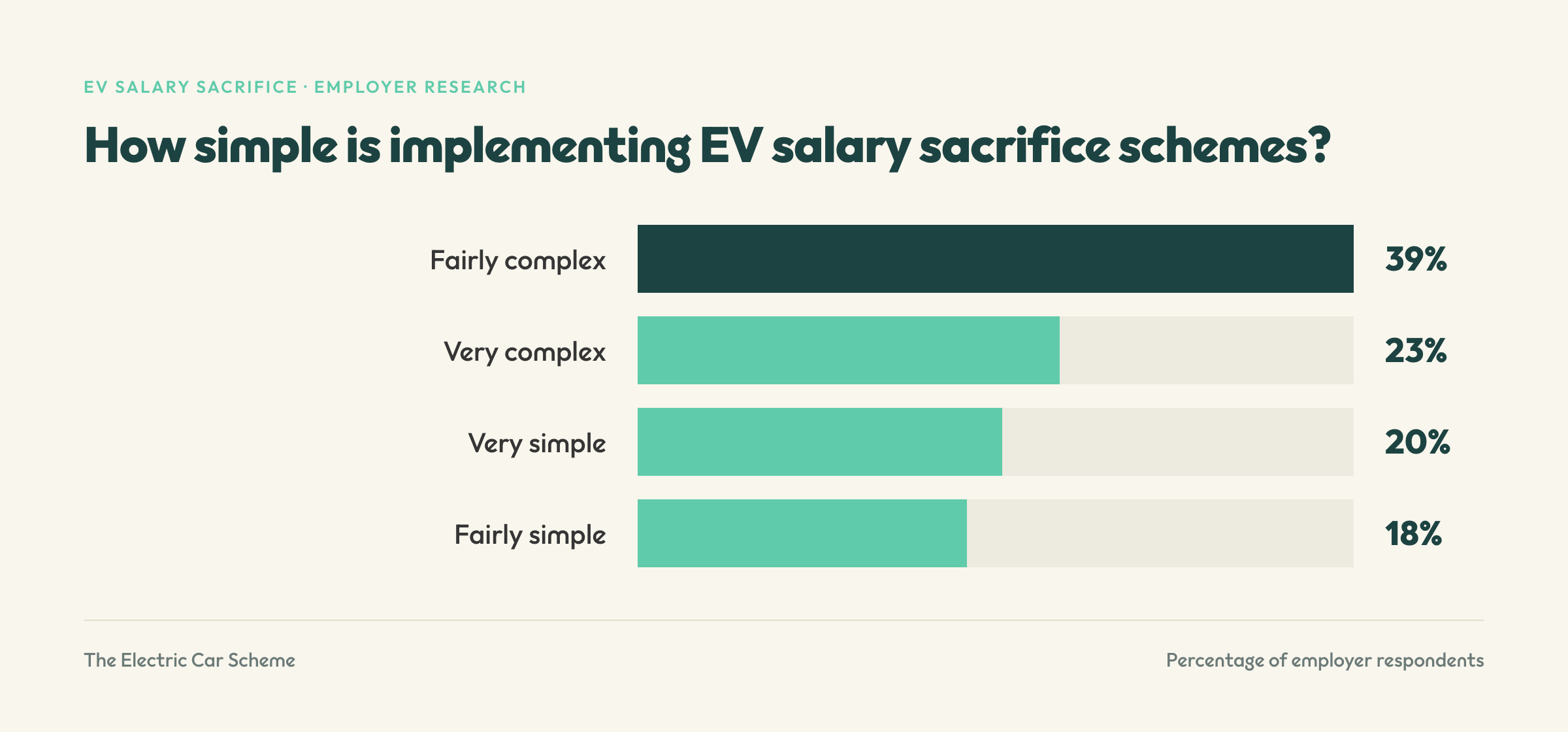
Although many people leaders find EV salary sacrifice schemes relatively easy to implement, opinions on the process's simplicity are mixed. 39% describe implementation as fairly complex, understanding that while the process is manageable, it often involves several steps that require careful planning and coordination. 23% consider it very complex, supporting the view that introducing these schemes can demand significant time, expertise, or administrative effort in some organisations.
At the same time, positive experiences remain well represented. A total of 20% view implementing EV salary sacrifice schemes as very simple, suggesting that some organisations believe they can introduce them with minimal difficulty. 18% of the audience regard the process as fairly simple, indicating that many find the requirements straightforward once the necessary arrangements are in place.
How scalable is implementing EV salary sacrifice schemes according to people leaders?
Implementing an EV salary sacrifice scheme is very scalable for 53% of people leaders, somewhat scalable for 20%, and has limited scalability for 11%, while 17% say it’s not scalable
Scalability is a priority:
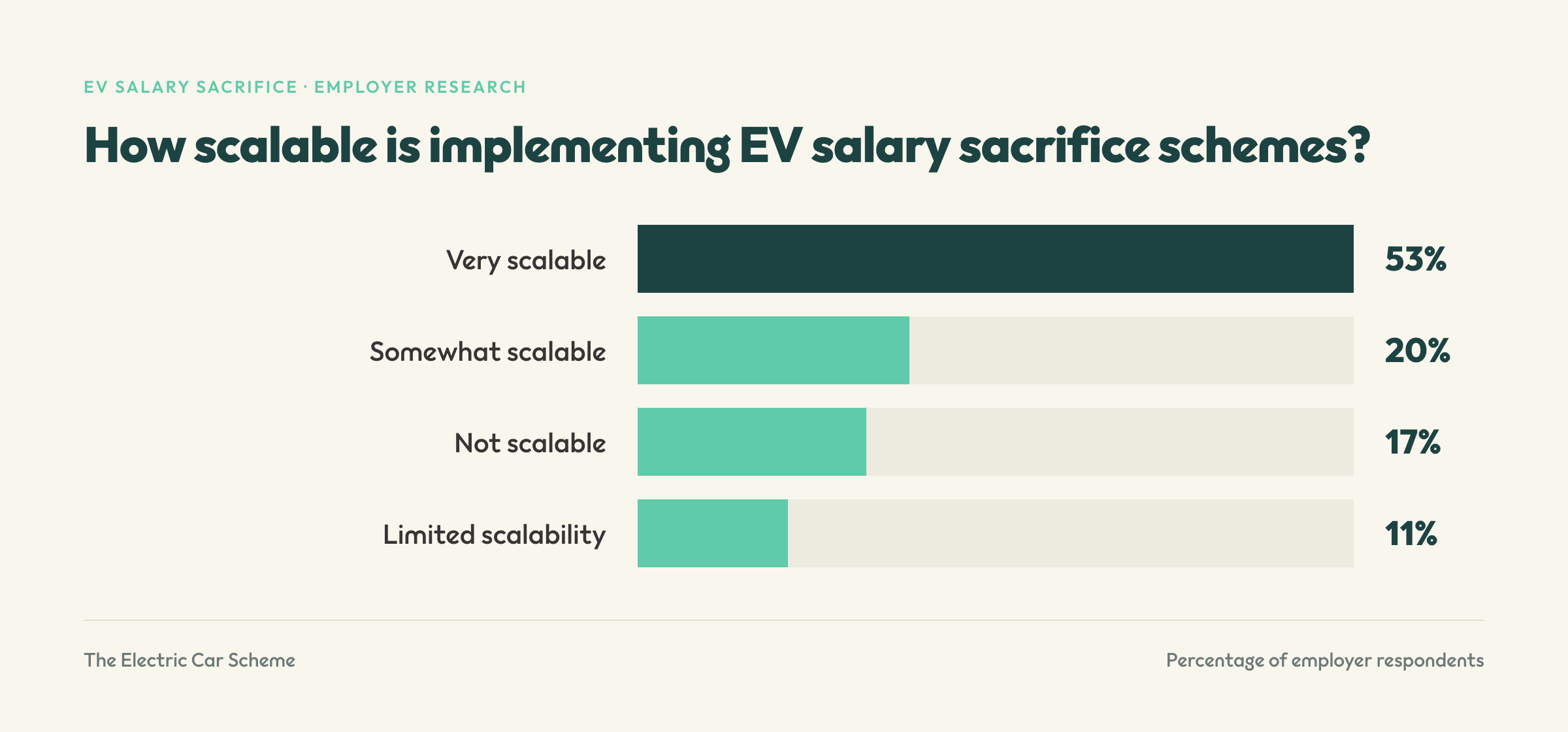
While opinions on the simplicity of implementing EV salary sacrifice schemes vary, confidence in their ability to grow across organisations is much stronger. More than half of people leaders - 53% - view these schemes as very scalable, making this the most common opinion by a clear margin. This supports the belief that EV salary sacrifice programmes can be successfully expanded as workforce needs change or more employees choose electric vehicles.
20% consider the schemes somewhat scalable, indicating that many organisations believe expansion is achievable, even if it may require additional planning or resources. In contrast, 17% of people leaders regard EV salary sacrifice schemes as not scalable, showing that some see practical barriers that could limit wider adoption within their organisations.
Another 11% believe scalability is limited, recognising that growth may be possible, but only to a certain extent. Combined, this presents a positive picture of long-term potential, with most viewing these schemes as capable of supporting a growing number of employees as demand for electric vehicles continues to increase.
Who owns the decision to begin implementing EV salary sacrifice schemes internally?
External advisors or provider recommendations are the reasons behind the decision to begin implementing an internal EV salary sacrifice scheme for 37% of people leaders, for 23% it’s a joint decision across departments, finance teams own the decision for 23%, HR or people teams for 15%, and C-suite or executive leadership are the owners for 1%
Ownership is spread across departments:
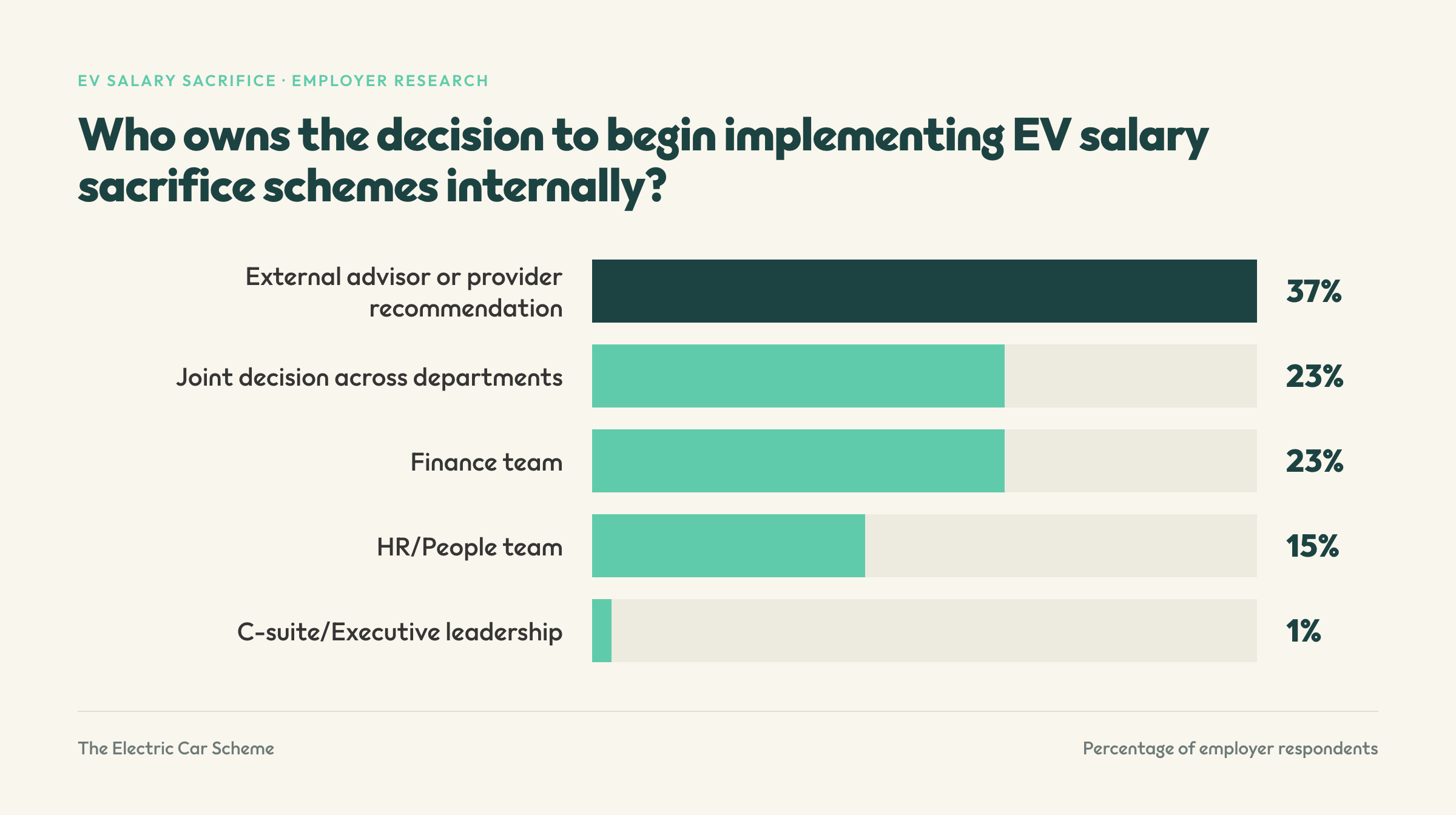
Following the strong confidence in the scalability of EV salary sacrifice schemes, attention turns to who drives the decision to introduce them within an organisation. 37% of people leaders attribute the decision to recommendations from an external adviser or provider. This emphasises the importance of specialist expertise in helping organisations assess the practical and financial considerations before moving forward with implementation.
Decision-making is also distributed across internal teams. 23% identify a joint decision across departments, pointing to a collaborative approach that brings together different areas within the organisation.
Another 23% place responsibility with the finance team, showing the importance of evaluating budgets, tax implications, and long-term financial planning before introducing a scheme.
15% identify the Human Resources or people team as the main decision-maker, emphasising its role in shaping employee benefits and workplace wellbeing initiatives. Only 1% attribute the decision primarily to the C-suite or executive leadership, indicating that implementation in these organisations is usually led by operational specialists rather than senior executives.
Which factor matters most to people leaders when selecting a provider for EV salary sacrifice schemes?
Ease of payroll integration is the factor that matters most for 43% of people leaders when selecting a provider for implementing an EV salary sacrifice scheme, cor and pricing transparency ae a top priority for 25%, 18% cite employee-facing app or experience as most crucial, and 13% look for customer support and account management, while no one is discussing vehicle choice and availability
Priorities for implementation are divided:
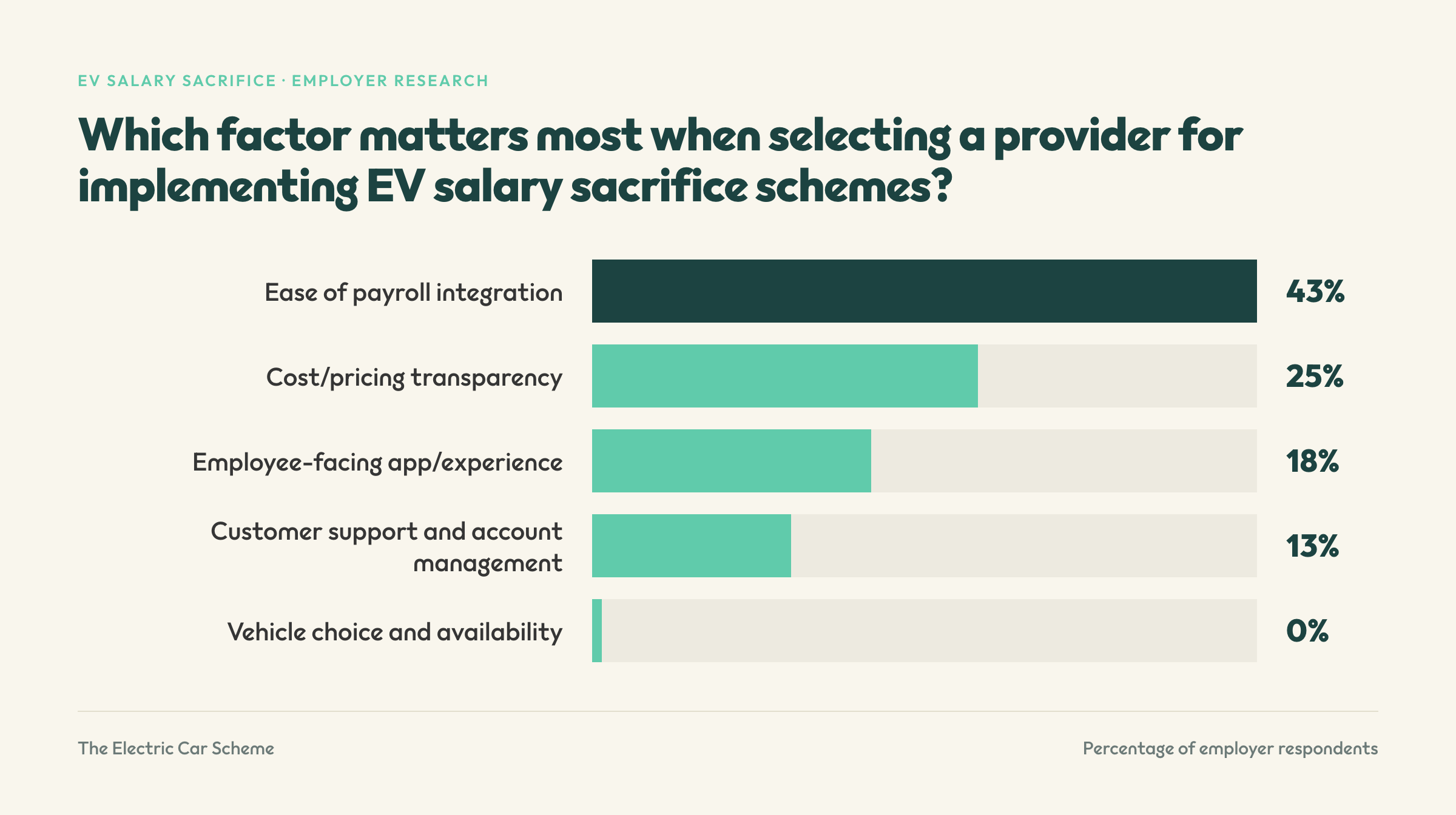
After identifying who typically leads the decision to introduce EV salary sacrifice schemes, the next priority is choosing the right provider.
The most important factor for people leaders is ease of payroll integration, with 43% placing it at the top of their list. This reveals the value of a scheme provider that integrates smoothly with existing payroll systems, reducing administrative complexity and ultimately minimising opportunity costs. Cost and pricing transparency follows at 25%, demonstrating the importance of clear, predictable costs when evaluating different scheme providers.
The employee-facing app or user experience ranks second at 18%, showing that organisations also value a straightforward, accessible experience for employees using the scheme. At the same time, 13% prioritise customer support and account management, recognising the benefit of ongoing guidance throughout implementation and day-to-day administration.
Interestingly, 0% of our audience identifies vehicle choice and availability as the most important factor. This aligns with the continued expansion of the UK electric vehicle market, where the range of available models continues to grow, and market revenue is projected to reach around US$41 billion in 2026.
How many employees would be eligible for EV salary sacrifice schemes when people leaders implement them?
For 31% of people leaders, fewer than 50 employees would be eligible for EV salary sacrifice scheme when they were implemented; however, 28% would have more than 5,000 eligible employees, 23% between 50 and 250, 9% between 251 and 1,000 employees, and 8% between 1,001 and 5,000 employees
Larger number of employees top the eligibility list:
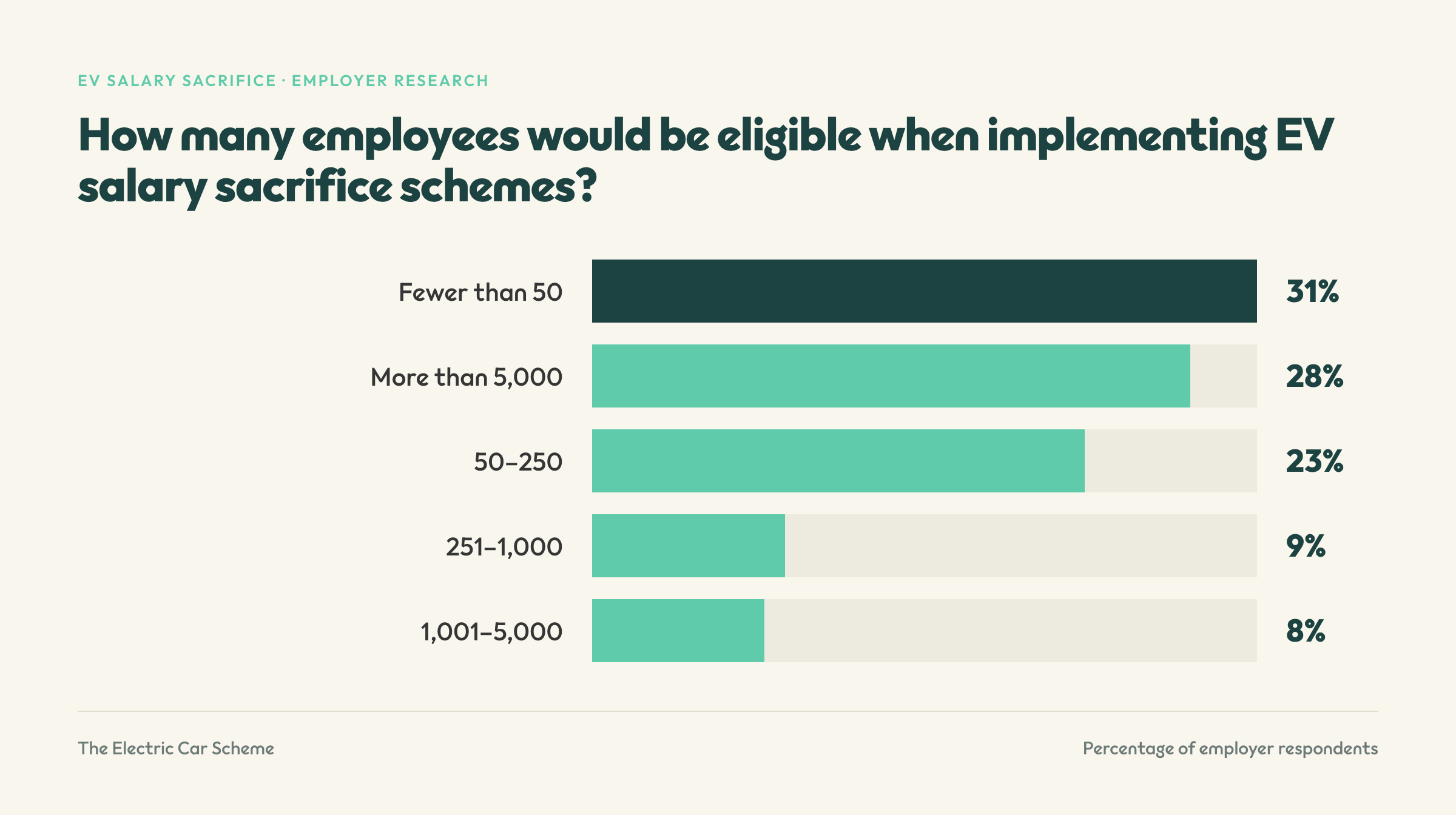
After considering what people leaders value most when choosing an EV salary sacrifice provider, the scale of employee eligibility reveals how these schemes are being introduced across organisations of different sizes.
From our audience, 31% report that fewer than 50 employees would be eligible, revealing that many businesses begin by offering the scheme to a relatively small workforce. Close behind, 28% make the scheme available to more than 5,000 employees, demonstrating that EV salary sacrifice programmes are also being adopted on a very large scale.
Medium-sized eligibility groups account for a smaller share. 23% provide access to between 50 and 250 employees, reflecting a steady uptake among organisations with modest workforces. Meanwhile, 9% extend scheme eligibility to between 251 and 1,000 employees, showing that some employers operate schemes across larger teams without reaching enterprise scale. Lastly, 8% makes the scheme available to between 1,001 and 5,000 employees, representing organisations with substantial workforces.
What is the biggest employee concern about EV salary sacrifice schemes, according to people leaders?
The biggest concern when implementing EV salary sacrifice schemes for 40% of people leaders is what happens when an employee leaves the company, 37% are concerned about employees understanding how the scheme works, 14% about the impact on employee take-home pay, and 8% about vehicle delivery times, while 0% are discussing concerns about charging access at home or at work as this is easily implemented
Employee concerns centre on core topics:
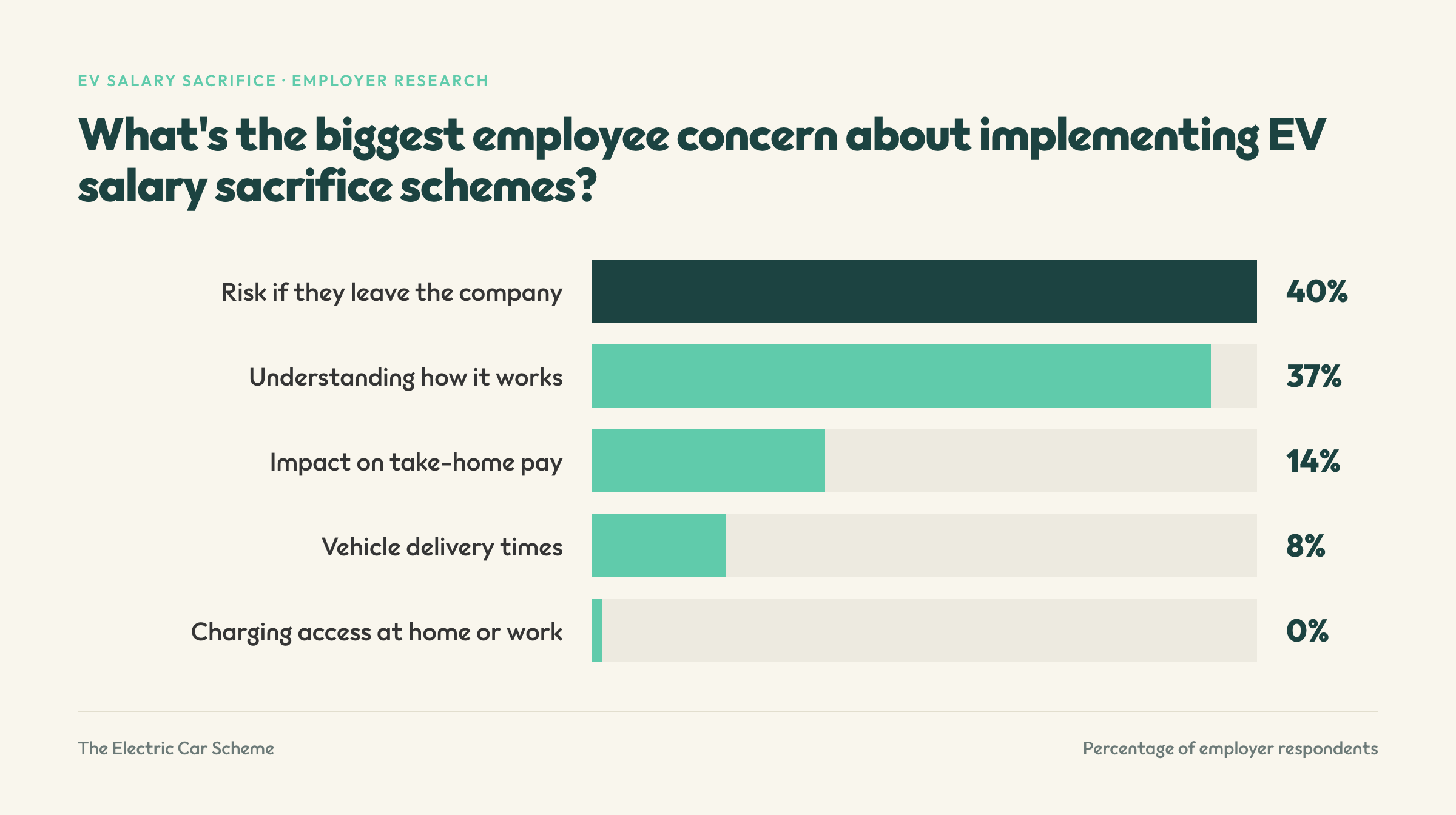
As EV salary sacrifice schemes become available to organisations of different sizes, people leaders also pre-empt the questions employees are most likely to raise before taking part in the programme. The leading concern, identified by 40%, is the risk of leaving the company before the agreement ends, underscoring the importance of understanding the commitments involved and the potential financial implications if employment changes.
Close behind, 37% identify understanding how the scheme works as the biggest concern, reinforcing the need for clear communication and straightforward guidance. Industry experts have also noted that salary sacrifice arrangements are often misunderstood, underscoring the importance of education for successful implementation.
Other concerns are less common but still influence employee decisions. 14% of people leaders identify the impact on take-home pay as the main issue, showing that employees want clarity about how salary deductions affect their monthly income. A smaller share of 8% view vehicle delivery times as the biggest concern, reflecting practical considerations around when an EV will become available.
None of the people leaders identify charging access at home or work as the main issue. This is likely because the UK government is increasing access to EV chargers in line with its 2030 goal of banning the sale of petrol and diesel vehicles.
How are people leaders communicating the launch of EV salary sacrifice schemes to staff?
62% of people leaders don’t yet have a formal communication plan in place for staff for the launch of implementing an EV salary sacrifice scheme, 16% have planned one-to-one HR consultations, 9% will host a company-wide town hall or webinar, 8% will use manager-led briefings, and 4% will communicate with staff via email and intranet updates
Where needed, communication plans are in place:
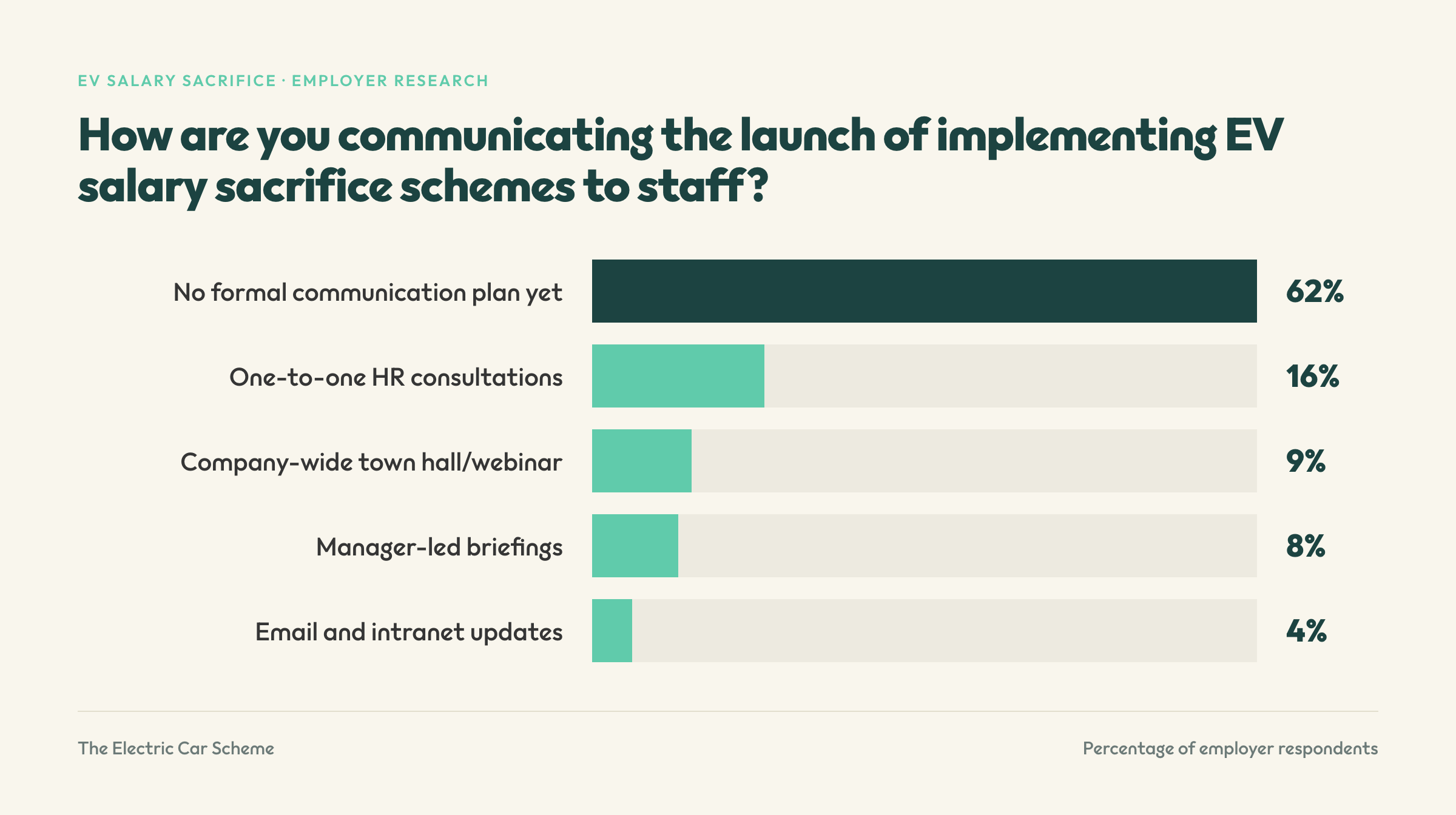
After identifying the main questions employees have about EV salary sacrifice schemes, how organisations communicate their launch becomes especially important. Despite the need for clear information, 62% of people leaders have no formal communication plan in place. This implies that many organisations are still developing their approach to introducing the scheme, even though effective communication can help employees understand how it works and what to expect.
Among those using structured communication methods, one-to-one HR consultations are the most common, with 16% choosing personalised discussions to explain the scheme and answer individual questions. Company-wide town halls or webinars account for 9% of our audience, providing employees with the opportunity to receive information through shared presentations and group discussions.
8% of people leaders rely on manager-led briefings, reflecting the value of direct conversations between employees and their line managers. Only 4% use email and intranet updates as their primary communication channels, underscoring the need to make digital resources available to staff at their convenience.
How do people leaders handle leavers when implementing EV salary sacrifice schemes?
When leaving a company, 27% of people leaders handle the matter of an EV salary sacrifice scheme by letting the employee take on the lease personally, 25% let their provider manage the process end-to-end, and for 5%, the employee returns or re-leases the vehicle; however, 24% are not yet decided what happens when an employee leaves, and 19% are unclear on this process
Leaving is something to be planned for:
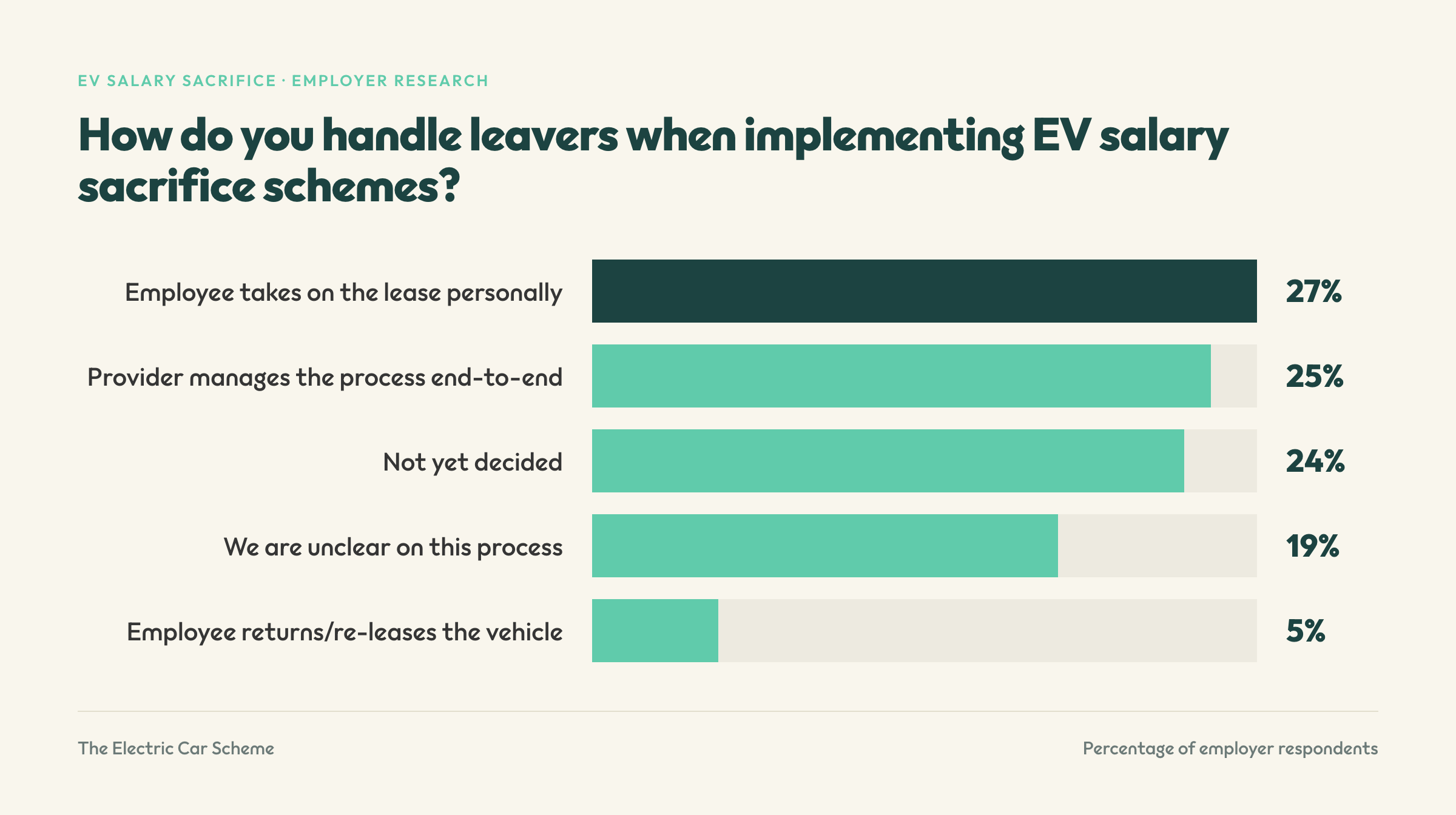
Understanding how an EV salary sacrifice scheme works should also cover what happens when a scheme-enrolled employee leaves the organisation. The most common approach, adopted by 27% of people leaders, is for the employee to take on the lease personally. This provides a clear route for continuing the agreement after employment ends.
Close behind, 25% rely on the scheme provider to manage the process from start to finish, marking the value of specialist support in handling administrative or contractual requirements.
Not every organisation has established a clear approach. 24% have not yet decided how they will manage employees leaving while participating in an EV salary sacrifice scheme, indicating that this area remains under development.
Another 19% of our audience is unclear on the process, showing that additional guidance and planning may still be needed before implementation is fully established. Only 5% require the employee to return the vehicle or arrange for it to be re-leased, making this the least common approach.
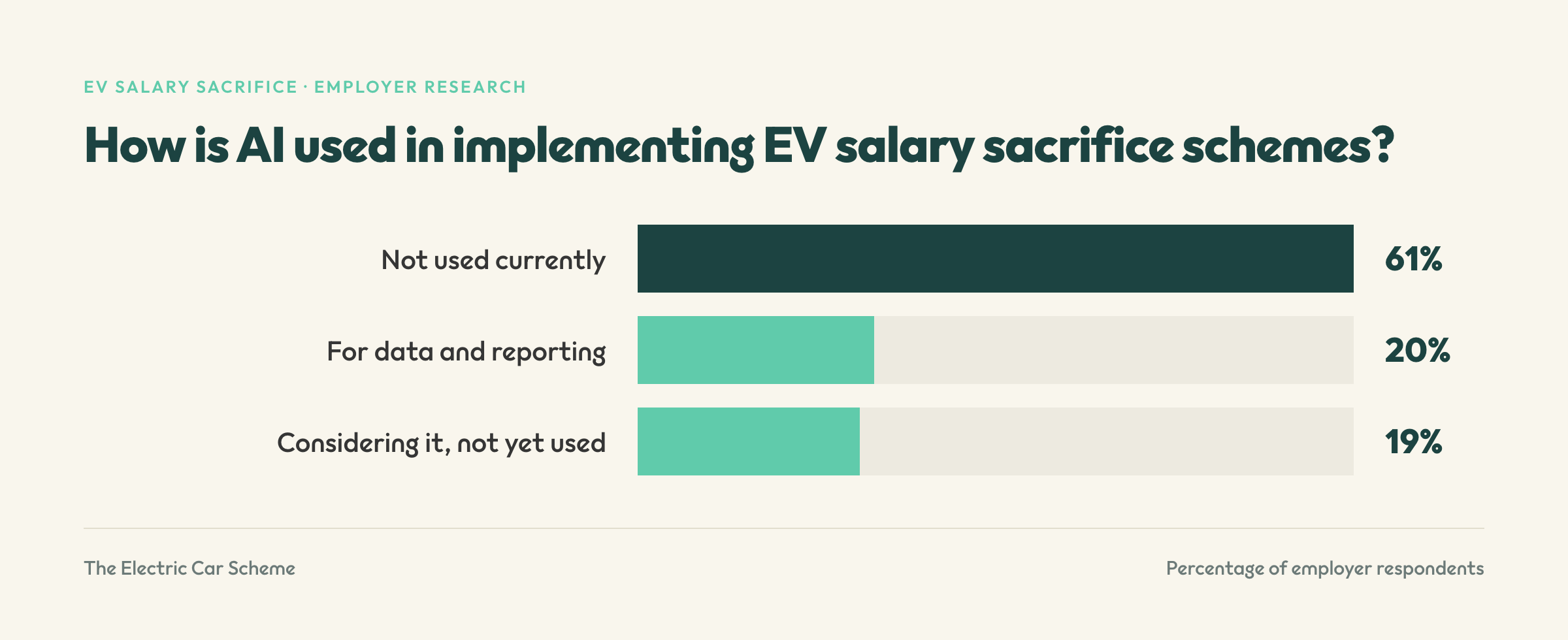
According to people leaders, how is AI used in implementing EV salary sacrifice schemes?
20% of people leaders are using AI for data and reporting when implementing EV salary sacrifice schemes, 19% are considering using AI but are not doing so yet, and 61% are not using AI currently for this purpose
AI use is not yet widespread:
As organisations refine their approach to managing EV salary sacrifice schemes, attention is also turning to the role of artificial intelligence in supporting implementation.
At present, 61% of people leaders do not use AI as part of the process, revealing that many organisations continue to rely on established systems and manual processes while introducing and managing their schemes. At the same time, broader workplace trends indicate that HR teams are increasingly exploring how AI can enhance benefits administration and improve operational efficiency.
Among those already using AI, 20% apply it to data analysis and reporting; some of the functionalities include using metrics for automated insights for monitoring scheme performance, tracking participation, and supporting informed decision-making. 19% of people leaders are considering AI but have not yet introduced it, demonstrating growing interest in its potential as organisations become more familiar with the technology.
Moving from awareness to action
As these findings show, EV salary sacrifice schemes are steadily moving from a niche employee benefit to a mainstream consideration for UK employers.
While many organisations are still navigating implementation, tax rules, and operational processes, there is growing recognition of the value these schemes can offer for employee retention, sustainability, and long-term workforce planning. The results also show that confidence increases with understanding.
As knowledge improves, providers refine their support, and businesses gain practical experience, more employers are likely to view EV salary sacrifice schemes as a realistic, scalable addition to their wider benefits strategy.
Last updated 28.07.26
