
The Tesla Model 2 (Model Q, Redwood): what happened to the £25,000 Tesla? Key information and insights for 2026
Key insights:
Tesla never officially named or launched a "Model 2"; the £25,000 car was reported cancelled by Reuters in April 2024 and Elon Musk called a conventional $25,000 Tesla "pointless" in October 2024.
The "Model Q" or "Redwood" reported in December 2024 was said to be 15% smaller and 30% lighter than a Model 3 with a 53kWh or 75kWh LFP battery, but it never arrived in the first half of 2025 as claimed.
What Tesla actually launched were the Model 3 Standard and Model Y Standard, priced from £37,990 and £41,990 in the UK, roughly £13,000 above the rumoured entry price.
Through The Electric Car Scheme, employees save 20-50% on any Tesla by paying from gross salary at a 4% Benefit-in-Kind rate for 2026/27.
For the best part of six years the cheapest car Tesla was supposed to build was the one that never existed. Known to the media as the Model 2, to Deutsche Bank analysts as the Model Q and inside Tesla as Redwood, the £25,000 Tesla generated more headlines than any car Tesla actually sells. This guide sets out what was promised, what was rumoured, what Tesla eventually delivered in its place, and what a more affordable Tesla still means for anyone considering an electric car salary sacrifice scheme in the UK. Where figures come from 2023 or 2024 reporting we say so, because a lot of what was written then did not survive contact with 2025.
What we know about the Tesla Model 2
The project started life in September 2020, when Elon Musk told Tesla's Battery Day audience that new cell technology would allow a "compelling $25,000 electric vehicle" within about three years. From that moment the car acquired a life of its own. It was previewed as a small hatchback, tipped to use a new low-cost production method and a structural battery pack, built from lightweight materials, and expected to carry the hardware for Full Self-Driving. Early estimates put the UK starting price at around £18,000 to £22,000, which would have undercut the Tesla Model 3 by more than half and put it head to head with the MG4, the BYD Dolphin, the Renault 5 and the Volkswagen ID.2.
Tesla itself was less forthcoming. By 2022 Musk said the company had "too much on its plate" and was not actively working on a $25,000 car, although a "smaller platform" that could be built at much lower cost was mentioned on the Q3 2022 earnings call. Investor Day in March 2023 showed off the manufacturing method (more on that below) without showing the car. In November 2023 Musk reportedly told staff at the Berlin Gigafactory that a €25,000 (around £21,700 at the time) model would be the plant's second product, and Tesla talked up plans to lift Berlin output from roughly 250,000 to one million cars a year.
Model 2, Model Q, Redwood: one car, three names
Tesla never named the car. "Model 2" was coined by fans as a nod to the S3XY line-up, and Musk has never used it. He has explained that the Model 3 was originally meant to be the Model E until Ford objected to the trademark, and Tesla has avoided anything that might invite a repeat. Others called it the "Baby Tesla" because it would have been the smallest car in the range.
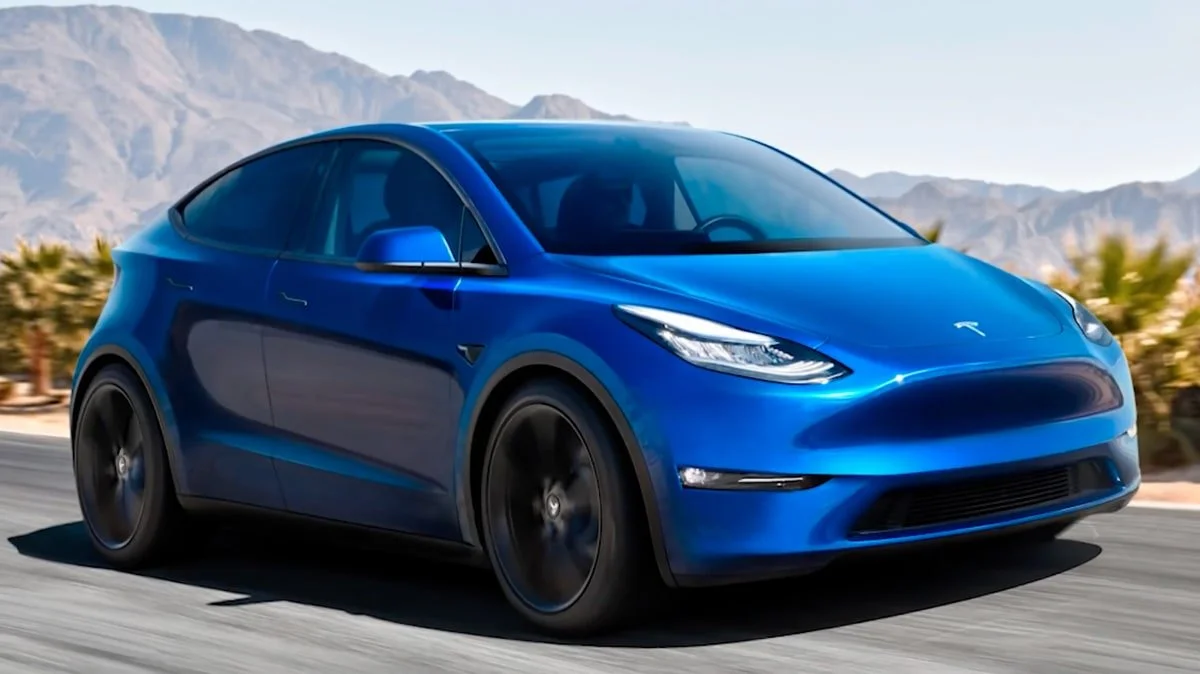
The most detailed public account came in December 2024. A Deutsche Bank investor note, written after Tesla's Head of Investor Relations Travis Axelrod met the bank's analysts in New York, described a new entry-level model the bank called the "Model Q". Internally the project was codenamed Redwood. The note said the car would launch in the first half of 2025, would be built on existing Model 3 and Model Y production lines rather than a new platform, and would be roughly 15% smaller and 30% lighter than a Model 3, which implied a length of around 3,988mm. The Model 2, the Model Q and Redwood were therefore the same rumoured affordable Tesla viewed through different sources, not three separate cars. It is worth stressing what the note did not do: it did not quote Tesla confirming a price, a name or a launch date, and when Tesla's own January 2025 results pointed to "more affordable models" arriving in the first half of 2025, the cars that eventually appeared were cheaper versions of the Model 3 and Model Y, not a new small car.
Has production of the Tesla Model 2 been cancelled?
Yes, in the form originally promised. On 5 April 2024 Reuters reported that Tesla had scrapped the low-cost car project, citing internal messages and three sources who said the decision was communicated to staff at a meeting in late February. A message from a programme manager on 1 March thanked the team for "executing the best design possible given the aggressive constraints we had to work within" and asked them to "tie things off and document things properly". Musk responded on X that "Reuters is lying (again)" without saying which part was wrong, and Tesla's April 2024 results then promised "new models" built on existing lines for 2025.
The clearest statement came on the Q3 2024 earnings call. Asked directly about a $25,000 car, Musk said that "having a regular $25,000 model is pointless. It would be silly. It would be completely at odds with what we believe", as Green Car Reports recorded at the time. The only sub-$30,000 Tesla he would commit to was the two-seat Cybercab robotaxi, which has no steering wheel or pedals. Tesla's resources moved to that project instead. Cybercab production began at Gigafactory Texas in early 2026 and the vehicle is being tested on public roads in Austin, but it is not a car you can buy, lease or salary sacrifice in the UK, and its unsupervised driving software remains unapproved.
The competitive backdrop explains a lot. BYD sold more than three million new energy vehicles in 2023 and outsold Tesla in pure EVs in the final quarter of that year. Building a $25,000 car profitably against Chinese electric cars that already sold for less was a harder proposition than it looked in 2020.
Is a smaller Tesla back on the table in 2026?
Possibly. In April 2026 Reuters reported that Tesla is again developing a compact electric SUV positioned below the Model 3, around 4.28m long and about 1.5 tonnes, with a smaller battery and a single motor, priced "substantially below" the Model 3 and built first in Shanghai. Electrek's summary of the report notes that the project is at an early stage, production is unlikely before 2027 and Tesla declined to comment. Treat it as a rumour with form: the 2024 reports were also sourced and specific, and the car they described was cancelled.
The $25,000 Tesla: Tesla Model 2 price, specs, and battery range

The "$25,000 car" label came from Battery Day in 2020, and every price estimate since has been a derivative of it. By 2023 inflation and supply shortages had pushed most observers to expect £30,000 to £35,000 at launch, with US tax credits bringing the effective price back towards £25,000. Musk had also suggested a UK figure of around £22,000, less than half the £48,490 that a Model 3 Standard Range RWD cost at the time, and the Berlin briefing pointed to €25,000. The December 2024 Deutsche Bank note settled on a US starting price under $30,000, which converted to roughly £25,000 after incentives.
None of those prices was ever attached to a real car. The table below sets the December 2024 rumours against what Tesla actually put on sale.
| Feature | Model Q / Redwood (rumoured, Dec 2024) | Model 3 Standard (real, UK) | Model Y Standard (real, UK) |
|---|---|---|---|
| UK price | ~£25,000 (after incentives) | £37,990 at launch (Jan 2026) | £41,990 at launch (Dec 2025) |
| Battery | 53kWh LFP (base) or 75kWh LFP (long range) | Smaller LFP pack than other Model 3s | Smaller pack than other Model Ys |
| WLTP range | Up to 310 miles (long range) | 332 miles | 314 miles |
| Drive | RWD and AWD planned | RWD | RWD |
| Size vs Model 3 | ~15% smaller, ~30% lighter, ~3,988mm long | Same body | Same body |
| Status | Never launched | On sale | On sale |
Rumoured specifications: body, battery and performance
The consensus was that the Model 2 would be a scaled-down Model 3 or Model Y in hatchback form, with a simpler interior, fewer options and no heated rear seats. The December 2024 reporting was more specific: two LFP battery options, a 53kWh base pack and a 75kWh long-range pack, a range of up to 310 miles (500km) for the larger battery, and both rear-wheel-drive and all-wheel-drive versions. LFP chemistry made sense for the price point because it is cheaper and more tolerant of daily full charging than NMC, at the cost of energy density. Earlier reports from China had suggested BYD Blade cells as an alternative. Performance was expected to be modest by Tesla standards, with 0-60mph in the five to seven second range and a softer suspension set-up, and FSD hardware was assumed to be standard with the software sold as a subscription.

What Tesla actually launched: the Model 3 Standard and Model Y Standard
In October 2025 Tesla unveiled Standard versions of its two best-sellers in the US, and they reached the UK in December 2025 (Model Y) and January 2026 (Model 3). The Model Y Standard arrived at £41,990 with a 314-mile WLTP range, a closed glass roof, manual seat and mirror adjustment and a seven-speaker audio system. The Model 3 Standard followed at £37,990 with 332 miles of range, 0-60mph in 6.2 seconds and a UK-specific power reduction that puts it in insurance group 32, the lowest of any Tesla. Both drop ambient lighting, the rear touchscreen and active dampers, and both keep basic Autopilot and FSD-ready hardware.
These are good value cars, and the Model 3 Standard is comfortably the cheapest way into Tesla ownership in the UK. They are not the £25,000 Tesla. The gap between the rumoured entry price and the real one is around £13,000, which is why the cheap Tesla story refuses to die. Our Tesla range guide for the UK compares every current variant, and the best value electric cars piece covers the rivals that do sit at or below £25,000.
Tesla's 'unboxed' production process
Whatever happens to the small car, the manufacturing idea behind it survives. At Investor Day in March 2023 Tesla's engineering chief Lars Moravy set out an "unboxed" process designed to cut factory footprint by 40% and per-vehicle build cost by up to 50%. Instead of moving a complete body shell down a line and repeatedly removing and refitting doors, the car is assembled in large sub-units. Seats are fixed directly to the structural battery pack, the pack is lifted into a body painted in sections, and the whole thing is joined late in the process. Tesla put the saving at roughly £830 per vehicle and admitted the difficulty of changing a production model that traces back to Henry Ford.
Moravy confirmed the first unboxed vehicle would not be a Model Y, and design chief Franz von Holzhausen said details of the next car would come later. Powertrain chief Colin Campbell added that the next-generation motor would use no rare-earth metals and that silicon carbide use had been cut by 75%, making the platform compatible with any battery chemistry. The Cybercab is the first product to use the method, so the £25,000 car's engineering lives on in a robotaxi. Any revived compact Tesla would almost certainly inherit it too.
Save 20-50% on a Tesla with The Electric Car Scheme
The Model 2 never became a salary sacrifice option, but the way we costed it in December 2024 still shows how the scheme changes the sums. At the time we estimated that a sub-£25,000 Tesla would have cost a 40% taxpayer around £250 to £300 a month for the base car and £300 to £350 for the long-range version through The Electric Car Scheme, after tax and National Insurance savings and with maintenance and breakdown cover included. Those figures were indicative, based on the Benefit-in-Kind rates and lease terms of the day, and they were for a car that never shipped, so treat them as a worked example rather than a quote. "This move represents Tesla's most serious attempt to democratise electric vehicles," said Gaurav Ahluwalia, Marketing Director at The Electric Car Scheme, when the Deutsche Bank note appeared. "The use of existing production lines could help Tesla achieve this aggressive price point while maintaining profitability." The first part remains true of the Standard variants; the second turned out to describe cheaper Model 3s and Model Ys rather than a new car.
The mechanism is the same for any Tesla you can lease today. With a salary sacrifice electric car the lease cost comes out of gross pay, so you do not pay income tax or employee National Insurance on that slice of salary. In return you pay Benefit-in-Kind tax at just 4% of the car's P11D value for the 2026/27 tax year, rising one point a year to 5% in 2027/28, 7% in 2028/29 and 9% in 2029/30, against up to 37% for a petrol or diesel car. The net effect is a saving of 20-50% compared with a personal lease, with higher-rate taxpayers at the top of that range. The employee tax savings guide walks through the arithmetic by tax band.
For a Tesla specifically, that means the Model 3 Standard and Model Y Standard become the affordable Teslas the Model 2 was meant to be, once the tax saving is applied. The Electric Car Scheme prices every car through multiple UK funders rather than a single lender, so the monthly figure reflects competition between them, and it offers new cars alongside used and nearly new Teslas delivered in around 14 days for anyone who wants a lower monthly cost still. Employers pay nothing to set the scheme up and are covered by Complete Employer Protection from day one, with no exclusion period and cover for resignation, redundancy, long-term sickness and parental leave. Through The Charge Scheme employees can also salary sacrifice home, workplace and public charging and save 20-50% on that as well. The Electric Car Scheme was named Best Salary Sacrifice Provider by Car Sloth in 2024 and 2025 and EV Salary Sacrifice Provider of the Year 2026 by SME News, and holds a 4.8 out of 5 rating on Trustpilot. Our guide to Tesla salary sacrifice covers the Tesla-specific details.
Market impact: what the cheap Tesla did without existing
The Model 2 changed the market as a threat rather than a product. Every credible report of a £25,000 Tesla put pressure on legacy manufacturers to bring forward their own small EVs and cut entry prices, and the results are on sale now: the Renault 5, the Citroën ë-C3, the Hyundai Inster, and the small Volkswagen that grew out of the ID.2 concept all landed in the window the Model 2 was supposed to fill. Tesla's own Standard variants then reset expectations for what a mid-size electric SUV should cost. As the best electric cars to salary sacrifice list shows, the sub-£30,000 segment is now crowded with cars that did not exist when the first Model 2 rumours appeared.
The used market felt it too. Each wave of cheaper new EVs, whether Tesla's price cuts in 2023, the Standard variants in 2025 or the prospect of a genuinely cheap Tesla, puts downward pressure on the residual values of existing electric cars. That is painful for anyone who bought outright, but it is the reason a nearly new electric car through salary sacrifice has become such good value: the lease price reflects a lower residual, and the tax saving applies on top. If Tesla's rumoured 2027 compact SUV does arrive, expect the same pattern again.
Should you wait for the Tesla Model 2?
No. There is no confirmed car, no confirmed price and no confirmed date, and the one thing Tesla has said clearly is that a conventional $25,000 model is not on its roadmap. The 2026 Reuters report is worth watching, but on its own timeline nothing reaches the UK before 2027 at the earliest, and a typical salary sacrifice term is two to four years. Anyone who waited from the December 2024 "first half of 2025" reports has now waited through two Standard-variant launches and a BiK rise from 2% to 4%.
The practical choice is between the Model 3 Standard and Model Y Standard on a salary sacrifice scheme, a used or nearly new Model 3 or Model Y at a lower monthly cost, or one of the genuinely sub-£25,000 rivals that the Model 2 was meant to fight. The EV salary sacrifice calculator shows what each route costs from your take-home pay, and salary sacrifice savings are secured in law to at least 2030, so there is no tax reason to hold off.
The bottom line
The Tesla Model 2, Model Q and Redwood were the same rumoured car under three names, and that car was never built. Tesla cancelled the conventional £25,000 project in 2024, called it pointless, and launched cheaper Model 3 and Model Y Standard variants from £37,990 and £41,990 in the UK instead, while moving the low-cost engineering into the Cybercab. A smaller Tesla may yet return, but not before 2027 and not at £25,000. For UK drivers who want an affordable Tesla now, the 4% Benefit-in-Kind rate for 2026/27 and a 20-50% saving through The Electric Car Scheme do the job the Model 2 was supposed to do.
Ready to see what a Tesla would cost you each month? Get an instant salary sacrifice quote on any new or used electric car, or if you are an employer, find out how salary sacrifice works for companies and book a demo.
Last reviewed: 18/09/2026
