
Autumn Budget 2026: What Could Change for Electric Car Salary Sacrifice, BiK Tax and Pay-Per-Mile
The Chancellor stands up in
As it happens
What the Chancellor says on electric cars, BiK and pay-per-mile, posted here as it's announced, with what it means for your salary sacrifice quote. Newest first.
- Loading updates…

The Autumn Budget could touch several things that affect what an electric car costs to run: Benefit-in-Kind tax (the tax you pay for having a company car, including one you lease through a salary sacrifice scheme), pay-per-mile road tax, fuel duty and the cost of charging at home. What it is very unlikely to touch is the thing your saving is built on. Salary sacrifice works because you pay for the car out of gross salary, before income tax and National Insurance. That is how you save 20-50%, and no Budget rumour points at it.
The rates on your quote are already law. Benefit-in-Kind on electric cars is 4% for 2026/27 and rises in small steps to 9% in 2029/30. A Budget can add to that table, and if it does, that is good news because it prices the later years of your lease. It cannot quietly change the years already published. So if you have a car on order, or are deciding whether to, cars ordered now are priced on known rates. Below is each thing that might change, what people are expecting, and what it would mean for you. We will update this page the same afternoon.
Will the Budget Change Benefit-in-Kind Tax on Electric Cars?
Benefit-in-Kind, or BiK, is the tax you pay for having a company car. For electric cars it is low on purpose: 4% in 2026/27, then 5%, 7% and 9% by 2029/30 (see our BiK rates page). A typical petrol company car sits at around 29%. On a £40,000 car, a 40% taxpayer pays £640 a year in BiK on the electric version and around £4,640 on the petrol one. That gap is where a lot of your saving comes from.
The speculation is about what happens after 2029/30, where the published table currently stops. The Budget could add 1 or 2 more years, and the expectation is that they would be in the region of 11% and 13%, still a fraction of petrol. If that happens, a 4-year lease signed today is priced for every single year of its term. If it does not, nothing changes: the rates you have today are the rates that apply. Either way, there is no scenario on the table where your BiK goes up for the years already published.

Thom Groot, CEO at The Electric Car Scheme, said:
“This Budget is the new Government’s chance to show it is serious about making net zero affordable for working households.
“Salary sacrifice is one of the most effective tools it has, and it should be protected and extended.
“Three changes would make the biggest difference: cap BiK on electric cars at 9% until 2035, with a lower rate for used EVs, so employers can plan with confidence and more people can afford to switch.
Could Used Electric Cars Get Cheaper to Tax?
Tax on a used company car is still based on what it cost new, not what it is worth now. A 3-year-old EV that sold for £40,000 new is taxed as a £40,000 car. There has been talk of the Budget changing that for electric cars, so that tax reflects the car's current value. We see no strong sign of it, but if it lands it would make used electric car salary sacrifice cheaper still. Used cars already come with the same 20-50% saving and delivery inside 14 days, so you are not waiting on it either way.
Pay-Per-Mile Road Tax: What the Budget Could Change
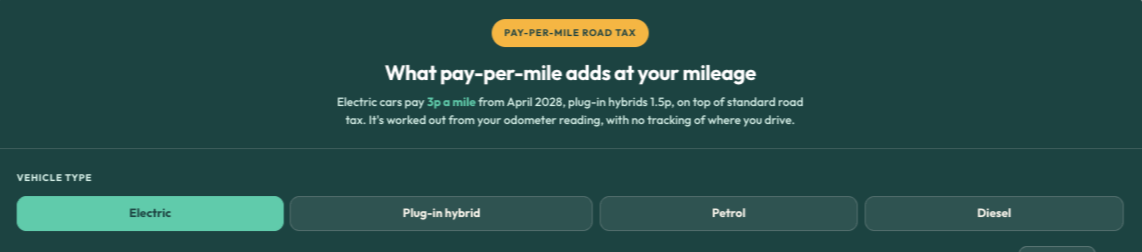
Pay-per-mile road tax (the official name is Electric Vehicle Excise Duty, or eVED) was announced at Autumn Budget 2025 and confirmed in July 2026: 3p per mile for electric cars from April 2028, based on your odometer reading, with no tracking of where you drive. At 10,000 miles a year that is £300, or £25 a month. A petrol driver covering the same miles pays roughly twice that in fuel duty.
This is the measure people are speculating about most. Could the rate go above 3p? Could the start date move earlier than April 2028? Could plug-in hybrids lose their half rate? Any of those would be in the Red Book annex on the day, and we would recalculate the same afternoon. What they would not change is the basic picture: even at a higher rate, an electric car pays a fraction of the per-mile tax a petrol car pays, and pay-per-mile does not touch the salary sacrifice saving itself. Our pay-per-mile calculator shows what it adds at your mileage.
Will More Electric Cars Escape the Expensive Car Supplement?
Cars with a list price over £40,000 pay extra road tax every year for 5 years, called the Expensive Car Supplement. Plenty of mid-range electric cars tip over that line. The government has said it would consider a higher threshold for electric cars, and if the Budget does it, a lot of popular models get cheaper to run. On a scheme car, road tax is included in your monthly payment, so this would show up in the price you are quoted rather than as a separate bill.
Fuel Duty: If Petrol Gets Dearer, the Gap Gets Bigger
Fuel duty comes up at every Budget. The temporary 5p cut from 2022 is being unwound in stages and the speculation is whether that speeds up or pauses.If duty rises, petrol costs more per mile and the gap between petrol and electric running costs gets wider. If it is frozen, the gap stays where it is, which already favours electric. It does not touch your salary sacrifice saving either way. Our savings calculator shows the full picture at your tax band.
Although a pause is somewhat likely, rising fuel prices are going to continue making EVs more competitive against petrol and diesel cars.
Charging at Home: VAT, Energy Bills and Driveways
Three smaller things could change what it costs to charge. Zero VAT on home batteries and solar panels is due to end on 31 March 2027 , and an extension is possible. Domestic electricity is temporarily zero-rated for VAT until 31 March 2027, and whether that continues is a Budget decision; public chargers still carry 20% VAT. And there is talk of making it easier to run a charging cable across the pavement, which would open up home charging for people in terraced houses without a driveway.
What it means for you: charging at home is the cheapest way to run an EV, and The Charge Scheme lets you pay for home, workplace and public charging through salary sacrifice with the same 20-50% saving.
What This Means for Employers
If you run the scheme for your company, the Budget changes very little. The scheme sits on law that is already in place, and the employer National Insurance saving on sacrificed salary carries on as before. The one thing to expect is the new National Living Wage and National Minimum Wage rates for April 2027, which are announced at almost every Budget. Salary sacrifice cannot take an employee's pay below minimum wage, so new rates raise the floor for who can join. We update the eligibility check on our side when the rates are published. Payroll does nothing until April.
Complete Employer Protection from day one is unaffected by anything on the list above. If you want to walk through it with us, register for our Budget webinar on Tuesday 3 November, 9:30 to 10:30.

Frequently Asked Questions
Should I Wait Until After the Budget to Order?
No. The rates behind your monthly cost, 4% BiK for 2026/27 and the published path to 2029/30, are already law. Waiting moves your delivery date, not your price. If anything does change at the Budget, we update this page the same afternoon.
Will My Monthly Cost Change?
Not unless the Budget rewrites rates that are already law, which nobody is expecting. Your quote is built on the published BiK table and your tax band. If a new rate is announced for a future year, it applies from that tax year and we tell you before it does.
Will the Budget Change Benefit-in-Kind on Electric Cars?
The published path, 4% in 2026/27 rising to 9% in 2029/30, is expected to stay. What might be added is rates for 2030/31 and beyond, which is good news if you are on a longer lease because it prices the final year.
Is Pay-Per-Mile Starting Sooner or Costing More?
That is the speculation, but nothing has been announced. Pay-per-mile for electric cars is set at 3p per mile from April 2028 around £300 a year at 10,000 miles. Any change would be in the Red Book on the day, and even a higher rate leaves electric paying far less per mile than petrol.
Does Salary Sacrifice Still Save Me Money if Fuel Duty Goes Up?
Yes, and by more. Your saving comes from paying for the car out of gross salary and a 4% BiK rate for 2026/27. Fuel duty touches neither. Dearer petrol just makes the electric car look better.
I Run Our Company's Scheme. Do I Need to Do Anything After the Budget?
Almost certainly not. The one likely change is new minimum wage rates for April 2027, which raise the eligibility floor; we update the checks on our side and payroll does nothing until April. We cover the detail at the webinar on 3 November.
Will Salary Sacrifice Be Extended to Home Energy?
It has been talked about, but there is no sign of it at this Budget. If that changes, we will say so here.
Where Can I Read the Official Documents?
HM Treasury publishes the Budget Red Book on gov.uk and the Office for Budget Responsibility publishes its Economic and Fiscal Outlook on obr.uk, both as soon as the speech ends. The rate tables are in the Red Book annex, not the speech. We link to both above once they are live.
Cars ordered now are priced on rates that are already law, so see what yours would cost with an instant quote.
This is general information, not tax advice. Benefit-in-Kind rates and thresholds can change; the current figures are in HMRC's guidance on tax on company benefits.
You Might Also Like…



Our pricing is based on data collected from The Electric Car Scheme quote tool. All final pricing is inclusive of VAT. All prices above are based on the following lease terms; 10,000 miles pa, 36 months, and are inclusive of Maintenance and Breakdown Cover. The Electric Car Scheme’s terms and conditions apply. All deals are subject to credit approval and availability. All deals are subject to excess mileage and damage charges. Prices are calculated based on the following tax saving assumptions; England & Wales, 40% tax rate. The above prices were calculated using a flat payment profile. The Electric Car Scheme Limited provides services for the administration of your salary sacrifice employee benefits. The Electric Car Scheme Holdings Limited is a member of the BVRLA (10608), is authorised and regulated by the FCA under FRN 968270, is an Appointed Representative of Marshall Management Services Ltd under FRN 667174, and is a credit broker and not a lender or insurance provider.
Copyright and Image Usage: All images used on this website are either licensed for commercial use or used with express permission from the copyright holders, in compliance with UK and EU copyright law. We are committed to respecting intellectual property rights and maintaining full compliance with applicable regulations. If you have any questions or concerns regarding image usage or copyright matters, please contact us at marketing@electriccarscheme.com and we will address them promptly.
