Best Electric Cars for the School Run in 2026

The best electric cars for families doing the school run in 2026 share three things in common: ISOFIX points that actually fit where you need them, a boot that swallows a buggy or scooter without a fight, and a daily range that never gets close to running low. The average school run in the UK covers less than 10 miles, so range anxiety isn't really the issue here. Fit, visibility and the monthly cost through electric car salary sacrifice matter far more day-to-day.
This guide picks a winner for five different school-run priorities: best overall, best for tight city streets, best for fitting three car seats, best 7-seater, and safest. Each pick includes its net monthly cost through The Electric Car Scheme, so you can compare real numbers rather than list prices. We've kept this tightly focused on the school-run use case; for the wider field of family EVs, our guide to the best electric family cars to salary sacrifice covers more ground.
What Makes a Great School-Run EV?
A good school-run car isn't necessarily the one with the longest range or the flashiest spec sheet. It's the one that makes the twice-daily routine less stressful, from the moment you're wrestling a car seat into place to the moment you're squeezing into a space outside the school gates.
The criteria that matter most for this use case are specific enough to be worth listing out:
ISOFIX count and how easily a seat clicks into place without contortion
Boot space with the back seats up, for buggies, scooters and PE kit
Daily range comfortably ahead of a typical 10-mile round trip, with margin for after-school clubs and errands
Visibility and parking sensors, given how tight school car parks and drop-off zones usually are
Euro NCAP child occupant score, since this is the passenger group that matters most on this particular journey
Here’s an overview of the cars we’ve selected and how they compare against one another
| Model | Best For | ISOFIX Points | Boot Space |
|---|---|---|---|
| Kia Niro EV | Best overall | 2 (rear outer) | 475L |
| Renault 5 | Tight streets | 3 (2 rear outer + front seat) | 326L |
| Citroën ë-Berlingo | Three car seats | 3 (rear bench) | 775L |
| Peugeot E-5008 | 7-seater | 2 (middle row outer) | 348L (7 seats) / 916L (5 seats) |
| Volvo EX90 | Safety | 4 (2 middle row + 2 third row) | 310L (7 seats) / 655L (5 seats) |
Not sure what any of this would cost for your own circumstances? Try the savings calculator to get a feel for the numbers before reading on.
Best Overall For The School Run: Kia Niro EV
The Kia Niro EV is the strongest all-rounder on this list for the specific demands of a daily school run.
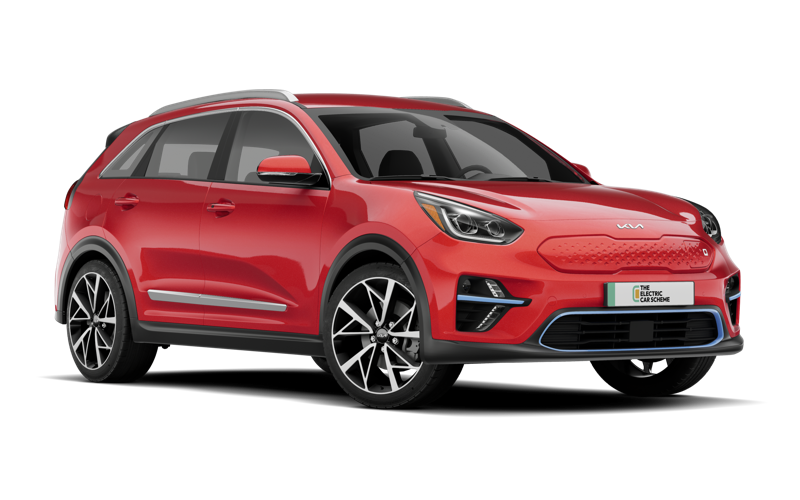
Its compact SUV footprint is easier to place in tight streets and school car parks than a full-size SUV, without giving up the boot space a growing family needs for buggies, scooters and the accumulated clutter of term time. The 475-litre boot is among the largest in its class, and two ISOFIX points on the rear bench's outer seats cover most single or two-child households.
Whatever it is, the way you tell your story online can make all the difference.
For families weighing up the wider field, our guide to the best electric family cars to salary sacrifice covers the Niro EV alongside other options in more depth. Through The Electric Car Scheme, it costs £651 a month for a 40% taxpayer on a 36-month term at 10,000 miles a year.
Best Small EV For Tight Streets: Renault 5
If your school run involves narrow residential streets or a car park with painfully tight bays, a smaller car makes daily life easier. The Renault 5 is compact enough to place confidently in gaps a larger SUV wouldn't attempt, while still offering a useful 326-litre boot for a folded buggy or scooter. ISOFIX points sit on the two outer rear seats, plus an additional mounting point on the front passenger seat, giving three fitting positions in total, though not the three-across-the-back layout some families need.
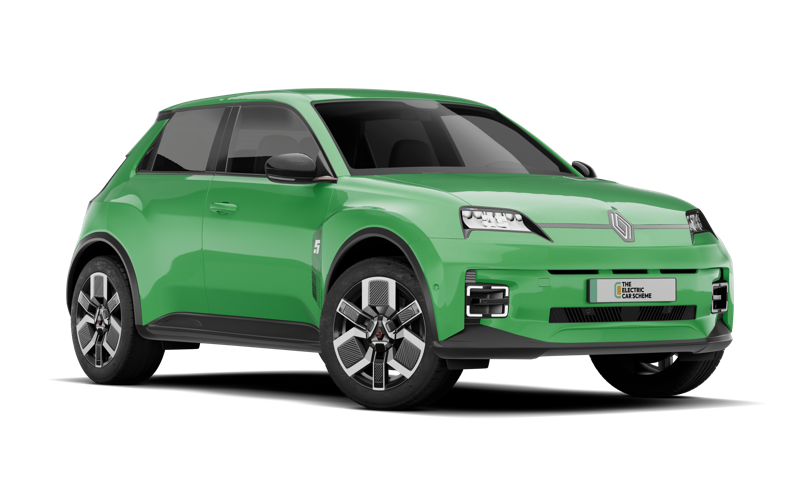
For a fuller field of compact options, our roundup of the best small electric cars goes into more detail on rivals such as the MG4 and Fiat 500e. Monthly cost through salary sacrifice comes in at £314 for a 40% taxpayer on the same 36-month term, the cheapest pick on this list.
Best for Three Car Seats: Citroën ë-Berlingo
Fitting three child seats across a single rear bench is one of the more specific and genuinely difficult problems in family car buying, and most electric cars simply can't do it without pushing a seat into the front. The Citroën ë-Berlingo is a rare exception: each second-row seat comes with its own ISOFIX mounting as standard, and the cabin is wide enough to fit all three side by side in the back, where most parents prefer them.
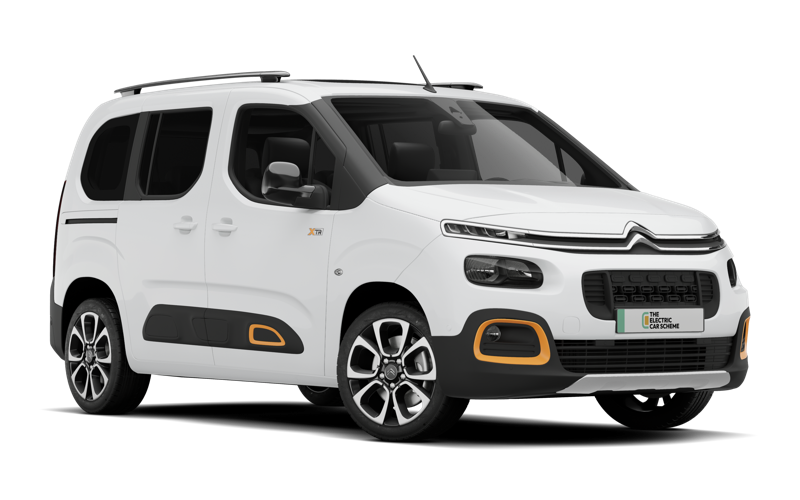
The load-carrying MPV body isn't going to win any style contests next to an SUV, but the payoff is a genuinely vast 775-litre boot for scooters, buggies and after-school sports kit, plus sliding rear doors that make loading children into tight spaces far less of a squeeze.
Families researching the wider car-seat question in more depth should also see our blog on the best EVs for car seats and children. The ë-Berlingo costs £500 a month through salary sacrifice for a 40% taxpayer on a 36-month term.
Best 7-Seater for The School Run: Peugeot E-5008
Once you're regularly ferrying more children than fit in a five-seater, whether your own or the school run rotation with neighbours, a genuine 7-seat EV changes the calculation. The Peugeot E-5008 stands out for the school run because its third row folds flat quickly, taking the boot from 348 litres with all seven seats in use to a genuinely useful 916 litres in five-seat mode. Two ISOFIX points sit on the middle row's outer seats.
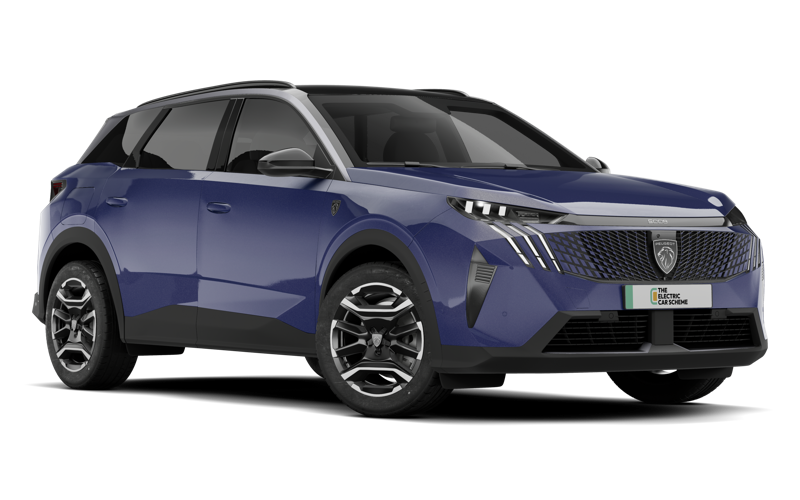
It sits at a lower price point than some rivals in the seven-seat class without a meaningful compromise on daily usability, which matters for a car that's doing a routine journey rather than the occasional long-distance trip. We go into more detail about the best electric 7-seater cars, covering the full category, including how the E-5008 compares with larger rivals.
The Safest Choice: Volvo EX90
For parents who put child safety above every other consideration, the Volvo EX90 is the clearest answer. It offers four ISOFIX points spanning both the second and third rows, an unusual level of provision for a seven-seat EV, and it recorded some of the highest scores Euro NCAP has ever awarded when it was tested in 2023, with particularly strong results in the child occupant protection category.
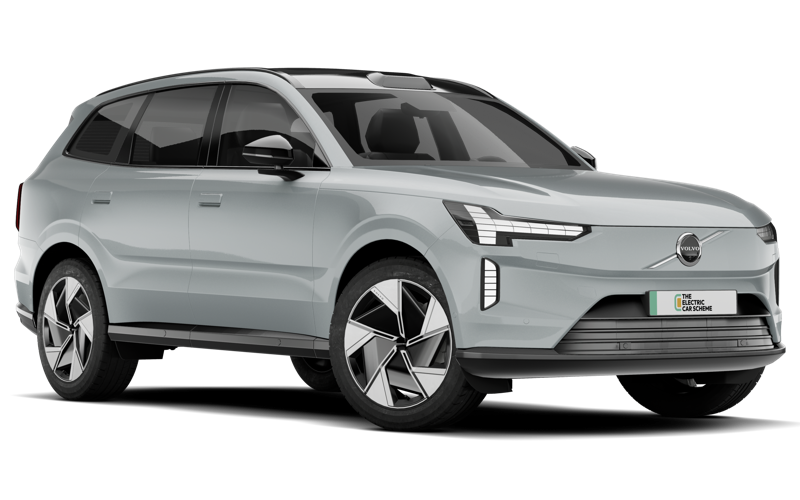
Day-to-day, that safety focus shows up in smaller ways too: a clear view out for reversing into tight drop-off spaces, and driver assistance systems tuned for exactly the kind of stop-start, pedestrian-heavy environment a school gate represents at 8:45 am. The boot holds 310 litres with all seven seats in use, rising to 655 litres with the third row folded.
It's the most expensive car on this list, at £878 a month through salary sacrifice for a 40% taxpayer on a 36-month term, but for families where safety is the deciding factor, it justifies the premium.
Running Costs Through EV Salary Sacrifice
Every car on this list benefits from the same tax treatment. Zero-emission vehicles sit at a 4% Benefit-in-Kind rate for 2026/27, compared with up to 37% for the petrol or diesel equivalent, which is the single biggest reason electric family cars have become so much cheaper to run through a workplace scheme than a personal lease. Employees typically save 20 to 50% compared with arranging the same car privately.
The table below compares all five picks on the criteria that matter most for a school run, alongside their net monthly cost.
| Model | Monthly Cost* |
|---|---|
| Renault 5 | £314 |
| Citroën ë-Berlingo | £500 |
| Peugeot E-5008 | £479 |
| Kia Niro EV | £651 |
| Volvo EX90 | £878 |
*Costs are illustrative for a 40% taxpayer on a 36-month term at 10,000 miles a year, correct at the time of writing. Get a personalised figure for your own tax band using our savings calculator, or go straight to our quote tool for any of these five models.
All costs through The Electric Car Scheme are single, predictable monthly payments that bundle in insurance, servicing and maintenance, breakdown cover, and road tax. There's no large upfront payment, and salary sacrifice usually doesn't involve a personal credit check. The Electric Car Scheme is an award-winning B Corp, independently certified for meeting high standards of social and environmental performance alongside its EV salary sacrifice offering.
Frequently Asked Questions
What EVs Should I Stay Away From?
There's no blanket answer here, since reliability varies by model year and specific trim rather than by brand alone. The safest approach for a school-run car is to check independent reliability data and Euro NCAP scores for the exact model and year you're considering, rather than relying on generalisations about a whole brand. All five cars featured in this guide have solid reliability track records and five-star or near-five-star Euro NCAP ratings.
What Is the Best Electric Car for a Child?
The Volvo EX90 is the strongest single pick for child safety, thanks to some of the highest Euro NCAP scores ever recorded and four ISOFIX points spanning its second and third rows. For families prioritising fit over outright safety scoring, the Citroën ë-Berlingo's three-across rear bench ISOFIX makes it easier to install multiple seats correctly.
What Is the 80% Rule for EVs?
The 80% rule refers to the common advice to charge an EV's battery to around 80% for daily use, rather than to 100%, since rapid charging slows significantly past that point and frequent full charges can add extra wear over time. For a school run of under 10 miles, most drivers won't need anywhere near 80% charge day to day, so this matters far more for longer trips.
Which EV Has the Least Problems?
Reliability data changes year to year as new models and updates are released, so it's worth checking current independent sources rather than relying on a fixed answer. In general, established models with several years on sale, such as the Kia Niro EV, tend to have more mature reliability data available than recently launched vehicles.
What Happens to Electric Cars After Eight Years?
Most electric cars remain fully usable well beyond eight years, with battery degradation typically modest under normal use. Manufacturer warranties on the battery pack commonly extend to eight years or more, and a well-maintained EV bought through salary sacrifice at this point would usually be considered for a used sale or continued private ownership.
There's no single best electric car for the school run, because the daily routine looks different for every family. What all five picks in this guide share is a school-run-specific strength, whether that's the Kia Niro EV's all-round practicality, the Renault 5's ease in tight streets, the Citroën ë-Berlingo's rare three-across ISOFIX fit, the Peugeot E-5008's flexible third row, or the Volvo EX90's class-leading safety record.
Whichever priority matters most for your family, the monthly cost through electric car salary sacrifice is worth checking against your own tax band before deciding. Every figure in this guide is illustrative for a 40% taxpayer, and your own saving may differ depending on salary and tax position.
Get a personalised quote to see your own monthly cost for any of these models.
ECS GUIDES AND ADVICE
Ready to Go Electric? Your Guides and Tools to a Smooth Switch
-
 How the Scheme Works
Find out how salary sacrifice can work for you or your business.
-
 The Charge Scheme
Save 20-50% on all charging costs through salary sacrifice - at home, the office, or in public..
-
 Complete Employer Protection
All employers and drivers are protected from day 1.
-
 Used Electric Cars
Discover the most affordable way to drive electric. Cars delivered in 14 days.
Are you an employer?
BOOK A DEMOAre you an employee?
SEE AVAILABLE CARSYou Might Also Like…


Last updated: 12.08.26
Our pricing is based on data collected from The Electric Car Scheme quote tool. All final pricing is inclusive of VAT. All prices above are based on the following lease terms; 10,000 miles pa, 36 months, and are inclusive of Maintenance and Breakdown Cover. The Electric Car Scheme’s terms and conditions apply. All deals are subject to credit approval and availability. All deals are subject to excess mileage and damage charges. Prices are calculated based on the following tax saving assumptions; England & Wales, 40% tax rate. The above prices were calculated using a flat payment profile. The Electric Car Scheme Limited provides services for the administration of your salary sacrifice employee benefits. The Electric Car Scheme Holdings Limited is a member of the BVRLA (10608), is authorised and regulated by the FCA under FRN 968270, is an Appointed Representative of Marshall Management Services Ltd under FRN 667174, and is a credit broker and not a lender or insurance provider.
Copyright and Image Usage: All images used on this website are either licensed for commercial use or used with express permission from the copyright holders, in compliance with UK and EU copyright law. We are committed to respecting intellectual property rights and maintaining full compliance with applicable regulations. If you have any questions or concerns regarding image usage or copyright matters, please contact us at marketing@electriccarscheme.com and we will address them promptly.