Electric cars for small businesses: a practical guide
Thanks for your interest in The Electric Car Scheme. Based on your headcount, we don't think our scheme is the right solution for your business right now, and we want to be upfront about that rather than waste your time.
The good news is that small businesses with fewer than around ten employees can still access the same UK tax savings that larger employer schemes use. This guide walks through the four practical routes available, depending on your business structure. The right choice depends on your headcount, your legal structure, who will be driving the car, and how much admin you want to take on.
If you actually have ten or more employees and you've landed here by mistake, book a call instead. Our scheme is likely a good fit, and we'd love to talk.
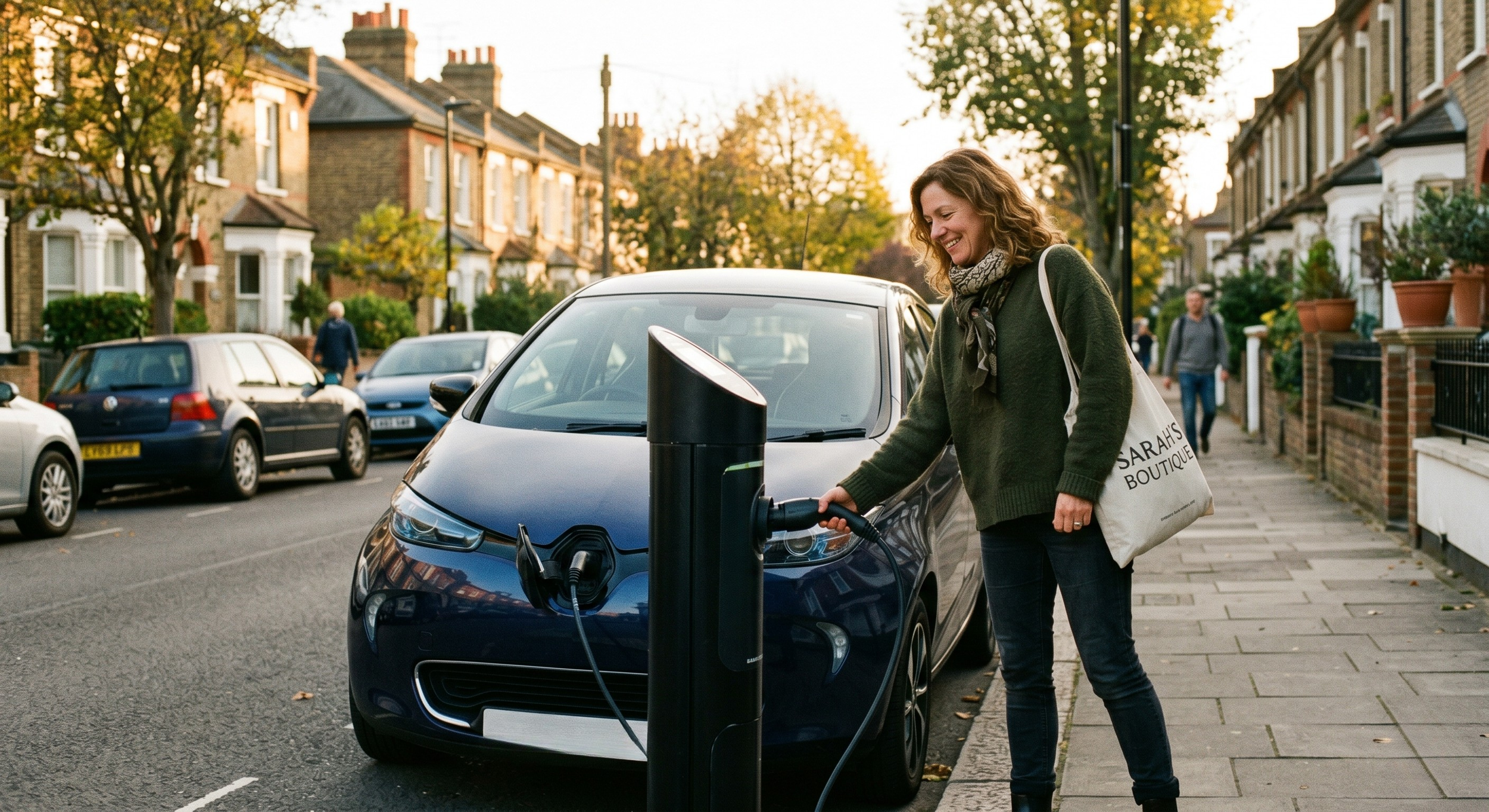
You access the same tax savings as larger employers
The tax framework that makes electric cars affordable in the UK is set by HMRC. It applies to every business, regardless of size. A sole trader, a five-person agency, and a 2,000-employee enterprise all use the same underlying rules.
Specifically, smaller businesses can access a low Benefit-in-Kind (BiK) rate on electric vehicles, currently 4% and significantly below petrol or diesel equivalents. They can use Income Tax and National Insurance relief on salary sacrificed for an EV where employees are involved, and Employer National Insurance savings on sacrificed salary. Limited companies that buy a new electric car outright qualify for 100% First Year Allowance, while sole traders and partnerships claim the same allowance against trading profit, apportioned for personal use. Lease payments funded by the business are deductible. VAT-registered businesses can typically recover 50% of the VAT on car lease payments where there's mixed personal and business use. Workplace charging provided by an employer is not a taxable benefit.
What changes at scale is lease pricing and administrative support, not the tax savings. Specialist providers aggregate volume across multiple lessors to secure lower lease rates, and they handle the admin and risk that comes with running a scheme. For smaller businesses, going direct means you keep the same tax savings while avoiding provider fees, but you take on the lease pricing and admin yourself.
The tax savings are the same. The route to access them is what differs.
Find the route that matches your structure
Your business structure determines which route fits best.
If you're a sole director of a limited company, or an owner-managed limited company with one or two people on the payroll, Route 1 is usually the simplest answer. The same logic applies to charities and Community Interest Companies (CICs), which use the same corporate tax mechanisms.
If you're a sole trader, a partner in a partnership, or a member of a Limited Liability Partnership (LLP), Route 2 is the route designed for you. The mechanics are different from a limited company because you're not technically an employee of your own business.
If you have a limited company approaching ten employees and you want to extend EV access to staff, Route 3 covers in-house salary sacrifice. This is the most admin-heavy route and only makes sense as you approach the scale at which a specialist provider becomes viable.
If you want minimal admin regardless of structure, or if your business mileage is moderate and you'd rather not put a car on your business at all, Route 4 covers personal leasing combined with HMRC approved mileage rates. It's the simplest option and often the right answer for low-mileage cases.
Route 1: Through your limited company, charity, or CIC
This route works for sole directors, owner-managed limited companies, charities, and CICs. It also covers contractor limited companies and small consultancies operating through a Ltd structure.
How it works
Your limited company funds the vehicle directly. You can either lease it through Business Contract Hire (BCH) or buy it outright. The car becomes a company asset or a company-leased vehicle. As a director or employee, you can use it personally and pay Benefit-in-Kind (BiK) tax on that personal use.
Charities and CICs follow the same mechanics. The organisation funds the vehicle, the driver pays BiK on personal use, and the corporate tax treatment matches that of any limited company.
Tax treatment
A 100% First Year Allowance applies if the company buys a new electric vehicle outright, meaning the full purchase price reduces the corporation tax bill in year one. Lease payments through BCH are deductible as a business expense, reducing taxable profit each year. VAT-registered companies can typically recover 50% of the VAT on lease payments where the car has mixed business and personal use. Insurance, servicing, and charging costs paid by the business are deductible. Mandatory payrolling of benefits in kind takes effect from April 2027, after which BiK is reported through PAYE rather than P11D.
Worked example: Priya, sole director
Priya runs a design consultancy as a limited company. She pays herself £55,000 a year. She's looking at a £40,000 electric vehicle on a Business Contract Hire lease at £500 a month, or £6,000 a year.
Going through the company, the £6,000 lease cost is deductible, generating a £1,140 corporation tax saving at the small profits rate. Priya picks up Class 1A Employer NI on the BiK of around £240 a year (Employer NI on the £1,600 BiK value), and pays £640 of BiK income tax personally as a higher-rate taxpayer. Her total annual cost works out at around £5,740.
Leasing the same car personally would mean funding £6,000 a year from take-home pay. As a higher-rate taxpayer, Priya would need around £10,345 of gross salary to clear that £6,000 net, after Income Tax and National Insurance. Going through the company saves her around £4,600 a year.
If Priya buys the car outright instead of leasing, she captures the full £40,000 against corporation tax in year one through the 100% First Year Allowance. That's a £7,600 corporation tax reduction in a single year for a small profits rate company.
When this is the right choice
You operate through a limited company, charity, or CIC. You'd be the main driver, or the car will be used by a small number of named directors or employees. You want a clean corporate tax treatment and you don't need to extend salary sacrifice to a wider workforce.
Leasing or buying through the company is the simplest route for owner-managed structures.
Route 2: Through your trade (sole traders, partnerships, LLPs)
This route works for sole traders, partners in traditional partnerships, and members of LLPs. It also applies to self-employed professionals, freelance consultants, and small practices structured as partnerships.
How it works
You buy or lease the EV through your business and claim the costs against your trading profit. Because you're not an employee of your own business, BiK doesn't apply. Instead, you apportion the vehicle's costs between business and personal use.
The apportionment is based on the percentage of business mileage versus total mileage. If the car is used 70% for business and 30% personally, you claim 70% of the deductible costs.
Partners in partnerships and members of LLPs follow the same logic. The vehicle is held within the partnership, costs are claimed at partnership level, and each partner's tax saving depends on their share of the profits and their personal marginal rate.
Tax treatment
If you buy a new electric vehicle outright, 100% First Year Allowance applies, but it's apportioned for personal use. So a 70% business use case on a £40,000 EV gives you a £28,000 deduction against trading profit in year one.
If you lease through your trade, the lease payments are deductible against profit, again apportioned for business use. A £6,000 annual lease at 70% business use gives you £4,200 of deductible cost per year.
VAT-registered businesses can typically recover 50% of the VAT on lease payments where there's mixed use, regardless of whether you're a sole trader or a limited company. The 50% rule is a flat block applied by HMRC.
You can't use mileage rates and capital allowances on the same vehicle. If you put the car through your trade, you claim actual running costs apportioned for business use. If you use mileage rates (Route 4), you can't also claim capital allowances or lease costs.
Worked example: Marcus, sole trader
Marcus is a self-employed consultant operating as a sole trader. His trading profit is £60,000 a year. He uses his car around 70% for business and 30% personally. He's looking at a £40,000 electric vehicle.
If Marcus buys the car outright through his trade, the 100% First Year Allowance applies to the business-use portion. That's £28,000 (70% of £40,000) deductible against his trading profit in year one. As a higher-rate taxpayer, his marginal rate combines Income Tax and Class 4 National Insurance, working out to around 42%. The deduction saves him roughly £11,760 in year one. Going forward, he can claim 70% of running costs (insurance, servicing, electricity) against his trading profit each year.
If Marcus leases instead, the £6,000 annual lease cost is 70% deductible. That's £4,200 against trading profit, saving him around £1,764 a year at his marginal rate. He still claims 70% of running costs separately. Cash flow is easier because there's no upfront capital, but the annual saving is smaller than the year-one outright purchase saving.
If Marcus is VAT-registered, he can also recover 50% of the VAT on lease payments. On a £6,000 annual lease, that's typically several hundred pounds of recovered VAT per year.
When this is the right choice
You're a sole trader, in a partnership, or a member of an LLP. You use the car significantly for business (typically 50% or more makes the apportionment worthwhile). You're comfortable tracking business versus personal mileage to support the apportionment.
Going through the trade is the standard route for self-employed people who use a car materially for work.
Route 3: In-house salary sacrifice
This route works for businesses approaching the ten-employee mark who want to offer EVs as a benefit before they reach the scale at which a specialist provider becomes viable. It applies to limited companies, charities, and CICs with employees.
How it works
You set up a salary sacrifice agreement directly with each participating employee. The employee agrees to reduce their gross salary by a set amount each month. In exchange, the business funds the lease for an EV the employee uses. The employee pays BiK on the vehicle. The business saves Employer National Insurance on the sacrificed salary.
What you take on as the employer
You source and sign the lease agreement, usually through BCH, and fund the lease payments before recovering them through payroll deductions. You handle insurance, maintenance, and breakdown cover, or build these into the lease. You report BiK through PAYE once mandatory payrolling takes effect from April 2027 (P11D until then). And you carry the financial risk if an employee leaves, goes on long-term sick, or takes parental leave.
The risks to consider
The biggest risk is early termination cost. If an employee leaves mid-lease, the business may be liable for thousands of pounds in termination fees. Complete Employer Protection covers this on third-party schemes, but running salary sacrifice in-house, you carry the risk yourself. With a small workforce, a single leaver can have a significant financial impact.
Lease pricing is the second consideration. Without aggregating volume across multiple lessors, you may pay more for the same vehicle than a specialist provider would secure. The tax savings are identical, but the underlying lease cost can be higher.
The third consideration is admin load. Salary sacrifice requires accurate payroll changes, BiK reporting, and ongoing communication with employees. There's also a National Minimum Wage check: salary sacrifice cannot reduce an employee's pay below NMW, which means you'll need to verify this for each participant on each pay run.
Worked example: Tom, employee at an eight-person agency
Tom earns £40,000 a year. His employer offers an in-house salary sacrifice arrangement on a £40,000 EV at £450 a month, or £5,400 a year. Tom is a basic-rate taxpayer.
Without salary sacrifice, Tom's £40,000 gross salary nets down to around £32,320 after Income Tax and Employee NI on the portion above his personal allowance.
With £5,400 sacrificed, his gross salary drops to £34,600. Lower Income Tax and Employee NI on the reduced salary means his net pay falls to around £28,432. He then pays £320 of BiK income tax (basic rate on the £1,600 BiK value), leaving him with around £28,112 net. In short, Tom gives up around £4,200 of take-home pay to drive a £40,000 EV.
A £450 a month personal lease would cost him £5,400 a year from take-home pay. Tom's annual saving through salary sacrifice is around £1,200, or roughly 22%.
For the employer, the picture is an Employer NI saving on the sacrificed amount, partially offset by Class 1A NI on the BiK, for a net annual NI position of several hundred pounds ahead per participating employee. That figure does not factor in admin time, lease pricing differences versus an aggregated provider, or early termination exposure if Tom leaves mid-lease. In-house schemes can leave the employer carrying several thousand pounds of termination cost per leaver.
The 22% saving in this example reflects in-house lease pricing. Specialist providers aggregate volume across multiple lessors and typically secure lower headline lease rates, which is where larger employers see savings of 30% or more. For small businesses running salary sacrifice in-house, the saving comes mainly from the tax mechanism, not the lease price.
When this is the right choice
You're approaching ten employees. You've accepted the admin and risk involved. You want to start offering EVs as a benefit before you reach the scale at which a specialist provider becomes viable.
Running salary sacrifice in-house is workable, but it carries real risk and admin load. For most small businesses under ten employees, Routes 1, 2, or 4 are simpler and lower-risk options.
Route 4: Personal lease and HMRC mileage rates
This route works for anyone, regardless of structure, who wants minimal admin or who has moderate business mileage. It's particularly relevant for sole traders and partners who don't want to put a car through their trade, and for limited company directors who'd rather keep the car personally owned.
How it works
You lease or buy a car personally, in your own name, with no involvement from your business. When you drive for business purposes, you claim HMRC's Approved Mileage Allowance Payments (AMAP) against your business or company's profits. The current rates are 45p per mile for the first 10,000 business miles in a tax year, and 25p per mile thereafter. The same rates apply to electric, petrol, and diesel cars.
If you're self-employed, the mileage allowance is deducted against your trading profit. If you're a director with a limited company, the company can reimburse you up to the AMAP rates without triggering a taxable benefit, and the reimbursement is a deductible business expense.
You can't combine this route with Routes 1 or 2 on the same vehicle. If you choose mileage rates, you can't also claim capital allowances, lease costs, or running costs. The mileage rate is intended to cover everything.
Tax treatment
The mileage allowance you claim or are reimbursed reduces your taxable income or your business's taxable profit. Personal commuting between home and a regular workplace doesn't count as business mileage. Travel to client sites, between offices, or for business meetings does.
Workplace charging at the business premises is still not a taxable benefit, even when the car is personally owned, provided the charging is offered to all employees at the site.
Worked example: David, sole trader
David is a freelance technology consultant operating as a sole trader. His trading profit is £80,000 a year. He drives 8,000 business miles annually visiting clients, with another 4,000 miles of personal use. He decides to lease a £40,000 EV personally at £450 a month (£5,400 a year), funded from take-home pay.
David claims 8,000 × 45p = £3,600 of business mileage against his trading profit. At his higher-rate marginal rate, this saves him around £1,500 a year in tax.
Compare this to putting the car through his trade with 67% business use (8,000 ÷ 12,000): a £6,000 lease apportioned at 67% gives £4,020 of deductible cost, plus apportioned running costs of perhaps £600 (insurance, servicing, electricity). Total deductible cost would be roughly £4,620, saving close to £1,950 at his marginal rate.
The trade route saves him around £450 more a year, but it requires apportionment tracking, capital allowances admin, and the car being held within his accounts. For David, who values simplicity, the personal lease and mileage route is worth the modest cost.
When this is the right choice
You want minimal admin. Your business mileage is modest, or your business use percentage is low. You don't want a car held within your business accounts. You'd rather keep the vehicle personally owned and just claim back the business element.
Personal lease and mileage rates is the simplest route, and often the right answer when business use is low or when admin overhead matters more than maximum tax efficiency.
Comparing the four routes
Route 1 suits limited companies, charities, and CICs with one or a few drivers. The vehicle is funded by the company, BiK applies to personal use, and the company captures corporation tax relief through First Year Allowance or lease deduction. Setup is days to weeks. Admin is low. Early termination risk is limited because there's only one or two drivers.
Route 2 suits sole traders, partnerships, and LLPs where the principal uses the car significantly for business. Costs are claimed against trading profit and apportioned for personal use. There's no BiK because there's no employer-employee relationship. Tax relief depends on the principal's marginal rate. Apportionment requires mileage tracking.
Route 3 suits limited companies approaching ten employees who want to extend EV access to staff. Funding comes from employee salary deductions, the employer saves NI on the sacrificed amount, and lease payments are deductible. Setup takes several weeks. Admin complexity is medium to high. Early termination risk is significant and scales with the number of participants.
Route 4 suits anyone wanting minimal admin or with low business use. The car is held personally, mileage is claimed at HMRC approved rates, and there's no business asset on the books. Tax relief is smaller than the other routes but the simplicity is unmatched. Best for low-mileage cases or anyone who values keeping things separate.
The BiK rate, where it applies, is identical to larger employer schemes. So is the corporation tax treatment, the First Year Allowance, and the VAT recovery. The route changes; the tax mechanism doesn't.
Key tax facts to know
Electric vehicles currently attract a low Benefit-in-Kind rate (4% at the time of writing), scheduled to rise gradually over coming years but remaining significantly below petrol or diesel equivalents. This is the percentage of the car's P11D value treated as a taxable benefit for the driver, and it applies under Routes 1 and 3 but not under Routes 2 or 4.
New, unused electric cars purchased by a limited company qualify for 100% First Year Allowance, with the full purchase price deductible against corporation tax in year one. Sole traders and partnerships claim the same allowance against trading profit, apportioned for personal use.
From April 2027, employers must report most benefits in kind through PAYE rather than P11D. This applies to Routes 1 and 3. Update your payroll software in good time.
EV charging provided by an employer at the business premises is not a taxable benefit, regardless of which route you use.
VAT-registered businesses can typically recover 50% of the VAT on car lease payments where the car has mixed personal and business use. Salary sacrifice reduces the employer's NI bill on the sacrificed amount, at the prevailing Employer NI rate. HMRC AMAP mileage rates are currently 45p per mile for the first 10,000 business miles and 25p per mile thereafter, applied uniformly across vehicle types.
The UK tax framework remains favourable for EVs across all four routes. Specific rates and thresholds change from time to time, so check current figures with your accountant or HMRC before committing.
When a specialist provider becomes the right choice
As your business grows past around ten employees, the maths shifts. At that point, providers like The Electric Car Scheme become viable. You hand over the admin, the price aggregation, and the early termination risk to a specialist, while keeping the same underlying tax savings. The lease pricing improves because volume is aggregated across multiple lessors.
You've reached the point of bringing in a specialist when you've grown past around ten employees, when admin time on an in-house scheme is becoming significant, when you've had or are concerned about an early termination event, or when employees are asking for a wider range of vehicles than you can source directly.
Once you reach scale, a specialist provider takes the admin and risk off your plate while delivering better lease pricing.
Already have ten or more employees?
If you've landed on this page but actually have ten or more employees, our scheme is likely the right fit. The Electric Car Scheme offers Complete Employer Protection from day one, market-leading lease pricing aggregated across the UK's leading lessors, and end-to-end admin handling so your HR and finance teams don't carry the load. We're highly rated on Trustpilot, B Corp certified, and ISO accredited for quality and environmental management.
Book a call with our team and we'll walk you through how the scheme would work for your business. There's no cost to set up, no cost to run, and no obligation from the call.
Frequently asked questions
Do small businesses get the same EV tax savings as larger employers?
Yes. The low BiK rate, Income Tax and NI relief on sacrificed salary, Employer NI savings, 100% First Year Allowance, 50% VAT recovery on lease payments, and HMRC mileage rates all apply equally to small businesses. The tax framework is set by HMRC and doesn't vary by company size.
Why don't most salary sacrifice providers work with businesses under ten employees?
Specialist providers rely on aggregated volume to secure competitive lease pricing and to spread the cost of admin and employer protection. For businesses with fewer than around ten employees, providers typically can't offer pricing that beats what the business can arrange directly.
Can a sole trader get an electric car tax-efficiently?
Yes. Sole traders have two main options. Route 2 puts the car through the trade and claims capital allowances or lease costs against profit, apportioned for personal use. Route 4 keeps the car personally owned and claims HMRC mileage rates on business miles. Salary sacrifice doesn't apply because there's no employer-employee relationship.
What's the best route for a partnership or LLP?
Partnerships and LLPs use Route 2. The vehicle is held at the partnership level, costs are claimed against partnership profit, and each partner's tax saving depends on their profit share and personal marginal rate. Apportionment for personal use applies.
Can a charity or CIC offer EVs through salary sacrifice?
Yes. Charities and CICs with employees can offer salary sacrifice using the same mechanics as a limited company. Smaller charities under ten employees would use Routes 1 or 3 depending on whether they want a single charity-owned vehicle or a wider employee benefit.
Is buying an EV outright better than leasing for a small limited company?
It depends on cash flow. Buying captures the 100% First Year Allowance in year one, giving the largest single corporation tax saving. Leasing spreads the cost and reduces taxable profit each year. Speak to your accountant before deciding.
What is the BiK rate for electric cars?
It's currently 4%, with gradual increases scheduled over coming years. This is the percentage of the car's P11D value taxed as a benefit for the driver. Even with planned increases, EVs remain significantly cheaper than petrol or diesel equivalents.
Can a one-person limited company put an EV on the business?
Yes. A director can lease or buy an EV through the limited company and use it personally. The director pays BiK on the personal use. The company benefits from corporation tax treatment and any available VAT recovery.
Do I need a salary sacrifice provider to offer salary sacrifice?
No. You can run salary sacrifice in-house if you have the time, capacity, and risk appetite. Providers add value through price aggregation, employer protection, and admin handling, which become more important as headcount grows past around ten employees. The tax savings themselves are the same either way.
What is mandatory payrolling of benefits in kind?
From April 2027, most employer-provided benefits in kind must be reported through PAYE rather than P11D. This includes company cars and EVs provided through salary sacrifice. Payroll software needs to be ready before the deadline.
Can I claim back the VAT on an electric car?
Partially. VAT-registered businesses can typically recover 50% of the VAT on lease payments for cars used for both business and personal travel. Full VAT recovery is only available on cars used 100% for business.
What if I use HMRC mileage rates instead of putting a car through my business?
You claim 45p per business mile for the first 10,000 miles in a tax year, and 25p per mile thereafter. The same rates apply to electric, petrol, and diesel vehicles. You can't combine mileage rates with capital allowances or running cost deductions on the same vehicle.
What happens if I lease through my business and then bring on employees?
You can keep the existing lease as a director's car. To extend EV access to new employees, you can either provide separate company cars or look at salary sacrifice once your headcount reaches around ten or more.
This guide is provided for general information only. The Electric Car Scheme is not a tax advisor, and the content here does not constitute tax, legal, or financial advice. Tax rates, thresholds, and rules change from time to time. Before making any decision about how to fund or structure a vehicle through your business, please consult a qualified accountant or tax advisor about your specific circumstances.