
Best Employee Benefits Scheme Statistics UK 2026
Employee benefit schemes can go a long way to attracting top talent, keeping employees engaged, enhancing their wellbeing, and encouraging them to aim higher and inculcate good habits in their lives. However, the challenge for many organisations in the UK is finding the best scheme for their needs.
To find out what 35,067 opinions of people leaders in the UK were about the best employee benefits schemes, we utilised AI-driven audience profiling to synthesise insights from online discussions for 12 months, ending on May 9th, 2026, to a high statistical confidence level. The resulting insights provide new how long it takes organisations to switch to new providers, and other aspects of improving the experience for employees.
Which employee benefits scheme companies do people leaders recommend?
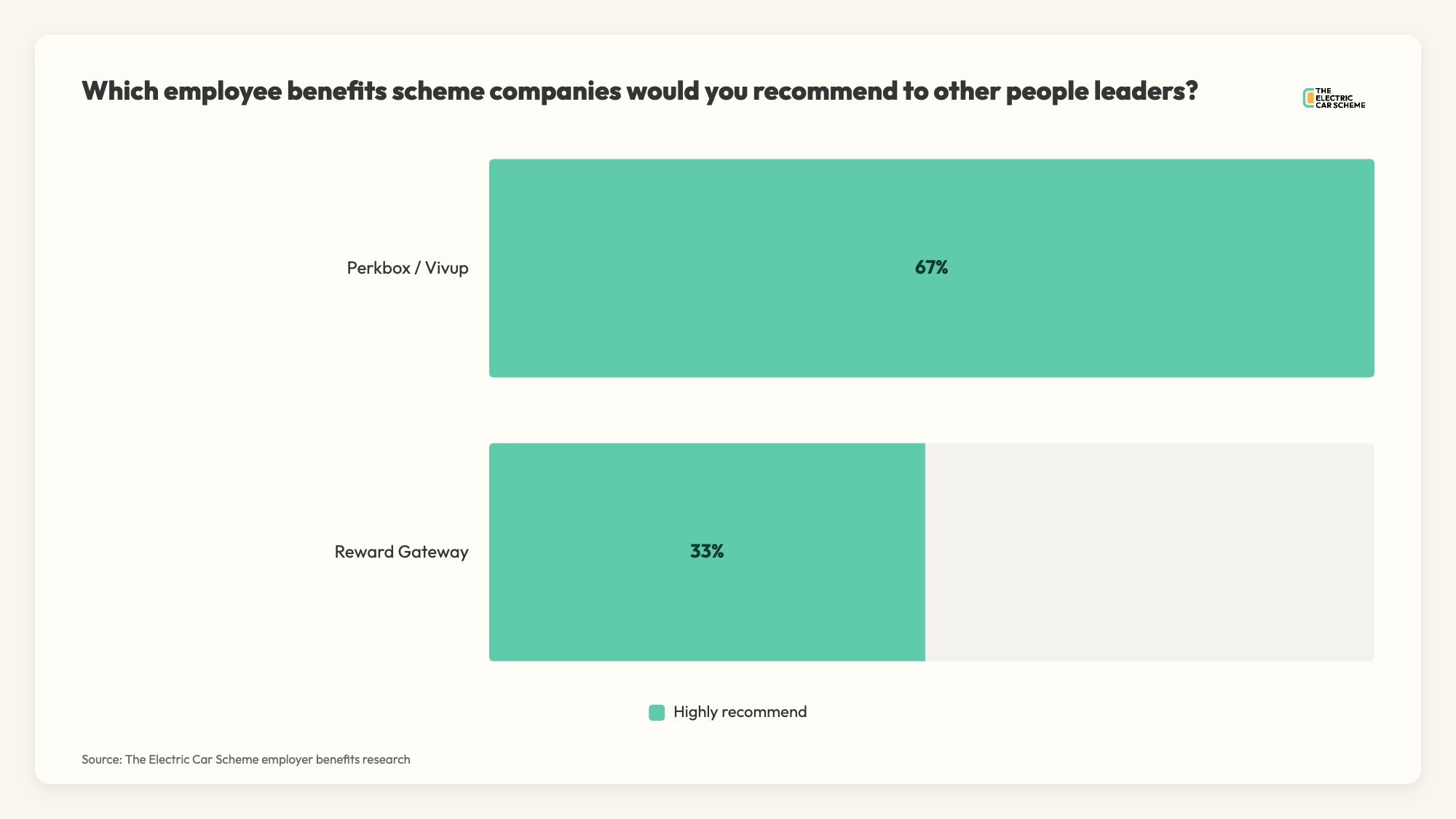
67% of people leaders recommend Perkbox or Vivup for other people leaders, and 33% Reward Gateway
Two contenders are recommended:
Employee benefits platforms such as Perkbox, Vivup, and Reward Gateway are popular because they give employees access to a wide range of perks in one place, including discounts, wellbeing support, reward programmes, and salary sacrifice benefits. They help employers improve employee engagement, retention, and workplace satisfaction while offering practical ways for staff to save money on everyday expenses.
This is evident in the 67% of people leaders who would recommend Perkbox or Vivup to other people leaders, and the 33% who feel the same about Reward Gateway.
Alternative options on the rise
However, specialised schemes like The Electric Car Scheme and its Charge Scheme are becoming increasingly attractive because they deliver highly targeted financial savings tied to electric vehicle ownership. The Charge Scheme helps employees reduce EV charging costs through salary sacrifice, making electric vehicle ownership more affordable while supporting sustainability goals and reducing commuting expenses.
Unlike general perks platforms, which may offer occasional savings across multiple categories, The Charge Scheme provides a benefit employees are likely to use regularly and see measurable monthly value from. For organisations focused on ESG initiatives, financial wellbeing, and modern mobility benefits, it can be an excellent alternative or complementary offering alongside traditional employee benefits platforms.
Which benefit area are people leaders focusing on in the next 12 months?
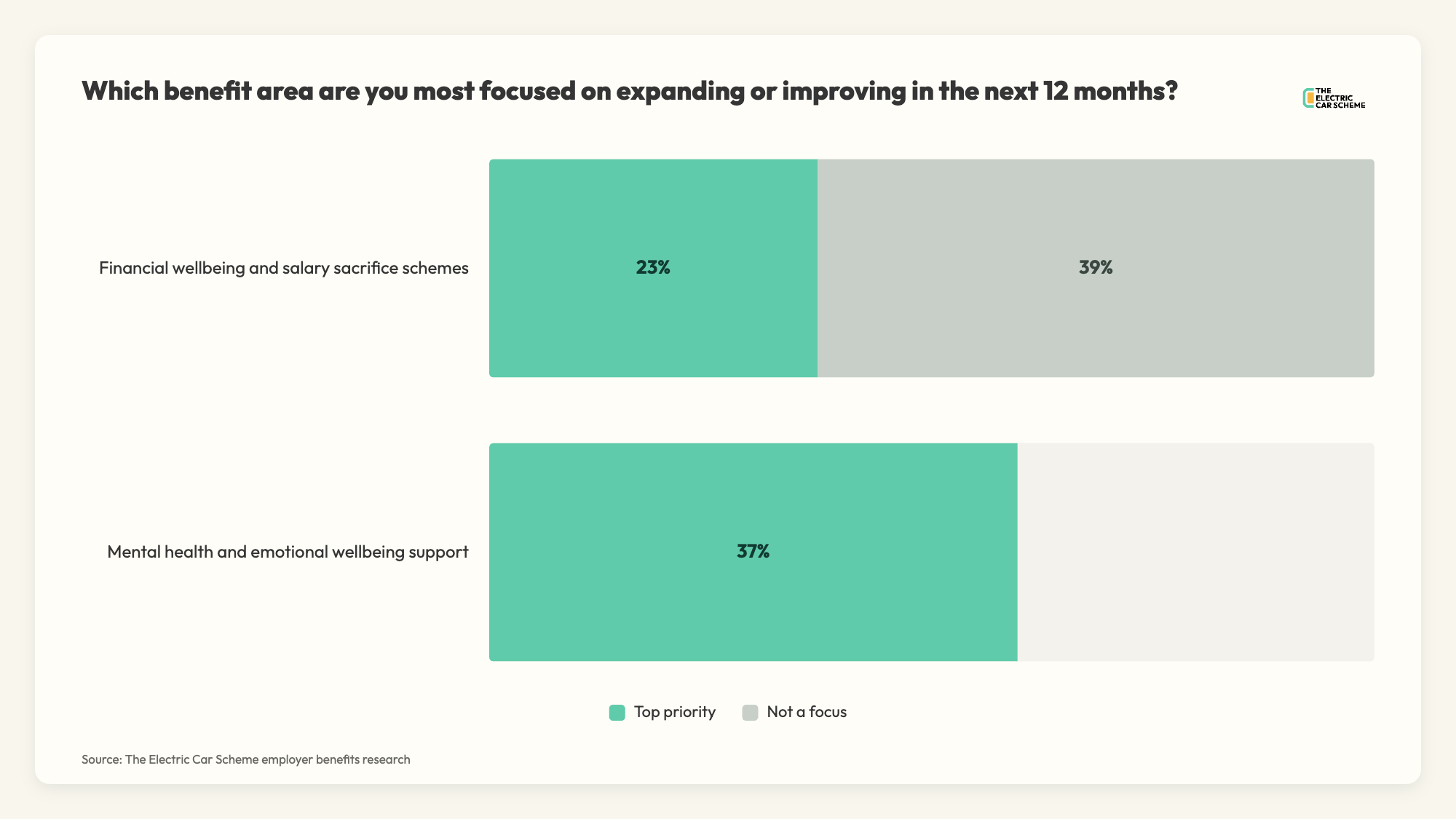
37% of people leaders are focusing on mental health and wellbeing support, and 23% on financial wellbeing and salary sacrifice schemes; however, 39% say this is not their focus
Focus on benefit areas centres on two areas:
Benefits play a big role in attracting and retaining employees, so organisations know their offering needs to be on point, and this means enhancing it from time to time.
For 23% of people leaders, expanding or improving financial wellbeing and salary sacrifice schemes (such as pension or EV schemes) is a top priority over the next 12 months. These organisations know how millions of people in the UK have been hit hard by inflation and energy prices, and they know how employees appreciate opportunities to save money in meaningful ways. However, not everyone has the same approach, with 39% not focused on this benefit area.
A strong focus on mental health
Mental health and emotional wellbeing support is a top-priority benefit area to be expanded or improved upon in the next 12 months for 37%. These organisations’ approach is also completely understandable, given the economic impact of mental health challenges. Every year, these challenges cost the UK economy around £118 billion. Notably, 72% of this cost is due to lost productivity among those unable to work due to mental unwellness, according to Mental Health UK.
What challenges do people leaders face when selecting a benefits scheme?
Comparing providers on a like-for-like basis isn’t much of a challenge for 88% of people leaders, while 3% find understanding tax and compliance implications challenging, and 3% don’t
Minimal challenges arise when selecting a benefits scheme:
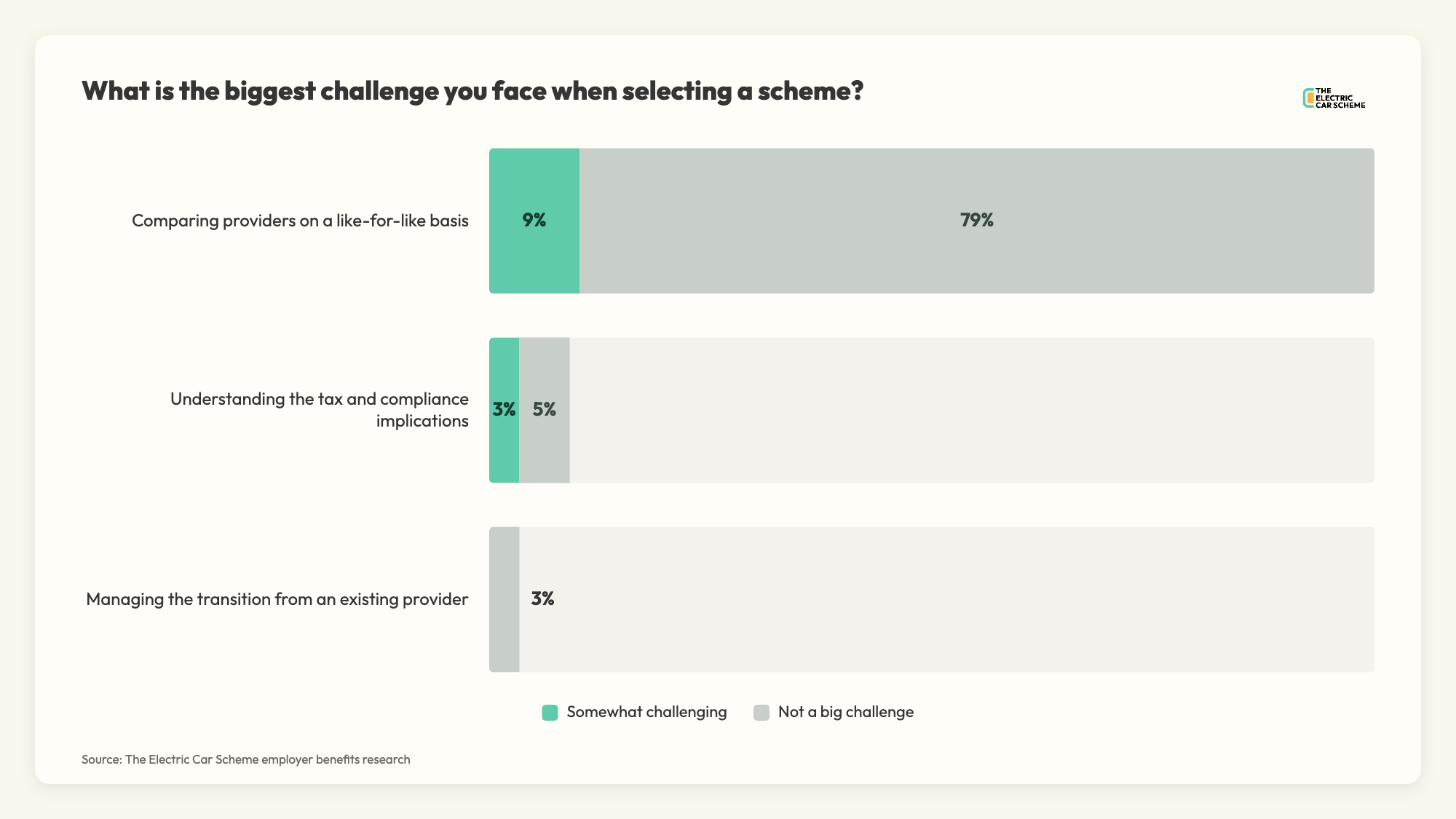
Selecting a benefits scheme may have challenges, but for our audience, they’re certainly not major stumbling blocks. According to 79% of people leaders, comparing providers on a like-for-like basis is not a big challenge, while 9% describe this aspect as somewhat challenging.
Understanding the tax and compliance implications isn’t a big challenge for 5%, although this can be somewhat challenging for 3%.
Financial benefits and simple provider transitions reduce employer hesitation
We’re not surprised that so few in our audience mention tax and compliance implications, as they are relatively easy to understand. For the 2026/2027 tax year, businesses pay a 15% Employer National Insurance Contribution (NIC) on employees’ salaries.
When an employee sacrifices a portion of their pay for an electric vehicle, the business no longer pays 15% NIC on the sacrificed amount. If you sacrifice £5,000 a year, the business saves £750 in tax. These savings completely offset the running costs of the EV salary sacrifice scheme, making it a net-zero expense for the company.
For the remaining 3% of our audience, managing the transition from an existing provider to another isn’t a big challenge. This opinion is likely based on the fact that these organisations have gone through the process of switching providers and found that it’s only slightly challenging, if not hassle-free.
Do people leaders value HR tech integration when choosing benefits scheme providers?
Benefit scheme providers’ ability to integrate into existing HR tech stacks is critical for 64% of people leaders and somewhat important for 36%
A smooth integration process is valued:
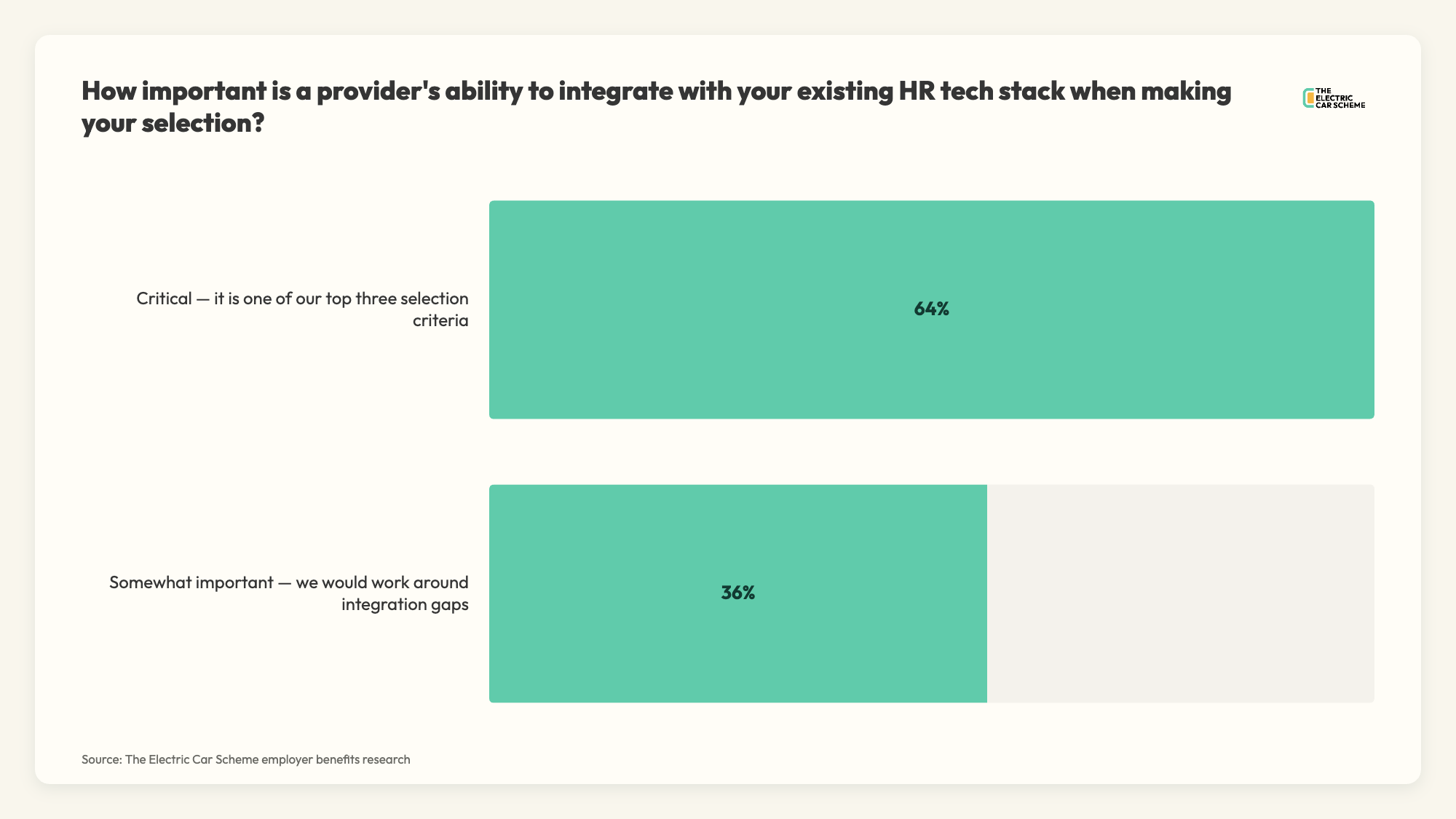
An employee benefits scheme provider’s ability to integrate with existing HR tech stacks when people leaders make their selection is not just critical for 64%. It's also one of the top three selection criteria. Clearly, these organisations are happy to offer a scheme to employees, provided doing so doesn’t come at the expense of building new HR tech stacks.
36% feel that a provider’s ability to integrate with existing stacks is somewhat important, although these organisations are prepared to work around integration gaps. This indicates that integration abilities aren’t high on these organisations’ lists of selection criteria, which means they emphasise savings, vehicle selection, and the employee experience.
How do people leaders benchmark their benefits against industry competitors?
65% of people leaders benchmark their benefits against industry competitors by reviewing job adverts and careers pages, and 35% commission a broker or consultant to do so
Benchmarking is approached from two angles:
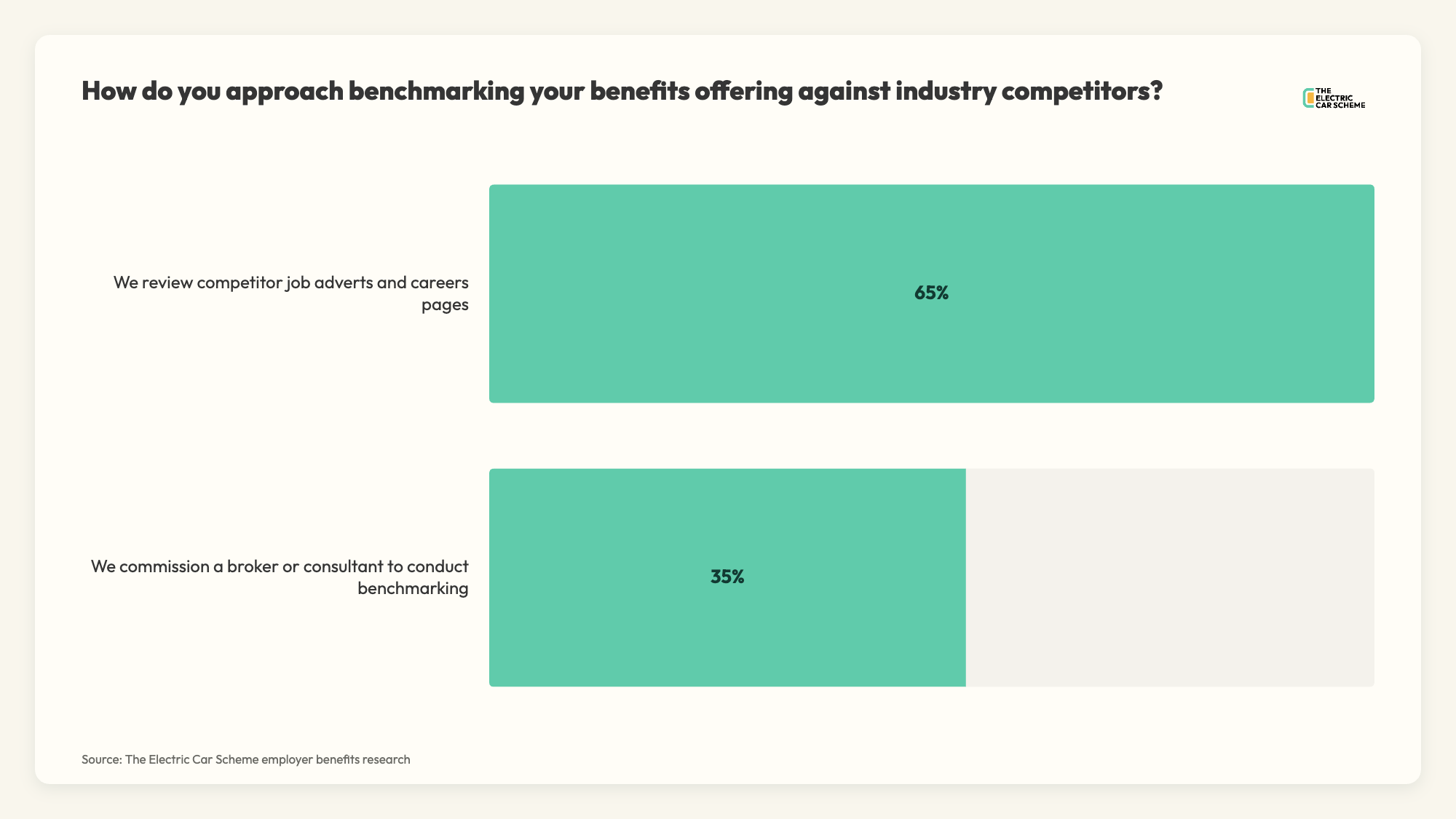
If an organisation’s benefits offering is to do its job of attracting and retaining talent, it needs to hold its own against competitors' offerings. According to a recent Aviva report, 93% of employees say workplace benefits, aside from salary, improve their overall happiness.
For our audience, benchmarking takes one of two routes. 65% benchmark their benefits offering by reviewing competitor job adverts and career pages. While this common approach seems sensible, it might not provide these organisations with enough information, as job ads and career pages often offer only a basic overview of benefits rather than discussing them in detail.
The remaining 35% commission a broker or consultant to conduct benchmarking, which provides a broader, deeper understanding of the benefits offered by competitors. This can help these organisations ensure their offering really is attractive.
How do people leaders describe their experience with their current benefits scheme provider?
33% of people leaders agree their current benefit providers are excellent, however 33% feel they’re poor, 22% say they’re average, and 13% are in the process of switching
Current provider experiences are not ideal:
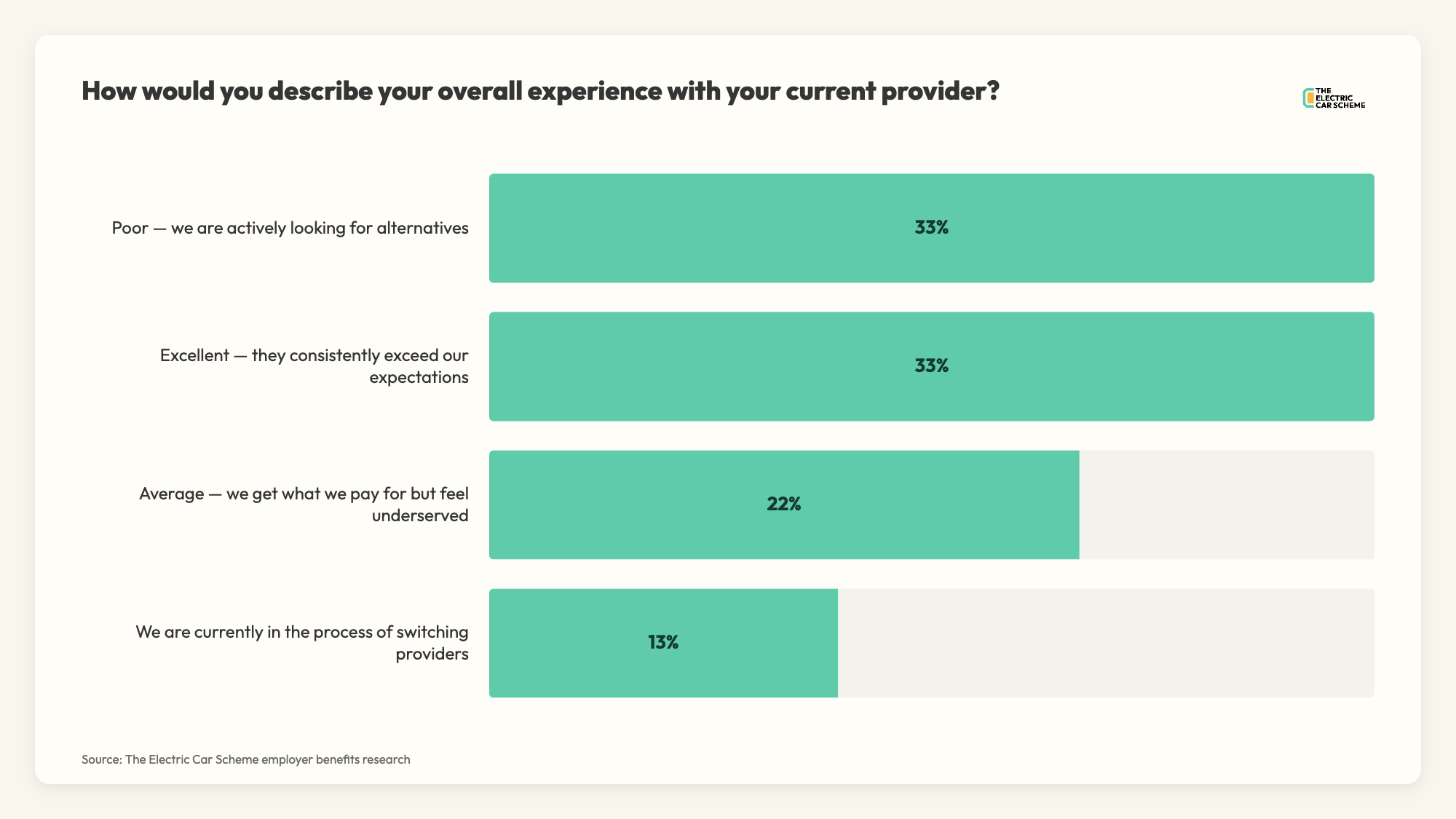
Our audience’s opinions about their overall experience with their current employee benefits EV salary sacrifice scheme reveal a mixed bag, with some providers far outshining others. A third (33%) describe the experience as poor and are actively looking for alternative providers. This may be due to the complexity of administering the scheme, a lack of vehicle options, or sub-standard support.
For 22%, the experience is average. While they get what they pay for, they feel underserved. Their providers don’t seem too concerned about differentiating themselves from others by going the extra mile. 13% are currently in the process of switching providers, which is a sure sign that their experience with their current provider has been decidedly lacklustre.
Conversely, the experience of the remaining 33% is excellent, as their providers consistently exceed their expectations. This tells us that their providers go above and beyond, ensuring every aspect of their offering is top-notch. But it also tells us many providers have room for improvement and that there’s plenty of room for those who offer great service to take the lead.
What common frustration do people leaders have with their current benefits scheme?
Limited flexibility or ability to tailor a benefit scheme to the workforce is a common frustration for 76% of people leaders, while outdated tech or clunky employee-facing platforms frustrate 24%
Common frustrations are shared:
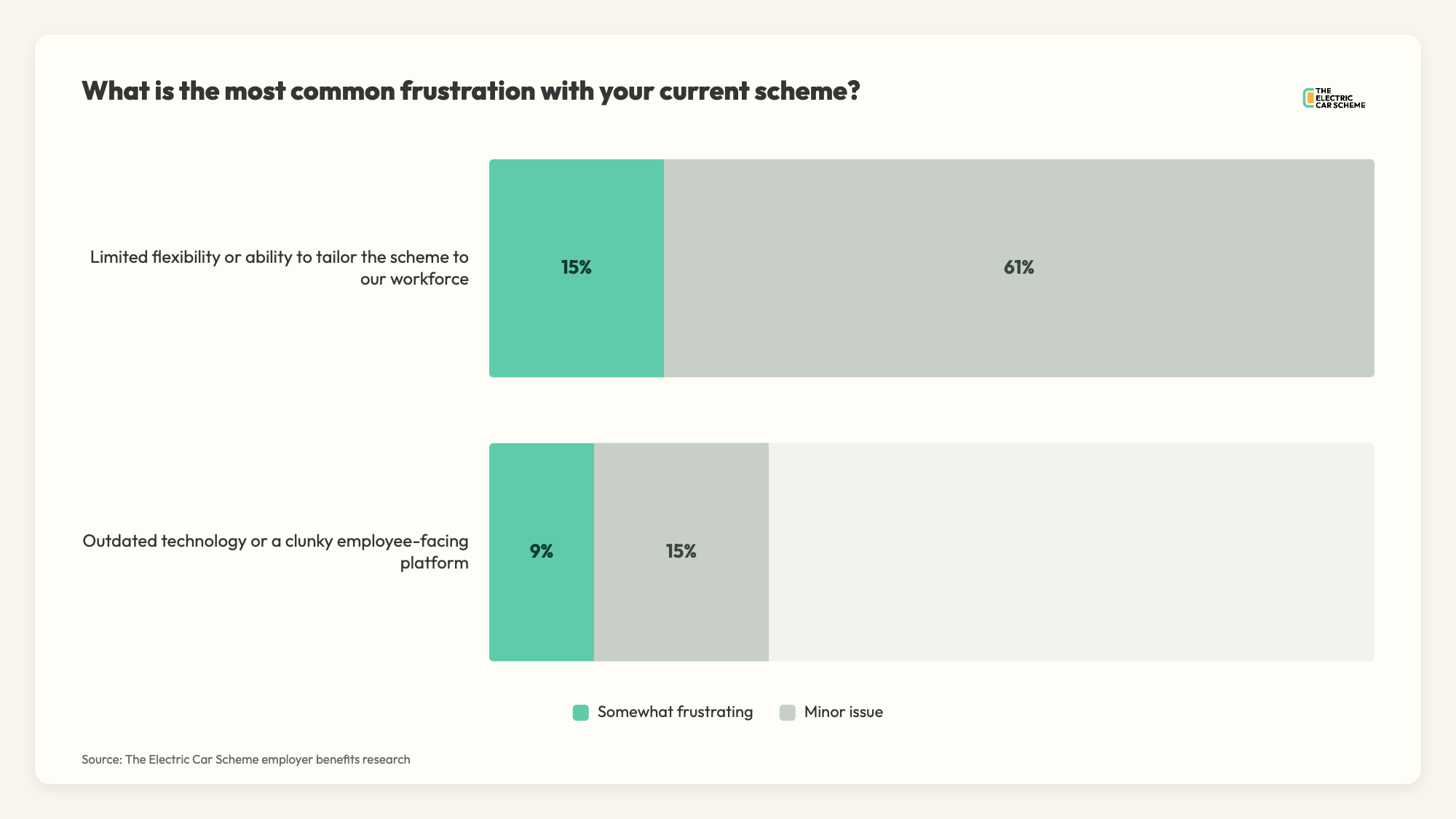
Given people leaders’ thoughts on their overall experience with their current employee benefits scheme providers, a sizeable segment of them are frustrated. But it seems that these frustrations are not too dire, and there are perhaps other reasons for their dissatisfaction.
Opining on the most common frustration with their current scheme, 15% find limited flexibility or ability to tailor the scheme to their workforce somewhat frustrating, although this is only a minor issue for 61%.
The problem here is that this could become a much bigger issue if the provider’s inability to tailor the scheme results in employee dissatisfaction. Recent research published in HR Magazine reveals that 70% of employees would leave their job if another company offered them better benefits, while 58% of employees think their workplace benefits are inadequate amid rising living costs.
9% say that outdated technology or a clunky employee-facing platform is somewhat frustrating for them, while this is a minor issue for 15%. This would particularly be the case if these issues make scheme administration more difficult or prevent employees from accessing important information or support when they need it.
What would prompt people leaders to switch to a different provider?
38% of people leaders would switch benefits scheme providers if they were lower costs or better value for money, yet 46% wouldn't be impacted by this, and 15% could be swayed by a more intuitive, modern platform
Money is not a major motivator:
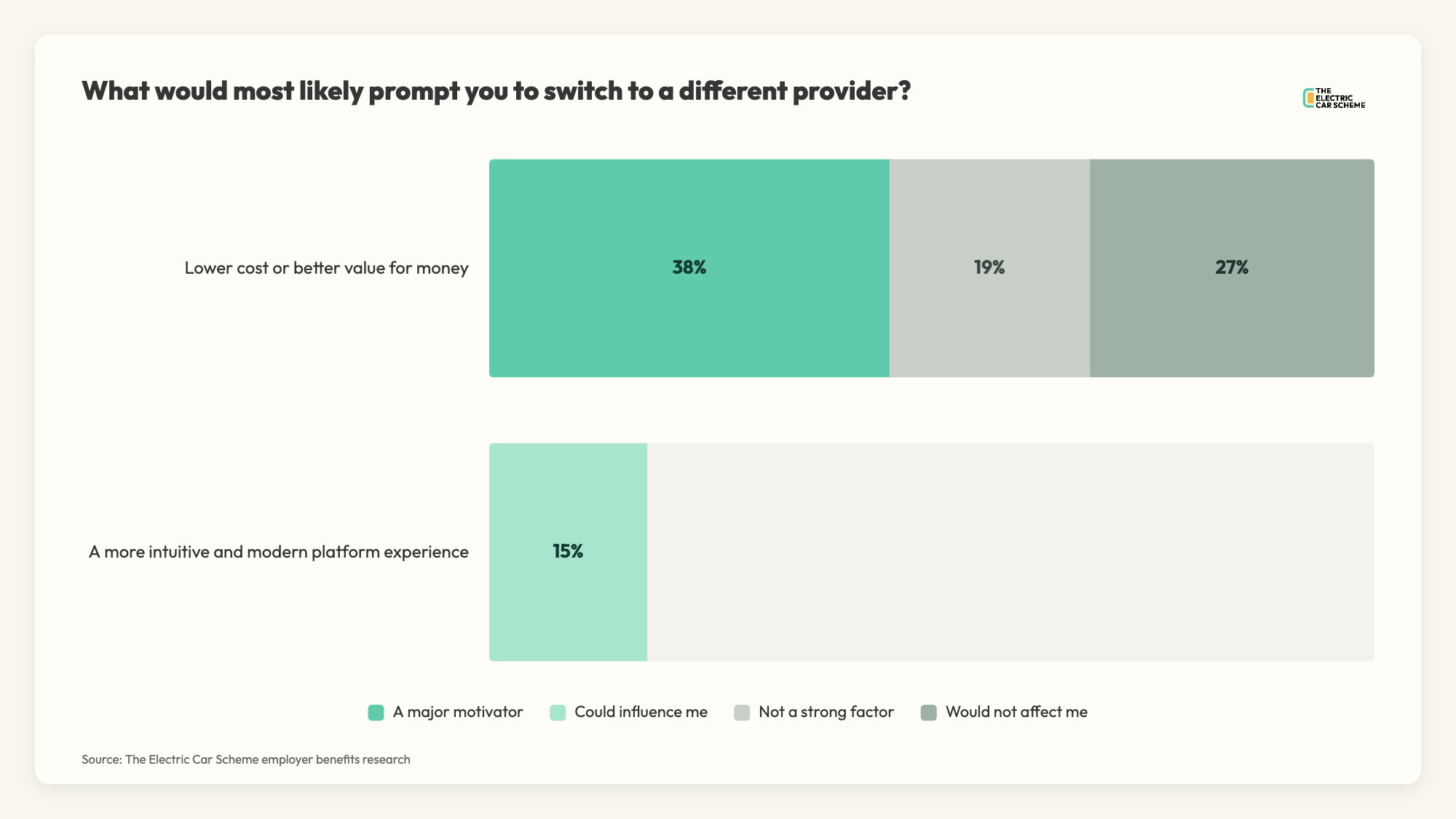
We saw above how some people leaders’ organisations are currently looking for another employee benefits scheme provider or are in the process of switching to another provider. We also saw how some segments of our audience rated their overall experience as poor or were frustrated by various aspects of their current scheme. This may leave you wondering what would prompt these organisations to switch to a different provider.
A lower cost or better value for money would be a major motivator for 38%, who don’t think they’re getting their money’s worth. Some of these people leaders may be among those who feel underserved, even if they acknowledge that they’re receiving what they pay for. However, this isn’t a strong factor for 19% and doesn’t affect 27%.
15% could be influenced to switch to a different provider by a more intuitive and modern platform experience. This ties in with what some in our audience say about outdated technology and clunky platforms above.
How long do people leaders' organisations take from research to signing with a new provider?
38% of people leaders’ organisations take less than a month to sign with a new benefits scheme provider, 29% 1-3 months,29% 306 months and 4% over a year
Timing varies for signing:
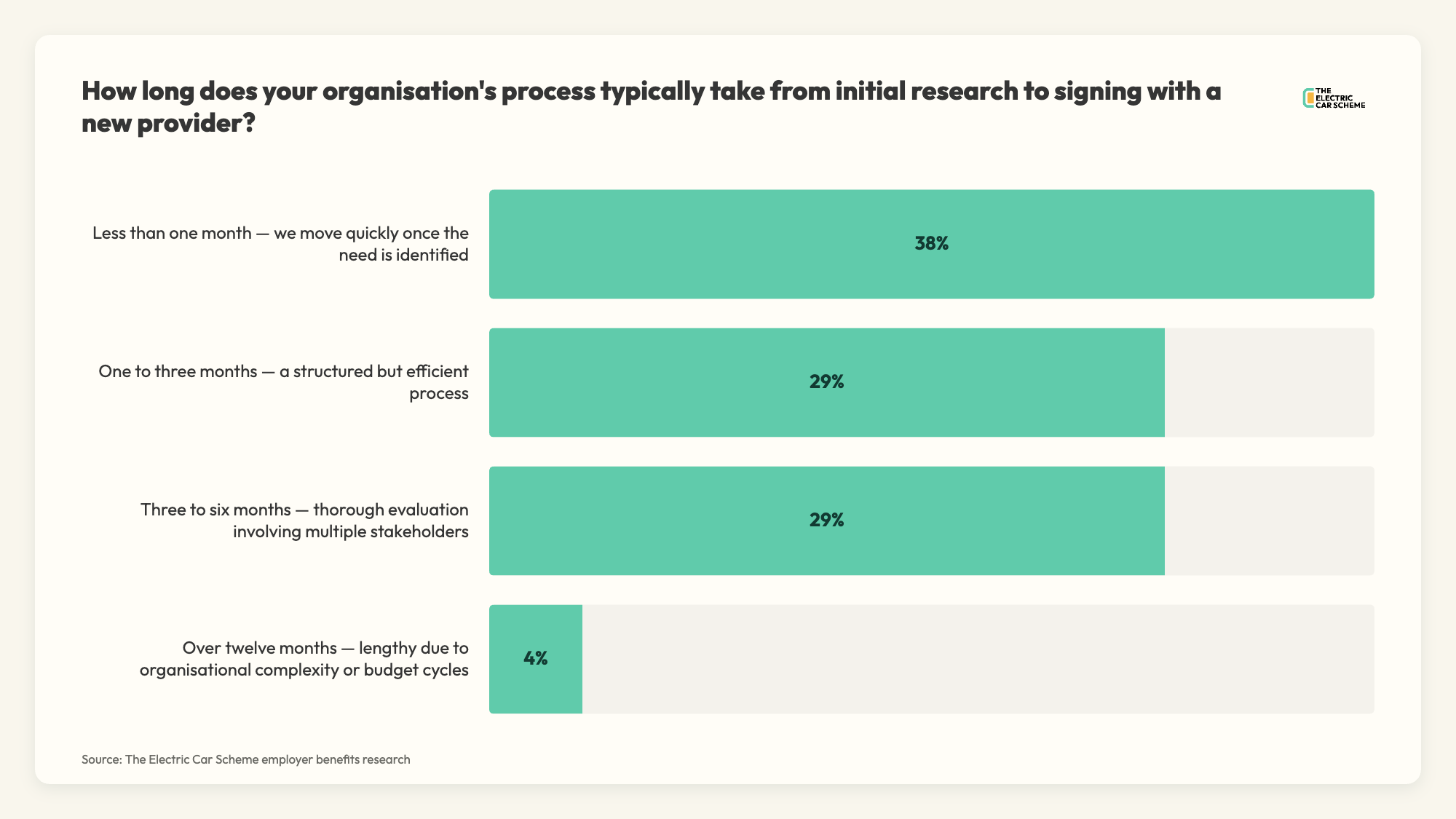
Switching to a new employee benefits scheme provider isn’t something most organisations can do overnight. It takes research, weighing up the pros and cons, and obtaining the relevant internal approvals and sign-offs, which can take time. According to 38% of people leaders, this is usually less than one month, as their organisations move quickly once the need is identified.
Thanks to a structured but efficient process, switching to a new provider takes one to three months for 29%. This undoubtedly ensures that nothing is left to chance during the switch and that the move happens as smoothly as possible.
Another 29% explain that the process takes three to six months in their organisations, as they conduct a thorough evaluation involving multiple stakeholders. This may include evaluating different providers before conducting more in-depth evaluations of those they shortlist.
4% say their organisations take longer than 12 months to switch to another provider. This lengthy process is due either to organisational complexity or budget cycles.
How do people leaders measure their employee benefits scheme success?
66% of people leaders measure employee benefits schemes by engagement or pulse surveys, and 34% by turnover reduction and improved retention
Success is measured in two ways:
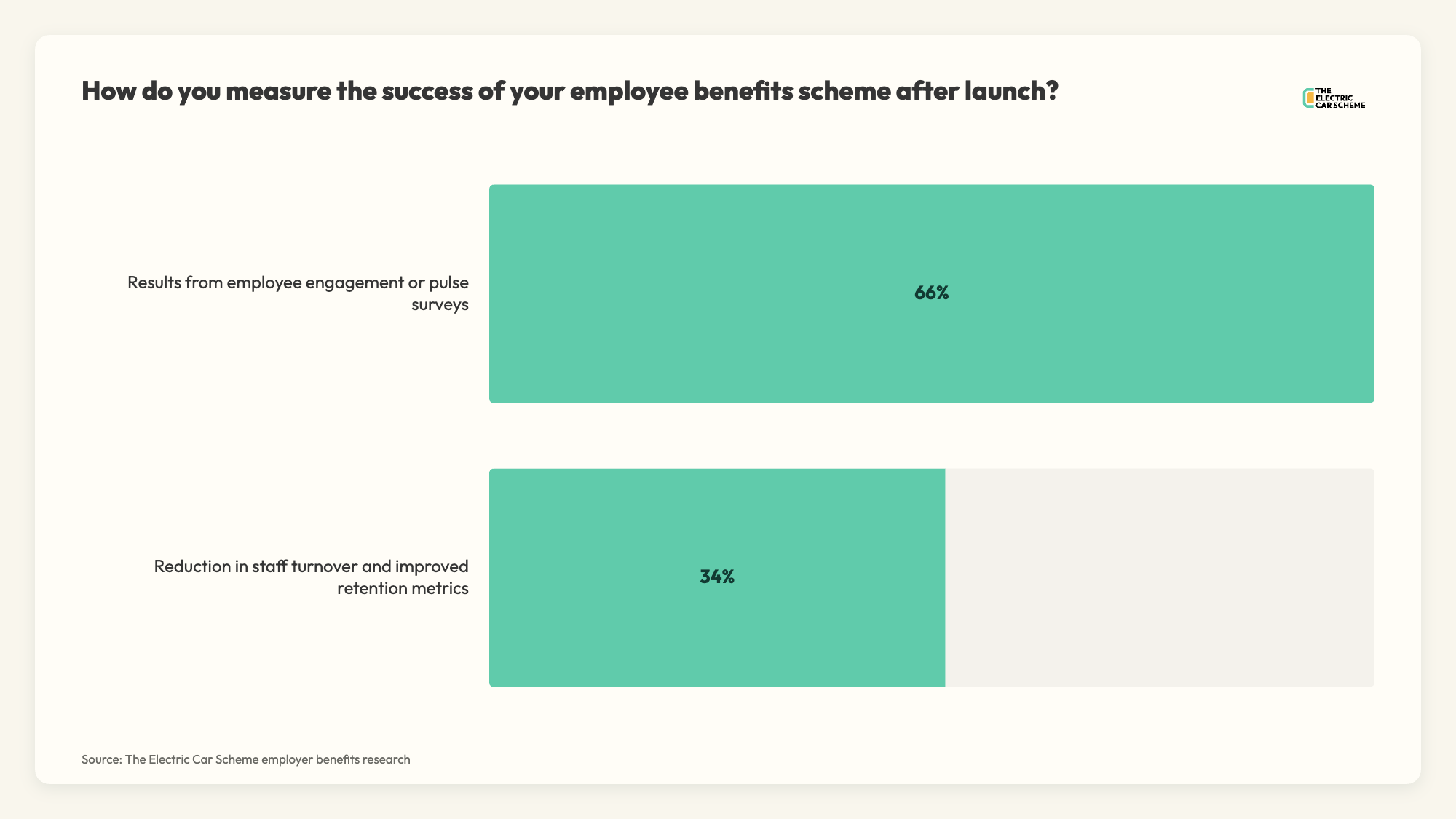
When organisations spend money on employee benefits offerings, they usually do so in the hope of a return, whether that is attracting and retaining talent or increasing satisfaction and engagement. However, organisations won’t know whether these offerings are making a difference unless they measure their success.
Surprisingly, the Chartered Institute of Personnel and Development (CIPD) 2026 Reward Survey found that 22% of employers have no objectives underpinning their benefits package. This limits their ability to assess whether their package improves retention, productivity, or employee wellbeing. Even among organisations that have set a clear purpose for their benefits package, 15% do not assess their impact against their original objectives. This means employers have little understanding of the effectiveness of their packages and cannot judge their value for money.
Employee surveys remain the leading way to measure benefits success
The opinions of the people leaders in our audience make it clear that they can and do measure the impact of their benefits packages.
66% use results from employee engagement or pulse surveys to do this, as these surveys give employees the opportunity to have their say.
The other 34% base their assessment on reduced staff turnover and improved retention metrics. While this may tie directly to their main reasons for offering benefits, this approach is lacking because it doesn’t give employees a platform to share their opinions on specific benefits where there may be room for improvement.
Which industry best describes people leaders' organisations?
73% of people leaders work in technology and software and 27% in healthcare and life sciences
The majority of our audience is in tech:
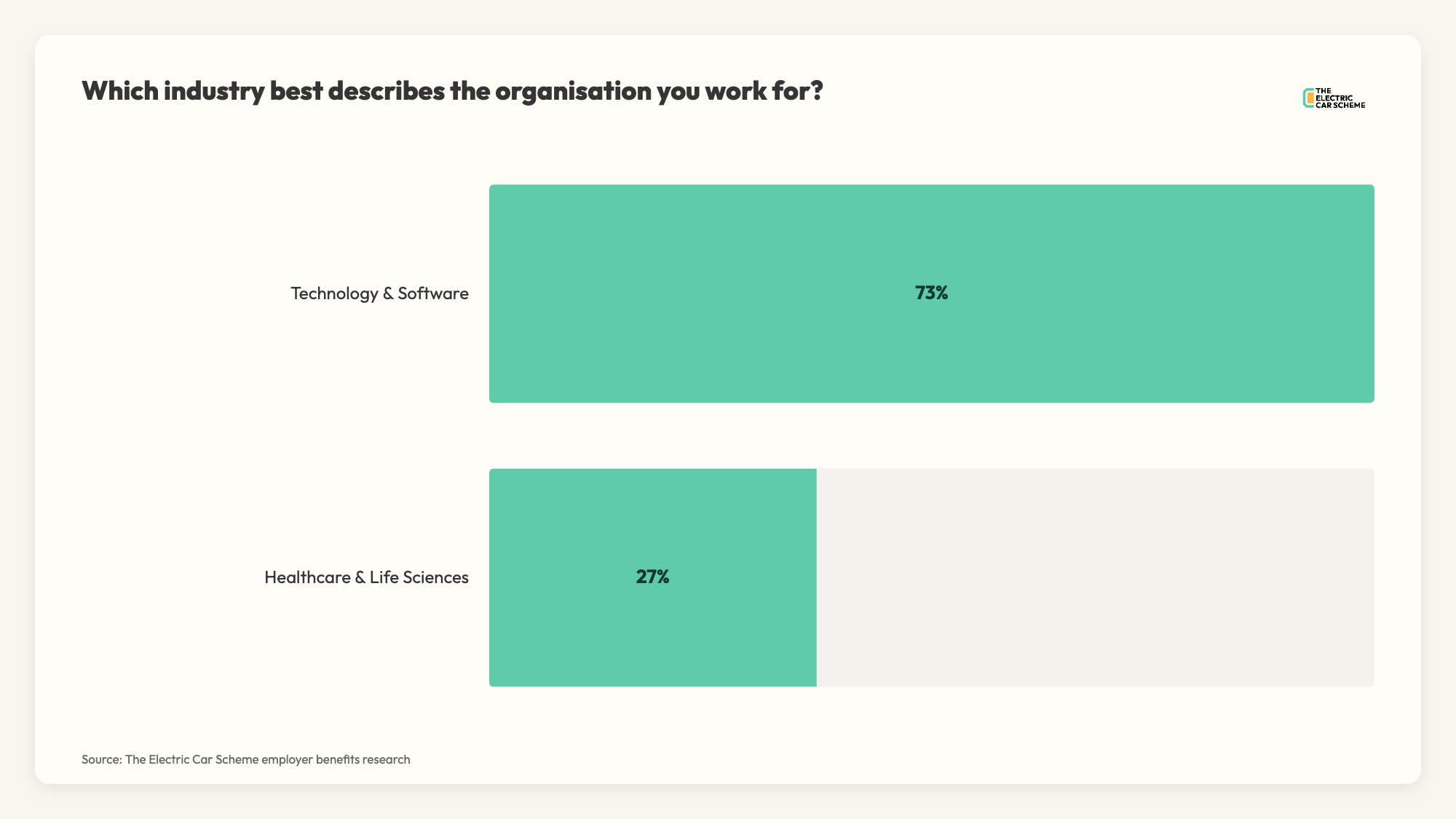
Almost three-quarters (73%) of our audience work for organisations in the technology and software industry. In 2026, UK technology and software employee benefits focus on flexibility, wellbeing, and hybrid work support, often managed through digital platforms like Perkbox/Vivup or Reward Gateway.
Popular schemes include salary sacrifice for tech (like TechBenefits, for example), private health insurance, enhanced parental leave, and hybrid work perks such as home office budgets. Judging by our audience’s opinions, EV salary sacrifice schemes are becoming increasingly popular as a benefit in this industry.
The remaining 27% work for organisations in the healthcare and life sciences industries. According to the Office for National Statistics, there were 6,170 businesses operating in the UK life sciences industry across 7,320 companies in 2023/2024, employing 359,600 people and generating £146.9 billion in turnover. 60% of these companies operated in the medical technology subsector and 40% in the biopharmaceutical sector.
Which city are people leaders based in?
31% of people leaders are based in London, 31% in Glasgow, 20% in Birmingham, 12% in Edinburgh, and 7% in Manchester
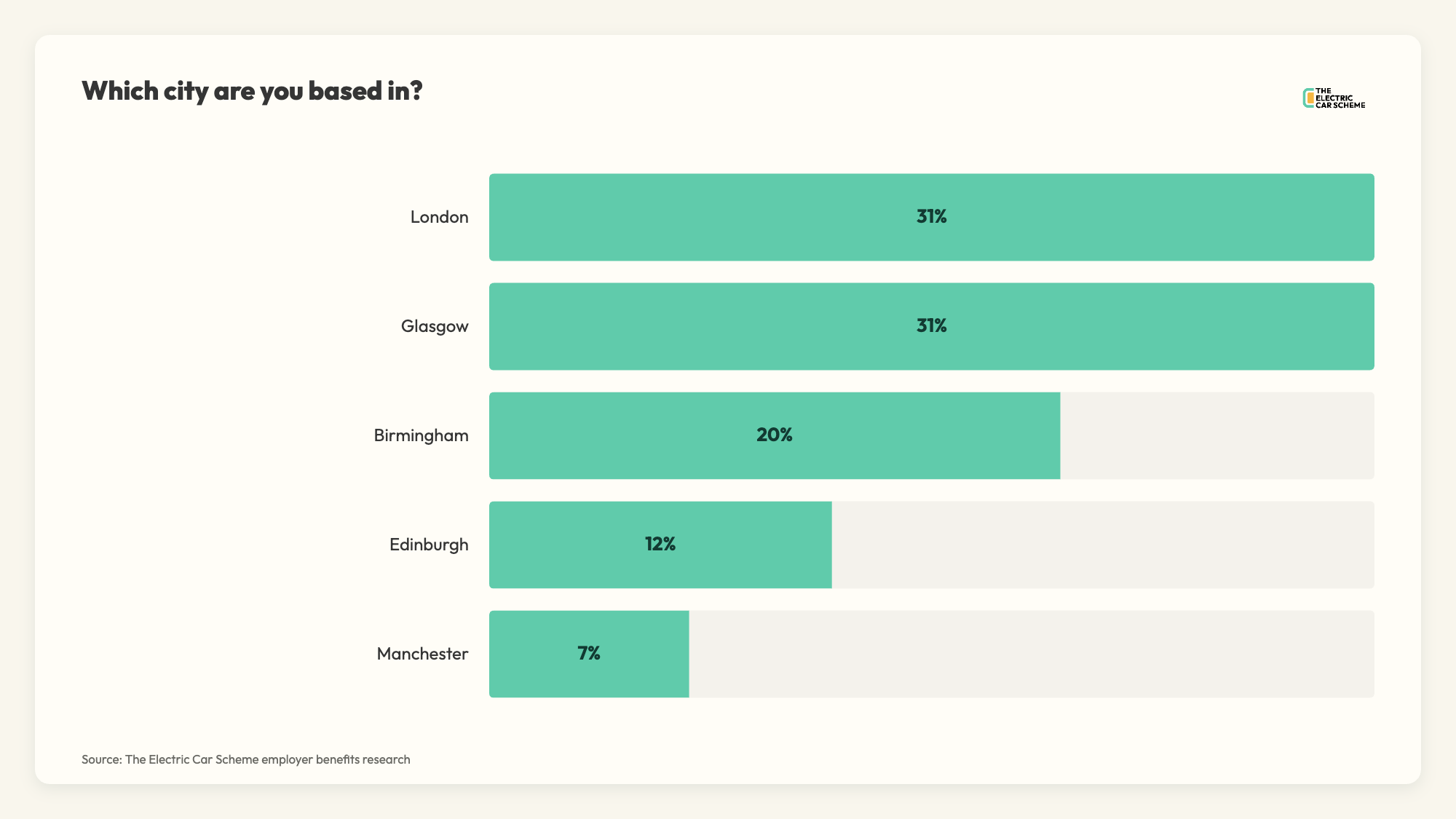
31% of people leaders in our audience are based in London and another 31% in Glasgow. This distribution reflects the prominence of both cities as major commercial and employment hubs, with London remaining the UK’s largest business centre and Glasgow playing a significant role in Scotland’s economy.
20% are based in Birmingham, reinforcing the importance of the Midlands as a growing centre for business activity and regional investment. Meanwhile, 12% are located in Edinburgh, a city strongly associated with finance, professional services, and technology, while 7% are based in Manchester, which continues to strengthen its reputation as one of the UK’s leading regional business and innovation centres.
Flexibility, value, and employee experience drive benefits scheme provider decisions
A few things stand out among these leaders' opinions. Their organisations understand the power of benefits when it comes to attracting and retaining staff and boosting engagement, satisfaction, and productivity.
However, when it comes to benefit scheme providers, these organisations won’t sign up to the first one they find. Instead, they’re looking for flexibility, value for money, easy integration, and a good quality employee experience.
If providers over-promise and under-deliver, people leaders aren’t afraid to look elsewhere. At a time of fierce competition and when employees know they deserve more than a basic salary, could we expect any less?
A word from our CEO

"It's telling that nearly a quarter of people leaders (23%) are prioritising financial wellbeing and salary sacrifice schemes over the next 12 months, and that EV salary sacrifice is emerging as one of the fastest-growing benefits in the technology and software sector. That matches what we see every day. When a third of organisations (33%) rate their current provider as poor and limited flexibility is the most common frustration for 76% of people leaders, employers are clearly looking for benefits that deliver real, measurable value rather than the occasional discount.
An EV salary sacrifice scheme does exactly that. With Benefit-in-Kind on pure electric cars held at just 4% for the 2026/27 tax year, employees typically save between 20% and 50% on the cost of a brand-new electric car, while the employer's 15% National Insurance saving offsets the cost of running the scheme. It is one of the few benefits that helps an organisation meet its financial wellbeing, retention and sustainability goals at the same time, without adding to the HR tech burden that so many people leaders told us matters to them.
If you are among the people leaders rethinking your benefits offering this year, I would encourage you to look closely at EV salary sacrifice. Our team would be glad to help you get started."
Thom Groot, CEO and co-founder, The Electric Car Scheme
About the data
Sourced using Artios from an independent sample of 35,067 opinions of people leaders in the UK across X, Quora, Reddit, Bluesky, TikTok and Threads. Responses are collected within a 95% confidence interval and 5% margin of error. Results are derived from what people describe online, from opinions expressed, not actual questions answered by people in the sample.
Are you an employer?
BOOK A DEMOAre you an employee?
SEE AVAILABLE CARSYou might also like…



Last updated: 18/06/2026
Our pricing is based on data collected from The Electric Car Scheme quote tool. All final pricing is inclusive of VAT. All prices above are based on the following lease terms; 10,000 miles pa, 36 months, and are inclusive of Maintenance and Breakdown Cover. The Electric Car Scheme’s terms and conditions apply. All deals are subject to credit approval and availability. All deals are subject to excess mileage and damage charges. Prices are calculated based on the following tax saving assumptions; England & Wales, 40% tax rate. The above prices were calculated using a flat payment profile. The Electric Car Scheme Limited provides services for the administration of your salary sacrifice employee benefits. The Electric Car Scheme Holdings Limited is a member of the BVRLA (10608), is authorised and regulated by the FCA under FRN 968270, is an Appointed Representative of Marshall Management Services Ltd under FRN 667174, and is a credit broker and not a lender or insurance provider.
Copyright and Image Usage: All images used on this website are either licensed for commercial use or used with express permission from the copyright holders, in compliance with UK and EU copyright law. We are committed to respecting intellectual property rights and maintaining full compliance with applicable regulations. If you have any questions or concerns regarding image usage or copyright matters, please contact us at marketing@electriccarscheme.com and we will address them promptly.
