How to Calculate Employee Turnover Rate: A Complete Guide for UK Businesses

Source: Shutterstock
Employee turnover is an important metric for UK businesses to monitor, yet many organisations struggle to calculate and understand it. Learning to calculate employee turnover rate properly allows businesses to identify retention issues early, benchmark against industry standards, and implement effective solutions. The UK average sits at 34%, but the figure that matters most is your own, measured consistently and compared with your sector.
This guide explains how, when and why your business should calculate employee turnover rate. We also consider how employee benefits, like The Electric Car Scheme, can help employees feel valued and support staff retention. You'll find the formula, a worked example, CIPD sector benchmarks, the main costs of losing people and five strategies to reduce turnover, including where electric car salary sacrifice fits in a wider benefits package and how to check whether it's working.
What is Employee Turnover Rate And How Do You Calculate It?
Employee turnover rate measures the percentage of employees who leave your organisation during a specific period (usually annually). This includes voluntary departures, such as resignations or retirements, and involuntary separations, like redundancies and dismissals. Employee turnover rates don’t include internal movements such as promotions or transfers.
Currently, the average turnover rate sits at 34% in the UK, based on CIPD analysis of the ONS Annual Population Survey. This varies across sectors, from 25% in public administration and defence to 52% in hospitality. Understanding your organisation's turnover rate helps you assess the effectiveness of your recruitment and employee retention strategies whilst highlighting potential management or cultural issues.
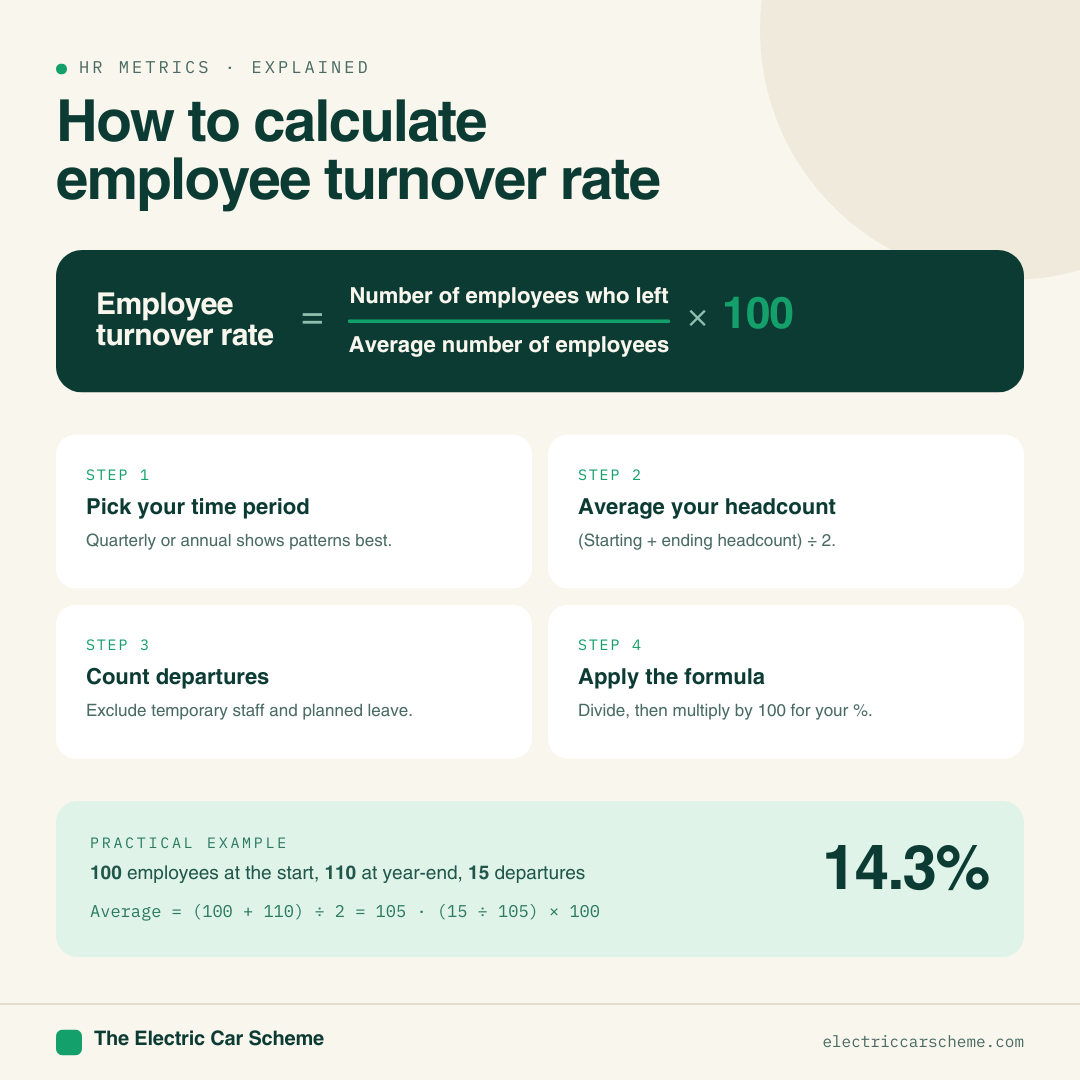
The calculation takes four steps:
Choose a time period, such as a quarter or a year.
Average your headcount by adding the start and end figures, then dividing by two.
Count the number of employees who left during that period.
Divide the number of leavers by your average headcount, then multiply by 100.
For example, 15 leavers against an average headcount of 105 gives a turnover rate of 14.3%.
When Should You Calculate Employee Turnover Rate?
Timing is almost as important as calculating turnover rate, and it varies from company to company.
Annual Calculations
Annual calculations are important for longer comparisons and industry benchmarking. It's important to calculate staff turnover annually to provide a better picture of how many employees are leaving and why.
Quarterly Reviews
Reviewing the employee turnover rate every three months is useful because it can help identify trends early. This allows HR teams to implement corrective measures before annual reviews.
Monthly Monitoring
Monthly monitoring is only essential for businesses experiencing high turnover or during periods of organisational change.
Segmented Analysis
Consider calculating turnover rates for:
Individual departments
Management levels
New hire cohorts (first-year turnover)
High-performing vs. low-performing employees
Compare your new hire turnover rate with your overall turnover rate. This will show whether you are having hiring or retention issues.
Understanding Your Employee Retention Results
How ‘good’ your turnover rate is depends on how it compares to the industry your business operates in.
Industry Benchmarks
UK turnover rates vary widely by sector. CIPD population-level data places it at 52% for 2022 to 2023, against 25% in public administration and defence. CIPD's figures count anyone who leaves a job, so they run higher than the turnover most employers report internally.
What Is a 'Good' Turnover Rate?
There's no single 'good' turnover rate, because it depends on sector, role mix and how turnover is measured. A 15% turnover rate might be excellent in retail but concerning in professional services.
What Are The Hidden Costs of High Employee Turnover?
High employee turnover is expensive beyond the obvious recruitment costs.
Direct Costs
Recruitment advertising and agency fees
Interview time and administrative expenses
Onboarding and training investments
Temporary staffing or overtime costs
Indirect Costs
Lost productivity during transition periods
Reduced team morale and engagement
Knowledge loss and skills gaps
Potential customer relationship impacts
Replacing a single employee costs UK businesses an average of £30,614. This price includes recruitment fees, training, and lost productivity during the transition. Published estimates of replacement cost vary, and few explain their method. PayFit puts the average at around £25,000, rising to £40,000 to £100,000 for specialist or senior roles, so costing your own leavers against the items above is more reliable.
Why Does Employee Retention Matter?
Beyond the direct cost of replacement, strong employee retention supports profitability. Gallup's analysis found that business units in the top quartile for engagement are 23% more profitable than those in the bottom quartile, and have 21% less turnover in high-turnover organisations and 51% less in low-turnover ones. The strategies below show where low-cost, high-impact benefits fit into that approach.
Proven Strategies to Reduce Employee Turnover
1. Comprehensive Employee Benefits Packages
Modern employees increasingly value benefits beyond traditional pension and healthcare offerings. Benefits that reduce everyday expenses are visible every month, and understanding employee benefits is the starting point for a package that covers financial, physical, emotional and social wellbeing.
2. Electric Car Salary Sacrifice Schemes
An electric car salary sacrifice scheme, such as The Electric Car Scheme, allows employees to access new and used EVs whilst saving 20-50% compared with a personal lease. This can help employees feel valued and support retention.
The scheme works by allowing employees to sacrifice part of their gross salary for an electric vehicle, reducing both Income Tax and National Insurance contributions. With EV Benefit-in-Kind tax set at 4% for 2026/27 (rising to 5% in 2027/28), employees typically save 20 to 50% whilst employers can support retention at no net cost to the business.
Key Retention Benefits Include:
Significant financial savings for employees
Enhanced environmental credentials appealing to younger workforce
No net cost to the business to run the scheme, plus employer National Insurance savings on the salary sacrificed
Complete Employer Protection against early termination risks from day one
3. Flexible Working Arrangements
CIPD's Flexible and Hybrid Working Practices in 2025 report, based on a survey of 2,000 employers and 5,000 employees, found that 3% of UK employees said they left a job because of a lack of flexible working. This is equivalent to around 1.1 million workers nationally.
4. Professional Development Opportunities
Investing in employee growth through training programmes, mentorship, and clear progression pathways demonstrates long-term commitment to staff development.
5. Recognition and Reward Systems
Regular acknowledgement of employee contributions, whether through formal programmes or informal appreciation, can support retention without a large budget. Non-financial rewards work best alongside financial benefits.
Implementing Turnover Reduction Strategies
1. Establish Baseline Metrics
Before implementing changes, ensure accurate baseline measurements of current turnover rates across different employee segments.
2. Identify Priority Areas
Focus initial efforts on departments or employee groups showing concerning turnover patterns.
3. Select Appropriate Interventions
Choose strategies aligned with your specific turnover drivers. If exit interviews reveal financial pressures, consider salary sacrifice schemes. If flexibility concerns emerge, explore remote working options. Actions differ by role:
Leaders: communicate openly and back sustainability goals with benefits such as green employee benefits
Managers: hold regular career conversations and protect teams from burnout
HR: structure the first 90 days of onboarding and act visibly on stay interview and survey feedback
4. Monitor Progress
Regularly calculating turnover makes it easier to compare data year-on-year and allows managers and HR professionals to accurately report on current rates, as well as to track the success of improvement strategies.
5. Communicate Changes
Ensure employees understand new benefits and retention initiatives through clear communication campaigns. Employees can check their typical savings by using The Electric Car Scheme’s EV salary sacrifice calculator.
Common Turnover Calculation Mistakes
Four mistakes distort turnover figures most often:
Including temporary staff. Seasonal or temporary workers shouldn't be included in turnover calculations as their departures are predetermined
Ignoring internal movements. While promotions and transfers shouldn't count as turnover, the vacancies they create should be considered
Using inconsistent time periods. Ensure consistent measurement periods when comparing turnover rates across different timeframes
Failing to segment data. Overall turnover rates can mask significant departmental or demographic variations requiring different interventions.
Frequently Asked Questions
How Do You Calculate Employee Turnover Rate?
Divide the number of employees who left during a period by your average headcount, then multiply by 100. Most UK businesses calculate this quarterly or annually for meaningful benchmarking.
What Is a Good Employee Turnover Rate in the UK?
A good turnover rate sits below your sector benchmark and falls over time. The UK average sits at 34% (CIPD analysis of ONS data, 2022 to 2023), but it ranges from 25% in public administration and defence to 52% in hospitality.
How Much Does Employee Turnover Cost UK Businesses?
Published estimates vary, and few explain their method. PayFit puts the average at around £25,000 per employee, so cost your own leavers using the direct and indirect items above.
Can Employee Benefits Reduce Staff Turnover?
Yes. Low-cost benefits such as electric car salary sacrifice schemes can support retention without requiring upfront employer investment, since they're funded through the employee's own gross salary.
Final Thoughts
For UK businesses looking to improve their retention figures and reduce recruitment costs, calculating the employee turnover rate can provide valuable insights. Calculating this is straightforward, but you need to analyse the results to find the real value.
Turnover calculation gives you the diagnosis, but retention strategy is what protects the bottom line. Pairing consistent measurement with low-cost, high-impact benefits, such as electric car salary sacrifice, gives UK employers a practical route to reducing costly departures.
Ready to see what The Electric Car Scheme could add to your retention strategy? Book a demo today.
Are you an employer?
BOOK A DEMOAre you an employee?
SEE AVAILABLE CARSECS GUIDES AND ADVICE
Ready to Go Electric? Your Guides and Tools to a Smooth Switch
-
 How the Scheme Works
Find out how salary sacrifice can work for you or your business.
-
 The Charge Scheme
Save 20-50% on all charging costs through salary sacrifice - at home, the office, or in public..
-
 Complete Employer Protection
All employers and drivers are protected from day 1.
-
 Used Electric Cars
Discover the most affordable way to drive electric. Cars delivered in 14 days.
You might also like…



Last updated: 13/10/2026
Our pricing is based on data collected from The Electric Car Scheme quote tool. All final pricing is inclusive of VAT. All prices above are based on the following lease terms; 10,000 miles pa, 36 months, and are inclusive of Maintenance and Breakdown Cover. The Electric Car Scheme’s terms and conditions apply. All deals are subject to credit approval and availability. All deals are subject to excess mileage and damage charges. Prices are calculated based on the following tax saving assumptions; England & Wales, 40% tax rate. The above prices were calculated using a flat payment profile. The Electric Car Scheme Limited provides services for the administration of your salary sacrifice employee benefits. The Electric Car Scheme Holdings Limited is a member of the BVRLA (10608), is authorised and regulated by the FCA under FRN 968270, is an Appointed Representative of Marshall Management Services Ltd under FRN 667174, and is a credit broker and not a lender or insurance provider.
Copyright and Image Usage: All images used on this website are either licensed for commercial use or used with express permission from the copyright holders, in compliance with UK and EU copyright law. We are committed to respecting intellectual property rights and maintaining full compliance with applicable regulations. If you have any questions or concerns regarding image usage or copyright matters, please contact us at marketing@electriccarscheme.com and we will address them promptly.