
Risks of EV Salary Sacrifice: What UK People Leaders Are Saying Online
Employee benefits have moved well beyond pensions and private healthcare. Alongside long-established salary sacrifice benefits such as pensions and cycle-to-work, employers now offer EV salary sacrifice, workplace charging, wellbeing programmes and a range of other flexible options. EV salary sacrifice has grown quickly on the strength of its tax treatment and sustainability credentials — and, like any benefit that combines payroll, tax and a multi-year asset, it brings financial, compliance and administrative considerations with it.
To understand how those considerations are actually being talked about, we used AI-driven audience profiling to classify 251,644 publicly posted opinions relating to EV salary sacrifice risk, gathered from UK-based online discussion over the 12 months to 7 July 2026. The results below describe the balance of opinion in that dataset across tax, payroll, employee experience, compliance, budgeting and long-term scheme management.
An important framing point before the numbers: this is not a survey. Nobody was asked a question. What follows is an analysis of what people chose to say in public, which makes it a good indicator of what is front-of-mind and a poor indicator of population-level prevalence. Please read the methodology section before quoting any figure.
Index
Methodology and data
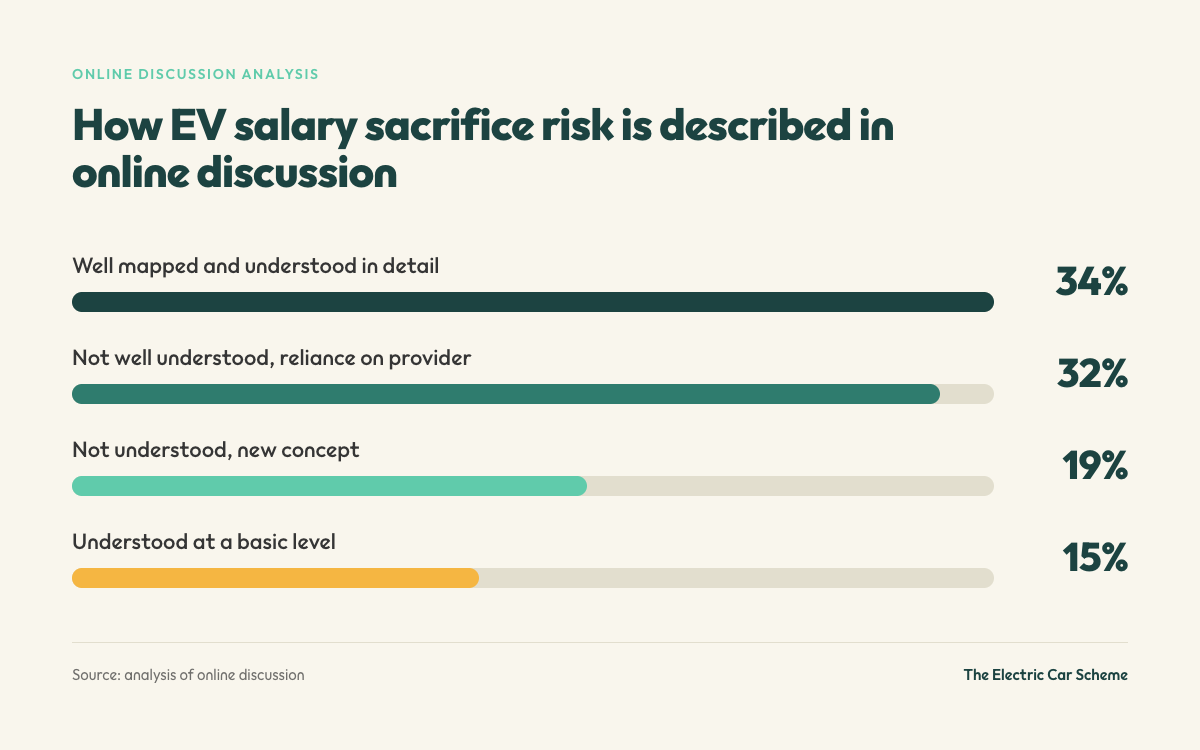
How risks are understood: 34% of opinions describe risks as well mapped and understood in detail, 15% as understood at a basic level, 32% as not well understood and reliant on the provider, and 19% as not understood at all because EV salary sacrifice is a new concept
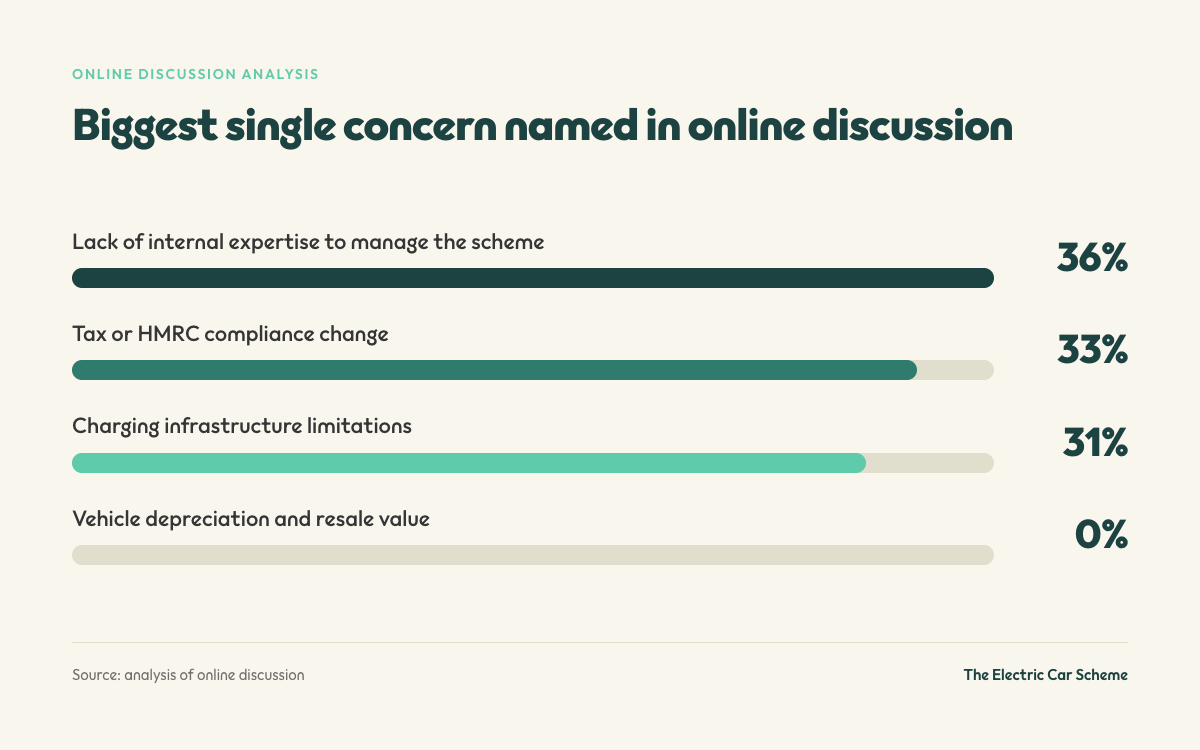
Biggest concern: 36% of opinions name lack of internal expertise, 33% name tax or HMRC compliance change, 31% name charging infrastructure limitations, and none name vehicle depreciation or resale value as the single biggest concern
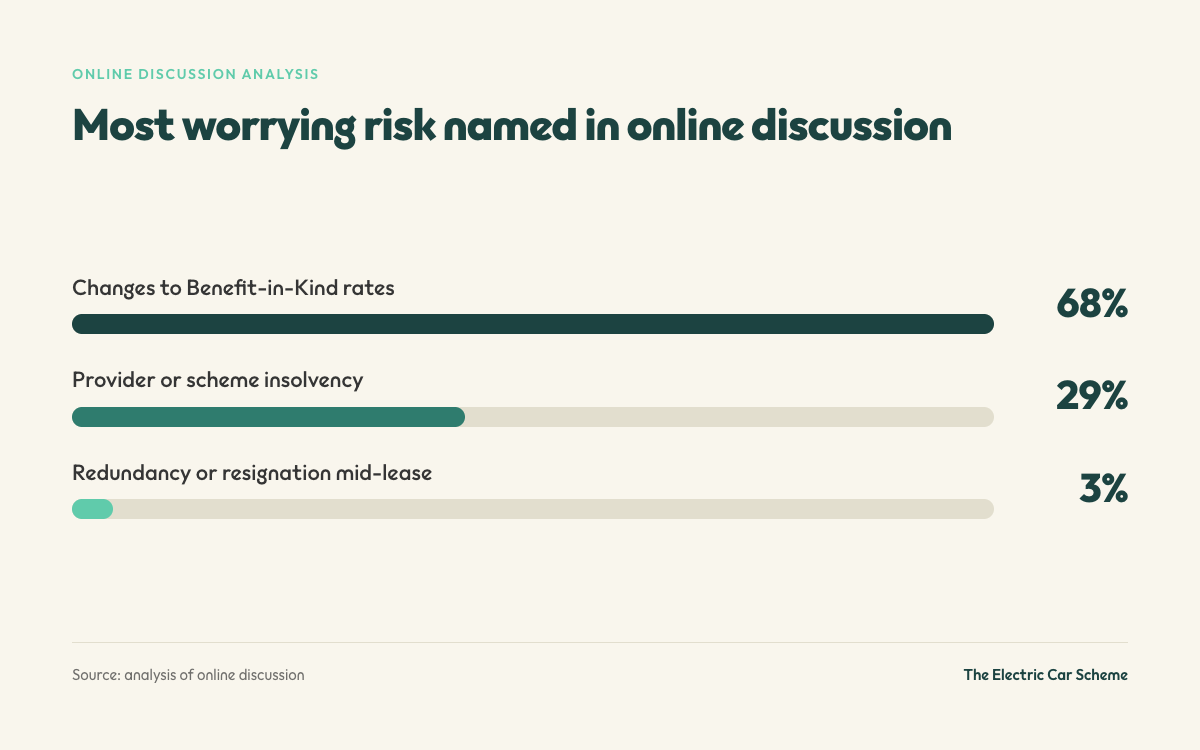
Most worrying risk: 68% name changes to Benefit-in-Kind rates, 29% name provider or scheme insolvency, and 3% name redundancy or resignation mid-lease
Risk drivers: 78% point to employee misunderstanding of scheme terms, 18% to complex tax and legislative change, and 3% to cost-of-living pressure
Departmental lead: HR or People in 50% of opinions, finance in 28%, fleet or facilities in 12%, and shared across departments in 9%
Risk ownership: no clear owner in 64% of opinions, an external provider in 20%, and the HR or People team in 16%
Benefits team knowledge: clear gaps in 64% of opinions, never tested in 12%, partial understanding in 12%, and full understanding in 12%
Policy clarity: very clear and documented in 32% of opinions, vague or informal in 32%, no formal policy in 29%, and somewhat clear in 6%
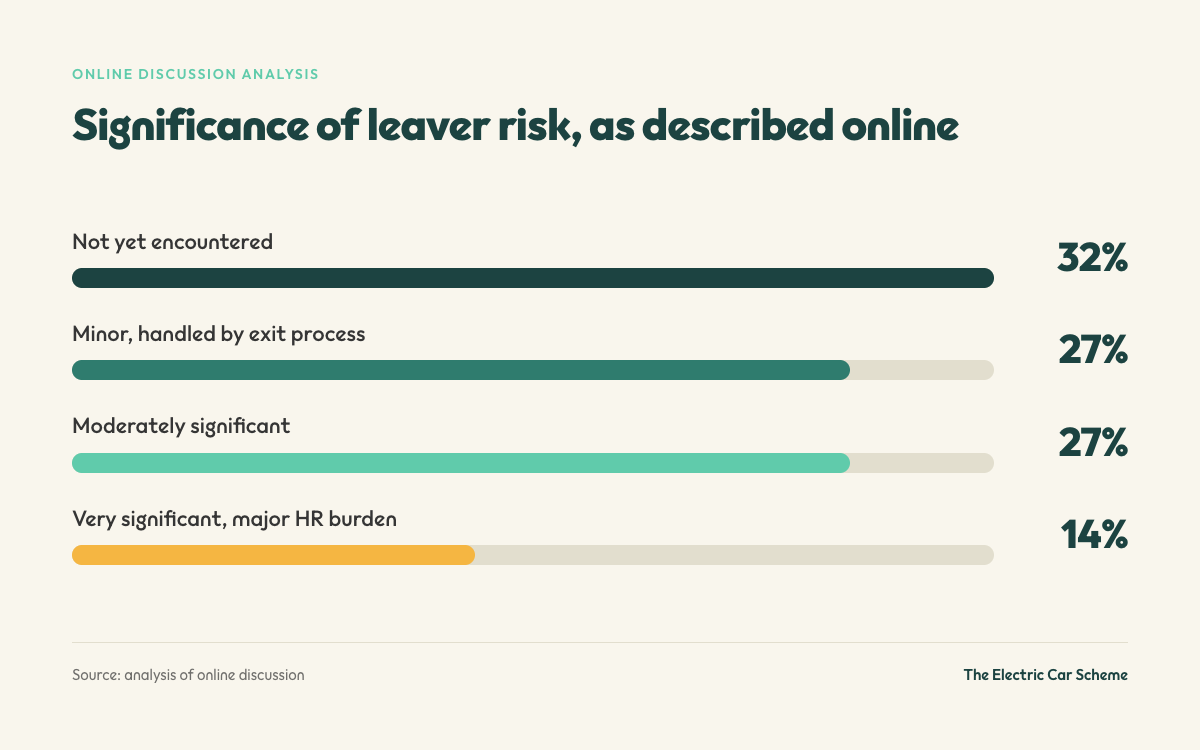
Leaver risk: not yet encountered in 32% of opinions, minor and handled by the exit process in 27%, moderately significant in 27%, and very significant in 14%
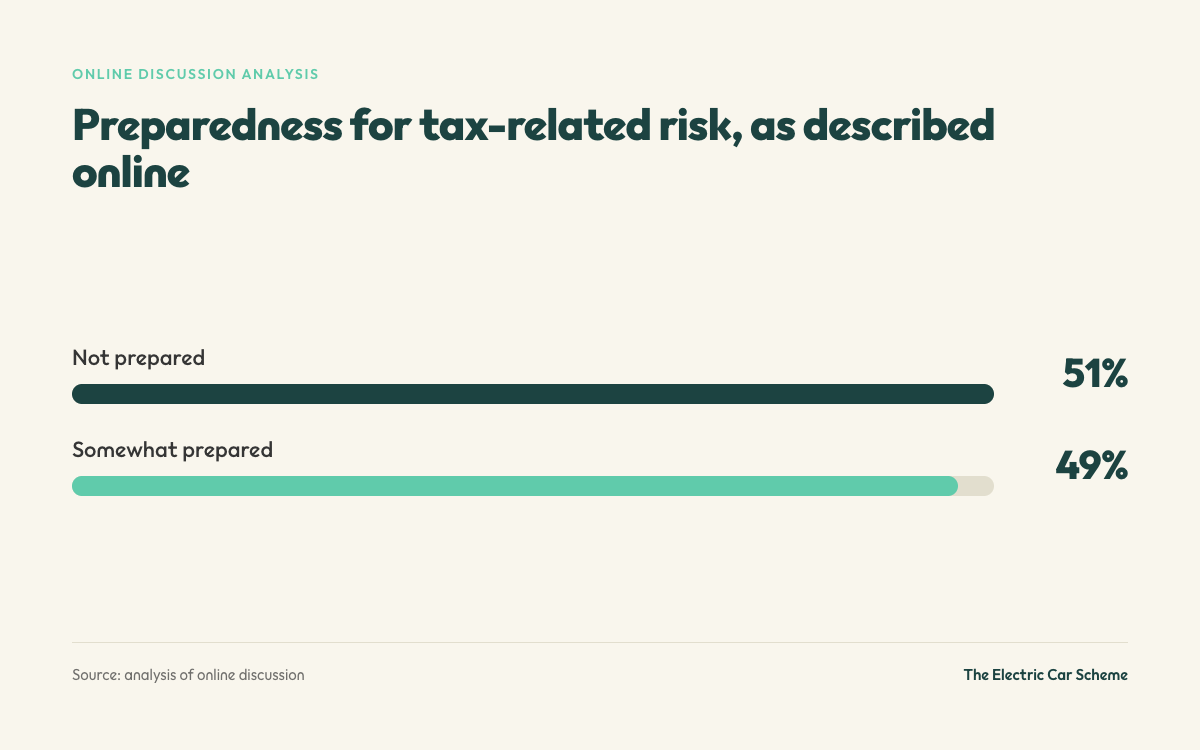
Tax preparedness: not prepared in 51% of opinions, somewhat prepared in 49%
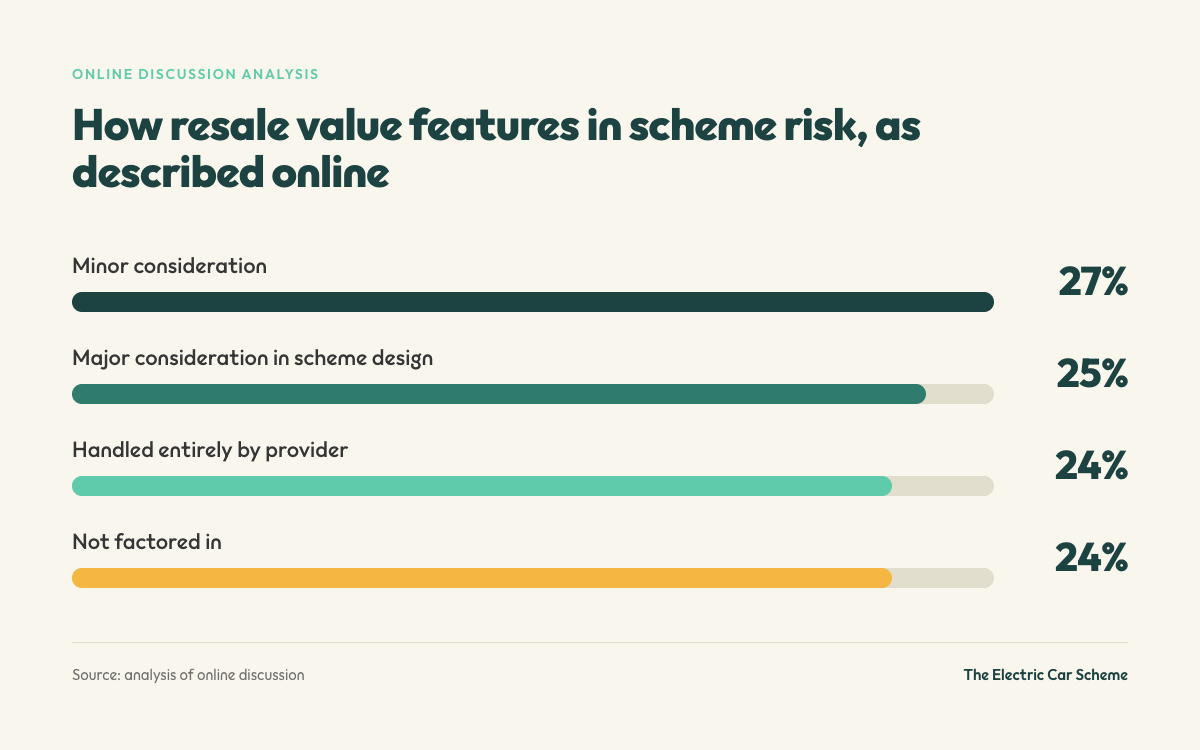
Resale value: a minor consideration in 27% of opinions, a major consideration in scheme design in 25%, handled entirely by the provider in 24%, and not factored in at all in 24%
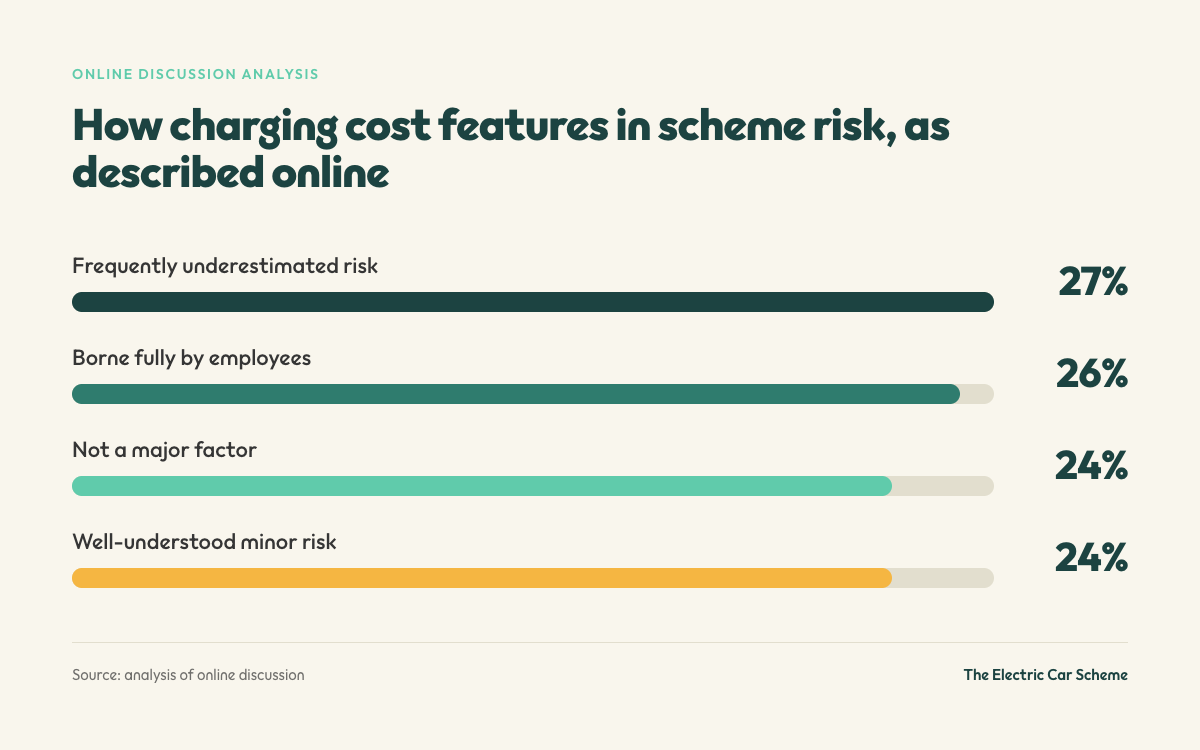
Charging costs: a frequently underestimated risk in 27% of opinions, borne fully by employees in 26%, a well-understood minor risk in 24%, and not a major factor in 24%
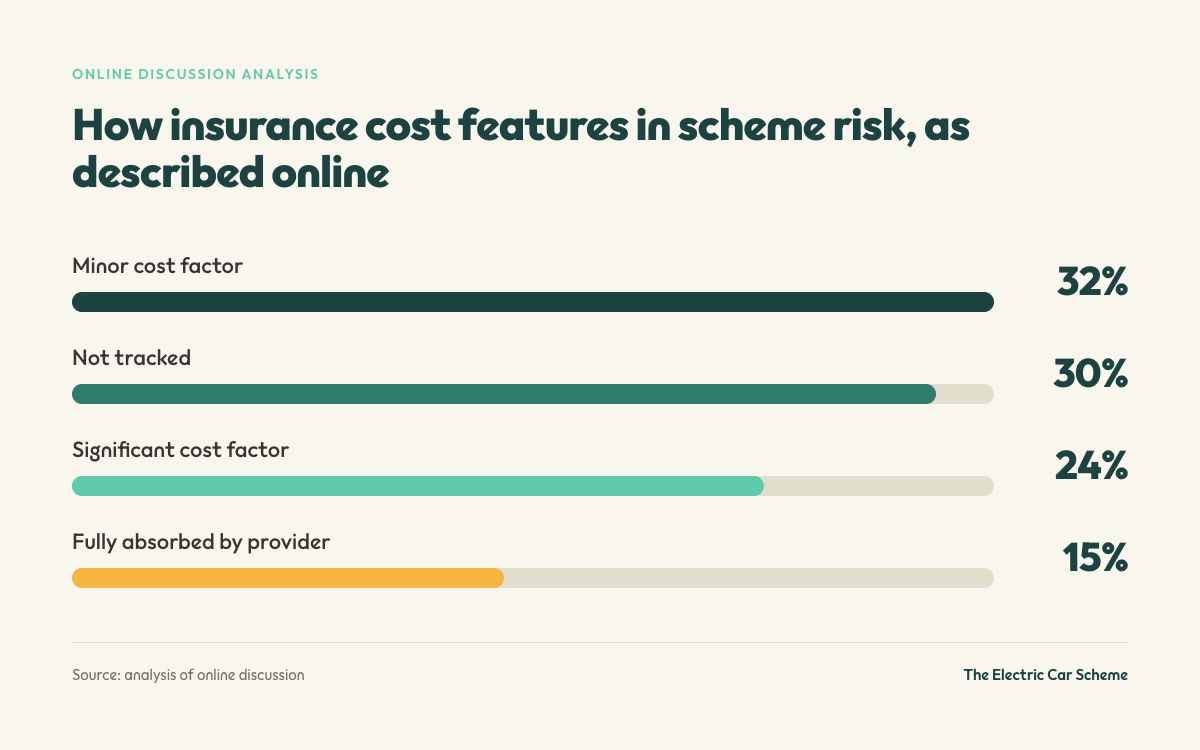
Insurance costs: a minor cost factor in 32% of opinions, not tracked in 30%, a significant cost factor in 24%, and fully absorbed by the provider in 15%
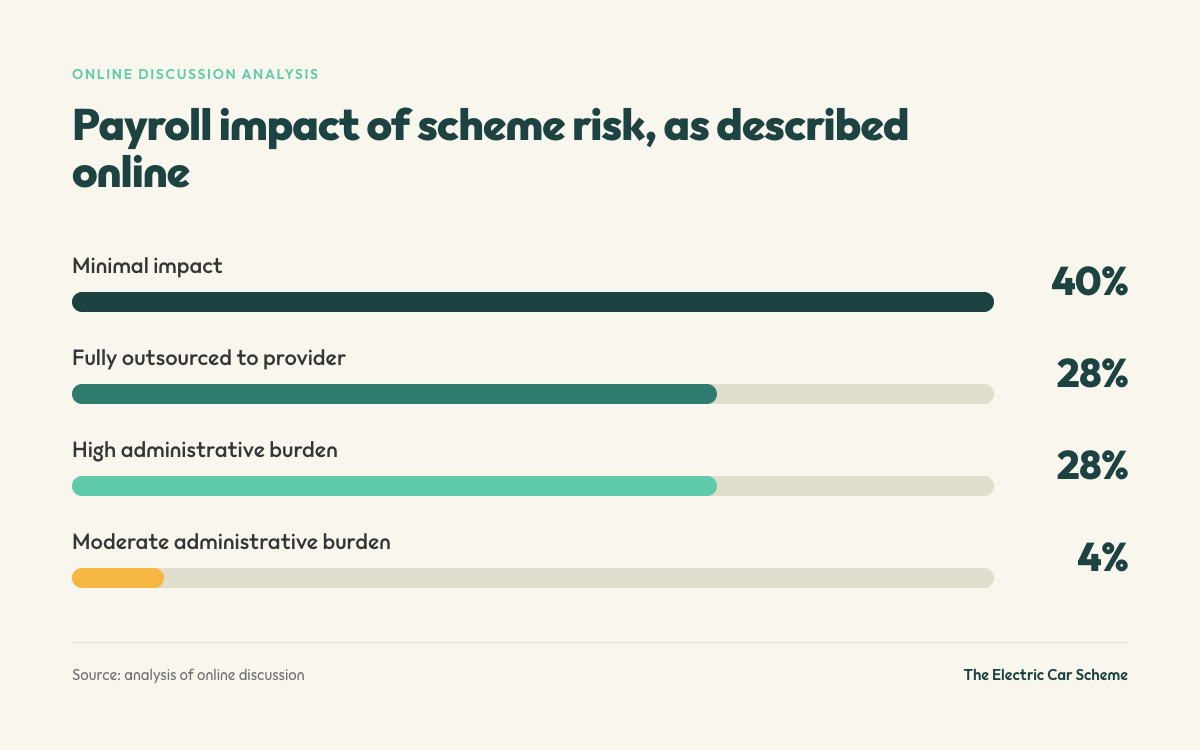
Payroll impact: minimal in 40% of opinions, fully outsourced to a provider in 28%, a high administrative burden in 28%, and a moderate administrative burden in 4%
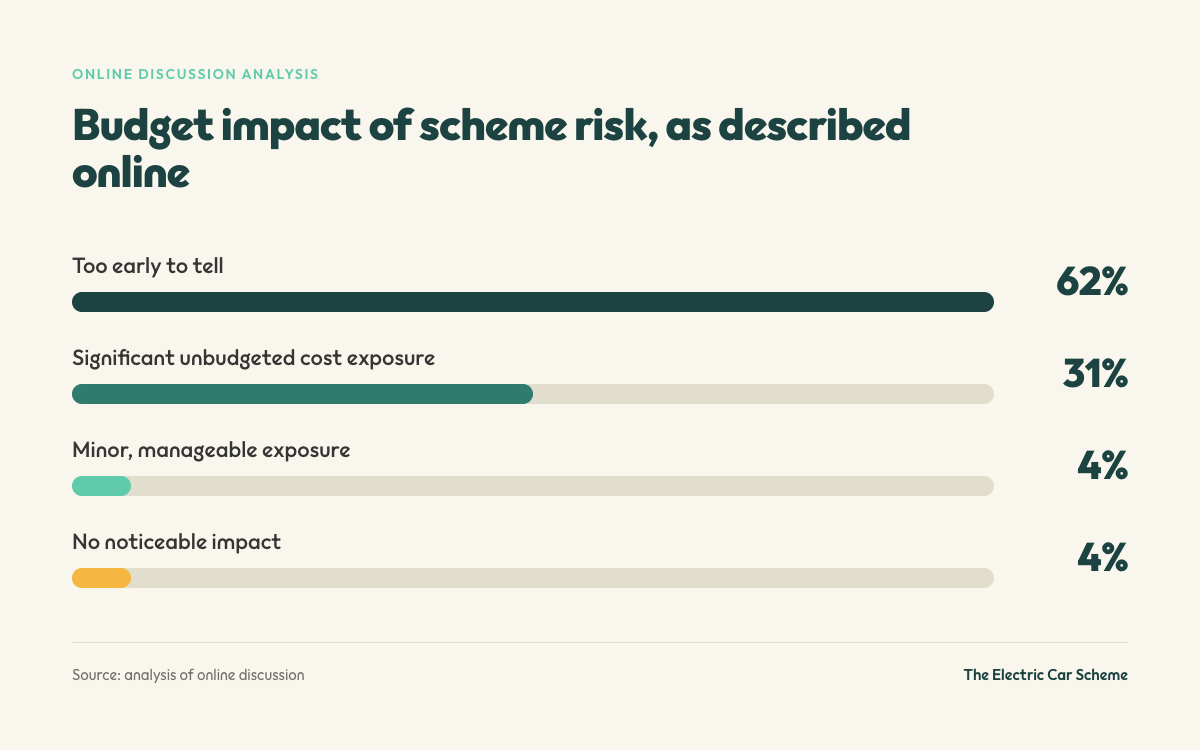
Budget impact: too early to tell in 62% of opinions, significant unbudgeted cost exposure in 31%, minor manageable exposure in 4%, and no noticeable impact in 4%
Risk by employee level: not analysed in 50% of opinions, higher for senior employees in 38%, consistent across levels in 6%, and higher for junior employees in 5%
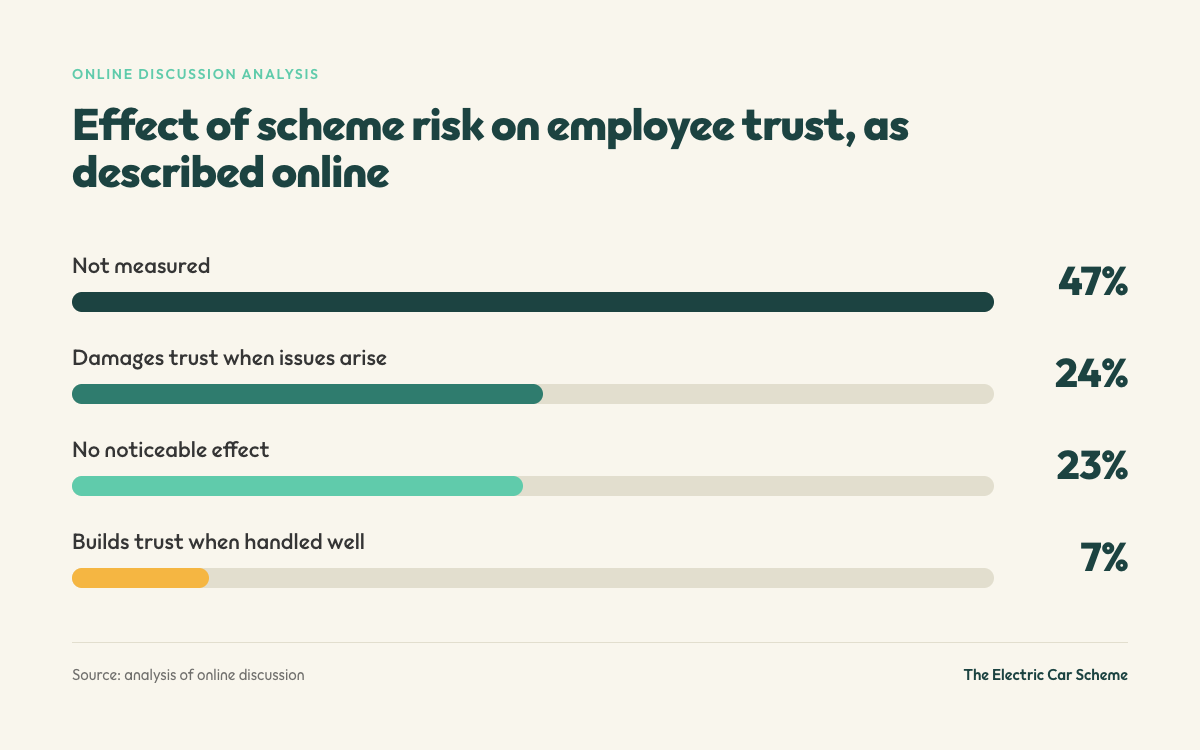
Employee trust: not measured in 47% of opinions, damaged when issues arise in 24%, no noticeable effect in 23%, and trust-building when handled well in 7%
Retention: no real impact in 53% of opinions, not measured in 47%
Pre-launch assessment: provider guidance only in 94% of opinions, informal internal discussion in 6%
Training: informal guidance only in 37% of opinions, none available in 29%, formal training for HR and managers in 29%, and provider-led training only in 5%
Review frequency: only when issues arise in 60% of opinions, never formally reviewed in 16%, quarterly or more often in 12%, and annually in 11%
Confidence: very confident in 33% of opinions, not confident at all in 33%, fairly confident in 17%, and not very confident in 17%
Overall management: very well managed in 24% of opinions, reasonably well managed in 24%, poorly managed in 30%, and not managed at all in 23%
AI tools: no expected benefit in 74% of opinions, some benefit in 22%, unsure in 4%
Reducing risk in EV salary sacrifice
How well are the risks of EV salary sacrifice understood?
34% of opinions describe the risks as well mapped and understood in detail, 15% as understood at a basic level, 32% as not well understood and reliant on the provider, and 19% as not understood at all because EV salary sacrifice is a new concept.
The commonly cited risks are real ones: Benefit-in-Kind increases over the life of a lease, the reduction in gross pay and its knock-on effects, no equity in the vehicle at the end of the agreement, and early termination charges if a lease ends ahead of schedule.
Understanding of those risks is uneven in the dataset. Roughly a third of opinions (34%) describe risk as mapped out in detail, and a further 15% describe a working knowledge of the basics. Set against that, 32% describe limited understanding combined with reliance on the scheme provider for the administrative side, and 19% describe EV salary sacrifice as new enough that the risks have not been examined at all.
Taken together, around half the dataset reflects a substantive grasp of scheme risk and around half does not. That is the recurring pattern across the sections that follow.
What is the biggest single concern about EV salary sacrifice risk?
36% of opinions name lack of internal expertise to manage the scheme, 33% name tax or HMRC compliance change, 31% name charging infrastructure limitations, and none name vehicle depreciation or resale value as the single biggest concern.
One well-defined constraint sits behind a lot of this discussion. Salary sacrifice reduces an employee’s gross pay, and HMRC is explicit that “a salary sacrifice arrangement must not reduce an employee’s cash earnings below the National Minimum Wage (NMW) rates”. From 1 April 2026 those rates are £12.71 an hour for workers aged 21 and over, £10.85 for 18 to 20 year olds, and £8.00 for under-18s and apprentices. Employers therefore need to model post-sacrifice cash pay — not take-home pay — against the relevant rate, and to keep doing so where hours or earnings fluctuate.
The largest single concern in the dataset, though, is capability rather than any specific rule: 36% of opinions name a shortage of internal expertise to run the scheme properly. Tax and HMRC compliance change follows at 33%, and charging infrastructure at 31%. These three sit close enough together that they are best read as one cluster of roughly equal weight rather than a ranking.
Notably, vehicle depreciation and resale value is named by no opinions as the single biggest concern — which is not the same as saying it is disregarded. As the resale section below shows, a quarter of opinions treat resale value as a major factor in scheme design. It simply is not what anyone raises first.
Which EV salary sacrifice risk causes the most worry?
68% of opinions name changes to Benefit-in-Kind tax rates as the most worrying risk, 29% name provider or scheme insolvency, and 3% name redundancy or resignation mid-lease.
The concern has a clear factual basis. The Benefit-in-Kind rate on a fully electric company car is 4% for 2026/27, rising to 5% in 2027/28, 7% in 2028/29 and 9% in 2029/30, up from 3% in 2025/26. That is one percentage point a year to 2027/28 and then two-point steps — so over the four years to 2029/30 the taxable benefit triples, which will land inside the term of leases being written today. Petrol, diesel and hybrid vehicles remain on substantially higher rates throughout, so the relative advantage holds; the absolute cost to the employee does not stand still. Employer Class 1A National Insurance on the benefit is charged at 15% in 2026/27.
That trajectory is confirmed and published, which makes it plannable — but it is a genuine cost escalation rather than a technicality, and 68% of opinions treating it as the leading worry is a reasonable response to it rather than a misunderstanding.
Provider or scheme insolvency is the second concern, named in 29% of opinions. Redundancy or resignation mid-lease is named in only 3%, which is striking given how frequently early termination appears as a driver elsewhere in the dataset — the exposure is widely acknowledged but rarely the thing people lead with, most likely because early termination protection is now a standard feature of most provider offerings.
What is driving EV salary sacrifice risk?
78% of opinions point to employee misunderstanding of scheme terms as the main risk driver, 18% to complex tax and legislative change, and 3% to cost-of-living pressure.
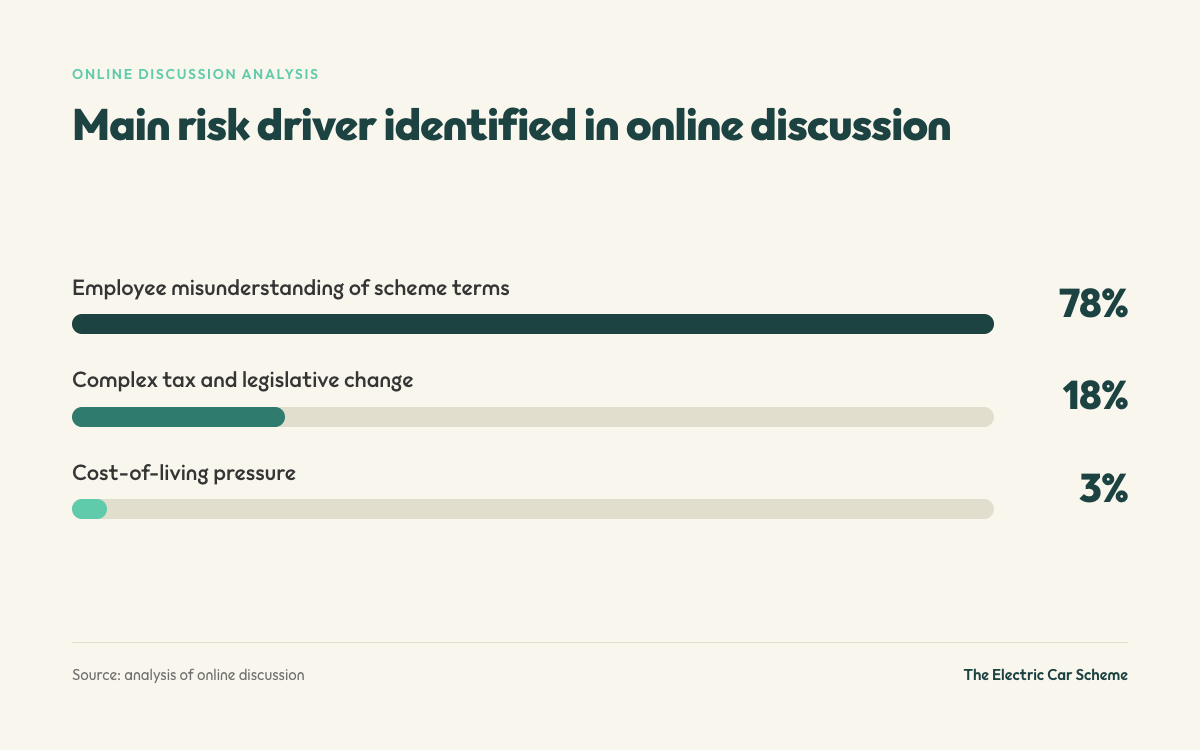
This is the most lopsided result in the dataset, and the most actionable one. More than three-quarters of opinions (78%) locate the problem in employees not fully understanding what they have signed up to.
That matters because the consequences of a misunderstanding land on both sides. Employees who have not grasped the early termination terms, the effect of a lower gross salary on borrowing capacity or pension contributions, or the running-cost difference between home and public charging, can end up materially worse off than they expected. Employers can be left with unbudgeted termination charges, NMW compliance failures, and a loss of trust in the benefit and in leadership.
Tax and legislative complexity is named in 18% of opinions and cost-of-living pressure in 3%. Both are real, but the dataset points overwhelmingly at communication rather than at the rules themselves.
Which department leads on EV salary sacrifice risk?
HR or People leads in 50% of opinions, finance in 28%, fleet or facilities in 12%, and responsibility is shared across departments in 9%.
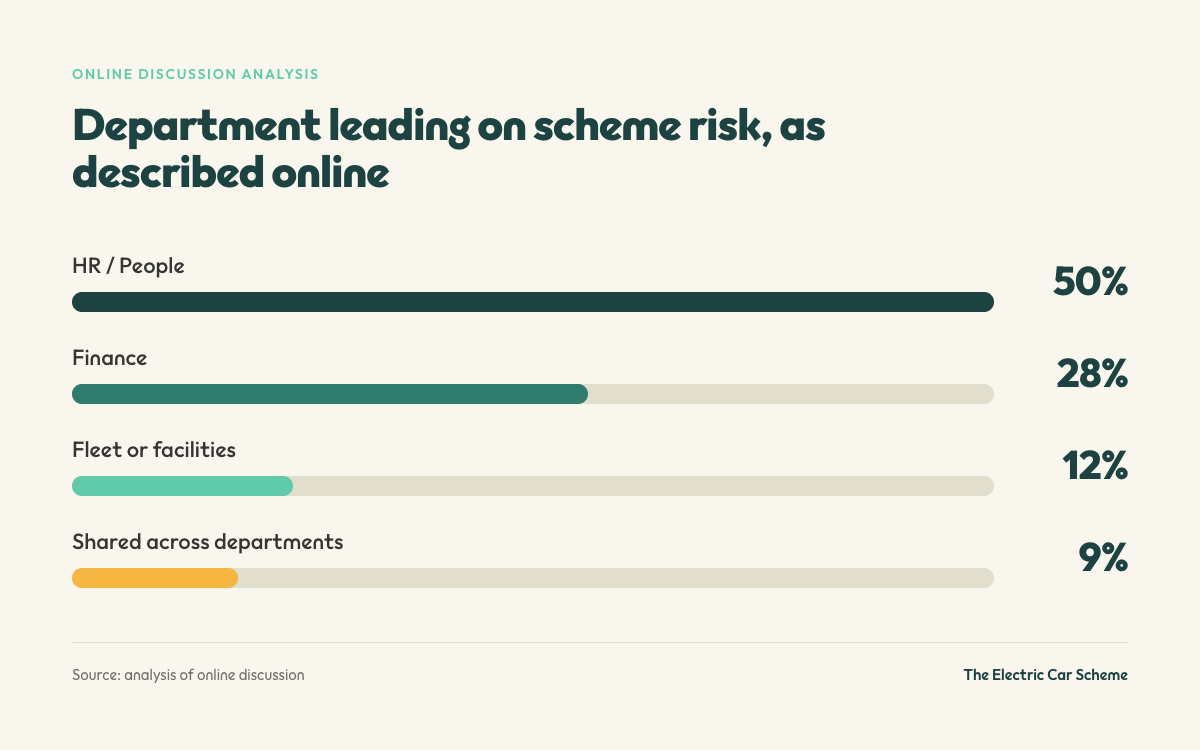
Half of opinions place HR or People in the lead on identifying and addressing scheme risk. That is a natural fit for the communication problem identified above — the team best placed to explain scheme terms to employees is generally the team that owns the benefit.
Finance leads in 28% of opinions, which makes sense where the dominant concern is unbudgeted termination exposure or Class 1A cost. Fleet or facilities leads in 12%, and 9% describe responsibility genuinely shared across functions.
The practical point is that EV salary sacrifice risk spans HR, payroll, finance and fleet, and single-function ownership tends to leave gaps at the boundaries — most often between the people who explain the scheme and the people who pay for it going wrong.
Who owns managing EV salary sacrifice risk?
No one clearly owns it in 64% of opinions, an external provider owns it in 20%, and the HR or People team owns it in 16%.
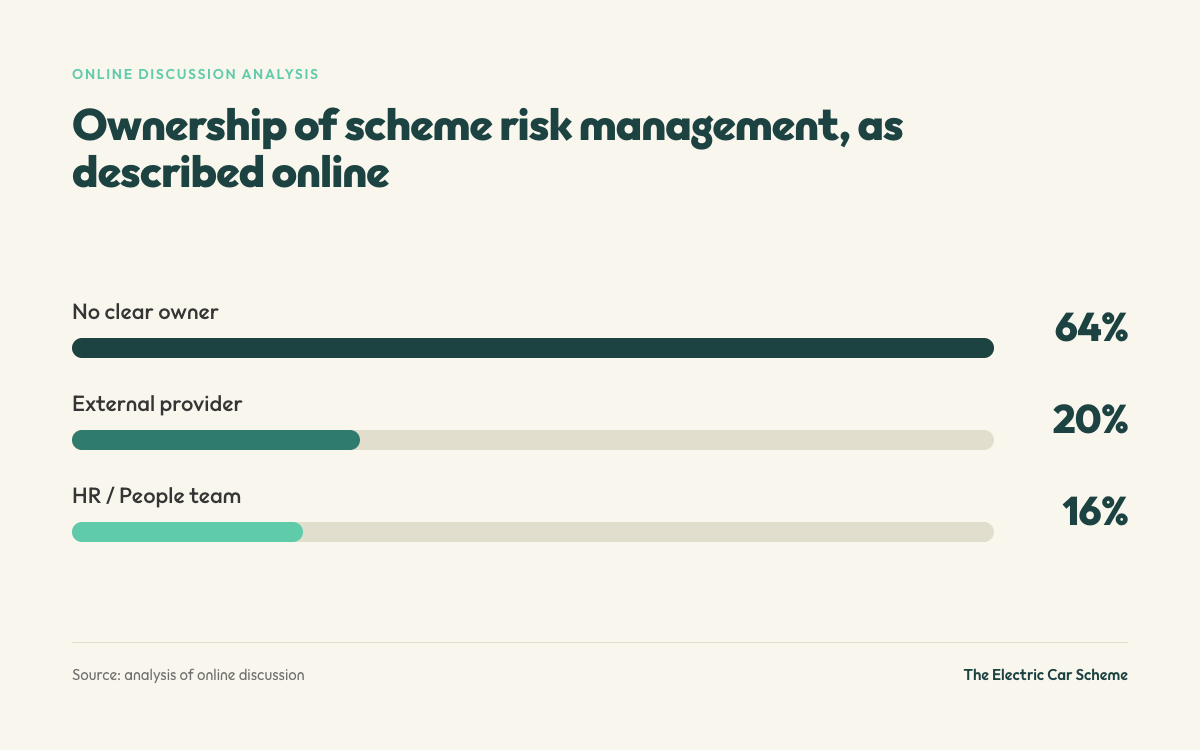
There is a distinction worth drawing between the previous section and this one. Leading on risk and owning it are different things, and the numbers diverge sharply: HR or People leads in 50% of opinions but formally owns risk management in only 16%.
In 64% of opinions, no one owns it clearly at all. Salary sacrifice has been available to UK employers for decades, but EV salary sacrifice at scale is comparatively recent, so it is unsurprising that governance has not caught up with adoption in a lot of organisations. A further 20% have handed ownership to an external provider.
Unclear ownership is the condition under which the other findings in this article become expensive: it is what allows an early termination charge, a payroll error or an NMW breach to arrive with no one accountable for having anticipated it.
Do benefits teams fully grasp EV salary sacrifice risk?
64% of opinions describe clear knowledge gaps in the benefits team, 12% describe knowledge that has never been tested, 12% describe partial understanding, and 12% describe full understanding.
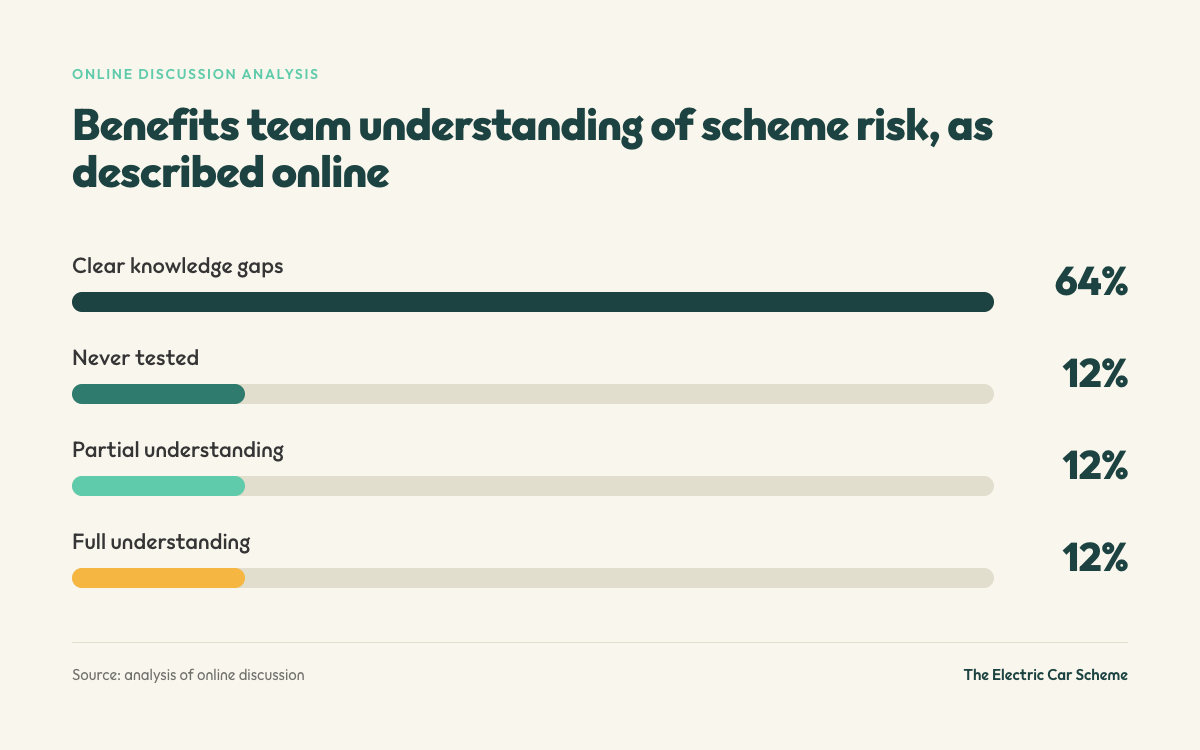
Benefits teams are usually the first line of explanation for employees, so their depth of understanding sets the ceiling on how well risk gets communicated. The factors that need explaining are not trivial: early termination charges, the effect of a reduced gross salary on pension contributions and other salary-linked entitlements, and the running-cost gap for employees without off-street parking.
Only 12% of opinions describe a benefits team with a full grasp of these, with another 12% describing partial understanding. Against that, 64% describe clear gaps and 12% describe understanding that has never been formally assessed.
Read alongside the training findings later in this article, the implication is consistent: structured training for the teams that promote these schemes is the single most underused lever available.
How clear are policies on EV salary sacrifice risk?
32% of opinions describe a very clear, documented policy, 32% describe a vague or informal one, 29% describe no formal policy at all, and 6% describe a somewhat clear policy.
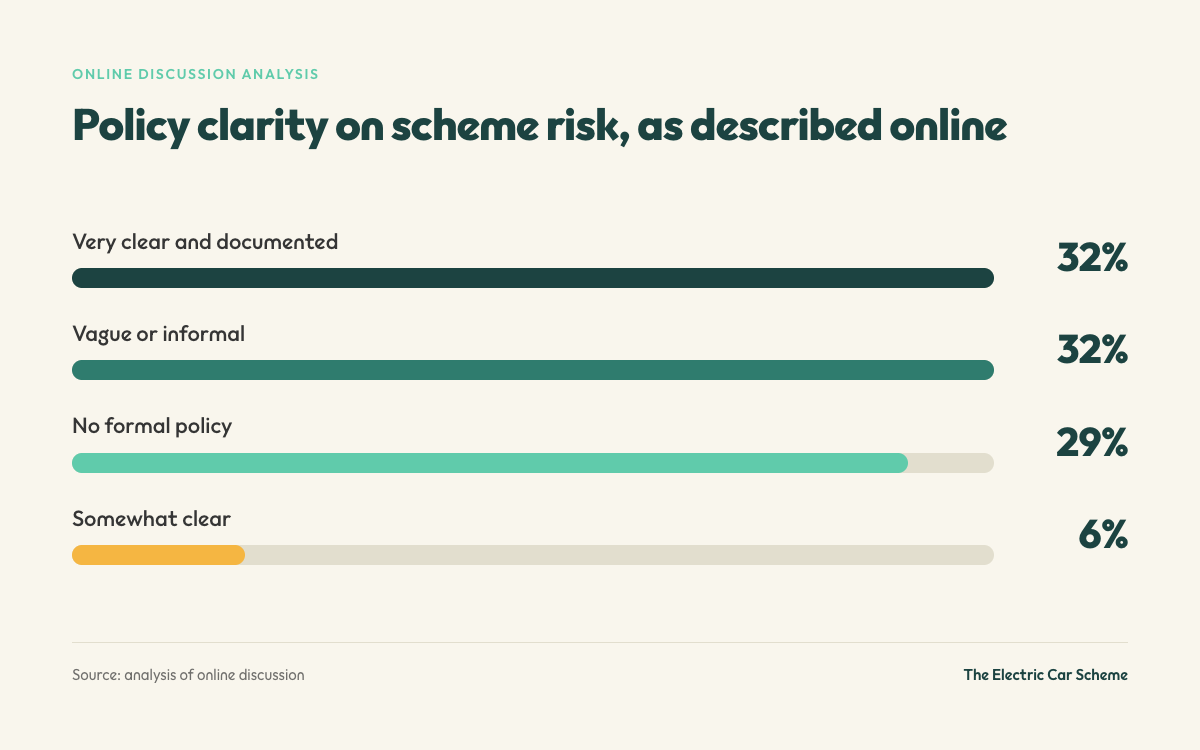
EV salary sacrifice introduces genuine administration and compliance obligations. Arrangements need adjusting as employees join and leave, and they interact with life events — marriage, divorce, redundancy, parental leave — that change pay and therefore change the NMW and reporting position. Non-cash benefit calculations and pay figures have to be recalculated accordingly.
Just under a third of opinions (32%) describe a clear, documented policy covering this. An equal share (32%) describe policies that exist but are informal or thin on detail, and 29% describe no formal policy at all. A written policy is what makes the response to a mid-lease leaver, a pay change or a rate change predictable rather than improvised.
How significant is leaver risk?
32% of opinions describe leaver risk as not yet encountered, 27% as minor and handled by the existing exit process, 27% as moderately significant, and 14% as very significant and a major HR burden.
Employees who resign, are made redundant or go on parental leave may need to end an arrangement early, and early termination charges can turn a benefit into a liability at short notice.
How significant that turns out to be depends on three things: whether early termination protection is in place, how much of any charge is passed to the employee, and how many months remain on the agreement. The dataset reflects that variability directly — 27% describe leaver risk as minor because their exit process already handles it, 27% describe it as moderately significant, and 14% describe it as a major HR burden.
The largest single group, 32%, has not encountered it yet. That is worth reading as a timing signal rather than a reassurance: leaver risk is a function of scheme maturity, and schemes launched in the last two years have not yet been through a full leaver cycle at volume.
How prepared are organisations for the tax risks?
51% of opinions describe organisations as not prepared for the tax-related risks of EV salary sacrifice, and 49% describe them as somewhat prepared.
Electric vehicles provided through a salary sacrifice arrangement are company cars made available for private use and are taxed as a Benefit-in-Kind accordingly. The rate is low relative to petrol and diesel equivalents and the schedule is published to 2029/30, but as set out above it rises from 3% to 9% across that period.
Two clarifications on the tax risks themselves, because both are commonly misstated:
The NMW test applies to cash earnings, not net pay. Employers must ensure post-sacrifice cash pay does not fall below the applicable NMW rate for the pay reference period. Take-home pay after tax and NI is not the relevant measure.
The Optional Remuneration Arrangement (OpRA) rules do not apply to electric cars. Cars with CO2 emissions of 75g/km or less are excluded from OpRA by section 120A ITEPA 2003, which is precisely why EV salary sacrifice is tax-efficient. A compliant EV scheme cannot produce an OpRA error on the car. OpRA can still bite on other, non-exempt benefits sacrificed alongside it.
The genuine tax exposures are elsewhere: NMW headroom on fluctuating pay, accurate P11D or payrolled-benefit reporting, Class 1A liability rising with BIK rates, VAT treatment on lease rentals, and charging reimbursement that is structured as a cash allowance and therefore attracts Class 1 NI and PAYE.
The dataset splits almost evenly on preparedness — 49% somewhat prepared, 51% not prepared. A two-point gap in a dataset of this kind is not a result, so the honest reading is that opinion is divided, not that one side edges it.
How do resale values factor into the risk?
27% of opinions treat resale value as a minor consideration, 25% as a major consideration in scheme design, 24% as handled entirely by the provider, and 24% as something not factored in at all.
Recent market data runs against the received wisdom here. According to Auto Trader Insight, across 2025 three-to-five-year-old EVs were the fastest-selling vehicles of any fuel type, averaging 25 days to sell — five days faster than the market as a whole. Enquiries for EVs in the three-to-six-year bracket were up 50% year on year, and total enquiries for used EVs up to six years old rose 27%.
The mechanism that makes this matter to employers is residual values. Lease pricing is built on the expected value of the vehicle at the end of the term, so falling residuals feed directly into monthly rentals, and rising rentals make the benefit less compelling for employees and more expensive to run. Strengthening used EV demand pushes the other way.
The dataset is genuinely divided on how much weight to give this: the four categories sit within three percentage points of each other, so this is best characterised as no consensus rather than as a ranking. Roughly half of opinions either leave resale risk to the provider (24%) or have not considered it (24%).
How do charging costs relate to the risk?
27% of opinions describe charging costs as a frequently underestimated risk, 26% as a risk borne fully by employees, 24% as a well-understood minor risk, and 24% as not a major factor.
The underlying cost gap is well documented. According to BYD, charging a typical EV to full costs around £17 at home against around £26 at a public charging station — figures that vary with battery size, tariff and charger speed. Two structural factors drive the difference: domestic electricity carries 5% VAT while public charging carries 20%, and public charging is priced at a commercial margin.
The consequence for employers is that the same benefit delivers materially different value depending on whether an employee has off-street parking. Left unaddressed, that turns into an equity problem within the workforce and a fairness problem in mileage reimbursement. Employers offering a charging allowance should also note that a flat monthly payment is liable to be treated by HMRC as a cash allowance, making it subject to Class 1 National Insurance and PAYE.
Opinion in the dataset is spread almost evenly across all four positions, from 27% treating charging as an underestimated risk down to 24% treating it as immaterial. As with resale value, the finding is the absence of a settled view.
How do insurance costs feature in the risk?
32% of opinions describe insurance as a minor cost factor, 30% describe it as not tracked, 24% as a significant cost factor, and 15% as fully absorbed by the provider.
Insurance is a live constraint on EV adoption more broadly. Recent industry analysis reports that 42.1% of UK consumers expect to switch to a fully electric vehicle within the next five years, up from 36.8% in 2024, while identifying EV insurance premiums — driven by higher repair costs, expensive battery components and limited specialist repair capacity — as one of the larger brakes on that intent. The premium gap has been narrowing but has not closed, so this is a figure to date-stamp rather than treat as fixed.
Within the dataset, 24% of opinions treat insurance as a significant cost factor and 32% as a minor one. The most interesting number is the 30% who do not track insurance costs against the scheme at all, which makes the 32% “minor” figure hard to rely on — a cost that is not measured is not really known to be small.
How does EV salary sacrifice risk affect payroll teams?
40% of opinions describe minimal payroll impact, 28% describe risks fully outsourced to a provider, 28% describe a high administrative burden, and 4% describe a moderate administrative burden.
The payroll workload is specific and recurring. Teams need to monitor fluctuating earnings so that post-sacrifice cash pay stays above the NMW rate; recalculate statutory benefit entitlements affected by a reduced gross salary; and keep pace with BIK rate changes and reporting requirements to avoid correction and penalty exposure.
28% of opinions describe that as a high administrative burden and 4% as a moderate one. A larger 40% describe minimal impact, and 28% describe the work as fully outsourced to the scheme provider — which explains a good part of the “minimal” figure. Where the administration is genuinely handled by a third party, payroll impact is low by design rather than by accident.
How does EV salary sacrifice risk affect budgets?
62% of opinions say it is too early to tell what the budget impact is, 31% describe significant unbudgeted cost exposure, 4% describe minor manageable exposure, and 4% describe no noticeable impact.
The employer is the contract holder on vehicles provided through salary sacrifice, which is what puts early termination charges on the employer’s books when an employee leaves mid-lease. Where the arrangement contains no protective provision, that lands as an unbudgeted cost. Reporting and payroll errors carry their own penalty exposure.
The dominant response by a wide margin — 62% — is that it is too early to judge, consistent with the picture elsewhere of schemes that have not yet been through a full cycle. Among those who do have a view, unbudgeted exposure clearly outweighs the alternatives: 31% describe significant unbudgeted cost against 8% combined describing minor or no impact.
Does the risk differ by employee level?
50% of opinions describe this as not analysed, 38% describe higher risk for senior employees, 6% describe consistent risk across levels, and 5% describe higher risk for junior employees.
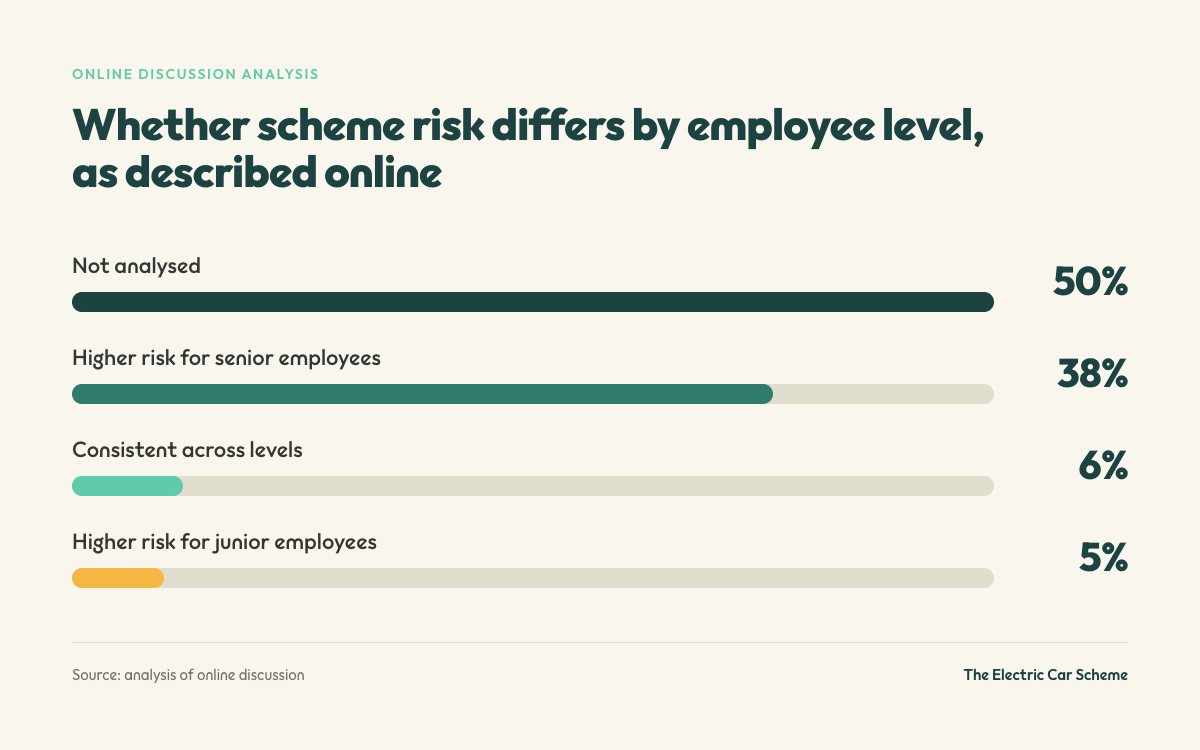
Half of opinions reflect no analysis of how risk varies by seniority. Among those that do, the weight sits firmly on senior employees (38%) rather than junior ones (5%).
There is a straightforward mechanism behind that, and it works in two directions. Higher earners have more headroom above the NMW floor, so the compliance constraint binds less tightly on them — but they also tend to take higher-value vehicles and longer terms, so the absolute early termination exposure per leaver is larger. Lower earners face the opposite profile: smaller absolute exposure, but a much tighter NMW constraint, which is why the April 2026 rate increases matter more at the junior end than the senior end.
For context on the population being discussed, ONS data shows 23.2% of UK employee jobs were high-paid as of April 2025, defined as paying more than £26.94 an hour — 1.5 times median hourly pay of £17.96. That describes the size of the higher-earning cohort; it does not explain the 38% figure above, and should not be read as doing so.
How does EV salary sacrifice risk affect employee trust?
47% of opinions describe trust impact as not measured, 24% say these risks damage trust when issues arise, 23% report no noticeable effect, and 7% say trust is built when risks are handled well.
Trust is worth taking seriously as a business variable: Deloitte reports that trusted companies outperform their peers by up to 400% in market value, and that customers who trust a brand are 88% more likely to buy again. That is a general trust finding rather than an employee-trust-specific one, but the direction is well established across the literature.
Nearly half of opinions (47%) reflect no measurement of the trust impact of EV salary sacrifice at all. Where there is a view, 24% describe damage when problems arise and 23% describe no noticeable effect.
The smallest group is the most interesting: 7% describe these risks as building trust when they are managed openly. Setting out the early termination position, the BIK trajectory and the charging cost difference up front — before someone signs — is what separates the 7% from the 24%. The risks are the same in both cases; the disclosure isn’t.
How does EV salary sacrifice risk affect retention?
53% of opinions describe no real impact on retention, and 47% describe it as not measured.
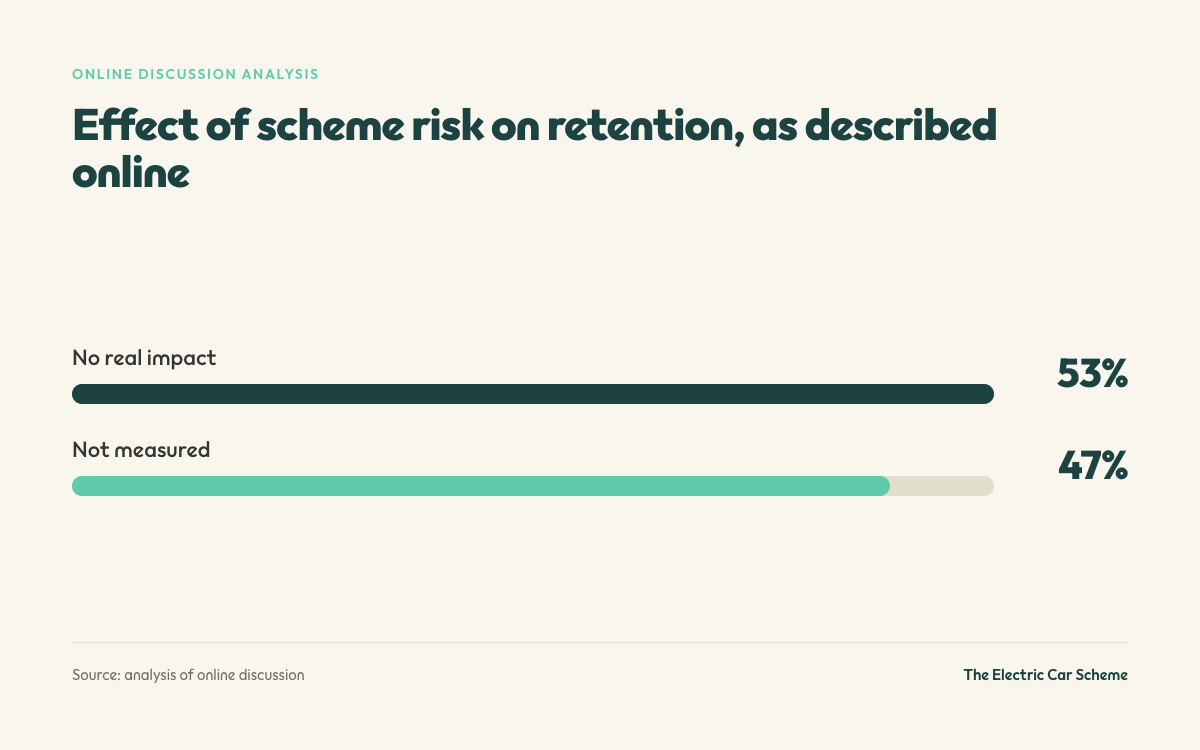
Only two positions appear in this dataset, and neither is positive or negative — one says no impact, the other says unknown. Given the 47% “not measured”, the 53% “no real impact” should be read as an absence of observed problems rather than as evidence of no effect.
For wider context, research by Remote reported via techUK found UK staff turnover rising from 25.8% to 35.6% over the five years to 2023, though the source does not specify the sector or population covered. Nothing in that research addresses EV salary sacrifice, and no causal link between the two should be inferred — it is offered only as a marker of the turnover environment these schemes are operating in.
The reasonable conclusion is that the retention effect of EV salary sacrifice risk, in either direction, is currently unmeasured rather than absent.
How is risk assessed pre-launch?
94% of opinions describe relying on provider guidance alone to assess risk before launch, and 6% describe informal internal discussion.
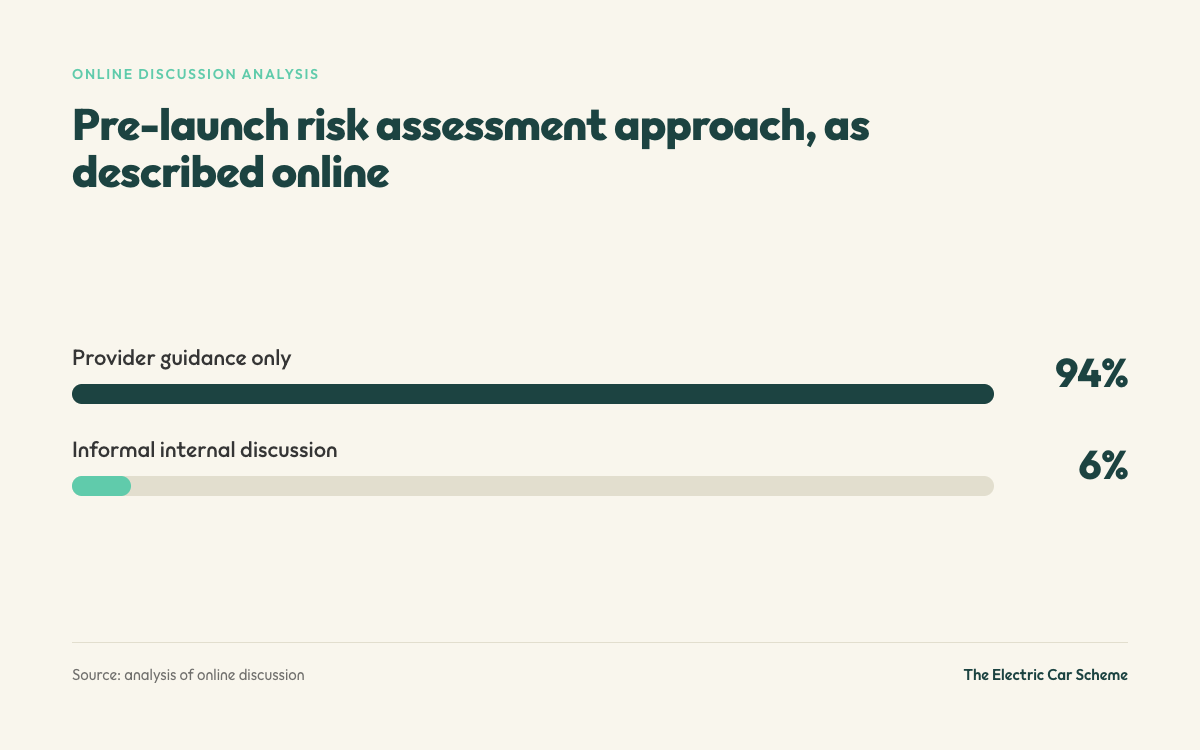
Only two approaches appear in the dataset, and the split is stark. This is the figure to treat with the most caution in the article: it is implausible that no UK organisation conducts a formal internal risk assessment before launching a benefit, so the absence of a third category almost certainly reflects what surfaced in online discussion rather than the full range of real-world practice. Read the 94% as “provider guidance dominates the conversation”, not as a prevalence estimate.
With that caveat, the signal is consistent with the ownership findings: where 64% of opinions describe no clear internal owner for scheme risk, provider guidance filling the gap at launch follows naturally. Provider expertise is real and worth using — providers see failure modes across hundreds of schemes that no single employer will encounter. What it cannot do is account for one employer’s specific pay structure, workforce mix, turnover profile and NMW headroom. Pairing external guidance with an internal review is the practical answer.
What training exists on EV salary sacrifice risk?
37% of opinions describe informal guidance only, 29% describe no training available at all, 29% describe formal training for HR and managers, and 5% describe provider-led training only.
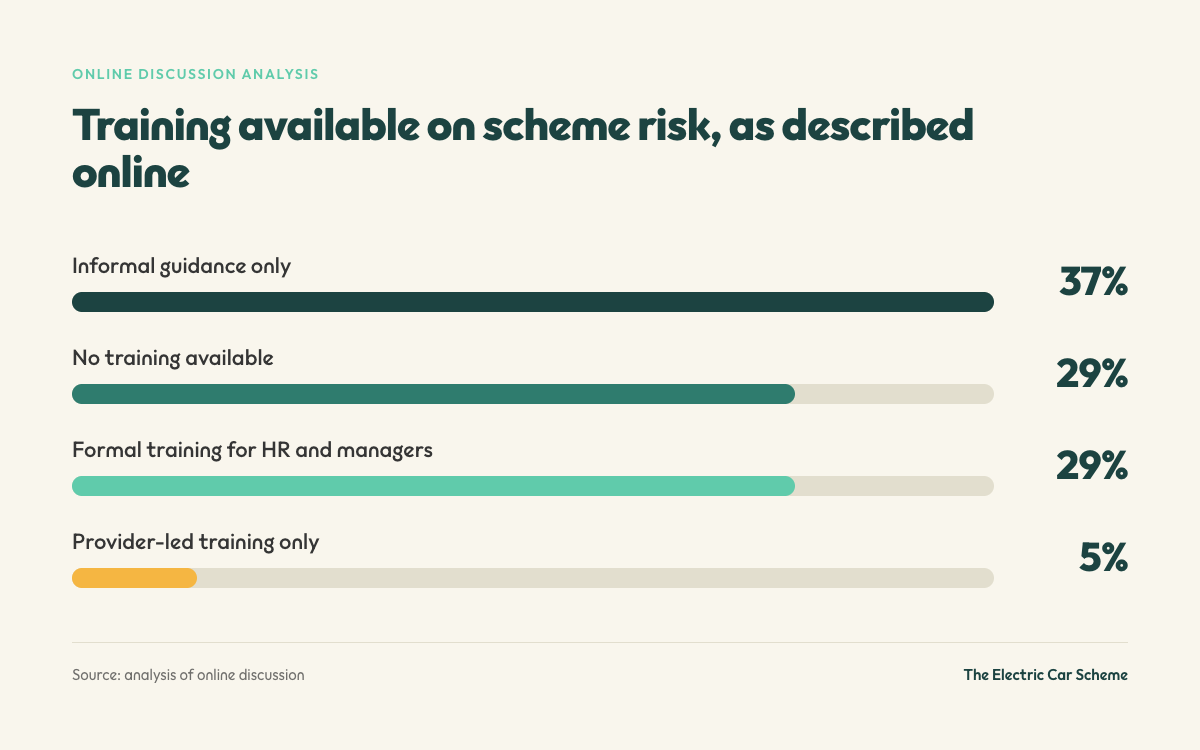
Training is the direct answer to the dataset’s single strongest finding — that 78% of opinions locate risk in employee misunderstanding of scheme terms. Teams who understand early termination mechanics, the NMW constraint and the BIK schedule can explain them accurately, and accurate explanation up front is what prevents the misunderstanding.
29% of opinions describe formal training in place for HR and managers. Against that, 37% describe informal guidance only, 29% describe nothing available, and 5% rely solely on provider-led training. On these numbers, roughly two-thirds of the discussion reflects no structured training on a benefit that carries payroll, tax and multi-year contractual exposure.
How often is EV salary sacrifice risk reviewed?
60% of opinions describe reviewing risk only when issues arise, 16% describe never having formally reviewed it, 12% describe quarterly or more frequent review, and 11% describe annual review.
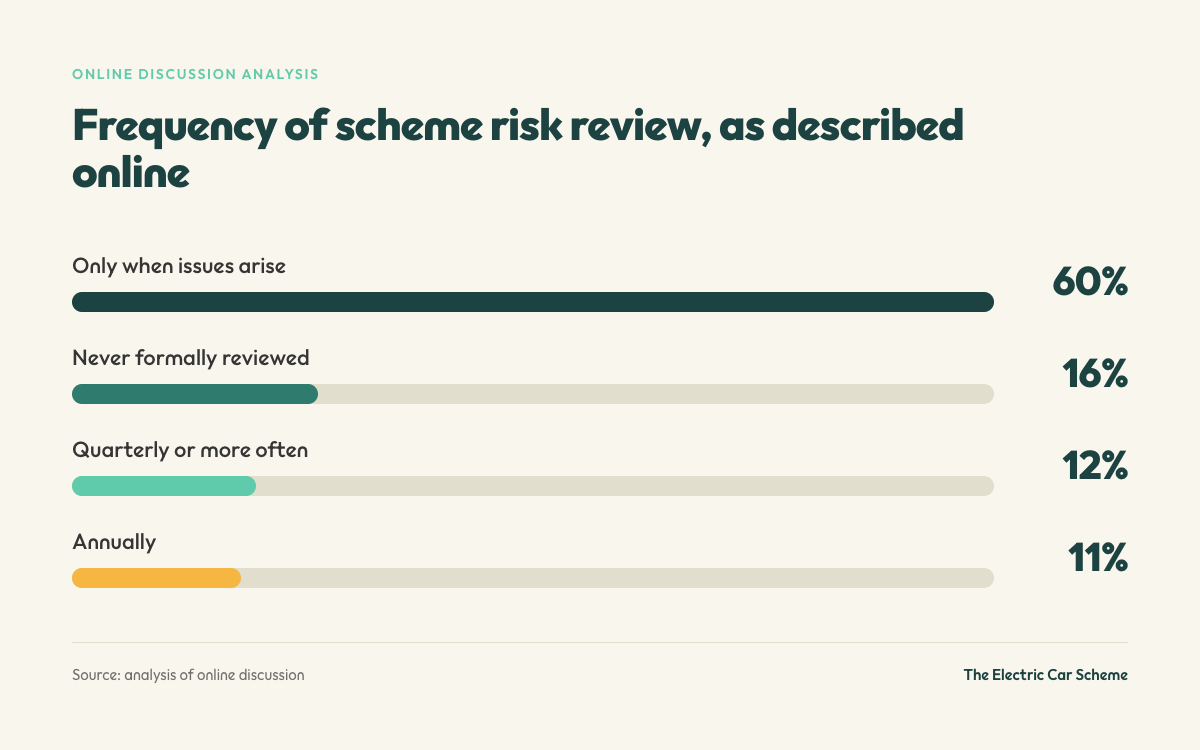
Reviewing only on failure is a reasonable approach for a static arrangement. EV salary sacrifice is not static: the BIK rate changes every April, NMW rates change every April, residual values move with the used market, and the leaver profile changes as a scheme matures. An annual review timed to the April changes is the minimum that keeps pace; anything less means the scheme is being run on assumptions that have already expired.
Only 23% of opinions describe review at least annually. 60% describe review triggered by problems, and 16% describe no formal review at all. Given that both of the scheme’s key variables reset on the same date each year, that is a solvable gap — a single scheduled review in Q1 would move most organisations from reactive to current.
How confident are people in managing these risks?
33% of opinions describe high confidence in managing EV salary sacrifice risk and 17% describe fair confidence, while 33% describe no confidence at all and 17% describe low confidence.
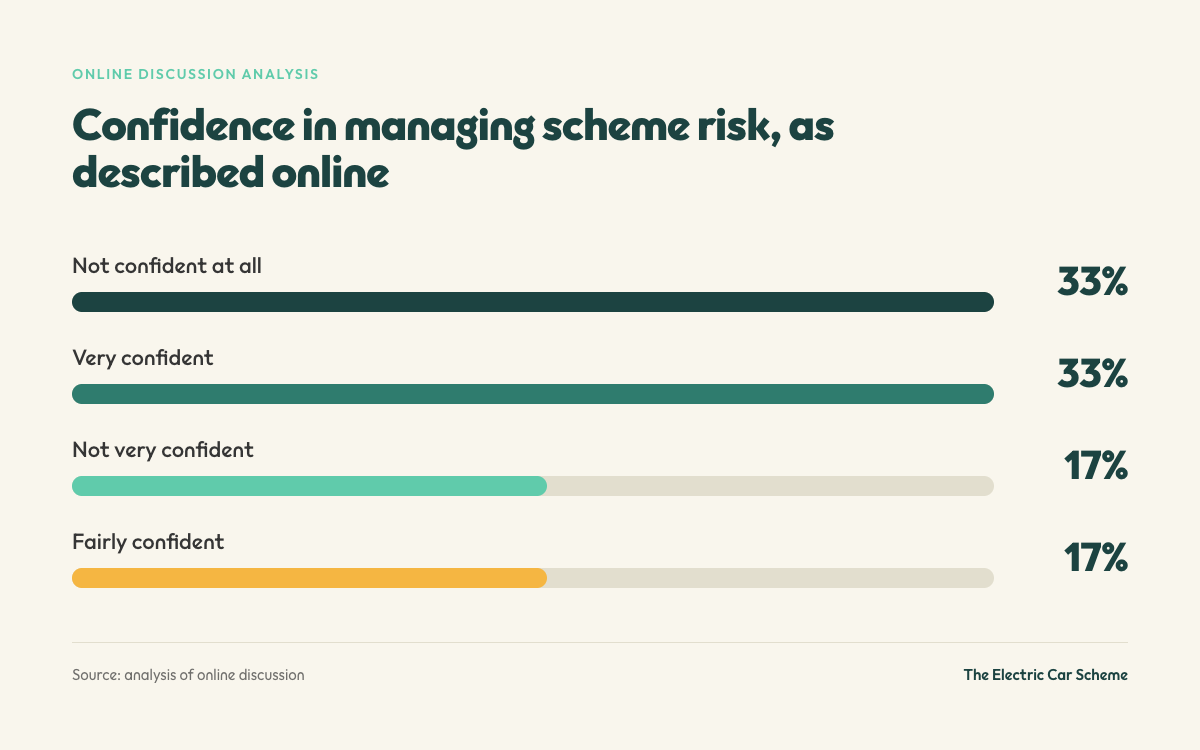
The dataset divides exactly in half: 50% of opinions express confidence and 50% do not, with the same 33/17 split on each side. That symmetry is a genuinely useful finding, because it maps onto the understanding and training results almost precisely — around half the discussion reflects a working grasp of scheme risk, and around half does not.
Confidence and competence are not the same thing, and it is worth noting that the 33% expressing high confidence sits uneasily alongside the 64% describing clear knowledge gaps in their benefits team. But the broad picture is consistent: the population splits into a prepared half and an unprepared half, and training is the main thing that distinguishes them.
Overall, how well managed is EV salary sacrifice risk?
24% of opinions describe risk as very well managed, 24% as reasonably well managed, 30% as poorly managed, and 23% as not managed at all.
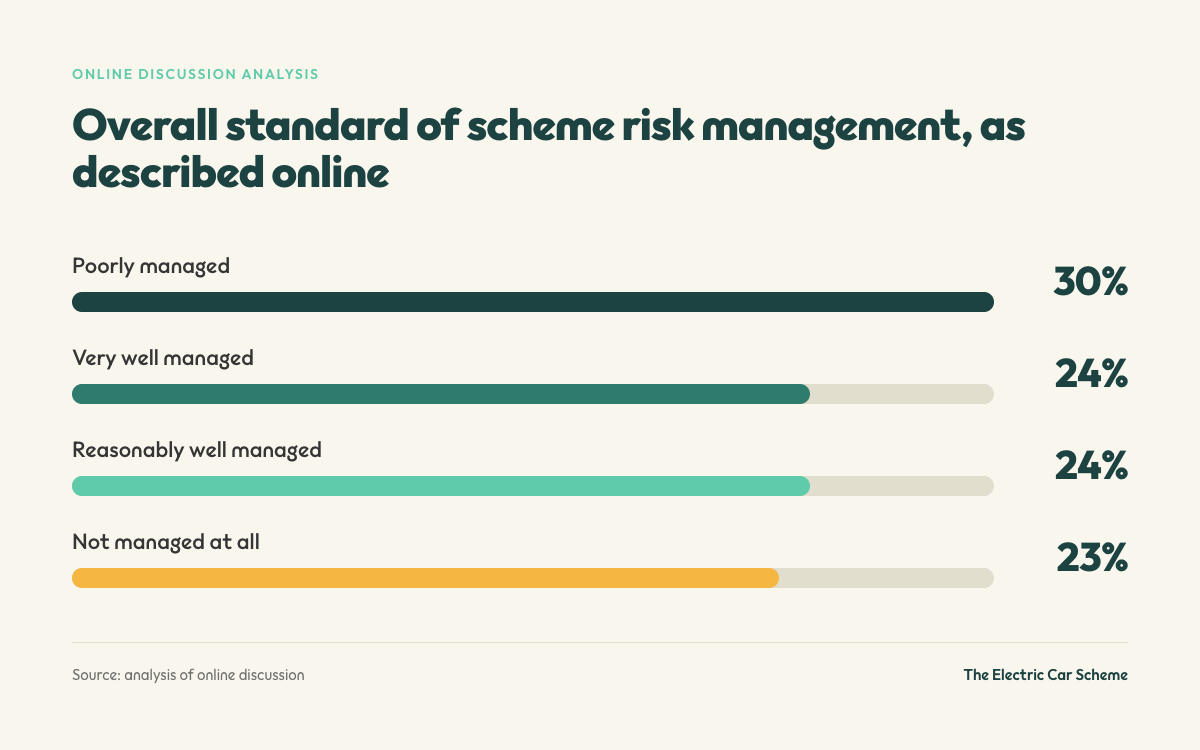
Grouped, 48% of opinions describe risk as at least reasonably well managed and 53% describe it as poorly managed or not managed at all — the same roughly even split seen on understanding, preparedness and confidence.
Within that, the 23% describing risk as not managed at all is the number that should concern anyone running a scheme. Poor management can be improved incrementally; no management means an early termination charge, a payroll correction or an NMW breach will arrive with no process in place and no one expecting it.
Would AI tools reduce EV salary sacrifice risk?
74% of opinions see no benefit in AI tools for reducing EV salary sacrifice risk, 22% see some benefit, and 4% are unsure.
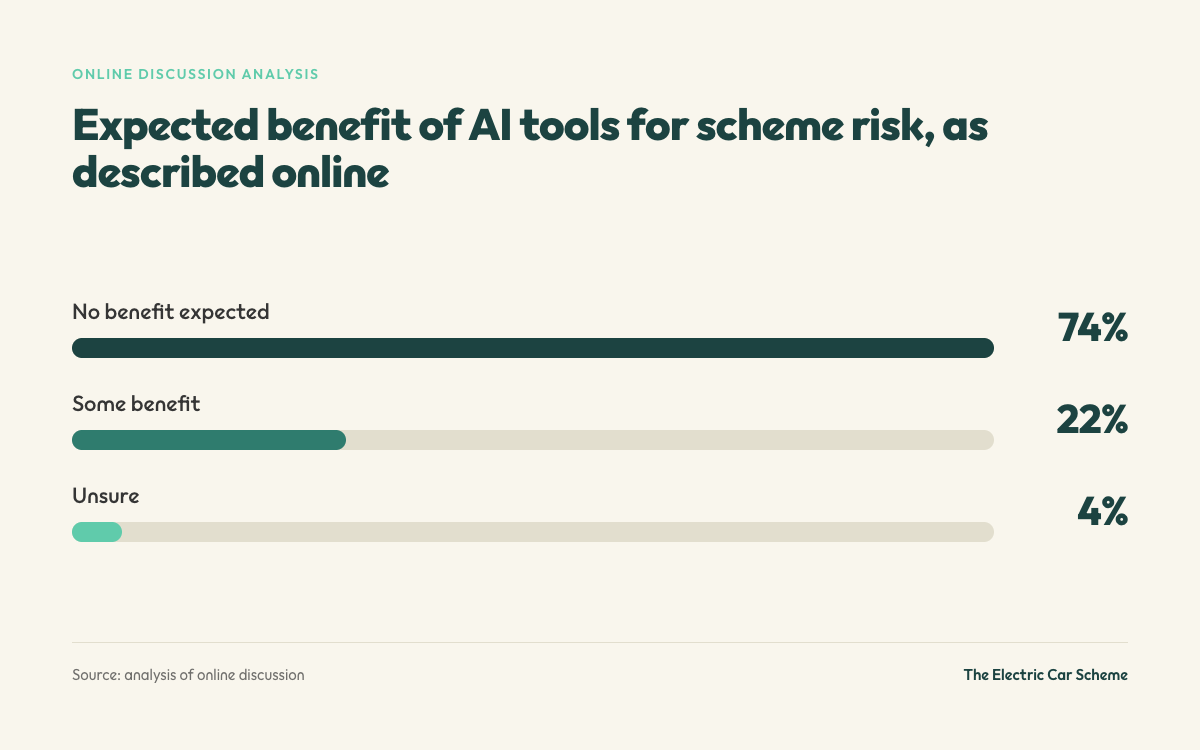
Scepticism about AI in financial contexts is broader than this dataset. YouGov found 19% of Britons comfortable taking financial advice generated by AI against 60% uncomfortable, and only 15% agreeing that AI-driven services from financial providers act in customers’ best interests.
The dataset reflects the same disposition: 74% see no benefit, 22% see some, 4% are unsure. Whether that assessment is correct is a separate question — NMW headroom monitoring across a fluctuating payroll and modelling BIK cost over a lease term are both well suited to automation. But the tasks the dataset treats as the real problem, explaining scheme terms clearly and owning risk internally, are not primarily tooling problems, and the scepticism is not unreasonable on those grounds.
Reducing risk in EV salary sacrifice
Read as a whole, the dataset splits close to evenly. Around half the discussion reflects organisations with a real grasp of EV salary sacrifice risk, and around half reflects organisations still building the knowledge, governance and processes to manage it. That split recurs on understanding, tax preparedness, confidence and overall management, which suggests it is one underlying divide rather than four separate findings.
Four gaps show up consistently, and all four are addressable:
Ownership. 64% of opinions describe no clear internal owner for scheme risk. Naming one person or team is the cheapest intervention available.
Policy. 61% describe policies that are informal or absent. A documented position on leavers, pay changes and the annual April rate changes turns improvisation into process.
Training. Around two-thirds describe informal or no training, while 78% identify employee misunderstanding as the leading risk driver. These two findings are the same finding.
Review cadence. Only 23% review at least annually, on a benefit where two key variables reset every April.
The other thing worth naming is that transparency appears to be protective. The 7% of opinions describing these risks as building employee trust are not describing lower-risk schemes; they are describing schemes where the early termination terms, the BIK trajectory and the charging cost difference are explained before anyone signs.
How The Electric Car Scheme addresses these risks: our Complete Risk Protection package covers employer exposure on early termination arising from resignation, redundancy, dismissal, parental leave and death. It does not cover NMW compliance, payroll accuracy or reporting obligations, which remain with the employer. If you would like to review your scheme’s exposure across the four gaps above, get in touch.
Methodology and data
Sourced using Artios from 251,644 publicly available opinions relating to EV salary sacrifice risk, posted on X, Quora, Reddit, Bluesky, TikTok and Threads by UK-based accounts, over the 12 months to 7 July 2026.
Please note the following limitations, which apply to every figure in this article:
The unit of analysis is an opinion, not a person. A single account may contribute more than one opinion, so percentages describe the composition of the opinion set rather than a headcount of individuals or organisations.
Nobody answered a survey question. Categories were assigned by classifying language people used unprompted. Where this article uses a phrase such as “opinions describing X”, that is a classification, not a quotation.
This is a non-probability sample. Because it consists of self-selected public posts rather than a randomly drawn sample, it does not support a margin of error or confidence interval, and it cannot be projected onto the UK employer population.
People post about what bothers them. Online discussion over-represents friction and under-represents routine, working arrangements, so the risk picture here should be read as a map of concern rather than a measure of incidence.
Small gaps are not findings. Differences of a few percentage points between categories should not be interpreted as meaningful, and this article does not treat them as such.
Figures may not total 100% due to rounding.
