
Risks of EV Salary Sacrifice Statistics: UK 2026
Employee benefits have evolved far beyond traditional pensions and private healthcare. Today, organisations can choose from a growing range of perks, including EV salary sacrifice schemes, workplace charging, cycle-to-work programmes, wellbeing initiatives, and other flexible benefits designed to attract and retain talent. While EV salary sacrifice has become one of the most popular options thanks to its tax advantages and sustainability credentials, it also introduces unique financial, compliance, and administrative considerations.
To find out what 251,644 opinions of people leaders in the UK were about the risks of EV salary sacrifice, we utilised AI-driven audience profiling to synthesise insights from online discussions over 12 months, ending on the 7th July, 2026, to a high statistical confidence level. The results cover the key risks organisations associate with EV salary sacrifice schemes, including tax, payroll, employee experience, compliance, budgeting, and long-term scheme management.
Index
Methodology and data
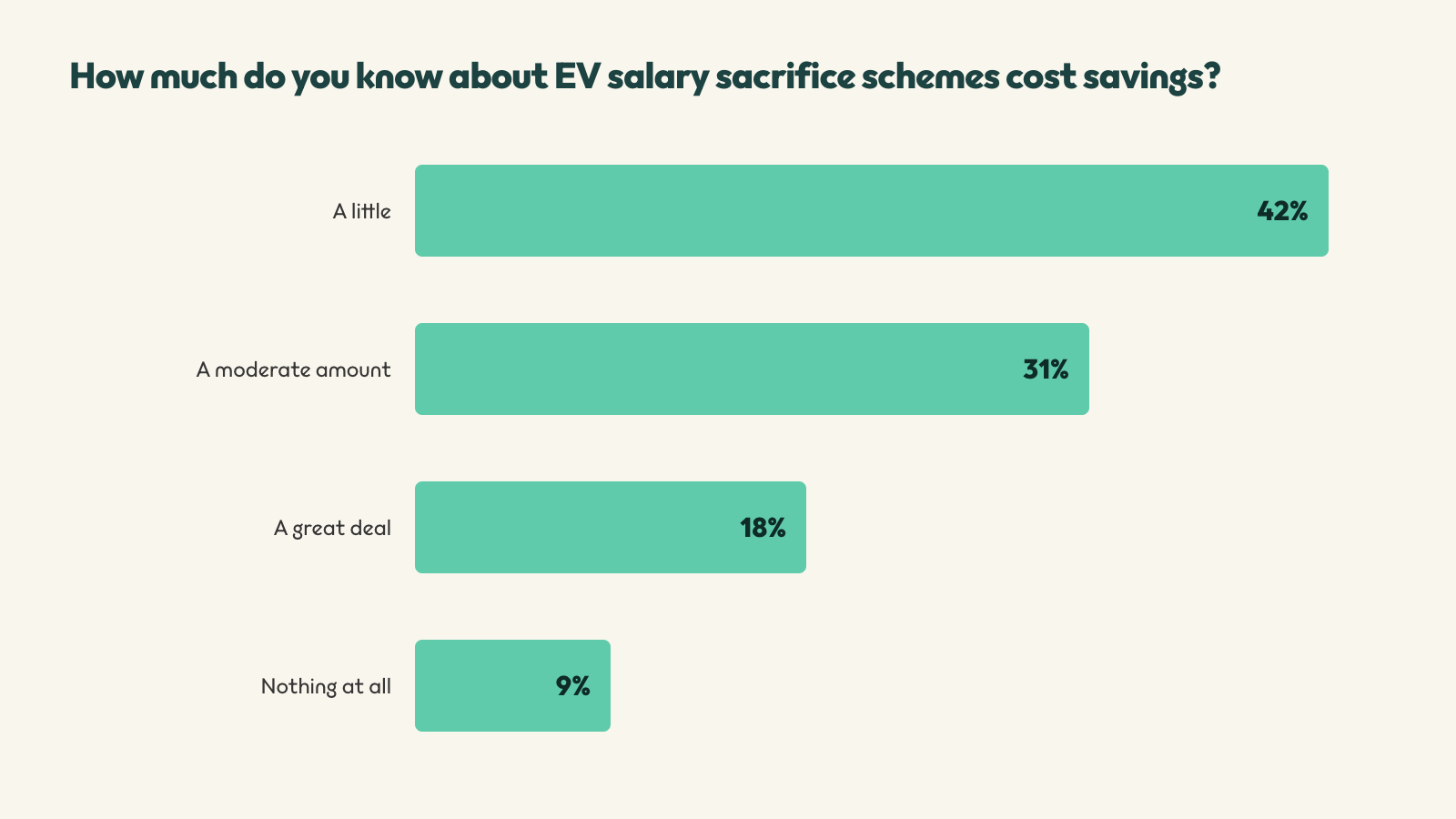
34% of people leaders understand the risks of EV salary sacrifice very well and have mapped them in detail, and 15% understand them somewhat and know the basics; however, 32% don’t know the risks very well and rely on their providers, and 19% don’t know the risks at all as EV salary sacrifice is a new concept to them
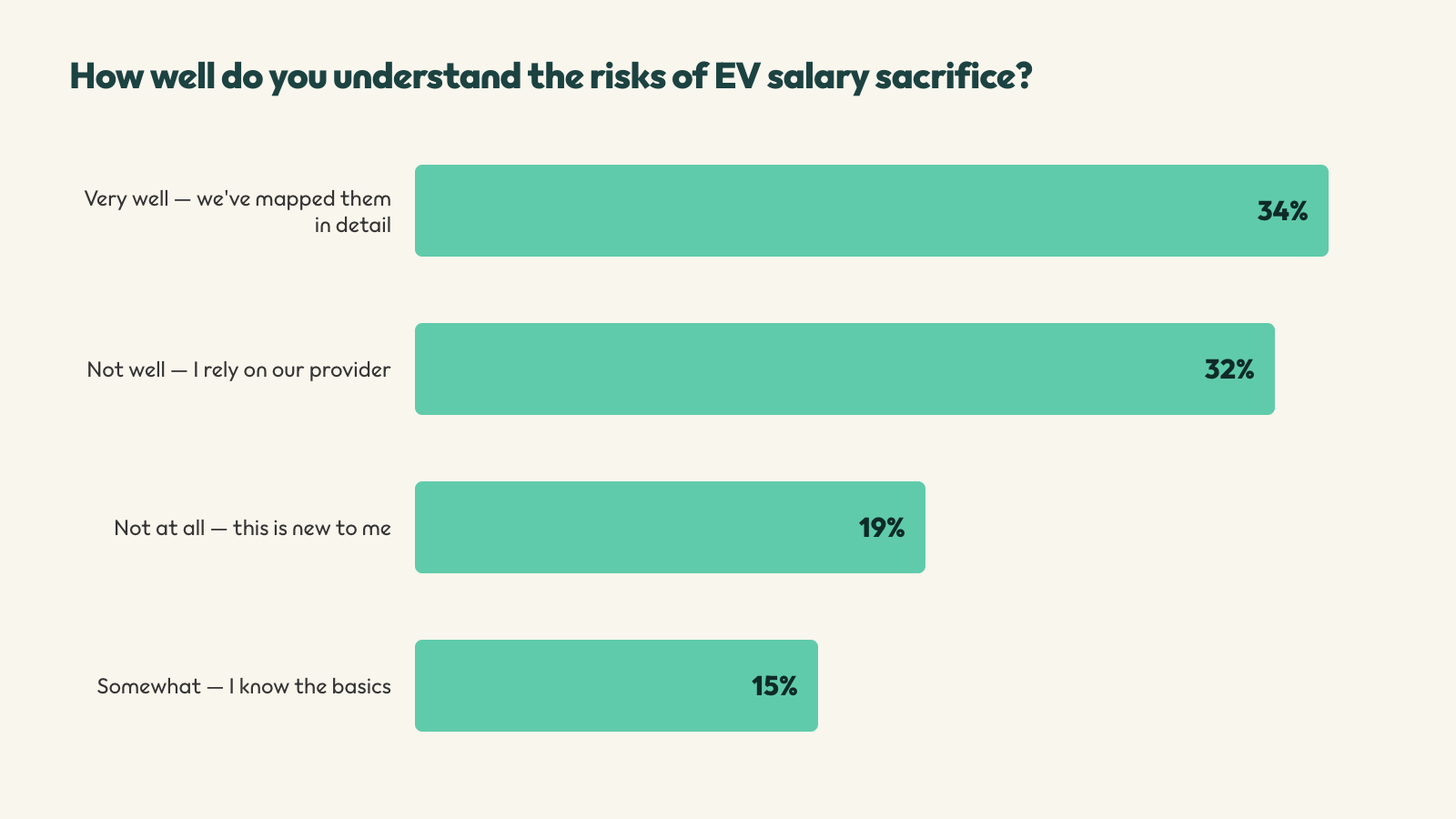
36% of people leader’s biggest concern about the risks of EV salary sacrifice is the lack of internal expertise to manage the scheme, 33% are most concerned about tax or HMRC compliance changes, 31% are worried about charging infrastructure limitations, and no one voices concerns about vehicle depreciation and resale value
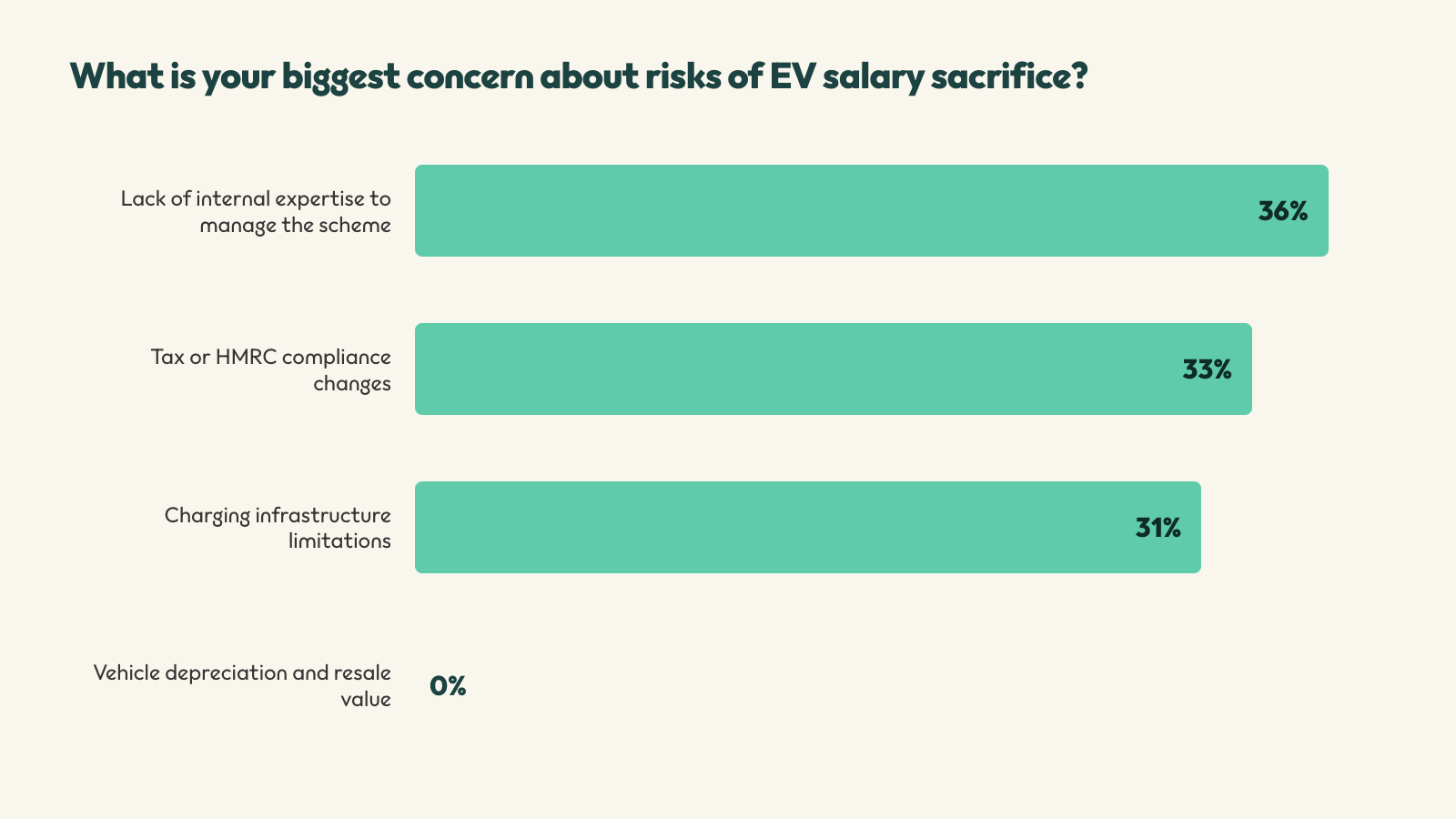
68% of people leaders cite changes to Benefit-in-Kind tax rates as the EV salary sacrifice risk that worries them the most, 29% are most worried about provider or scheme insolvency, and 3% are concerned about redundancy or resignation mid-lease
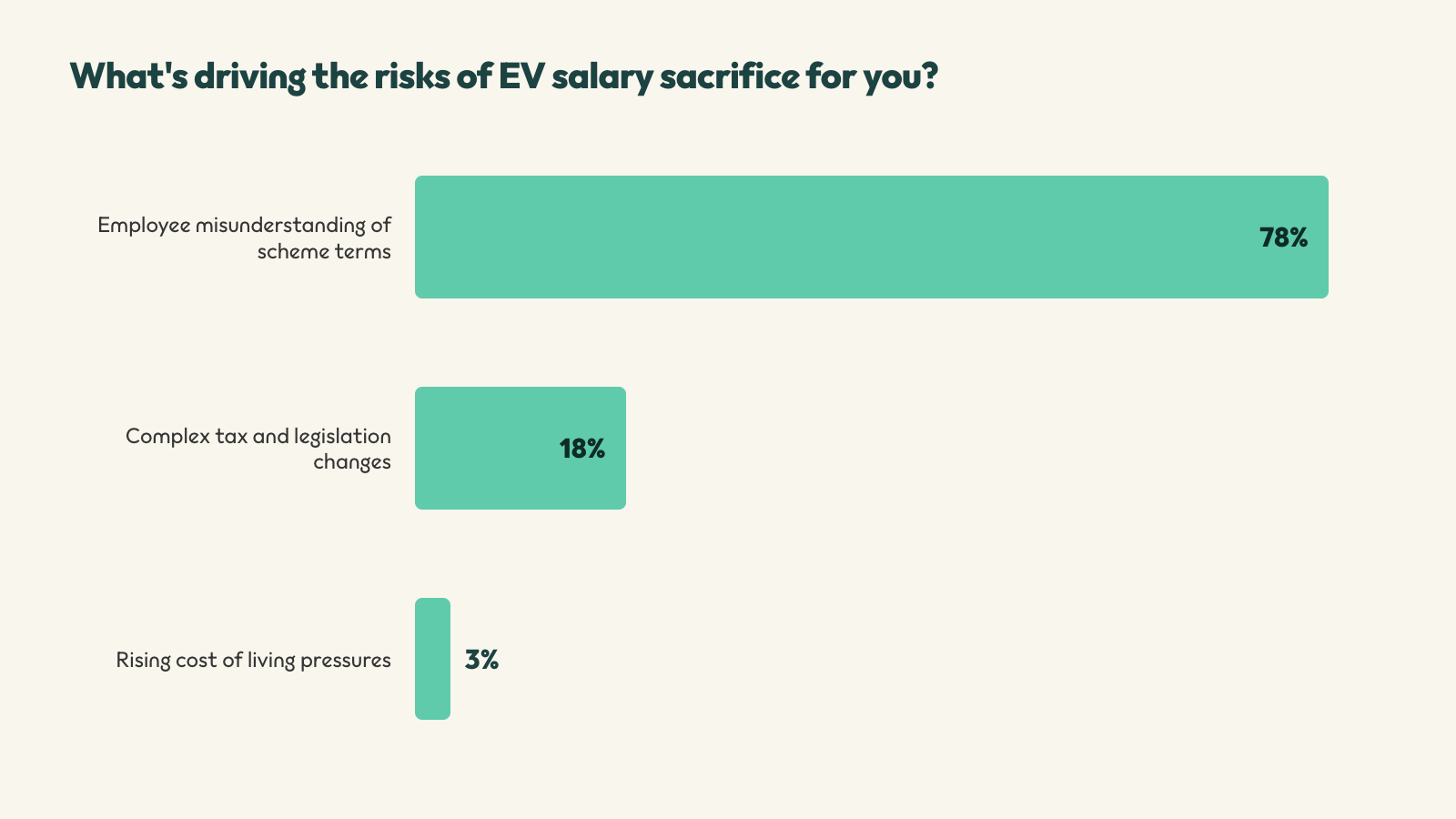
Employee misunderstanding of EV salary sacrifice scheme terms is the biggest risk driver for 78% of people leaders, while complex tax and legislation changes drive the risks for 18%, and the rising costs of living pressures are at the forefront for 3%
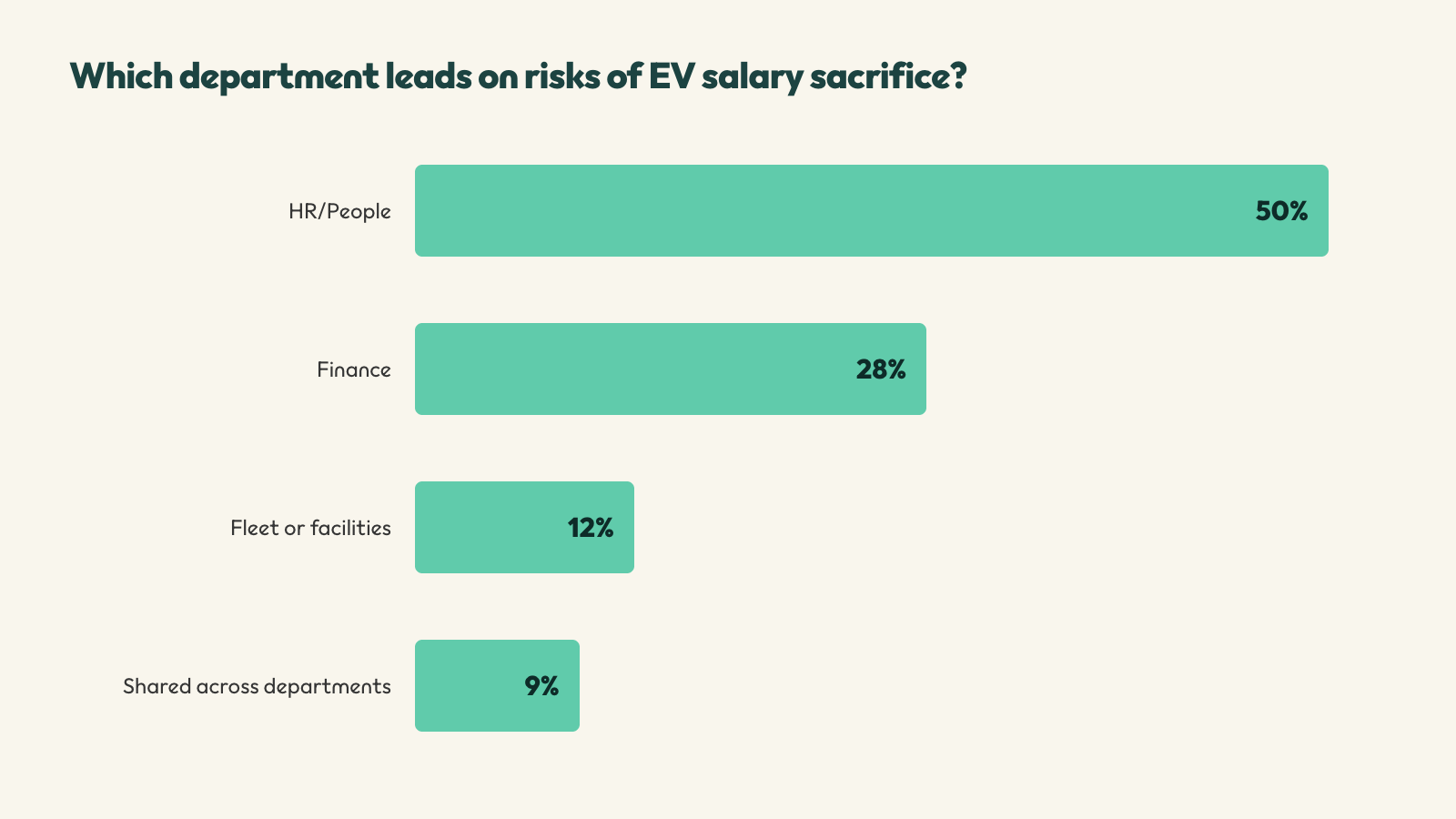
HR or people departments lead on the risks of EV salary sacrifice for 50% of people leaders, finance leads for 28%, fleet and facilities for 12%, and for 11%, the risks are shared across departments
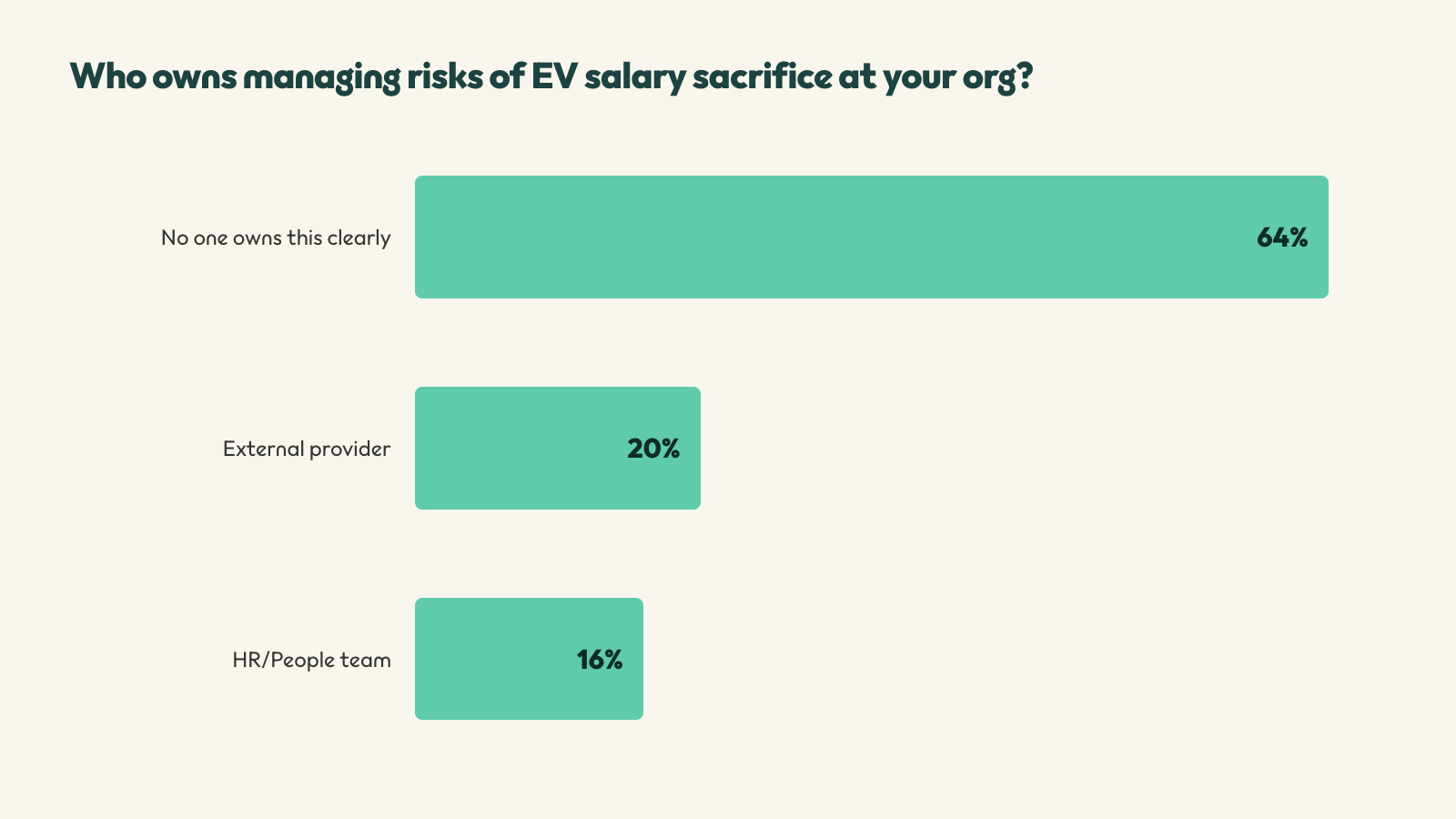
While the HR or People team own managing the risks for EV salary sacrifice at 16% of people leader’s organisations, and external providers own them at 20%, no one currently owns managing the risks at 64% of organisations
64% of people leader’s benefits teams do not fully grasp the risks of EV salary sacrifice schemes and there are clear knowledge gaps, and 12% are unsure as they have never been tested; however, 12% partially understand the risks, and 12% understand them fully
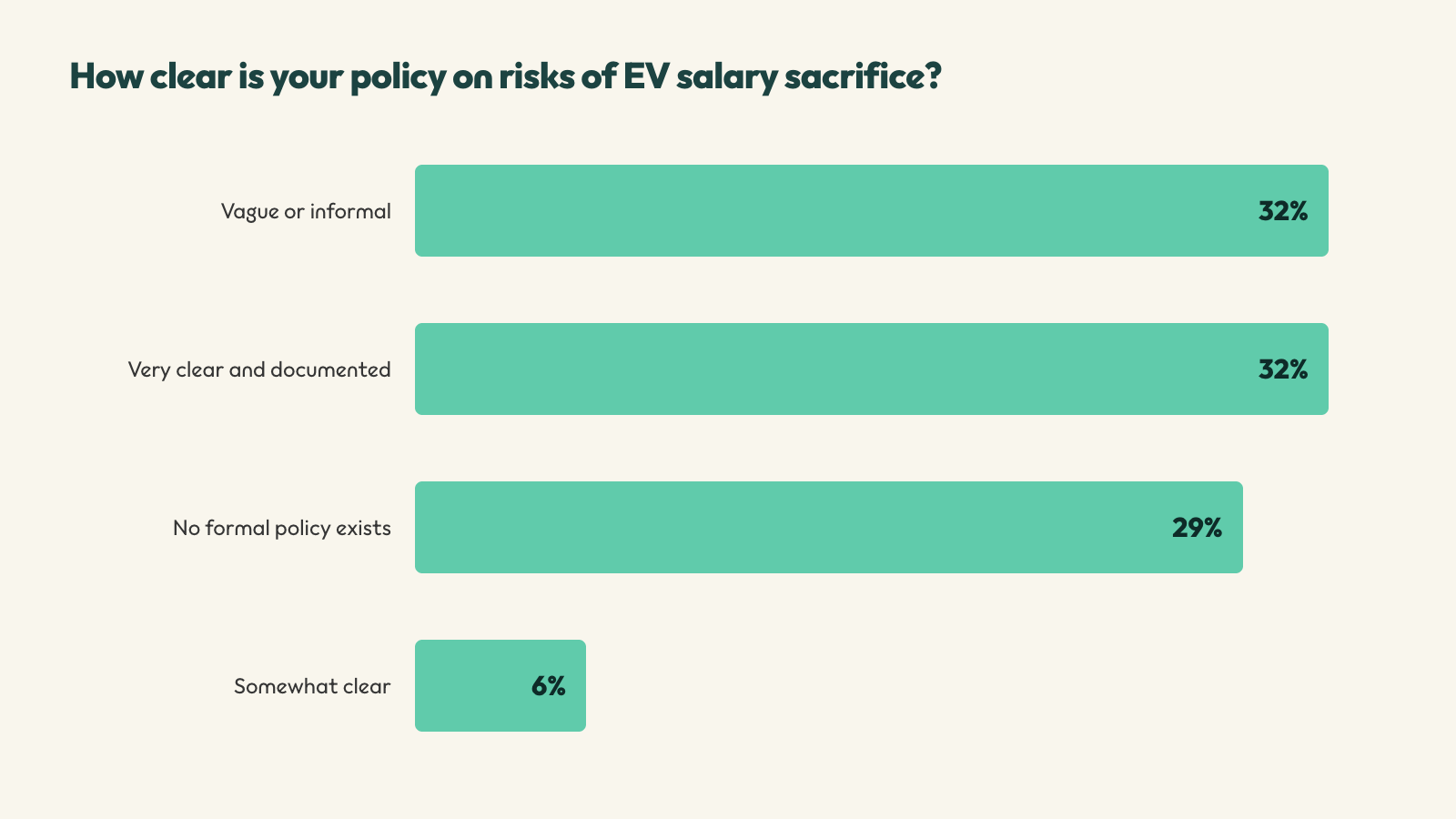
32% of people leader’s policies on the risk of EV salary sacrifice are very clear and documented, and 6% are somewhat clear, but 32% have vague or informal policies, and 29% don’t have any formal policy whatsoever
For 32% of people leader’s, the risks of EV salary sacrifice for leavers are not something they’ve yet encountered, 27% have encountered this and agree there are moderate risks as their exit process handles it, 27% say the risks are moderately significant, and 14% agree they are very significant and they cause a major HR headache
51% of people leaders are not prepared for the tax-related risks of EV salary sacrifice, but 49% are somewhat prepared for the tax risks these schemes may pose
Resale values as an EV salary sacrifice risk are a minor consideration for 27% of people leaders, but for 25%, they’re a major consideration in scheme design, 24% let these risks be handled entirely by their provider, and a further 24% have not factored resale risks in
27% of people leaders feel that charging costs that relate to the risk of EV salary sacrifice are frequently underestimated, 26% accept that employees bear this risk fully, 24% agree it's a well-understood minor risk, and for 24%, charging risk is not a major factor
For 32% of people leaders, the risks of EV salary sacrifice affecting insurance costs is a minor cost factor, 30% don’t track these costs, and for 15%, they’re fully absorbed by the provider, but for 24% insurance costs are a significant cost factor
The risks of EV salary sacrifice schemes have a minimal impact on 40% of people leaders’ payroll team, 28% fully outsource these risks to a provider, 28% of payroll teams find them a high administrative burden, and 4% find them a moderate burden
It’s too early to tell if EV salary sacrifice has any impact on 62% of people leaders’ budgets; however, 31% note significant unbudgeted cost exposure, 4% see minor manageable cost exposure, and a further 4% don’t see any noticeable budget impact
The risks of EV salary sacrifice differing by employee level are not something 50% of people leaders have analysed, 38% see a higher risk for senior employees. 6% agree the risk is consistent across all employee levels, and 5% think there’s a higher risk for junior employees
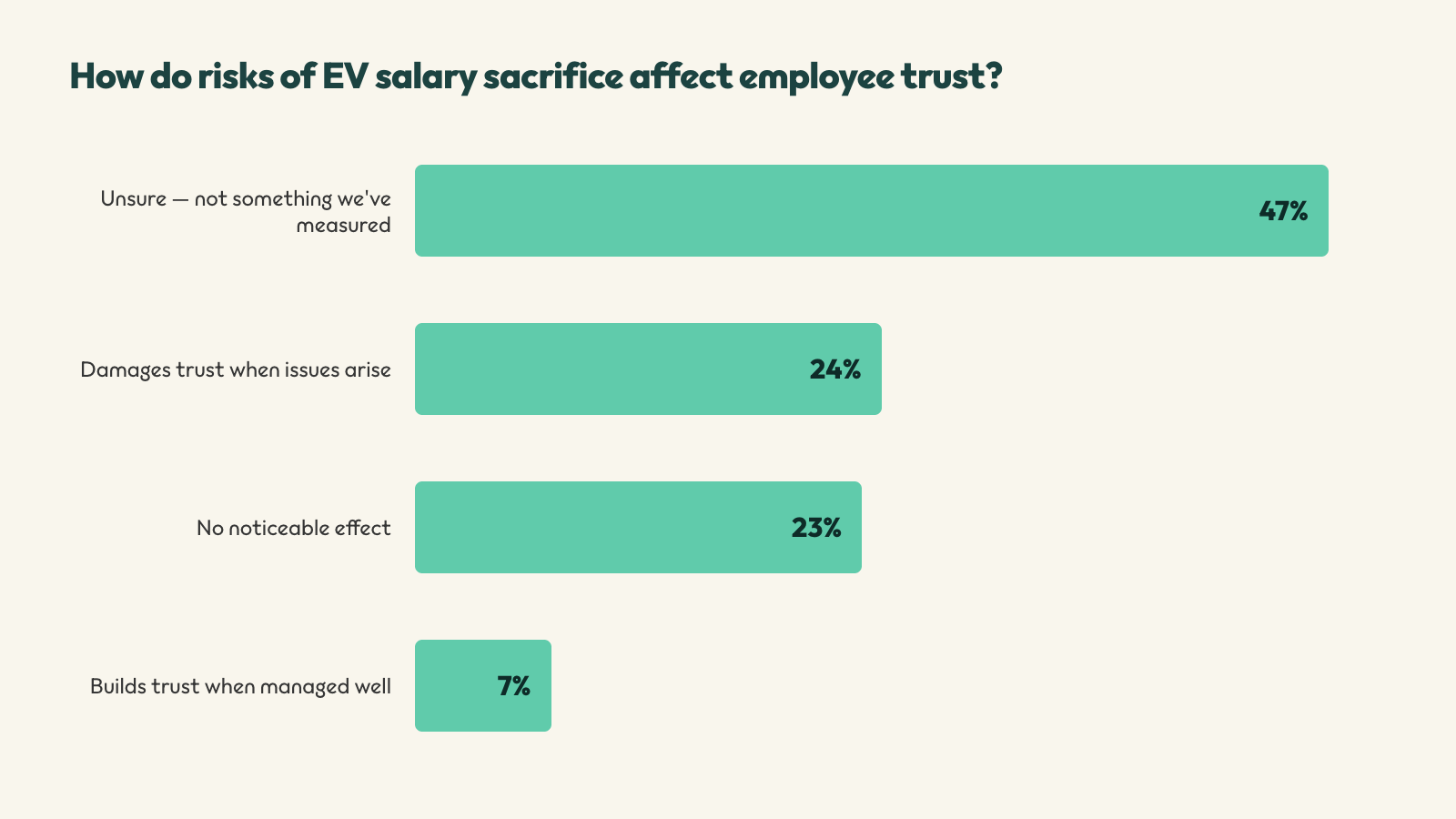
47% of people leaders are unsure how the risks of EV salary sacrifice affect employee trust as they have not measured this, 24% say these risks damage trust when issues arise, 23% have not seen any noticeable effect, and 7% find that when these risks are managed well, it builds employee trust
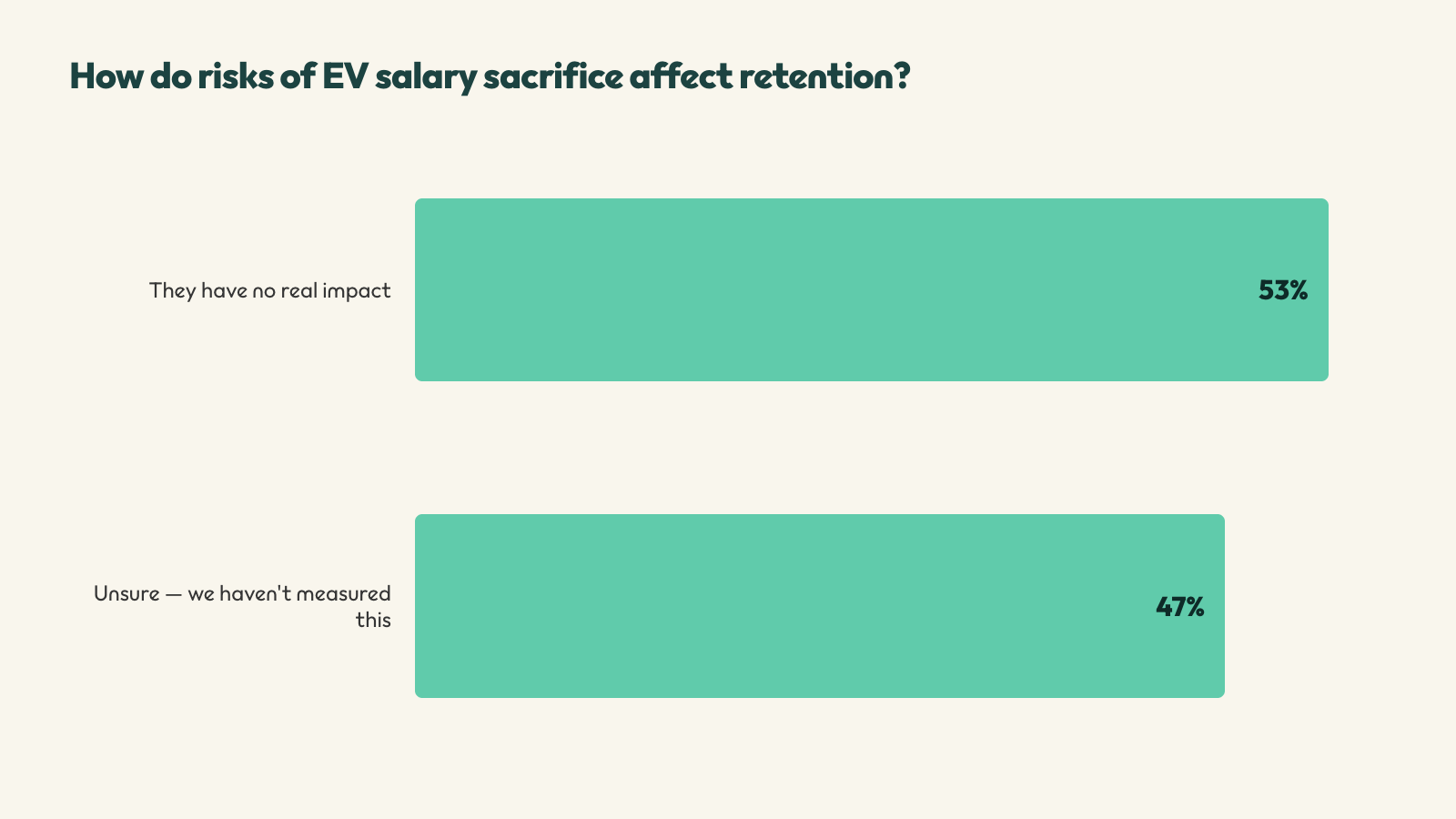
The risks of EV salary sacrifice have no real impact on retention for 53% of people leaders and 47% are unsure as they have not measured the impact on retention
94% of people leaders rely only on a provider's guidance to assess the risks of EV salary sacrifice pre-launch, and 6% rely on informal internal discussions
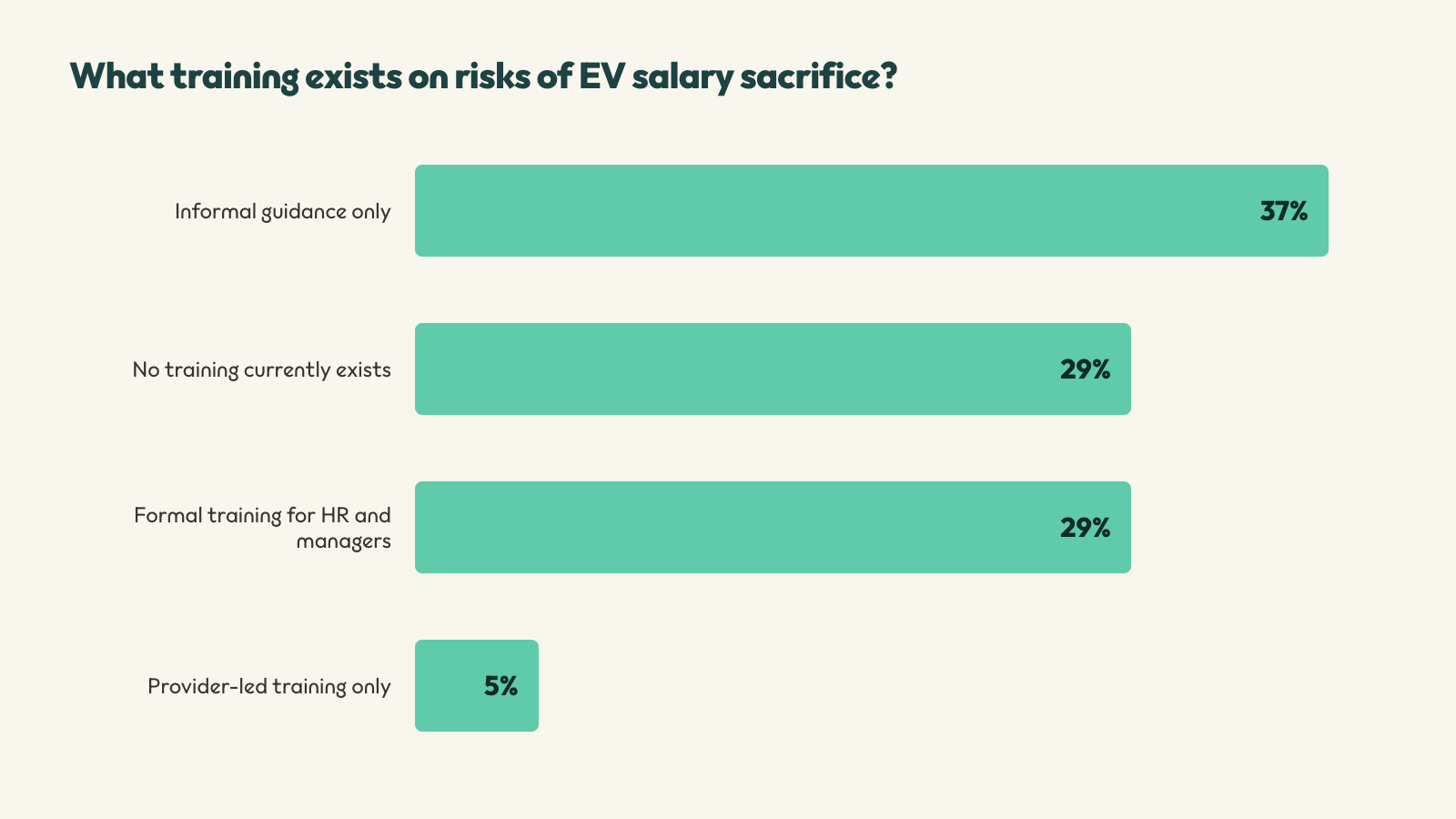
37% of people leaders only have informal guidance on the risks of EV salary sacrifice available, and 29% have no training available whatsoever, but 29% have formal training for HR and managers, and 5% have provider-led training only
60% of people leaders only review the risks of EV salary sacrifice when issues arise, and 16% have never reviewed the risks; however, 12% review the risks quarterly or more often, and 11% review them annually
33% of people leaders are very confident in managing the risks of EV salary sacrifice, and 17% are fairly confident, but the exact opposite applies too, as 33% are not confident managing these risks at all, and 17% are not very confident
24% of people leaders agree that overall, the risks of EV salary sacrifice are very well managed at their organisation, and another 24% say they’re reasonably well managed, but 30% find these risks to be poorly managed, and 23% say they’re not managed at all
74% of people leaders don’t see that AI tools would have any benefit in reducing the risks of EV salary sacrifice, 4% are not sure if these tools would offer any benefits, and 22% think that they would offer benefits to some degree
Reducing risks in EV salary sacrifice
Methodology and data
Sourced using Artios from an independent sample of 251,644 opinions of people leaders in the UK across X, Quora, Reddit, Bluesky, TikTok, and Threads. Responses are collected within a 95% confidence interval and 5% margin of error. Results are derived from what people describe online, from opinions expressed, not actual questions answered by people in the sample.
How well do people leaders understand the risks of EV salary sacrifice?
34% of people leaders understand the risks of EV salary sacrifice very well and have mapped them in detail, and 15% understand them somewhat and know the basics; however, 32% don’t know the risks very well and rely on their providers, and 19% don’t know the risks at all as EV salary sacrifice is a new concept to them
Risk awareness is not even across the board:
While EV salary sacrifice schemes pose definite advantages, they aren’t without risks. These range from potential BIK (Benefit in Kind) tax hikes to reduced take-home salaries and a lack of equity in the leased vehicle at the end of the plan. If a lease is terminated early, additional fees may apply.
However, not all people leaders share the same understanding of the risks posed by these schemes.
While 34% are well-versed in the risks and have assessed them in great detail, 15% admit they’re only somewhat aware of the basics. A further 34% don’t understand the risks very well at all and place their trust in their scheme providers to handle the administrative side of their plans. Additionally, 19% don’t have a clear understanding of the risks involved at all, as the concept of EV salary sacrifice is completely new to them.
What is people leaders' biggest concern about the risks of EV salary sacrifice?
36% of people leader’s biggest concern about the risks of EV salary sacrifice is the lack of internal expertise to manage the scheme, 33% are most concerned about tax or HMRC compliance changes, 31% are worried about charging infrastructure limitations, and no one voices concerns about vehicle depreciation and resale value
Concerns centre on three main areas:
People leaders and employers face a few key challenges when implementing EV salary sacrifice schemes. One is the wage limit imposed. Employees’ net pay can’t drop below the National Minimum Wage (NMW) threshold of £8.60 for 18 to 20 year olds and £11.44 for workers aged 21 or older, even if their salaries are variable.
Yet our audience’s primary concern regarding the risks is a lack of internal expertise required to manage these schemes effectively. For 36%, this is a leading concern, followed closely by 33% who are primarily concerned about navigating HMRC and tax compliance shifts.
The remaining 31% feel that limited EV charging infrastructure will be their greatest challenge. Interestingly, while vehicle depreciation is a universal drawback that reduces vehicles’ resale value over time, none of the people leaders in our audience expresses this as their top concern at present.
Which risks of EV salary sacrifice worry people leaders most?
68% of people leaders cite changes to Benefit-in-Kind tax rates as the EV salary sacrifice risk that worries them the most, 29% are most worried about provider or scheme insolvency, and 3% are concerned about redundancy or resignation mid-lease
Factors out of leader’s control cause the most concern:
With the BIK tax increasing from 3% to 4% from April 2026, hybrid, petrol, and diesel vehicles are set to continue attracting higher BIK rates. This is part of the UK Government’s multi-year programme, which will increase the BIK tax on EVs by 1 percentage point each year until 2028, progressively affecting employees’ net pay.
Understandably, then, people leaders are most worried about changes to Benefit in Kind tax rates. These increases increase administrative burdens when ensuring employees’ salaries don’t drop below the NMW while salary sacrifice schemes are active. 68% of our audience cite this as their biggest worry.
Many people leaders are also concerned about EV salary sacrifice schemes and providers becoming insolvent, with 29% admitting to this being their number-one worry. A small minority (3%) are also concerned about employees resigning or being made redundant mid-lease, which would leave leaders and their organisations fully responsible for the vehicles if Early Termination Protection (ETP) is not in place.
What's driving the risks of EV salary sacrifice for people leaders?
Employee misunderstanding of EV salary sacrifice scheme terms is the biggest risk driver for 78% of people leaders, while complex tax and legislation changes drive the risks for 18%, and the rising costs of living pressures are at the forefront for 3%
Risk drivers largely focus on misunderstandings:
When it comes to the main drivers of EV salary sacrifice scheme risks, the majority of our audience (78%) agrees that employee misunderstanding of the terms of salary sacrifice schemes is one of the largest obstacles to overcome.
When workers don’t fully understand the terms of these contracts, employers can be left with costly early termination fees, major compliance risks such as NMW violations, and even damaged trust in business leadership if employees’ own borrowing power or pension values are impacted.
Shifting tax rates and legislation around EV salary sacrifice schemes is also creating considerable risks, according to 18% of our audience. While these shifts can create challenges in ensuring that employees’ salaries don’t fall below the National Minimum Wage, so can the pressures of rising costs of living. 3% of our audience members say that these pressures are creating challenges for their organisations’ effective management of salary sacrifice schemes.
Which department leads on the risks of EV salary sacrifice at people leaders' organisations?
HR or people departments lead on the risks of EV salary sacrifice for 50% of people leaders, finance leads for 28%, fleet and facilities for 12%, and for 11%, the risks are shared across departments
HR and people departments take the lead in risks:
The risks of EV salary sacrifice require consistent, proactive management by the right teams and people. Among our audience, 50% of HR and people departments are primarily responsible for identifying and addressing these risks. These departments could support a more streamlined implementation and management of salary sacrifice schemes by educating employees on their terms, benefits, and potential impacts, thereby granting them a clearer understanding of the risks involved.
Many organisations have also tasked their finance departments with these efforts; 28% of people leaders’ financial teams handle their businesses’ salary sacrifice schemes and associated risks. 12% note that facilities and fleet departments manage the administrative responsibilities behind these programmes, and for 9%, this task is shared across departments, bringing together HR, finance, and other expertise to ensure risks are managed holistically.
Who owns managing the risks of EV salary sacrifice at people leaders' organisations?
While the HR or People team own managing the risks for EV salary sacrifice at 16% of people leader’s organisations, and external providers own them at 20%, no one currently owns managing the risks at 64% of organisations
Lack of risk ownership is clear:
While salary sacrifice schemes have been available to UK employees for decades, EV salary sacrifice schemes are relatively new to British workplaces. With this in mind, it’s understandable that many people leaders have yet to designate a person, team, or department to manage the risks involved. This is true for 64% of our audience, as nobody clearly owns this responsibility within their organisations just yet.
Only 16% of our audience’s HR and people teams are officially tasked with managing their EV salary sacrifice risks. While these leaders’ organisations have opted to manage these risks internally, even more (20%) are outsourcing these workflows to external providers instead.
Overall, nearly two-thirds of organisations still lack a clear hierarchy for risk management workflows, leaving them vulnerable to sudden financial liabilities and compliance gaps, especially when EV leases are disrupted.
Do people leaders' organisations’ benefits teams fully grasp the risks of EV salary sacrifice?
64% of people leader’s benefits teams do not fully grasp the risks of EV salary sacrifice schemes and there are clear knowledge gaps, and 12% are unsure as they have never been tested; however, 12% partially understand the risks, and 12% understand them fully
Benefits teams are somewhat risk-aware:
Factors such as early termination charges, reduced pension contributions due to lower gross taxable income, and high EV running expenses without at-home charging facilities can affect workers’ long-term financial standing, and many employees may be unaware of these risks or their potential impacts. Benefits teams need a deep understanding of the risks employees face when taking out EV salary sacrifice schemes, so they can help their talent mitigate them.
But there are significant gaps which still need to be bridged. 64% of people leaders acknowledge that there are still clear knowledge gaps among their organisations’ benefits teams. A further 12% aren’t sure of these teams’ level of knowledge as they have never formally assessed it.
Only 12% of people leaders are confident that their benefits teams are fully aware of the risks involved, and an equal 12%’s teams have a partial understanding of the complex factors at play.
Judging by these opinions, it’s clear that more organisations could benefit from structured training to ensure that their benefits teams truly understand the implications of the schemes they promote.
How clear is people leaders' policy on the risks of EV salary sacrifice?
32% of people leader’s policies on the risk of EV salary sacrifice are very clear and documented, and 6% are somewhat clear, but 32% have vague or informal policies, and 29% don’t have any formal policy whatsoever
A lack of clear policies is noted:
EV salary sacrifice schemes introduce various new complexities to administration and compliance. These schemes may need to be adjusted as employees opt in and out of them, and could be affected by marriages, divorces, redundancies, and parental leave agreements. They can also impact non-cash benefit calculations and take-home pay values, which must be carefully recalculated to ensure accuracy.
With these hazards in mind, it seems clear that having a structured, concise policy on the risks of EV salary sacrifice is essential for any organisation offering these plans. That said, many organisations have yet to develop such policies, with 32% of people leaders noting that their policies are still informal and lacking in vital detail, and nearly as many (29%) admitting that their companies don’t have a formal policy in place.
Another 6%’s organisations’ policies are clear to some extent, and just under a third (32%) note that these policies are very clear and well documented.
Considering that just as many organisations seem to have complete policies as none at all, there is a serious divide in corporate preparedness. This leaves many organisations vulnerable to compliance risks amid changing employee circumstances and legislative demands.
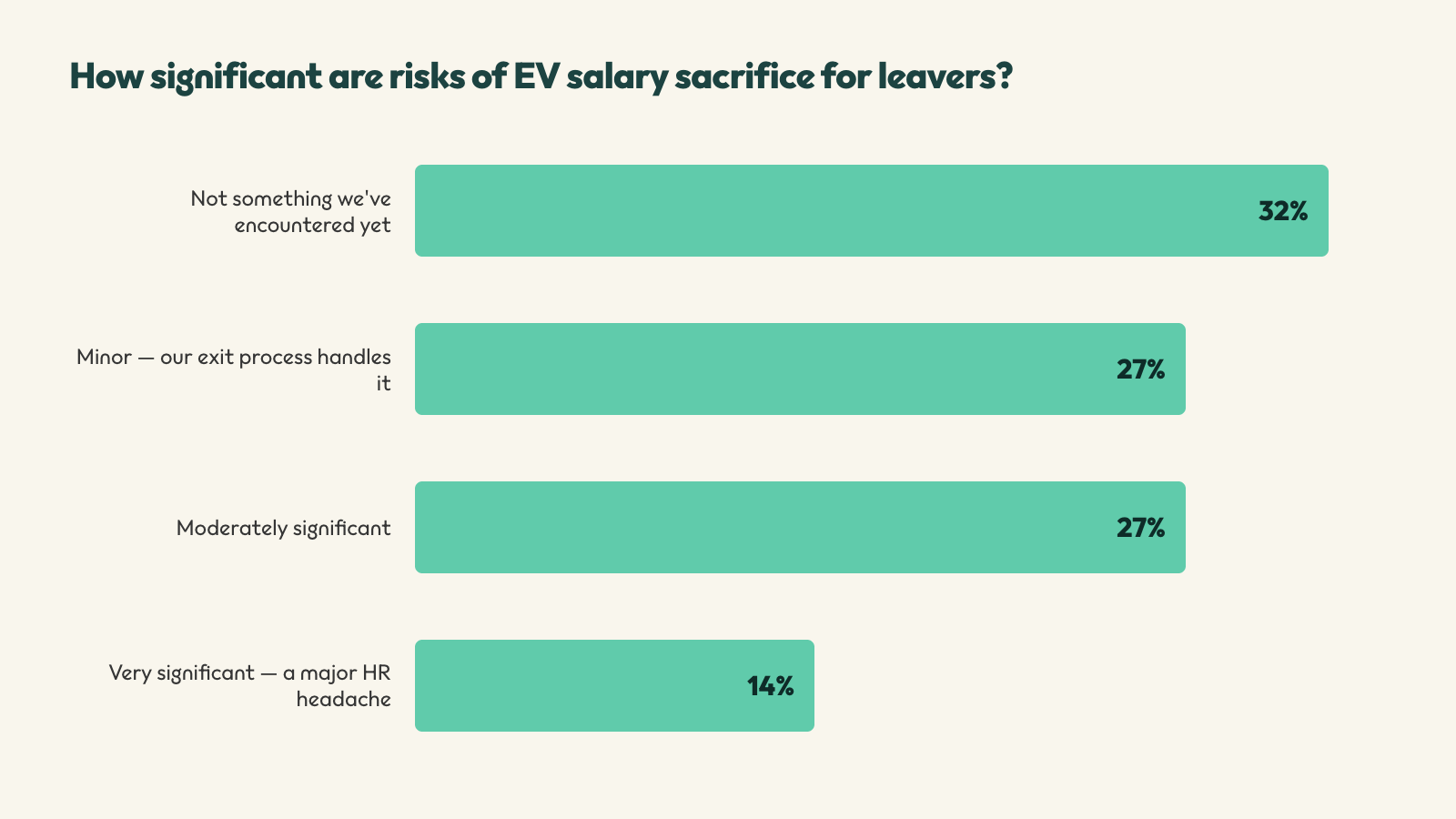
How significant are the risks of EV salary sacrifice for leavers at people leaders' organisations?
For 32% of people leader’s, the risks of EV salary sacrifice for leavers are not something they’ve yet encountered, 27% have encountered this and agree there are moderate risks as their exit process handles it, 27% say the risks are moderately significant, and 14% agree they are very significant and they cause a major HR headache
Leavers raise the risk factor:
Employees who resign, take parental leave, or face redundancy can face additional hurdles when they terminate their EV salary sacrifice plans early. These workers can face significant financial penalties like early termination fees, which can quickly turn a workplace benefit into a notable financial liability.
The level of risk involved in these situations depends on many factors, including whether or not a worker’s employer has early termination insurance included in their plans, what portion of the early termination fee is passed on to employees, and how many months remain on the terminated lease. In our audience’s organisations, the level of risk posed to leavers varies widely.
For 27% of people leaders, these risks are minor and are handled by their exit processes, while just as many note that the risks are moderately significant. 14% feel that the risks to leavers are very significant, creating extra burdens for their HR teams to handle. Interestingly, 32% note that they have not yet encountered any risks to leavers, perhaps due to their EV salary sacrifice plan offerings having yet to be scaled.
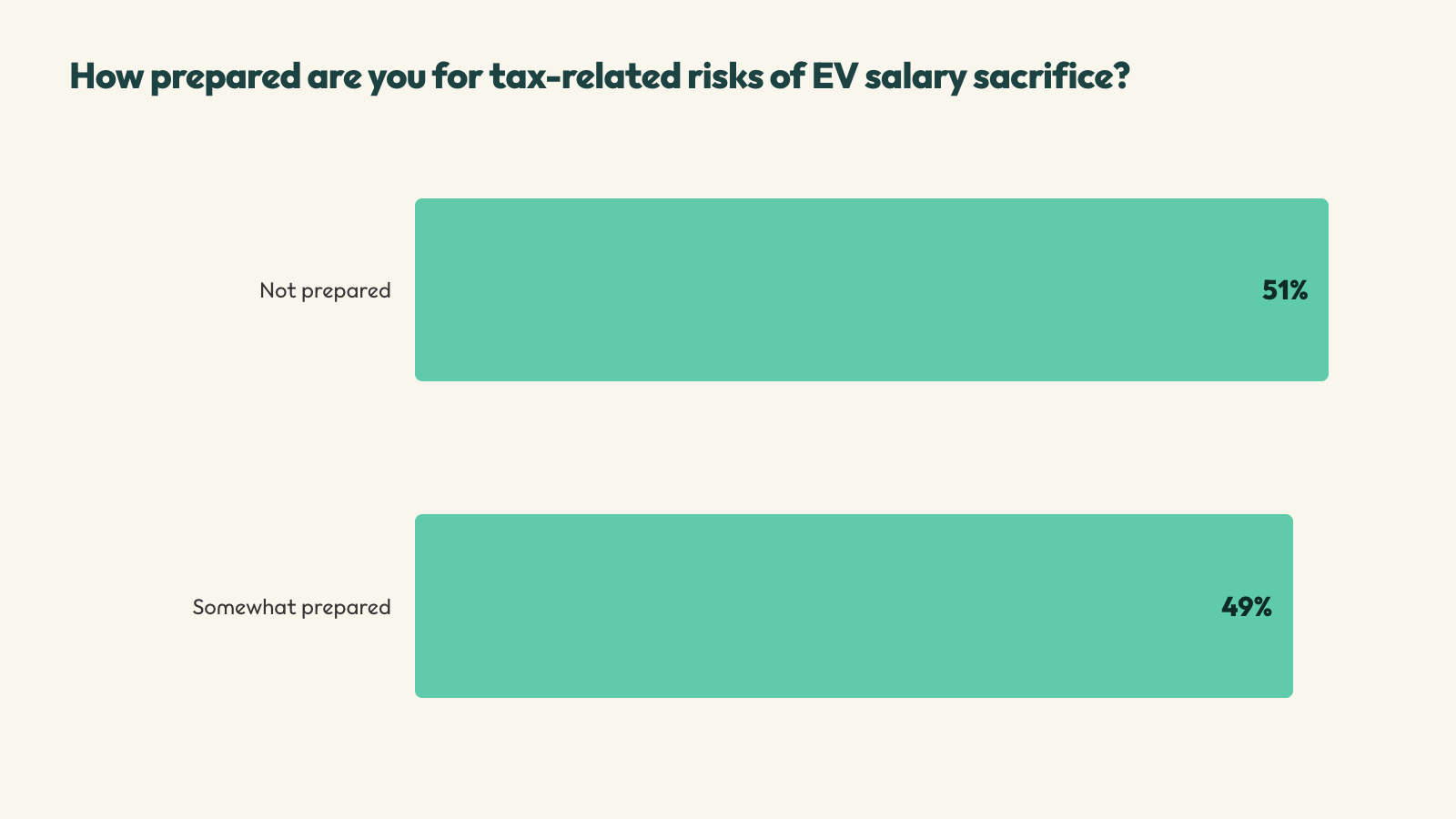
How prepared are people leaders for tax-related risks of EV salary sacrifice?
51% of people leaders are not prepared for the tax-related risks of EV salary sacrifice, but 49% are somewhat prepared for the tax risks these schemes may pose
Risk preparedness is almost even:
Although electric vehicles offered through the Electric Car Scheme are classified as company cars intended for personal use and are thus liable for BIK tax, the rate is set favourably and will only rise marginally in the foreseeable future.
The Electric Car Scheme’s Complete Risk Protection package also provides employers with extensive tax protection against early termination due to resignations, redundancies, dismissals, parental leave, and even death. However, employers who aren’t covered by this package could encounter serious tax-related risks, from National Minimum Wage violations to Optional Remuneration Arrangements (OpRA) errors, and increased Class 1A liabilities on higher BIK vehicles.
These risks all require ongoing preparation to address and mitigate, but people leader’s sentiments are split on this topic. Overall, 49% feel somewhat prepared to handle any possible tax risks that could arise, while a slightly greater 51% don’t believe they’re prepared at all. Conducting in-depth internal policy reviews and working with compliance experts to outline clear safeguards could be the keys to building greater resilience among under-prepared organisations.
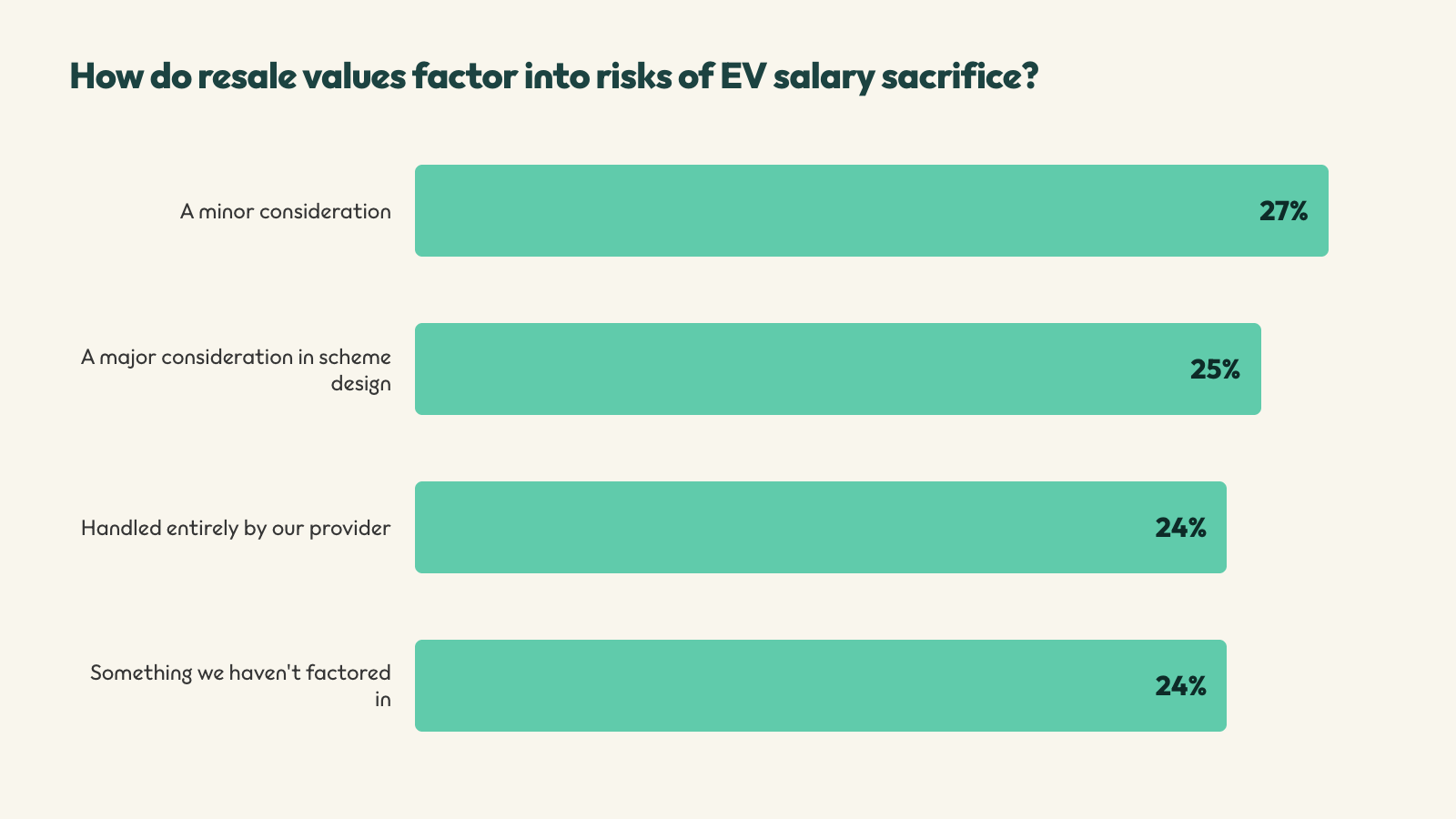
How do resale values factor into the risks of EV salary sacrifice for people leaders?
Resale values as an EV salary sacrifice risk are a minor consideration for 27% of people leaders, but for 25%, they’re a major consideration in scheme design, 24% let these risks be handled entirely by their provider, and a further 24% have not factored resale risks in
Resale risk is divided:
In 2025, 3-to-5-year-old used EVs were the fastest selling vehicles out of all available fuel types, according to Autotrader Insight’s Road to 2030 report series. Demand and enquiries for electric vehicles within the 3 to 6 year bracket is up 50% year on year, as per the report, with total enquiry numbers for used EVs up to 6 years old rising 27% year on year as well.
These numbers reflect a growing demand for pre-used EVs, whose depreciation allows buyers to purchase them for a more affordable price while still gaining the advantages of sustainable travel. This depreciation is generally good news for buyers, but for people leaders and their organisations, any significant drops in EV resale values can directly increase the monthly lease prices that EV salary sacrifice providers charge. As the prices of plans rise, they become less compelling for employees and businesses alike, increasing the lease costs for workers and driving up employers’ financial risks.
Our audience has varying opinions on how resale values factor into the risks of offering EV salary sacrifice programmes. For 24%, resale values have not played a role in their decision overall, and for another 24%, the entire process is handled by their salary sacrifice scheme providers. Resale factors are a minor consideration for 27% of organisations, and 25% feel that resale value is a major point to consider when designing EV salary sacrifice schemes.
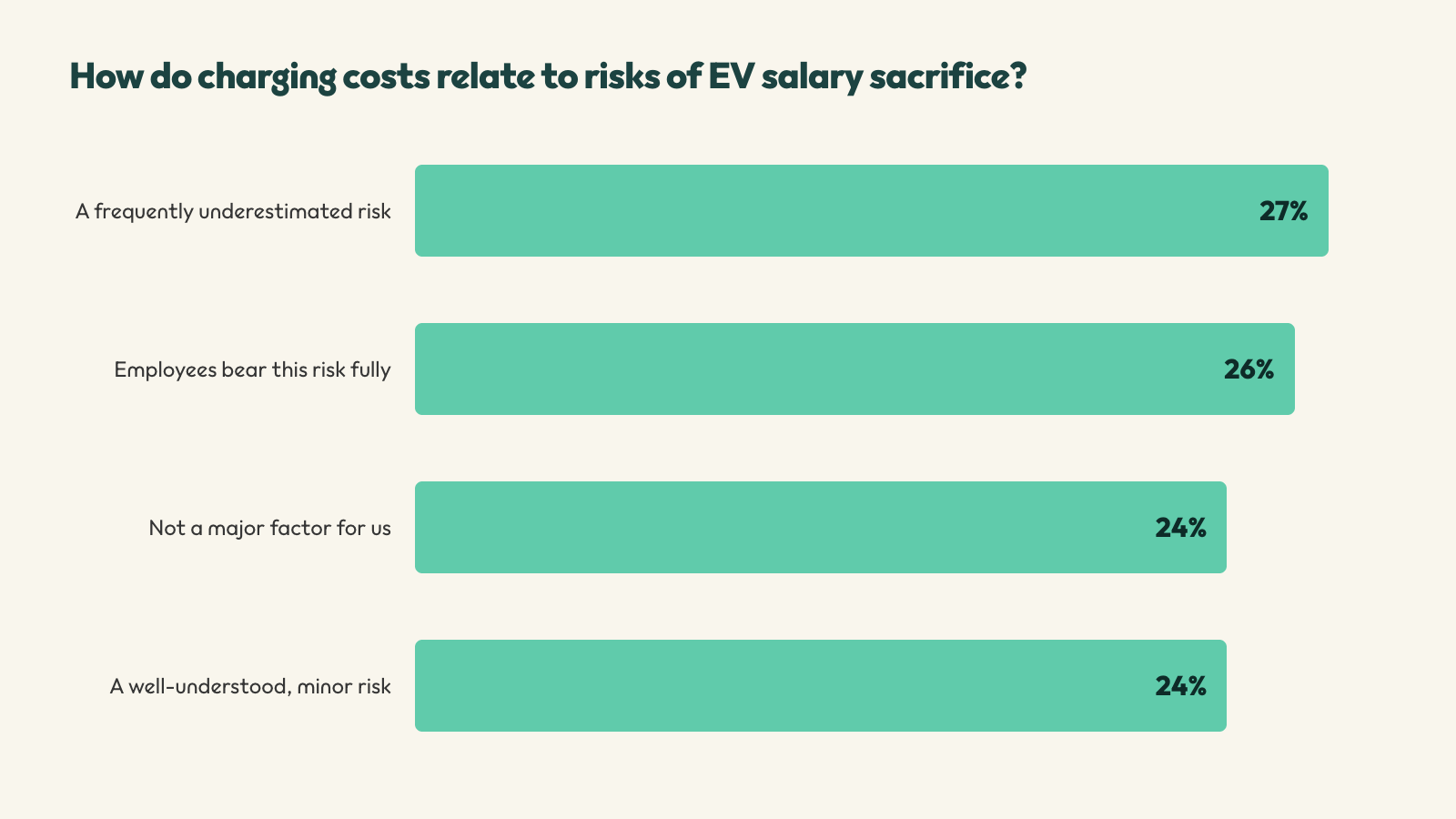
How do charging costs relate to the risks of EV salary sacrifice for people leaders?
27% of people leaders feel that charging costs that relate to the risk of EV salary sacrifice are frequently underestimated, 26% accept that employees bear this risk fully, 24% agree it's a well-understood minor risk, and for 24%, charging risk is not a major factor
Charging doesn’t have to raise a risk:
According to recent research from BYD, the average cost of charging an EV at home is around £17, while the average cost of using a public charging station is £26. This creates a divide between the employees who have access to charging facilities at home and those who need to spend more on public services and contend with higher VAT rates to keep their vehicles charged.
Without addressing these discrepancies, organisations risk offering unequal benefits to their staff, and may also find it significantly more challenging to fairly reimburse employees for company mileage. Companies that do offer EV charging allowances need to be cautious as well, as flat monthly allowances can easily be viewed as ‘cash allowances’ by HMRC, leaving these funds subject to both Class 1 National Insurance and PAYE tax, raising the costs of offering salary sacrifice schemes.
For 27% of people leaders in our audience, charging costs carry frequently underestimated risks, and 24% feel that while they fully understand the risk, it is minor nonetheless. At opposite ends of the spectrum, 24% don’t feel that charging costs are a serious factor for them, while 26% agree that employees bear the full risk regardless of where they choose to charge up.
How do the risks of EV salary sacrifice affect insurance costs for people leaders?
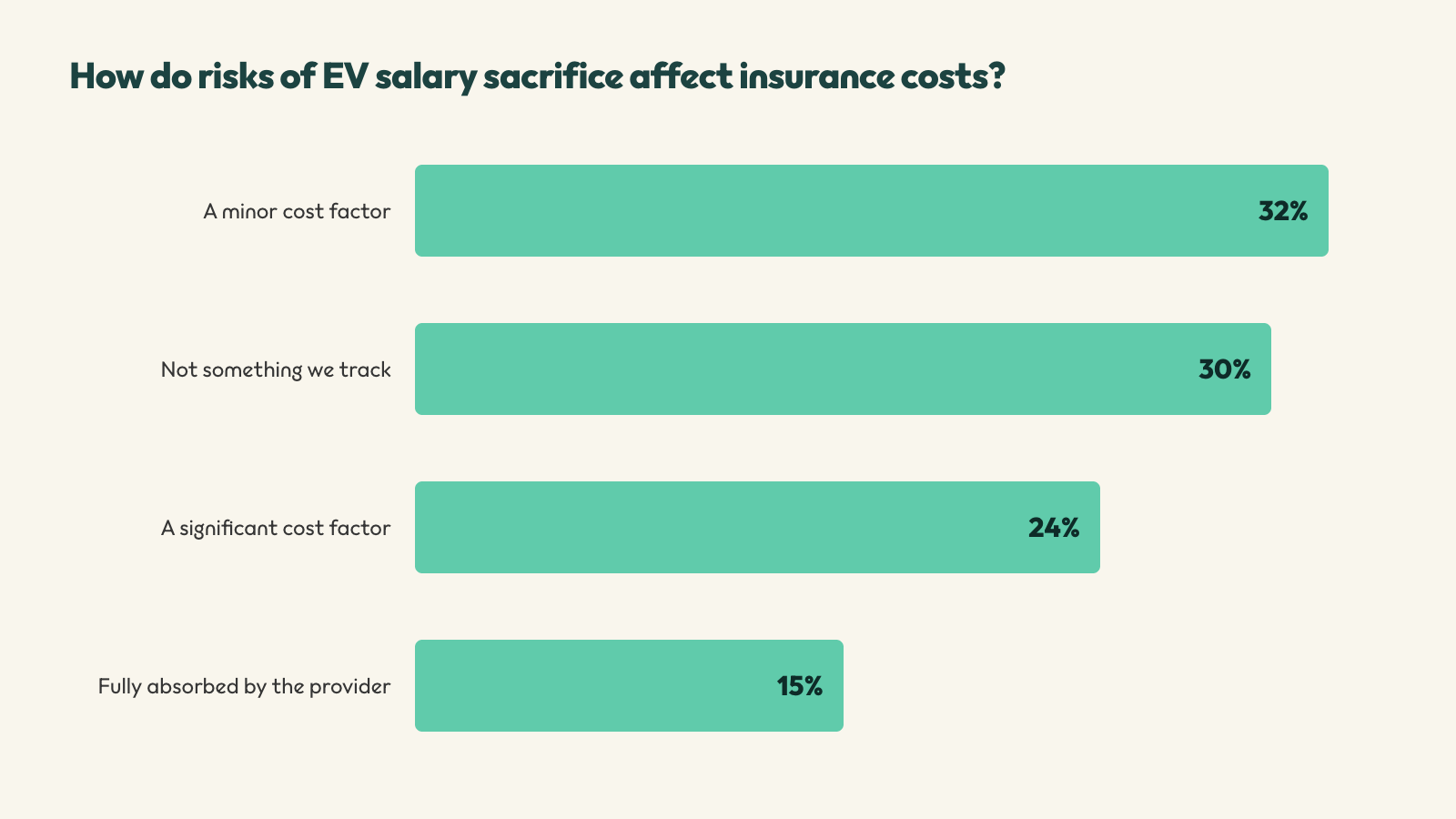
For 32% of people leaders, the risks of EV salary sacrifice affecting insurance costs is a minor cost factor, 30% don’t track these costs, and for 15%, they’re fully absorbed by the provider, but for 24% insurance costs are a significant cost factor
Insurance costs create concerns:
Recent data shows that more than 42% of consumers in the UK expect to switch to a fully electric vehicle by 2030, up from 36.8% in 2024. Despite this growing intent, however, studies have identified that high EV insurance premiums, which are significantly more costly than insurance for petrol and diesel vehicles, are one of the largest deterrents hindering this movement.
It makes sense, then, that 24% of people leaders believe insurance costs are a significant cost factor in their rollouts of EV salary sacrifice schemes. By contrast, 32% feel that insurance premiums are only a minor cost factor for their organisations, and 30% don’t yet track these expenses or their impacts on their salary sacrifice programmes.
In 15% of cases, the programmes' providers fully absorb the costs of premiums, offering some welcome relief to scheme adopters across the UK.
How do the risks of EV salary sacrifice affect payroll teams at people leaders' organisations?
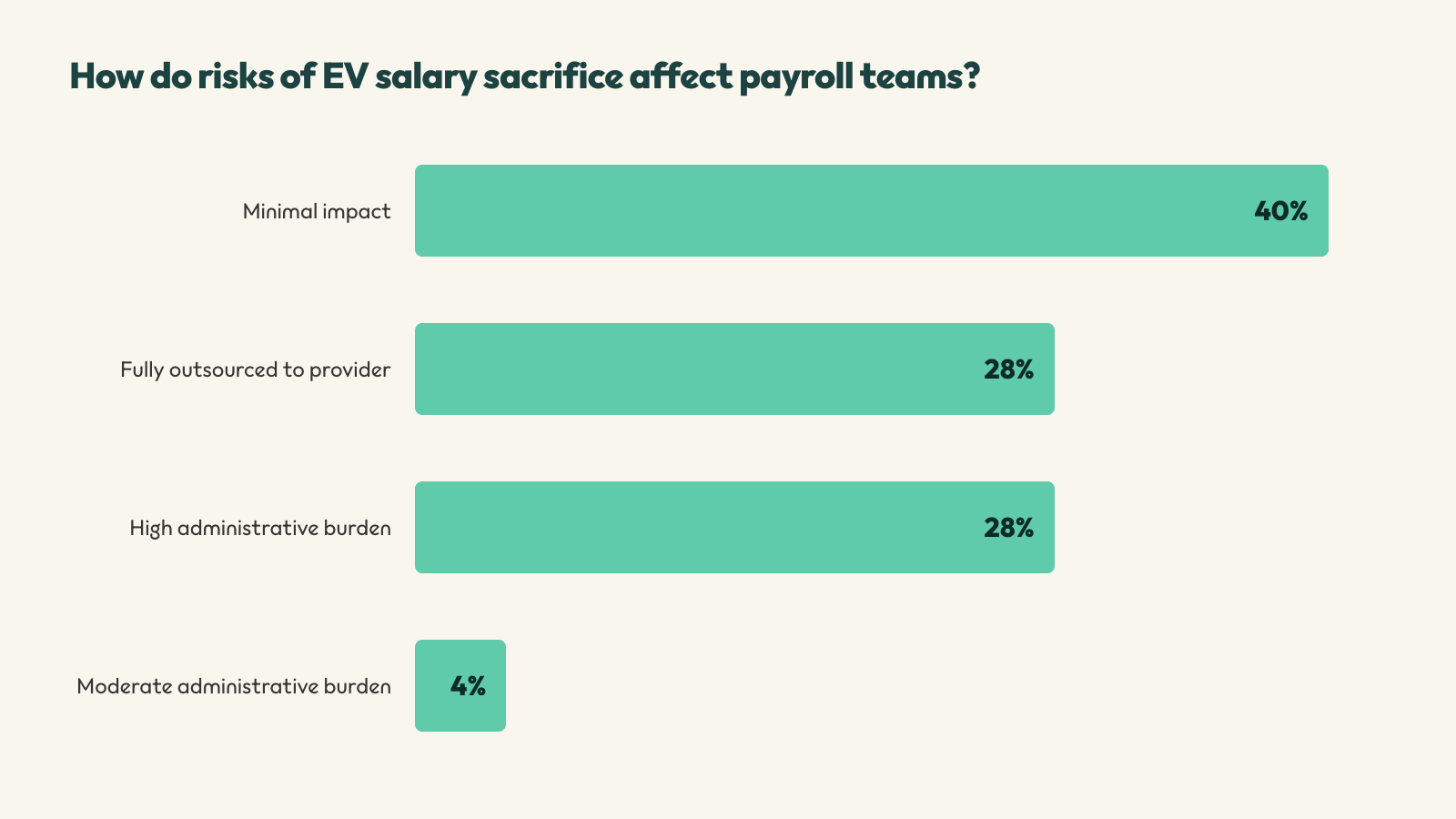
The risks of EV salary sacrifice schemes have a minimal impact on 40% of people leaders’ payroll team, 28% fully outsource these risks to a provider, 28% of payroll teams find them a high administrative burden, and 4% find them a moderate burden
Payroll teams feel the brunt:
EV salary sacrifice programmes can carry a series of risks for payroll teams. These teams need to consistently monitor employees’ fluctuating earnings to make sure that their salaries never dip below the NMW threshold and trigger any violations, and must also manually perform complicated calculations for statutory benefits, which can be directly impacted by reduced gross salaries. Payroll departments are also tasked with managing ongoing contract changes and shifting BIK tax rates to minimise the risk of being audited and penalised by HMRC.
All these responsibilities combined carry higher administrative burdens, demanding more time and effort to ensure ongoing compliance and overall success. In line with this, 28% of people leaders’ payroll teams face high administrative burdens in the wake of their organisations’ EV salary sacrifice schemes, and 4% note that the additional administrative demands, while present, are minor.
However, 40% feel that these responsibilities have had minimal impacts on their payroll staff. Additionally, in 28% of cases, the extra administrative work is fully outsourced to their schemes’ providers, eliminating many of the expected burdens of salary sacrifice risk management.
How do the risks of EV salary sacrifice affect people leaders' budgets?
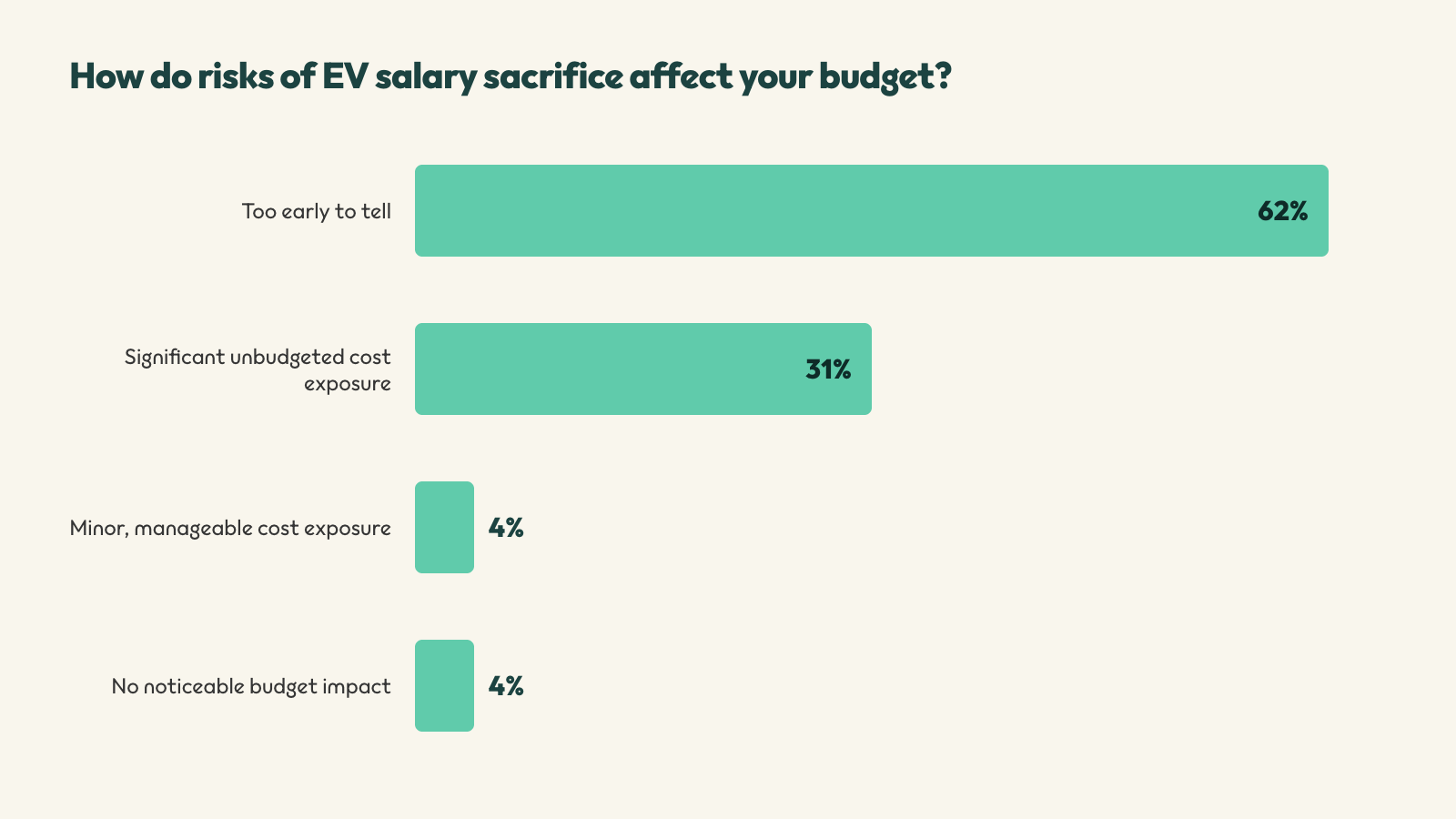
It’s too early to tell if EV salary sacrifice has any impact on 62% of people leaders’ budgets; however, 31% note significant unbudgeted cost exposure, 4% see minor manageable cost exposure, and a further 4% don’t see any noticeable budget impact
Not all budgets are impacted:
Employers are the official contract holders for all leases delivered under EV salary sacrifice schemes in the UK. Because of this, any early cancellations of leases by employees can trigger expensive early termination fees that dig into organisations’ budgets, especially if their salary sacrifice plans don’t include protective stipulations. HMRC tax and non-compliance penalties can be exceptionally costly as well, should payroll calculations fail to accurately value fluctuating earnings and complicated statutory benefits.
31% of people leaders’ organisations have been exposed to significant cost exposures for which they have not sufficiently budgeted. Just 4% each have not experienced any budget impacts or that they have been minor and largely manageable, showing the seriousness of the financial risks involved.
For 62%, however, it is too early to judge just how much of an impact EV salary sacrifice programmes will have on their fiscal budgets.
How do the risks of EV salary sacrifice differ by employee level for people leaders?
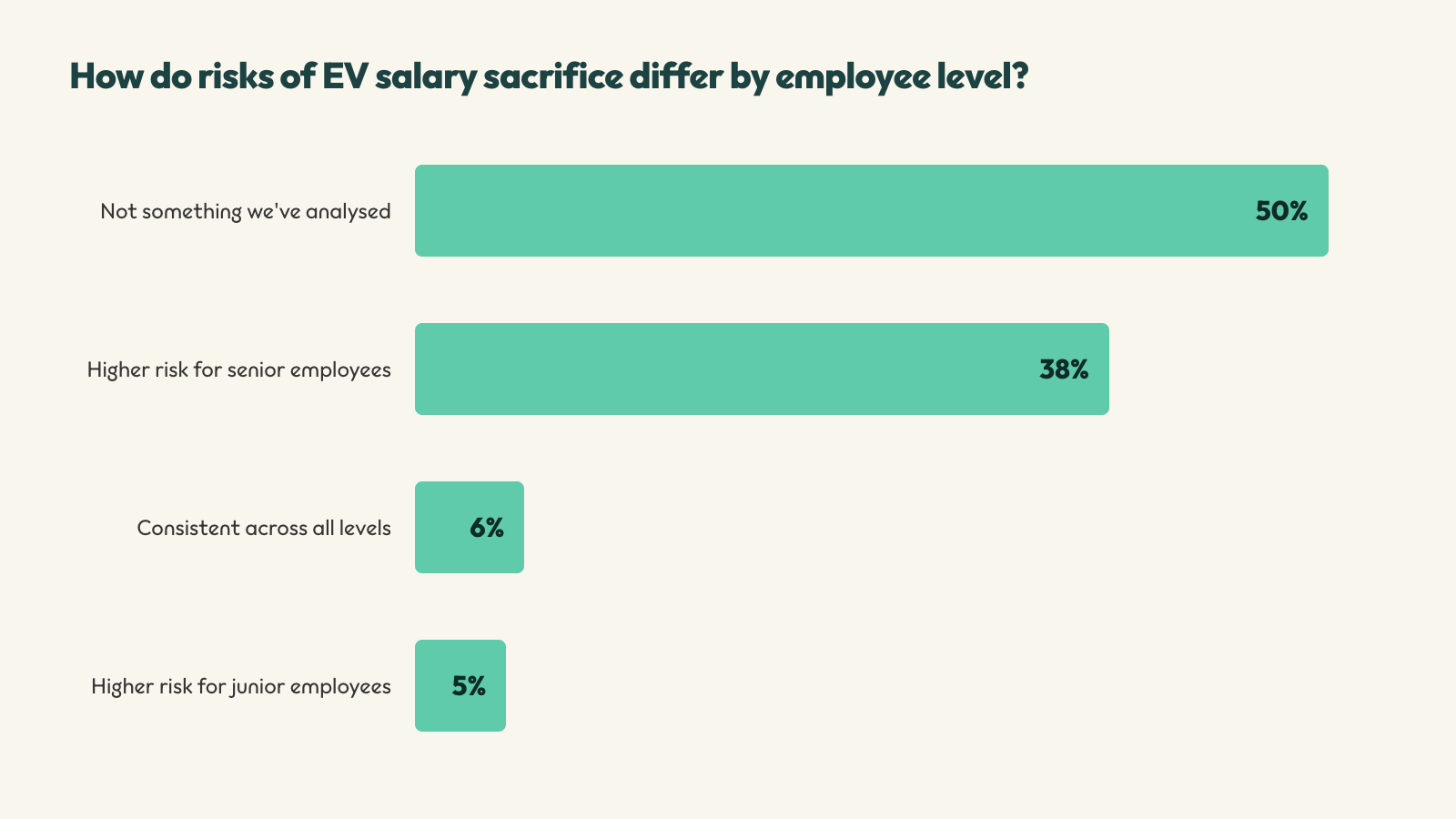
The risks of EV salary sacrifice differing by employee level are not something 50% of people leaders have analysed, 38% see a higher risk for senior employees. 6% agree the risk is consistent across all employee levels, and 5% think there’s a higher risk for junior employees
Employee level has an impact:
The UK Government’s latest data shows that, as of April 2025, the proportion of high-paid jobs (paying over £26.94, at least 150% of the median hourly pay) rose to over 23.2%. With nearly a quarter of UK positions now classified as high-paying, it correlates that 38% of people leaders report higher risks of EV salary sacrifice among their senior employees.
Although 50% of leaders note that they have not analysed how the risks differ according to employee level within their organisations, a far smaller 6% find that the risks and impacts hit consistently across all levels. Only 5%’s junior employees face the highest risk, suggesting that the higher earners within an organisation are often those who drive these schemes, leaving them and their employers open to significant financial exposures as a result.
How do the risks of EV salary sacrifice affect employee trust for people leaders?
47% of people leaders are unsure how the risks of EV salary sacrifice affect employee trust as they have not measured this, 24% say these risks damage trust when issues arise, 23% have not seen any noticeable effect, and 7% find that when these risks are managed well, it builds employee trust
Employee trust is built on risk management:
With Deloitte data showing that companies trusted by their employees outperform their peers by as much as 400%, employee trust is a clear and critical factor in overall operational success. While undeniably important, this trust can also be fragile, and is quickly impacted by factors such as the many employee-facing risks of EV salary sacrifice schemes.
When it comes to how employee trust is affected by these schemes at our people leaders’ companies, many are still unsure of the impacts at play. Nearly half (47%) have not yet measured the risks or their impacts as yet. 24% say that trust is damaged when issues arise, but almost as many - 23% - feel that the risks of EV salary sacrifice have no noticeable effects on employee confidence.
Further, for 7%, these risks can actually help to build trust among workers when managed effectively and transparently. These sentiments point to a notable opportunity for employers and people leaders. Those that openly communicate the potential challenges of their schemes and offer employees comprehensive protection packages may be able to turn high-risk benefits into a lasting culture of corporate care that renews loyalty and helps to retain valuable talent.
How do the risks of EV salary sacrifice affect retention for people leaders?
The risks of EV salary sacrifice have no real impact on retention for 53% of people leaders and 47% are unsure as they have not measured the impact on retention
Risk and retention go hand in hand:
Staff turnover rates in the UK increased steadily in the 5 years leading up to 2023, rising from 25.8% to 35.6%.
One of the primary drivers behind this trend is unmet needs; when employees don’t feel that their financial and psychological needs are met, they may begin to look for more fulfilling opportunities elsewhere. If EV salary sacrifice schemes aren’t implemented effectively, they can take a toll on workers’ financial stability and futures, further exacerbating these detrimental effects.
Although these risks are real and present, our audience hasn’t cited them as having a significant impact on employee retention to date. For 53%, these risks have no real impact on their turnover rates. That said, this statistic alone doesn’t suggest they have negligible effects on this metric. With 47% of people leaders yet to measure these impacts and still feeling uncertain, more quantifiable data is needed to gain a deeper understanding of how EV salary sacrifice schemes could be prompting some UK workers to polish up their resumes.
How do people leaders assess the risks of EV salary sacrifice pre-launch?
94% of people leaders rely only on a provider's guidance to assess the risks of EV salary sacrifice pre-launch, and 6% rely on informal internal discussions
External providers are relied on for risk assessment:
Analysing the risks of EV salary sacrifice programmes before they launch is key to offering structured schemes that truly benefit employees. The people leaders in our audience primarily rely on the guidance and expertise of their scheme providers for this task.
The vast majority, 94%, turn to their salary sacrifice programme administrators to develop a concise understanding of the risks and their potential impacts. By contrast, just 6% of people leaders hold informal internal discussions to analyse the risks involved and brainstorm strategies to mitigate them.
Relying heavily on providers for risk analysis can accelerate scheme rollouts, but it also suggests that most companies are outsourcing oversight to third parties who may not fully grasp their organisations’ unique circumstances. Leaders could better safeguard their talent and budgets by pairing external support with consistent internal reviews that align EV salary sacrifice schemes with their specific financial and HR situations.
What training exists on the risks of EV salary sacrifice for people leaders?
37% of people leaders only have informal guidance on the risks of EV salary sacrifice available, and 29% have no training available whatsoever, but 29% have formal training for HR and managers, and 5% have provider-led training only
Training is not standardised:
People leaders who have access to training on the risks of EV salary sacrifice schemes are better equipped to protect their organisations against liabilities like NMW violations, unbudgeted early termination fees, and negative impacts on employee trust and motivation. The right training also provides these leaders with tools on how to educate employees on potential personal impacts, ultimately building a more trustworthy workplace and more sustainable benefit schemes.
But it appears that it may still take time before this type of training is widely available to people leaders in the UK. 37% of people leaders only have access to informal guidance on the risks of EV salary sacrifice, and 29% admit there’s no training on this topic available to them. 5% note that their organisations rely only on provider-led training.
Another 29%’s organisations offer formal training for HR personnel and managers. For this contingent, structured training may help to ensure that risks can be successfully identified and addressed before they take hold, thereby protecting their workforces and companies alike.
How often do people leaders review the risks of EV salary sacrifice?
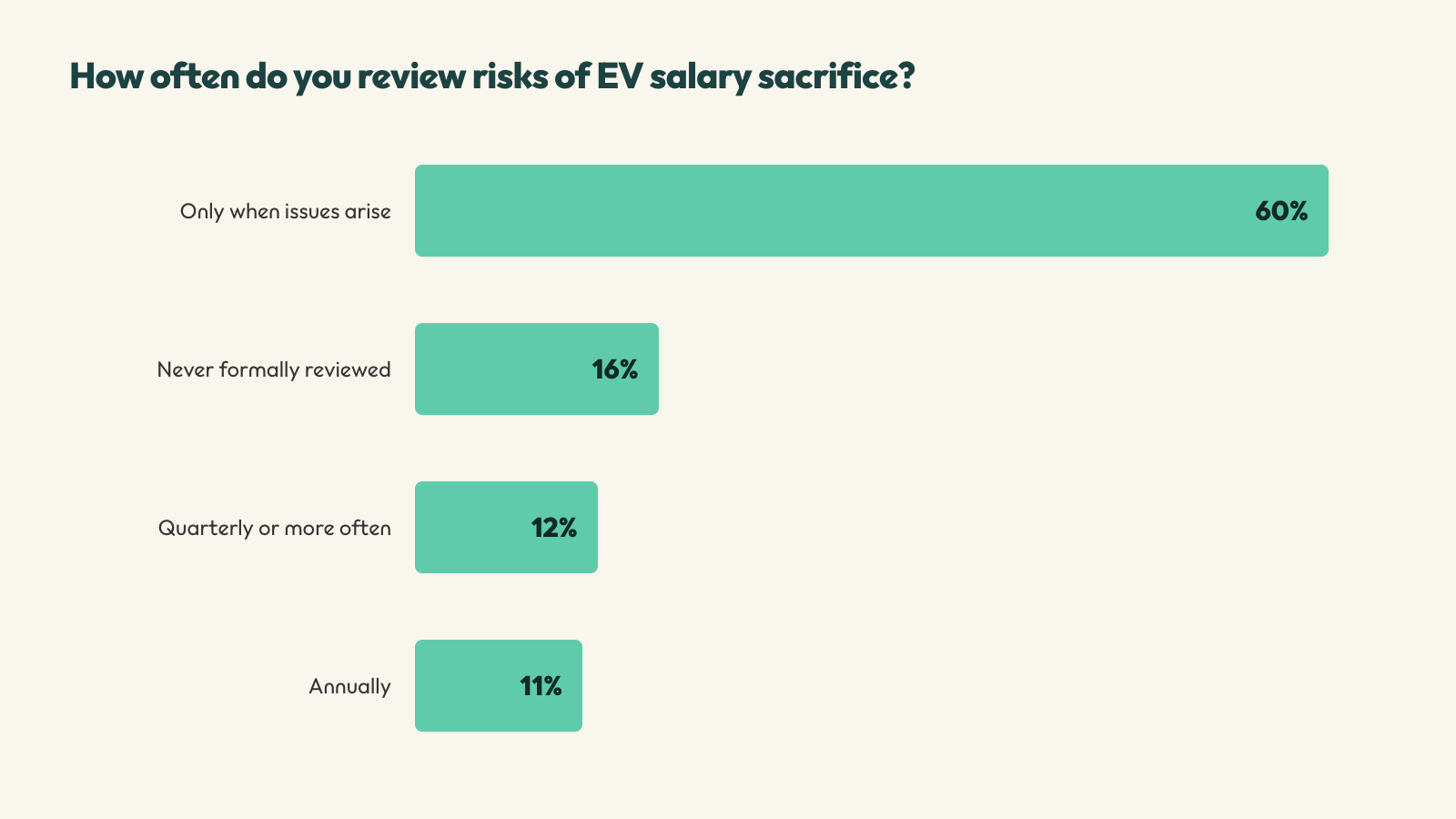
60% of people leaders only review the risks of EV salary sacrifice when issues arise, and 16% have never reviewed the risks; however, 12% review the risks quarterly or more often, and 11% review them annually
Risk review varies:
Budgeting is an essential aspect of business management, and it’s recommended that businesses review their budgets at least once a month to track performance and make necessary adjustments.
Some of the main risks of EV salary sacrifice directly impact businesses’ budgets through liabilities such as early termination fees and HMRC non-compliance penalties. These liabilities can be costly, especially when large teams are involved, requiring consistent risk review to manage and mitigate them.
However, only a small percentage of people leaders’ organisations perform risk review regularly; just 12% do so quarterly or more often, and 11% review EV salary sacrifice risks once a year. 16% never formally review these risks at all, and for the 60% who remain, they say that their companies only perform this analysis when issues actually arise.
By shifting to a more proactive approach through regular review schedules, many UK organisations could improve their risk management strategies, helping safeguard their bottom lines without compromising workforce satisfaction.
How confident are people leaders in managing the risks of EV salary sacrifice?
33% of people leaders are very confident in managing the risks of EV salary sacrifice, and 17% are fairly confident, but the exact opposite applies too, as 33% are not confident managing these risks at all, and 17% are not very confident
Confidence levels are evenly split:
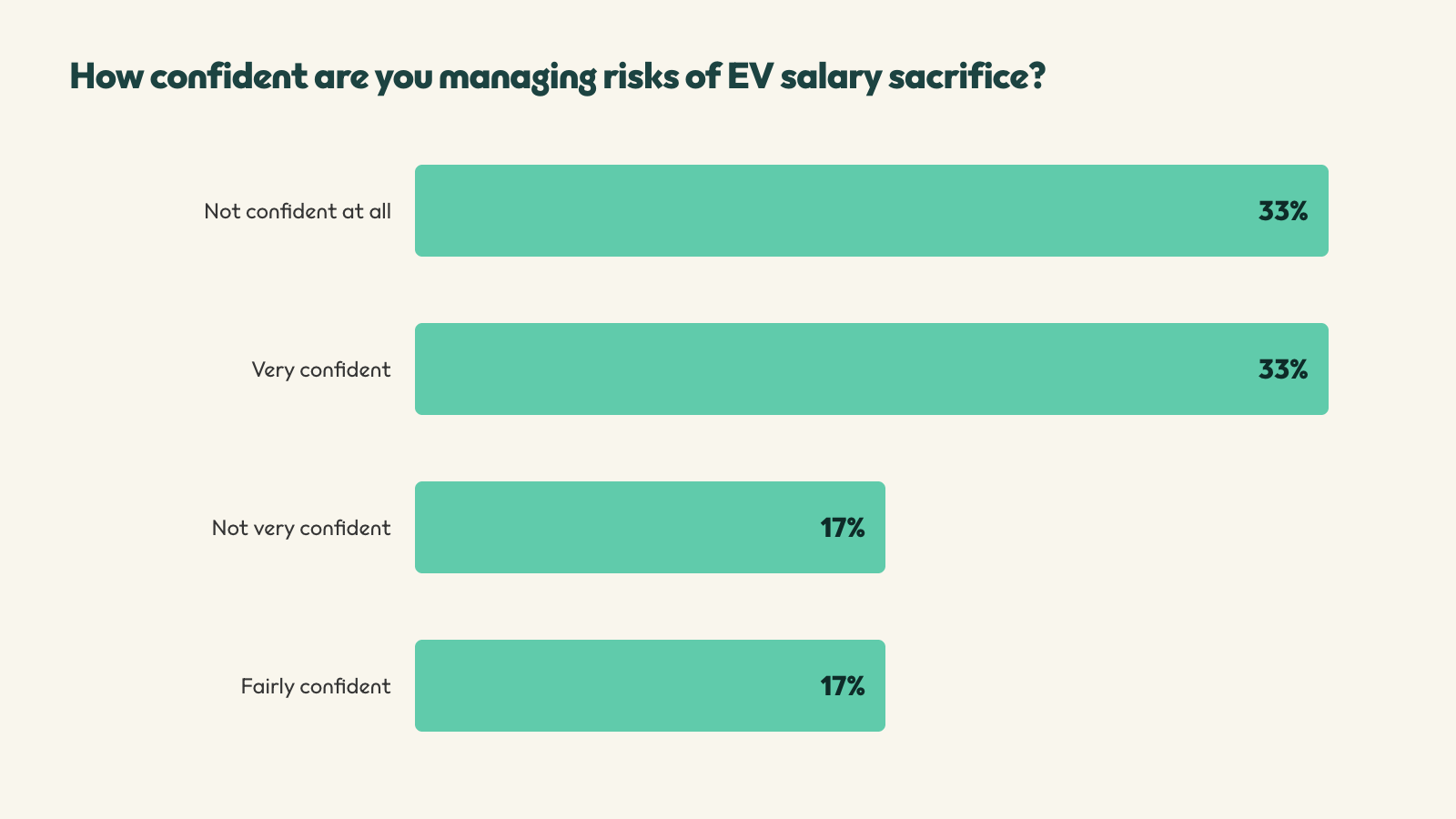
In terms of people leaders’ confidence in managing the risks of EV salary sacrifice, one third (33%) feel very confident in their abilities. But just as many leaders admit to not feeling confident in this arena at all.
17% don’t feel particularly capable of managing these risks, and the remaining 17% classify themselves as ‘fairly confident’, but still feel there’s room for improvement in their skillsets.
Just as training helps leaders to identify and manage the key risks related to electric vehicle schemes, so too can it build confidence in these abilities, supporting the 50% of people leaders who feel uncertain of their skills to tackle potential threats with renewed assurance.
Overall, how well managed are the risks of EV salary sacrifice at people leaders' organisations?
24% of people leaders agree that overall, the risks of EV salary sacrifice are very well managed at their organisation, and another 24% say they’re reasonably well managed, but 30% find these risks to be poorly managed, and 23% say they’re not managed at all
Overall risk management fluctuates:
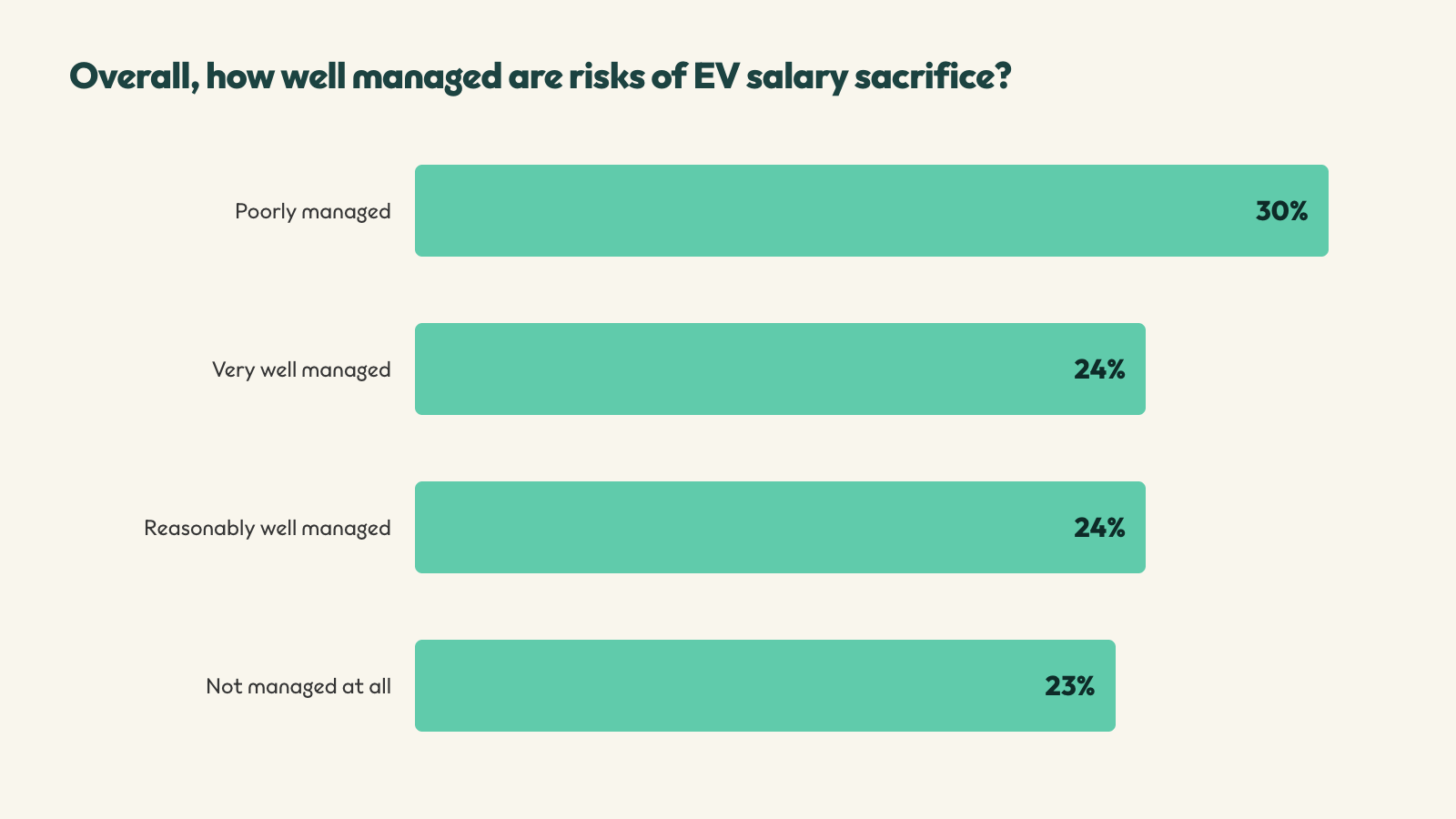
Our audience’s opinions on how well their organisations manage the risks of EV salary sacrifice schemes are split. 24% each consider their companies to be managing these risks very well or reasonably well, but nearly as many (23%) note that these risks aren’t being managed at all.
A further 30% feel that their organisations manage EV salary scheme risks poorly, leaving them prone to a range of financial and workforce-related disadvantages.
Would AI tools reduce the risks of EV salary sacrifice for people leaders?
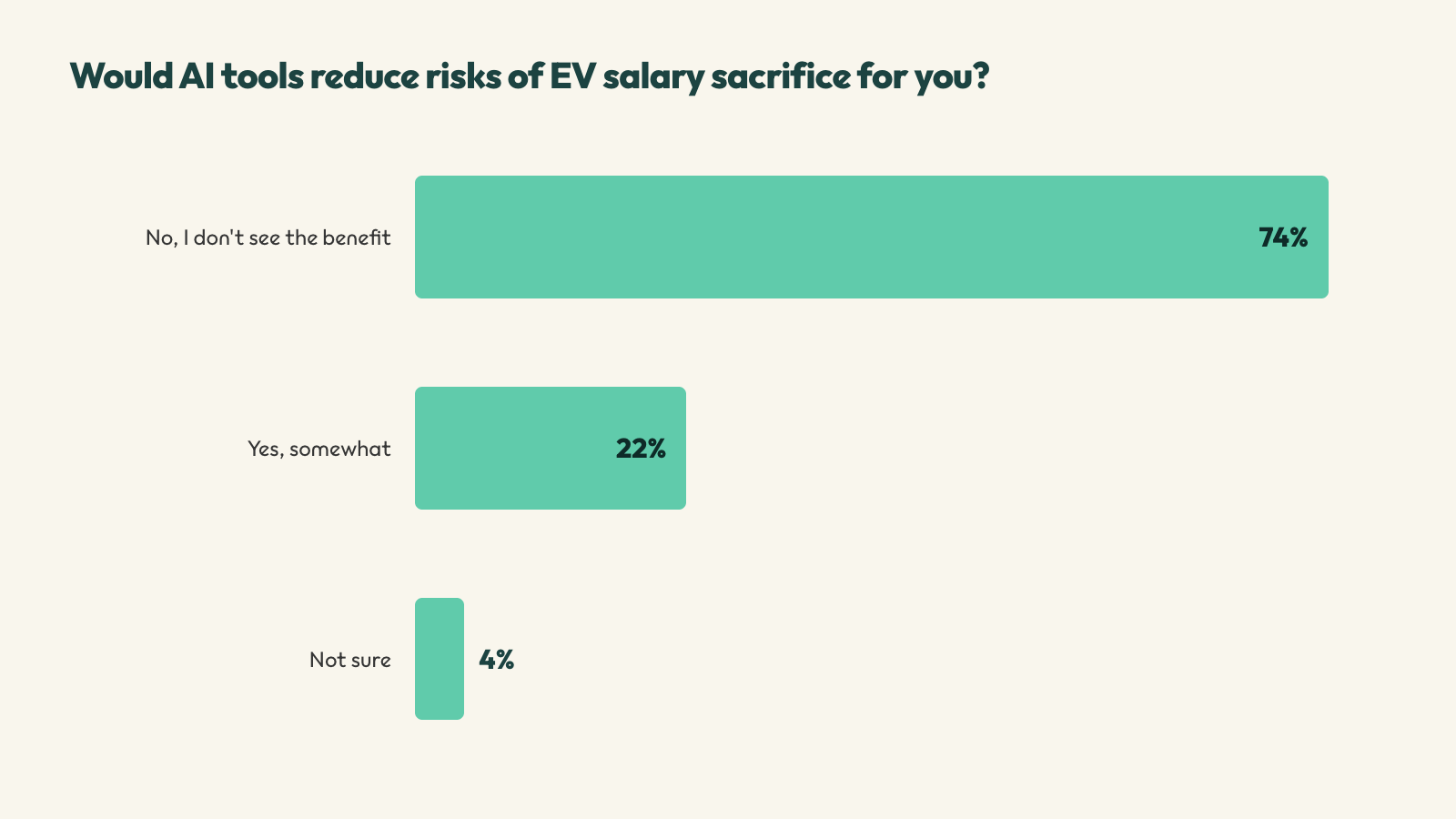
74% of people leaders don’t see that AI tools would have any benefit in reducing the risks of EV salary sacrifice, 4% are not sure if these tools would offer any benefits, and 22% think that they would offer benefits to some degree
AI tool use isn’t expected:
AI may be becoming more widely adopted across UK industries and sectors, but there are still some reservations around its use, especially in financial applications. According to YouGov, just 19% of Britons feel comfortable taking financial advice generated by AI, and a mere 15% feel that AI services offered by financial providers genuinely support their best interests.
Our audience reflects similar trends. Overall, 74% of people leaders don’t see any benefit in implementing AI tools to mitigate the risks of EV salary sacrifice, and another 4% aren’t sure whether there are any real benefits. The minority (22%) believe AI could have benefits in risk management, but only to a certain degree.
Judging by this spread, it seems that EV salary sacrifice risk management will remain human-led in the foreseeable future, requiring human intelligence and compassion to fully understand the risks businesses and employees face today.
Reducing risks in EV salary sacrifice
Based on these statistics, it’s clear that while EV salary sacrifice schemes offer excellent opportunities for employers and employees, they also introduce a range of financial, operational, and compliance considerations that require careful planning. Many organisations are still developing the knowledge, governance, and internal processes needed to manage these schemes confidently, with responsibility often shared across multiple teams or supported by external providers.
As adoption continues to grow, organisations that invest in clear policies, regular risk reviews, employee education, and specialist expertise will be better positioned to maximise the benefits of EV salary sacrifice while reducing unnecessary risk.
Last updated 21.07.26
