
Cost Savings of EV Salary Sacrifice Schemes Statistics: UK 2026
As organisations expand their employee benefits packages, EV salary sacrifice schemes are becoming an increasingly attractive option alongside workplace charging solutions and other sustainable mobility initiatives. These benefits can help make electric vehicle ownership more accessible while supporting employers' recruitment, retention, and environmental goals.
To find out what 177,880 opinions of people leaders in the UK were about the cost savings of EV salary sacrifice schemes, we utilised AI-driven audience profiling to synthesise insights from online discussions over 12 months, ending on the 7th of July 2026, to a high statistical confidence level. The results illustrate how people leaders perceive the cost-saving potential of EV salary sacrifice, the factors influencing those savings, and the approaches organisations are taking to maximise their long-term value.
Index
Methodology and data
42% of people leaders know a little about EV salary sacrifice schemes' cost savings, 31% know a moderate amount, and 18% know a great deal, while 9% know nothing at all about the associated cost savings
Employee benefit enhancement first attracted 49% of people leaders to EV salary sacrifice scheme cost savings, 33% were first attracted by the cost savings for employees, and 18% were attracted by the national insurance savings that salary sacrifice schemes offer
Reduced benefit-in-kind rates are the biggest driver of EV salary sacrifice schemes cost savings for 44% of people leaders, income tax relief is the biggest driver for 32%, National Insurance relief motivates 20%, and VAT or leasing efficiencies are the biggest cost savings driver for 5%
15% of people leaders’ employees report a £251-£400 average monthly saving due to an EV salary sacrifice scheme, which is very significant, 2% agree this amount makes a noticeable difference but 18% don't think it makes much difference, and 6% say this sum makes hardly any, while 16% save under £100, which is a noticeable amount, but this is not very much for 26%; those saving over £400 agree that it makes a difference for 7% and but another 7% don't really notice it, and for those saving between £100 and £200, only 1% notice it, and 2% don’t see much difference
11% of people leaders’ organisations under £10,000 annually form EV salary sacrifice schemes, which is still huge saving, 29% consider this sum a decent amount, 18% a small saving, and 19% no real saving, while those whose organisations save between £50,001 and £100,000 find this to be a decent saving, and 2% consider it a small one, with no one discussing savings of £100,000
40% of people leaders agree that EV salary sacrifice schemes have met their expectations, 19% agree they have exceeded them, and 24% are unsure, while 18% found that these schemes are below their expectations
99% of people leaders don’t calculate employer National Insurance, and 1% use an EV salary sacrifice scheme provider-supplied calculator
45% of people leaders measure EV salary sacrifice schemes cost savings for their business in corporation tax relief, 22% look at reduced recruitment or retention costs as a measure, 21% measure savings in National Insurance contributions saved, and 11% currently don’t measure the these scheme’s cost savings
81% of people leaders roll EV salary sacrifice scheme savings into their wider benefits budget, 19% don’t factor these savings into their budget, and no one voices factoring it in on an ad hoc basis
For 36% of people leaders, fuel or energy cost volatility hasn't made any real change in EV salary sacrifice uptake, and a further 36% don’t track this, while 23% report a decreased interest in the scheme, and 6% an increased interest
Payroll processing time is a significant administrative cost for 57% of people leaders when running an EV salary scheme, while compliance or reporting time makes up significant costs for a further 32%, but 11% say that there is no impact on these costs whatsoever
Only 2% of people leaders cite EV salary sacrifice scheme charging infrastructure costs as a major hidden costs concern, while this is of some concern for 23%, and a minor concern for 40%, but not a concern for 3%, maintenance and service costs are some concern for 18%, and a minor concern for 7%, and 6% share the same level of concern about early EV salary sacrifice termination fees
Government policy changes are the main risk to sustaining EV salary sacrifice scheme cost savings for 6% of people leaders, 48% agree this poses a significant risk, and 31% think it’s a minor risk, while rising vehicle or leasing prices pose a significant risk to cost savings for 7%, and another 7% find this a minor risk
27% of people leaders are very likely to use AI tools to calculate EV salary sacrifice schemes cost savings, 26% are somewhat likely, and 22% are not sure, but 25% are not likely to use AI tools for calculations at all
Turning EV salary sacrifice cost savings into long-term value
Methodology and data
Sourced using Artios from an independent sample of 177,880 opinions of people leaders in the UK across X, Quora, Reddit, Bluesky, TikTok, and Threads. Responses are collected within a 95% confidence interval and 5% margin of error. Results are derived from what people describe online, from opinions expressed, and not actual questions answered by people in the sample.
How much do people leaders know about the cost savings of EV salary sacrifice schemes?
42% of people leaders know a little about EV salary sacrifice schemes' cost savings, 31% know a moderate amount, and 18% know a great deal, while 9% know nothing at all about the associated cost savings
Knowledge leads to reduced costs:
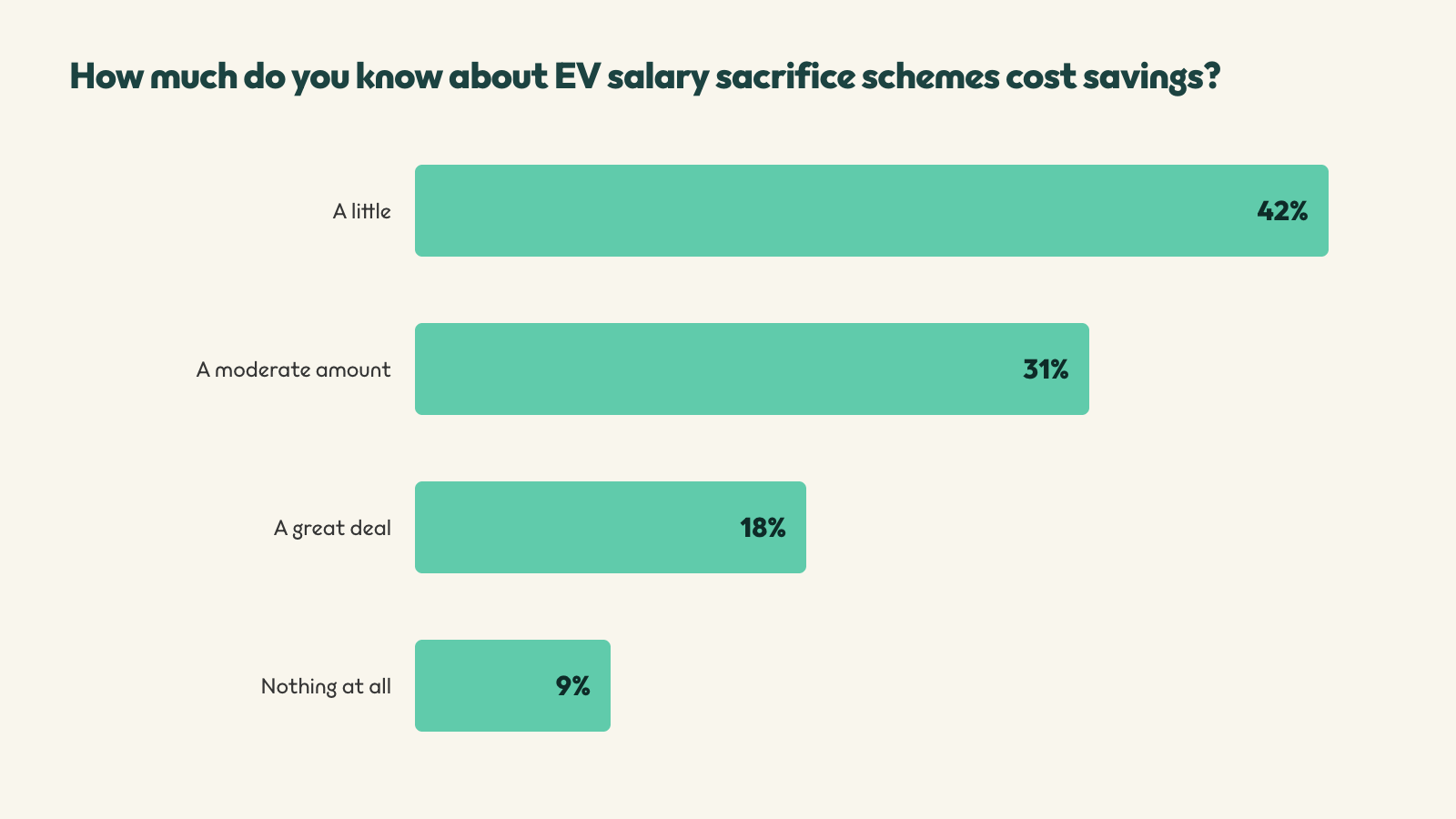
Knowledge of the cost savings linked to EV salary sacrifice schemes is well established among many people leaders, although there’s still room for greater awareness. A little knowledge is the most common at 42%, showing that many understand the basics but have not yet explored the financial benefits in depth.
A further 31% of people leaders have a moderate amount of knowledge, giving them a stronger understanding of how these schemes can reduce costs for both employers and employees. 18% know a great deal, reflecting a sizeable group that is already confident with the financial advantages. Only 9% of our audience have no knowledge at all, making this the smallest group by a clear margin.
Growing awareness comes at an important time for employers. From April 2025, the employer's Class 1 and Class 1A National Insurance rates increased by 1.2 percentage points to 15%, making salary sacrifice agreements an even more attractive way to manage employment costs.
At the same time, the decision not to introduce employer National Insurance on pension contributions, together with the extension of the reduced benefit-in-kind rates for electric vehicles until 2030, continues to strengthen the financial case for including EV salary sacrifice schemes within employee reward packages.
What first attracted people leaders to cost savings of EV salary sacrifice schemes?
Employee benefit enhancement first attracted 49% of people leaders to EV salary sacrifice scheme cost savings, 33% were first attracted by the cost savings for employees, and 18% were attracted by the national insurance savings that salary sacrifice schemes offer
Initial attraction has three main starting points:
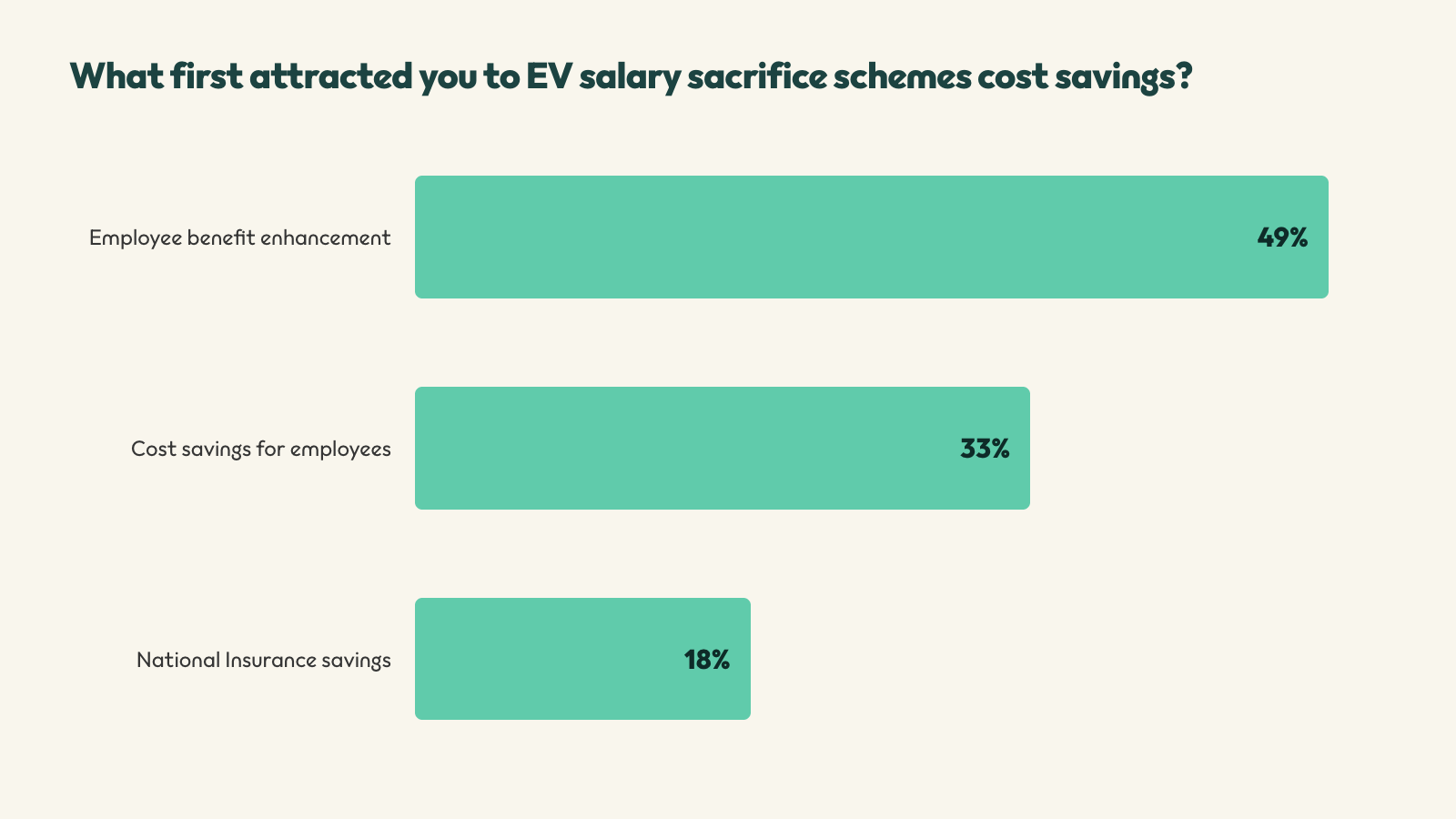
Building on the growing understanding of EV salary cost savings, the main attraction for many people leaders is the wider value these schemes bring to employees. 49% are first drawn to the opportunity to enhance employee benefits, making this the strongest driver by a comfortable margin. This aligns with the wider market, where half of UK employers now rank EV salary sacrifice schemes among their top three employee benefits, emphasising their growing importance within competitive reward packages.
Financial savings also play a major role in encouraging interest. Cost savings for employees are the primary attraction for 33% of people leaders, underlining the appeal of making electric vehicles more affordable through tax and National Insurance efficiencies.
National Insurance savings come first for 18%, reinforcing that employer savings remain an important part of the decision-making process, even if they are not the leading motivation.
What's the biggest driver of cost savings of EV salary sacrifice schemes for people leaders?
Reduced benefit-in-kind rates are the biggest driver of EV salary sacrifice schemes cost savings for 44% of people leaders, income tax relief is the biggest driver for 32%, National Insurance relief motivates 20%, and VAT or leasing efficiencies are the biggest cost savings driver for 5%
Cost savings drivers are widespread:
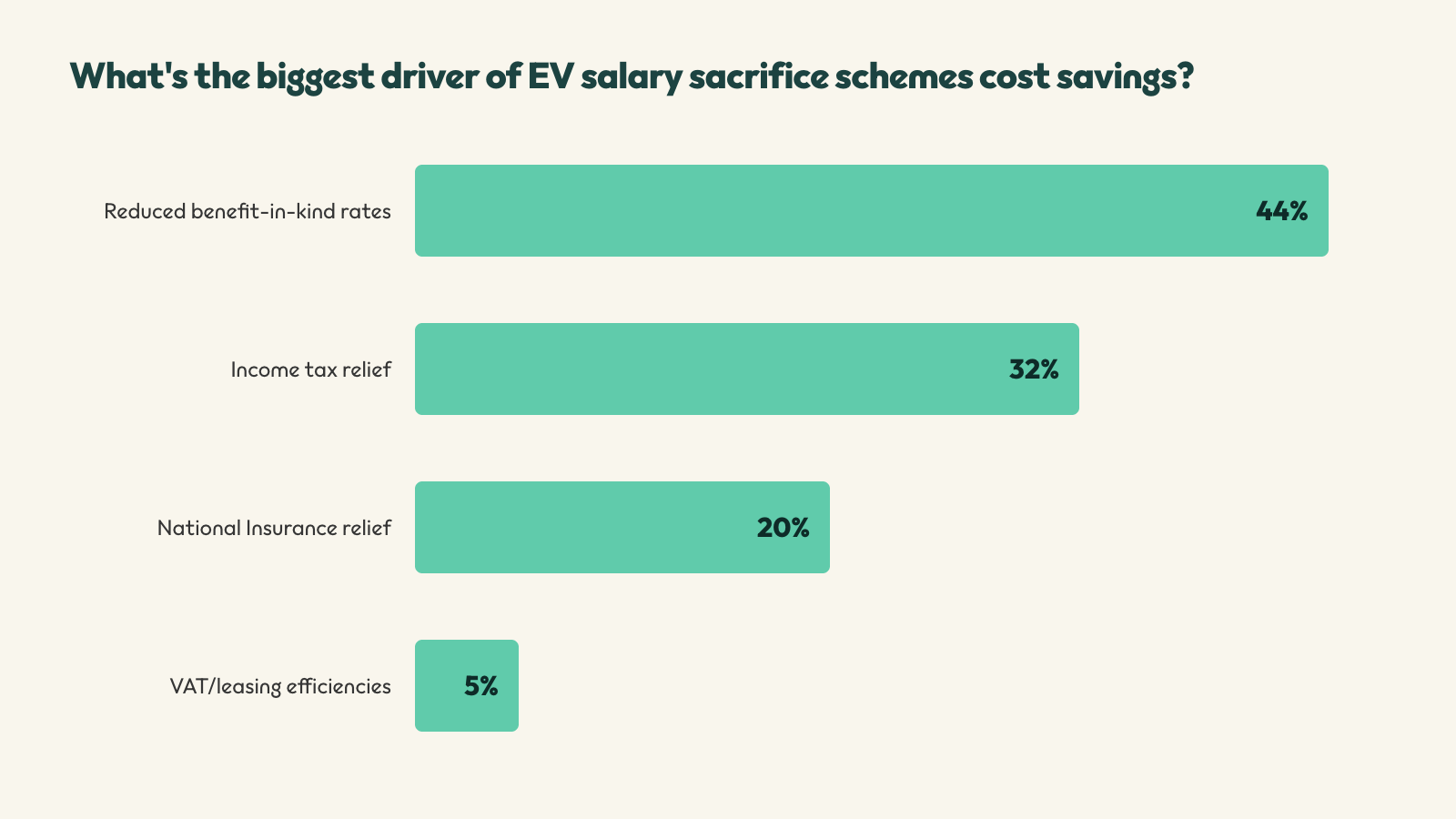
Reduced benefit-in-kind rates are the biggest cost-saving driver behind EV salary sacrifice schemes for 44% of people leaders. Income tax relief follows at 32%, indicating how tax savings remain a major factor when assessing the value of these schemes.
National insurance relief is the leading driver for 20% of people leaders, reflecting the importance of lowering employment costs alongside employee savings. VAT and leasing efficiencies account for 5%, making them the least influential factor, although they still contribute to the overall financial appeal.
The savings created by these tax advantages extend beyond reducing costs alone. Nearly half of employers report that offering an EV salary sacrifice scheme has helped them attract and retain employees, while half rank it among their top three workplace benefits. More than a quarter list it among their top two employee perks, demonstrating that financial incentives also strengthen recruitment and retention strategies.
What's the average monthly EV salary sacrifice scheme cost saving employees report to people leaders?
15% of people leaders’ employees report a £251-£400 average monthly saving due to an EV salary sacrifice scheme, which is very significant, 2% agree this amount makes a noticeable difference but 18% don't think it makes much difference, and 6% say this sum makes hardly any, while 16% save under £100, which is a noticeable amount, but this is not very much for 26%; those saving over £400 agree that it makes a difference for 7% and but another 7% don't really notice it, and for those saving between £100 and £200, only 1% notice it, and 2% don’t see much difference
Employee savings impact varies:
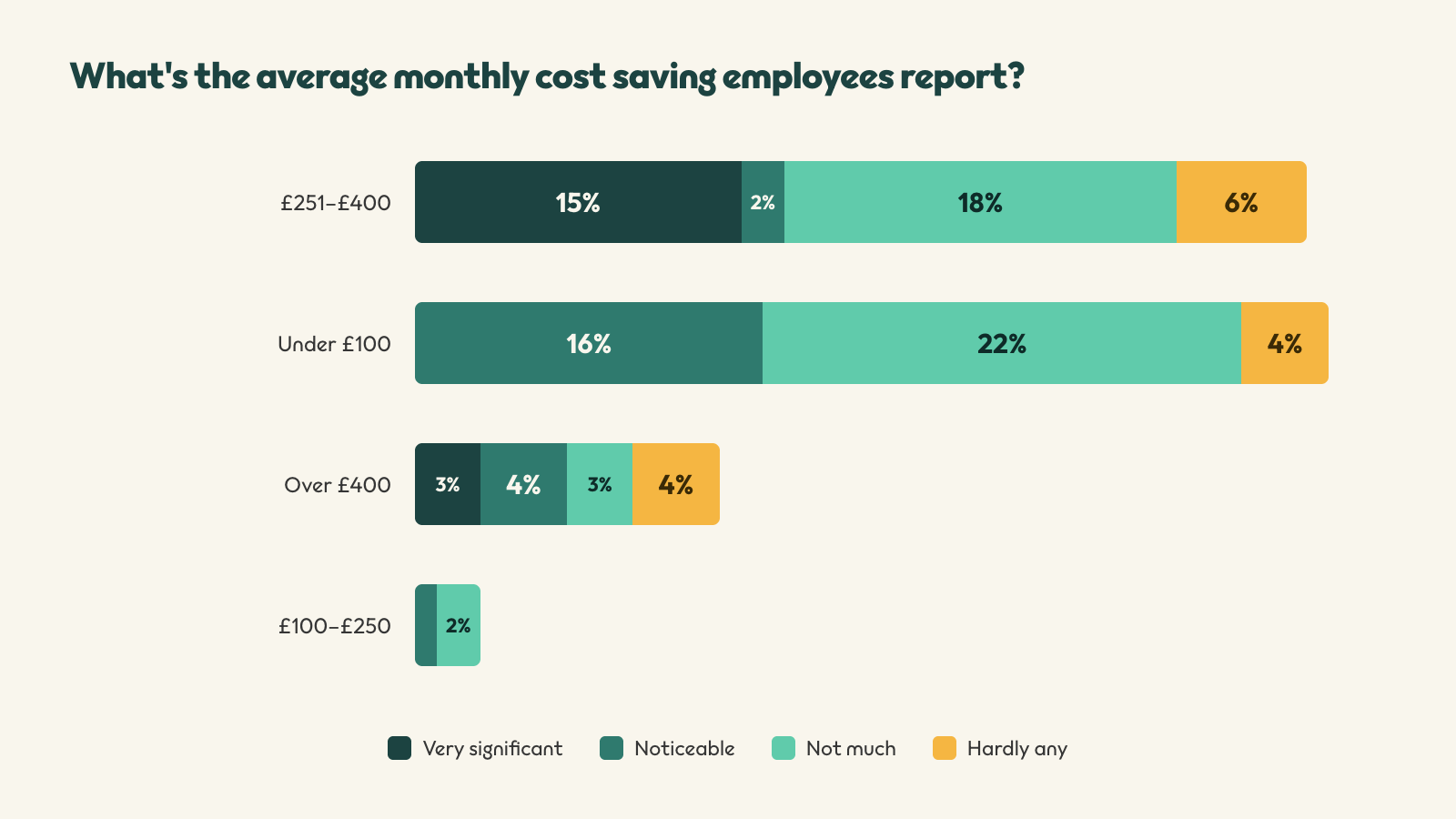
Employees’ monthly savings through EV salary sacrifice schemes vary, but the largest share of people leaders associate the greatest savings with the £251-£400 range. Within this group, 15% describe the savings as very significant, while 2% view them as noticeable. 18% of our audience believes savings at this level do not make a major difference, and 6% feel they provide hardly any benefit. This shows that while mid-range savings are widely recognised, people value their impact differently.
Lower monthly savings of under £100 are viewed as noticeable by 16% of people leaders, while 22% consider them to offer limited value, and 4% see hardly any benefit. Savings of more than £400 are regarded as very significant by 3%, noticeable by 4%, not much by 3%, and hardly any by another 4% of people leaders.
The £100 to £250 range attracts relatively little attention, with 1% of people leaders viewing it as noticeable and 2% as offering limited value. Employees paying for an EV through gross salary can typically reduce costs by 30% to 60% compared with personal leasing, thanks to income tax and National Insurance savings, which helps explain why salary sacrifice schemes remain an attractive option for many workplaces.
What's the total annual cost saving from EV salary sacrifice schemes at people leaders' organisations?
11% of people leaders’ organisations under £10,000 annually form EV salary sacrifice schemes, which is still huge saving, 29% consider this sum a decent amount, 18% a small saving, and 19% no real saving, while those whose organisations save between £50,001 and £100,000 find this to be a decent saving, and 2% consider it a small one, with no one discussing savings of £100,000
Total savings can be significant:
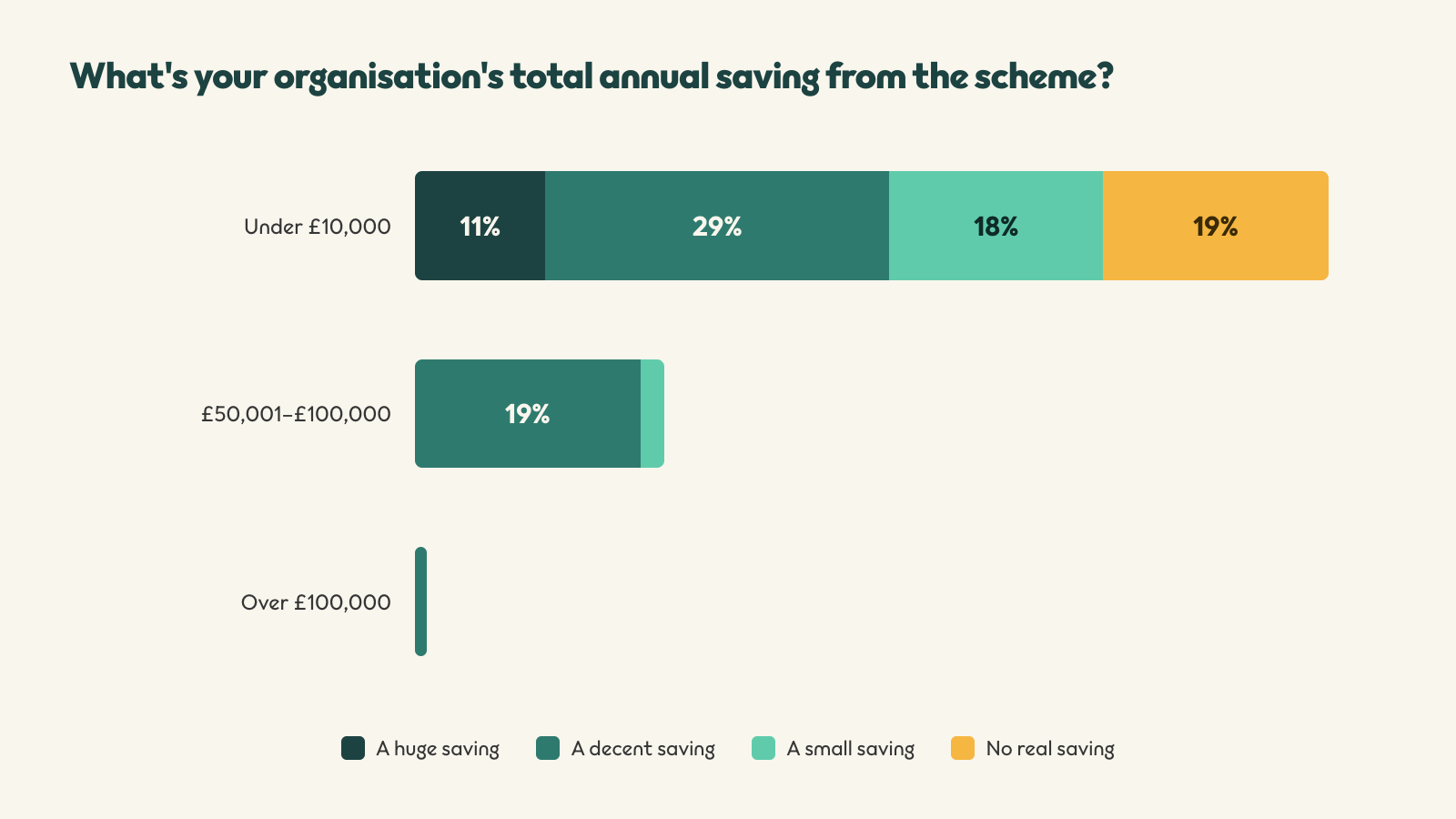
Annual savings from EV salary sacrifice schemes are most commonly reported in the under £10,000 range, although people leaders’ organisations view their impact differently. Within this bracket, 11% consider the savings to be huge, making it the strongest positive rating. A further 29% describe savings under £10,000 as decent, while 10% see them as small. Another 19% of people leaders feel this level delivers no real savings, showing that the value depends on factors such as workforce size, employee uptake, and existing benefit structures.
Larger annual savings are less common but remain meaningful where they occur. Savings between £50,001 and £100,000 are considered decent by 19% of people leaders, making this the dominant view for higher-value schemes. Less than 1% regard savings in this range as huge, 2% as small, and fewer than 1% see no real savings. Annual savings of more than £100,000 are rare, with fewer than 1% identifying them as a decent saving.
How do salary sacrifice savings compare to expectations for people leaders?
40% of people leaders agree that EV salary sacrifice schemes have met their expectations, 19% agree they have exceeded them, and 24% are unsure, while 18% found that these schemes are below their expectations
Expectations are mostly met:
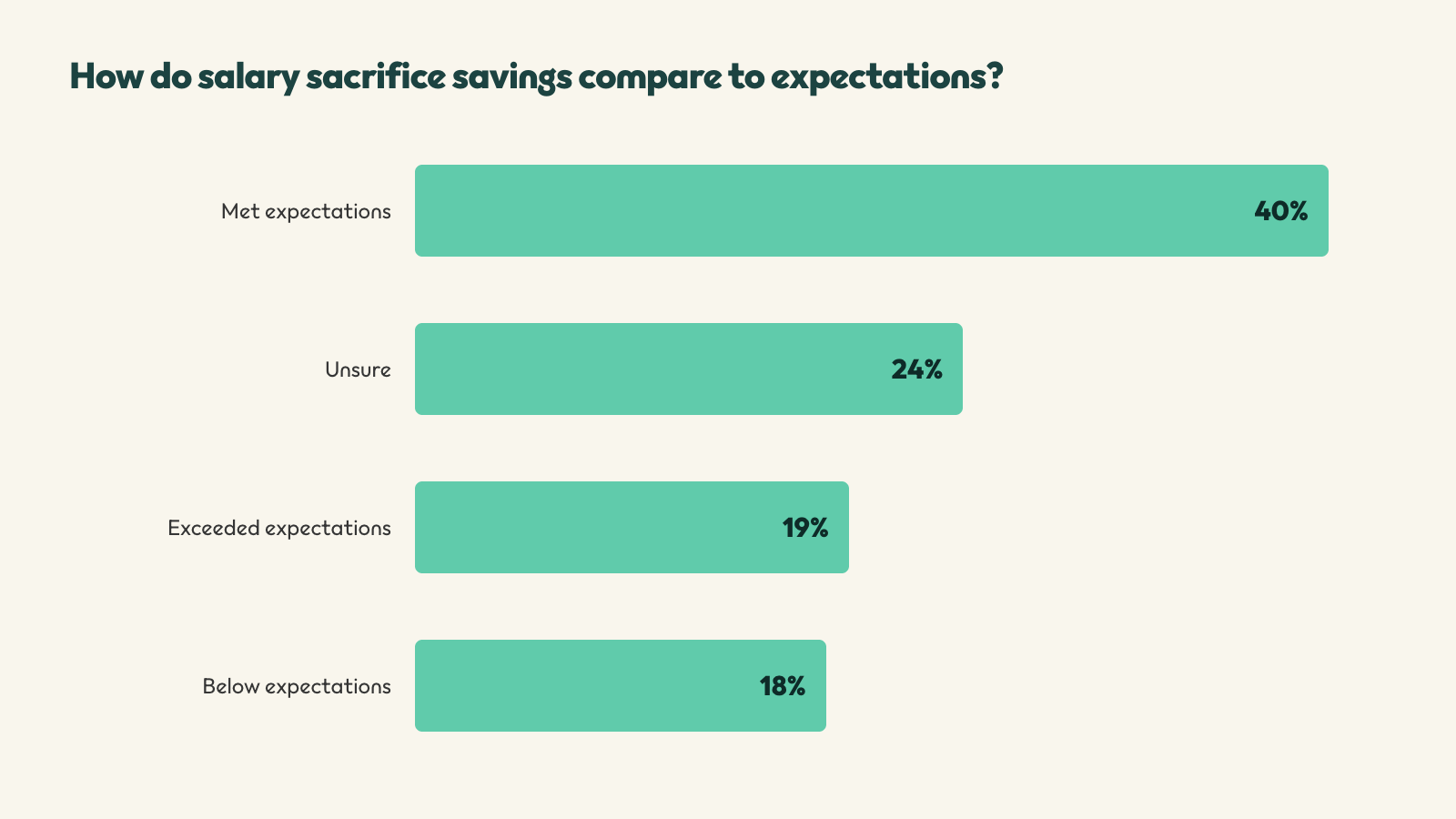
Salary sacrifice schemes are delivering the level of savings many organisations anticipated. For 40% of people leaders, the financial benefits have met expectations, making this the most common outcome. Another 19% report that savings exceeded expectations, showing that nearly one in five organisations are seeing stronger financial results than originally planned. This illustrates the potential for well-managed schemes to create meaningful value while supporting employee access to electric vehicles.
At the same time, experience is not identical across every organisation. 24% of people leaders remain unsure whether the savings have matched expectations, which may point to schemes that are still relatively new or where the full financial impact is still being assessed. A further 18% indicate that savings have fallen below expectations, demonstrating that outcomes can vary depending on factors such as uptake, implementation, and ongoing management.
How do people leaders calculate employer National Insurance savings?
99% of people leaders don’t calculate employer National Insurance, and 1% use an EV salary sacrifice scheme provider-supplied calculator
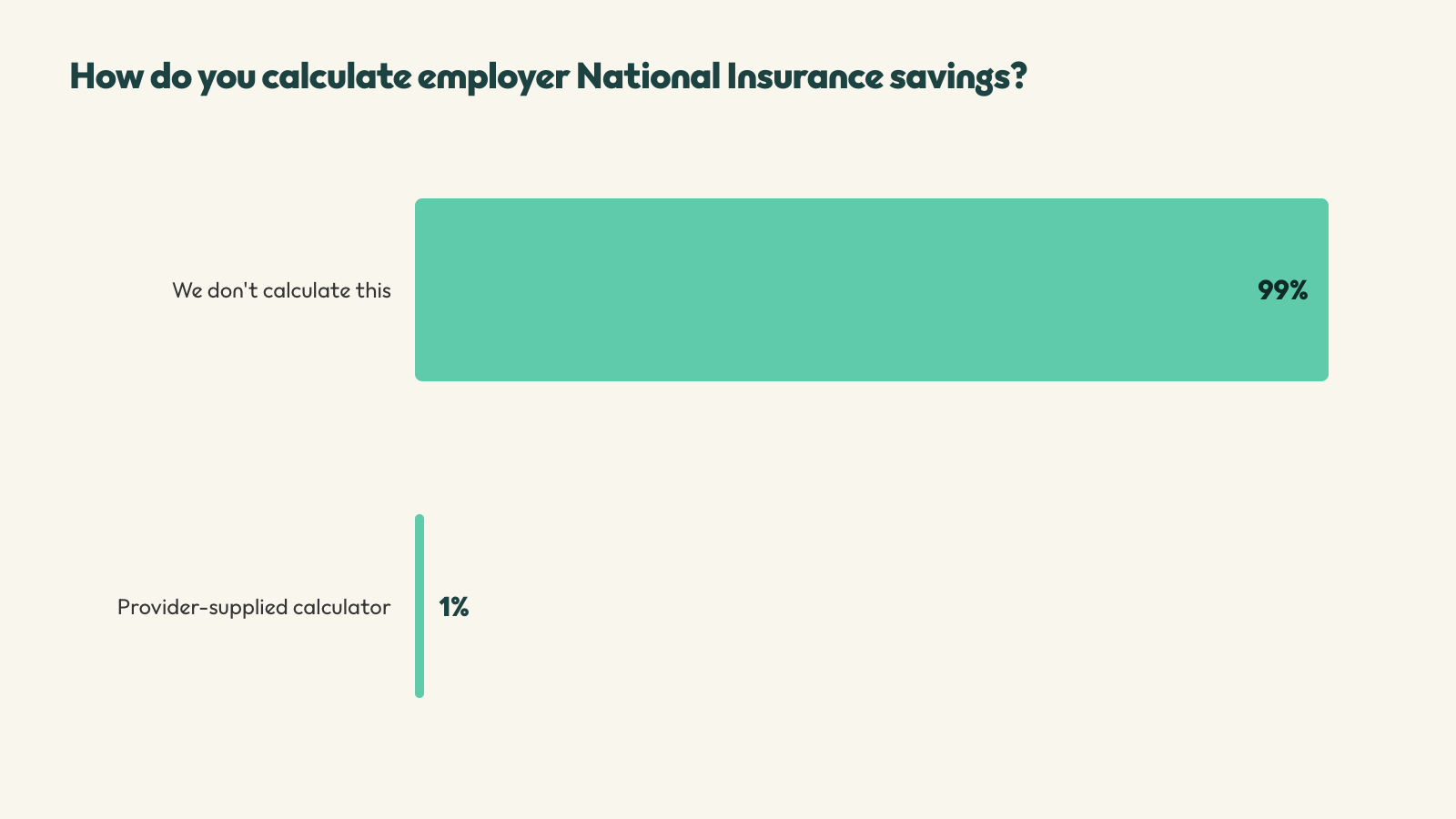
Employer National Insurance savings are rarely calculated directly by people leaders. An overwhelming 99% do not calculate these savings at all, while just 1% use a provider-supplied calculator. This reveals that most organisations rely on external providers or focus on the wider benefits of salary sacrifice schemes rather than measuring National Insurance savings internally.
This approach is understandable, as employer National Insurance calculations can be complex and depend on payroll, earnings, and the structure of the salary sacrifice arrangement. Under UK parliament rules, employers can reduce their National Insurance liability when part of an employee’s salary is exchanged for an eligible benefit, provided the arrangement meets the relevant requirements.
How do people leaders measure EV salary sacrifice schemes' cost savings for their business?
45% of people leaders measure EV salary sacrifice schemes cost savings for their business in corporation tax relief, 22% look at reduced recruitment or retention costs as a measure, 21% measure savings in National Insurance contributions saved, and 11% currently don’t measure the these scheme’s cost savings
Measurement of cost savings is divided:
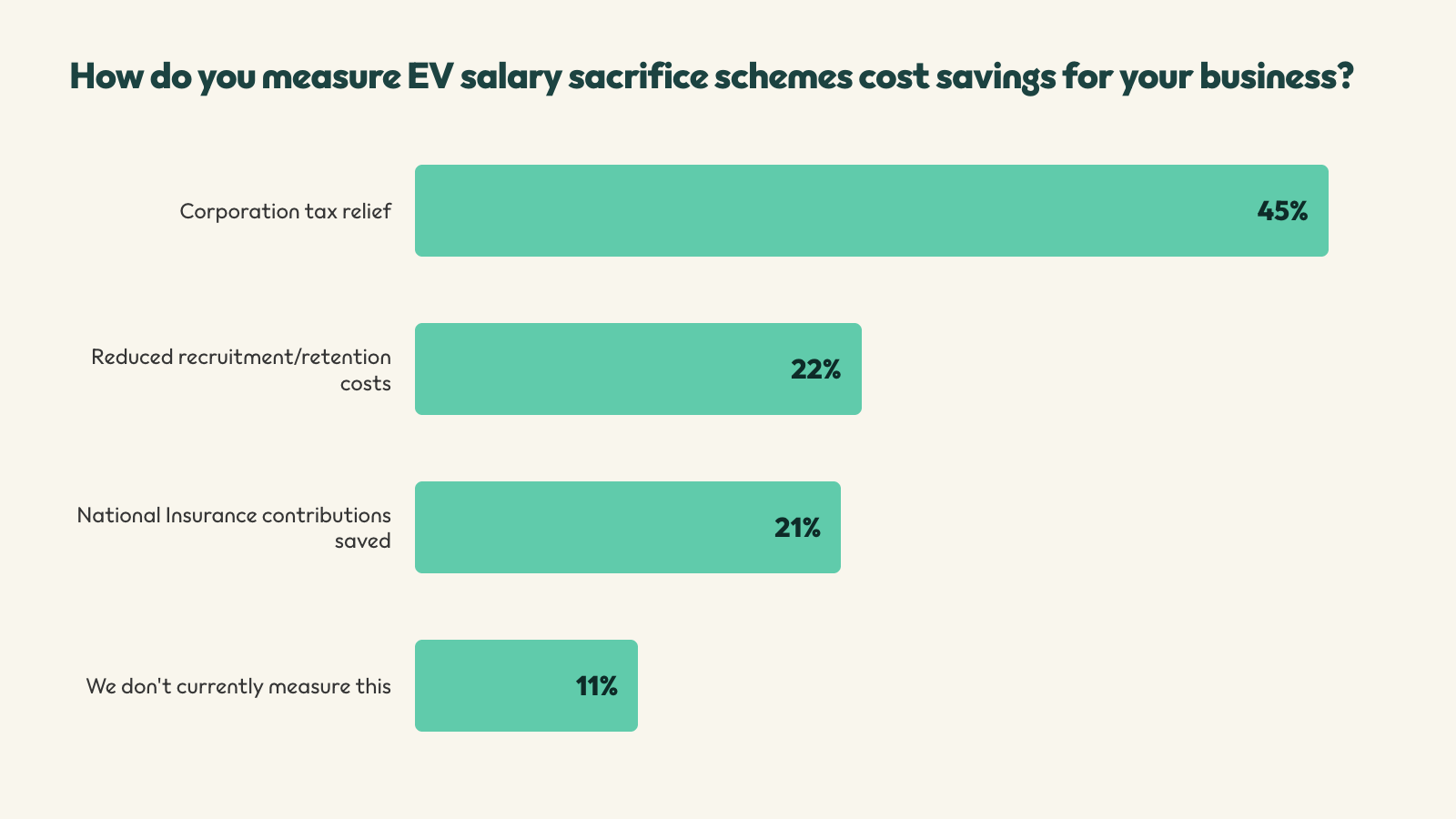
People leaders use several methods to measure the financial value of EV salary sacrifice schemes, with corporation tax relief at 45% being the most common. This emphasises the importance of tax efficiencies when assessing the business case for offering electric vehicles as an employee benefit.
22% of people leaders focus on reduced recruitment and retention costs, recognising that attractive workplace benefits can help improve staff loyalty and make organisations more competitive when hiring. A further 21% of our audience measures savings through lower employer National Insurance contributions, while 11% do not currently measure cost savings at all.
Looking beyond the employer perspective, salary sacrifice can also provide worthwhile savings for employees. Higher-rate taxpayers can often save between £2,000 and £3,000 each year when leasing a new electric car through an eligible scheme, while lower-rate taxpayers typically reduce leasing costs by around 30%.
How do people leaders factor cost savings of EV salary sacrifice into budget planning?
81% of people leaders roll EV salary sacrifice scheme savings into their wider benefits budget, 19% don’t factor these savings into their budget, and no one voices factoring it in on an ad hoc basis
Budget inclusion reveals a clear trend:
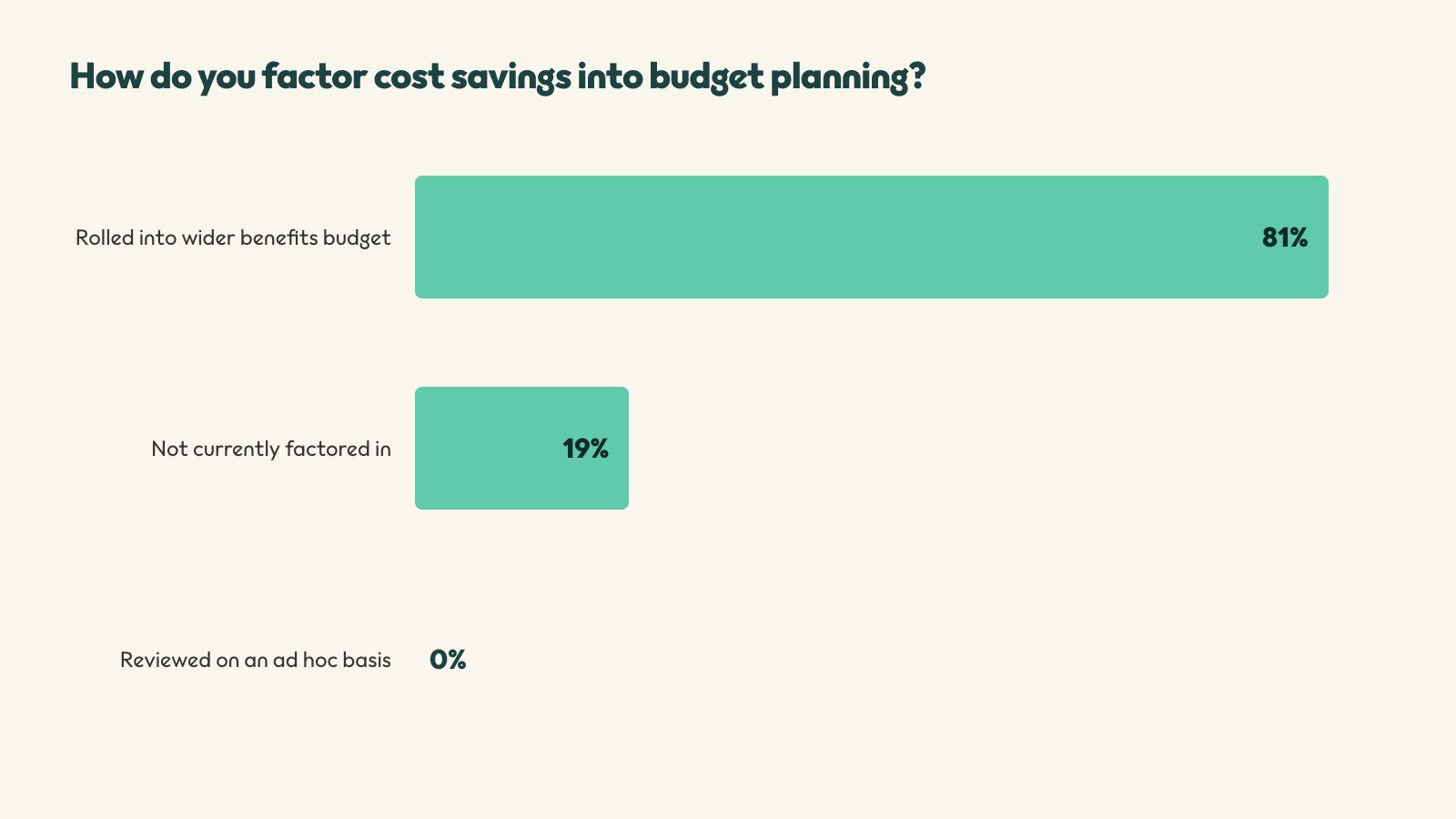
Cost savings from EV salary sacrifice schemes are most often built into long-term financial planning rather than treated as a separate budget item. For 81% of people leaders, the savings are rolled into the wider employee benefits budget, showing that these schemes are viewed as an established part of overall remuneration and benefits spending. Integrative savings in this way can make budgeting more predictable while helping organisations balance the costs and value of employee benefit programmes.
19% of people leaders do not currently factor these savings into budget planning, indicating that some organisations have yet to incorporate the financial impact into their regular forecasting processes. Interestingly, no people leaders in our audience discussed reviewing these savings on an ad hoc basis. This doesn’t mean it doesn't happen, just that it didn’t arise as an option in online conversations.
How has fuel/energy cost volatility affected EV salary sacrifice uptake for people leaders?
For 36% of people leaders, fuel or energy cost volatility hasn't made any real change in EV salary sacrifice uptake, and a further 36% don’t track this, while 23% report a decreased interest in the scheme, and 6% an increased interest
Energy volatility impact not a concern:
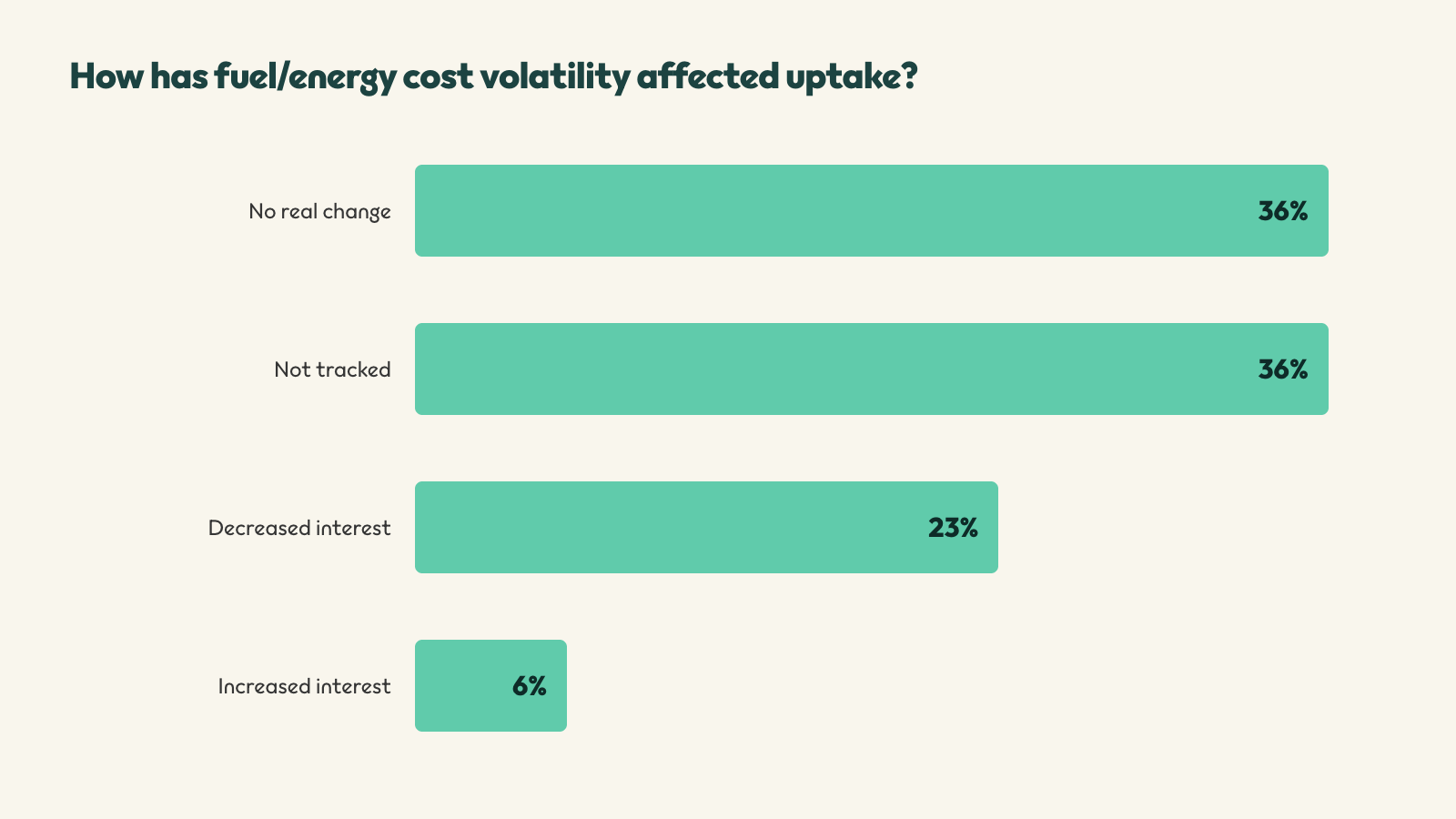
Fuel and energy cost volatility has had a mixed effect on EV salary sacrifice schemes. For 36% of people leaders, changing fuel and energy prices have made no real difference to uptake, indicating that decisions are often influenced by broader factors such as employee benefits, affordability, and long-term business planning. An equal 36% do not track the impact at all, revealing that many organisations are not directly linking changes in energy costs with participation in their schemes.
Meanwhile, 23% have seen interest decrease as fuel and energy costs have fluctuated. Rising electricity prices, uncertainty around charging costs, or wider economic pressures may have influenced employee decisions in these organisations.
In contrast, 6% of people leaders report increased interest, demonstrating that some employees continue to view electric vehicles as an attractive option despite changing energy prices.
What's people leaders’ biggest administrative cost when running an EV salary sacrifice scheme?
Payroll processing time is a significant administrative cost for 57% of people leaders when running an EV salary scheme, while compliance or reporting time makes up significant costs for a further 32%, but 11% say that there is no impact on these costs whatsoever
Admin costs are variable:
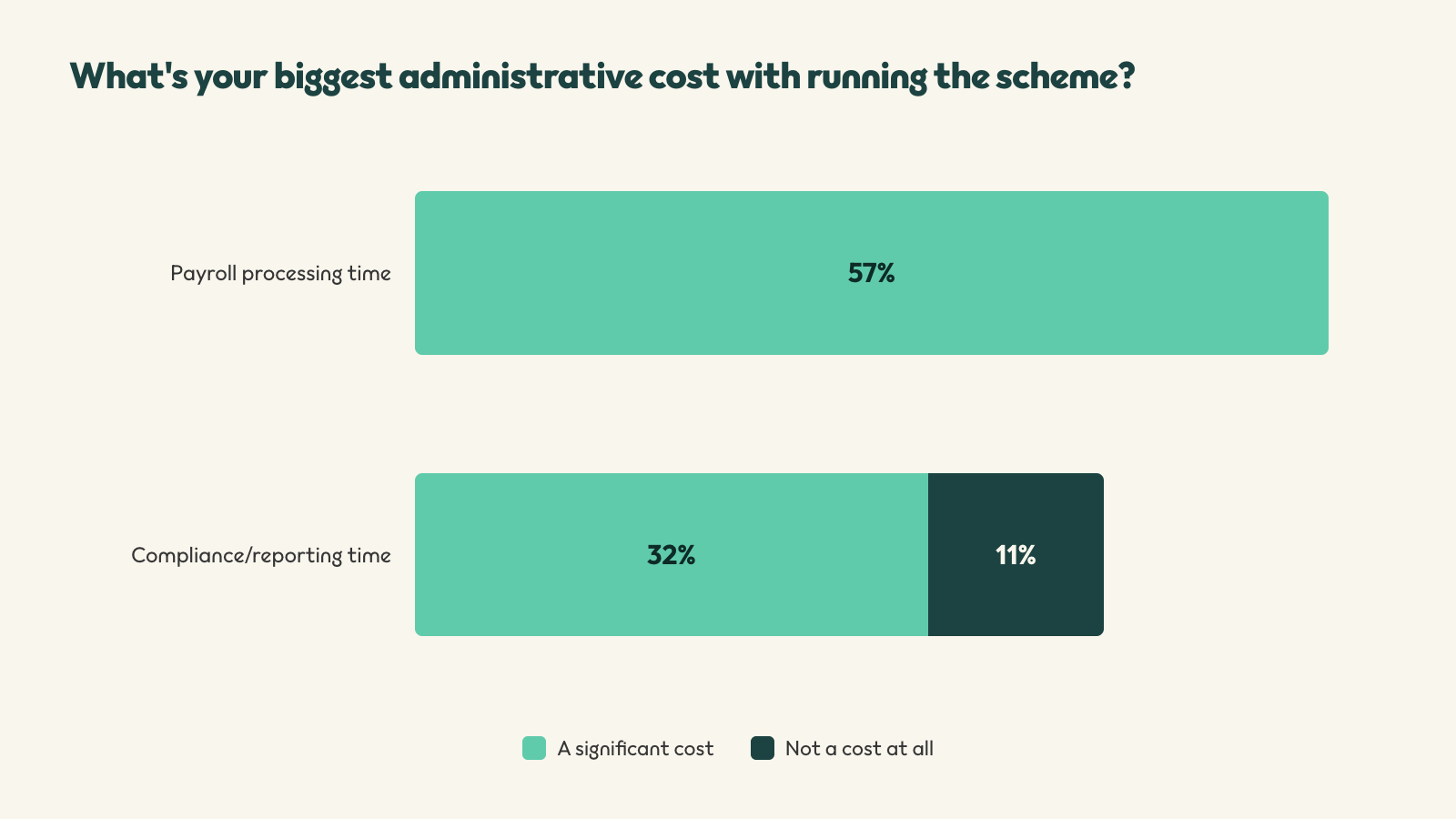
Administrative costs associated with EV salary sacrifice schemes are concentrated in a few key areas. Payroll processing time is the biggest challenge, with 57% of people leaders identifying it as a significant cost. This emphasises the ongoing work required to manage salary adjustments, employee deductions, and payroll administration throughout the life of the scheme.
Compliance and reporting also require considerable attention. 32% of people leaders view the time spent on compliance and reporting as a significant administrative cost, while 11% consider it not to be a cost at all. The difference suggests that organisations experience varying levels of administrative effort depending on their internal processes and the support available from their scheme provider.
Although compliance responsibilities take time, EV salary sacrifice schemes are designed to operate within HMRC and VAT rules when they are set up and managed correctly. This means organisations can benefit from a compliant framework while focusing on their administrative resources on payroll and day-to-day scheme management, rather than navigating complex regulatory requirements from scratch.
What's the biggest EV salary sacrifice scheme hidden cost concern for people leaders?
Only 2% of people leaders cite EV salary sacrifice scheme charging infrastructure costs as a major hidden costs concern, while this is of some concern for 23%, and a minor concern for 40%, but not a concern for 3%, maintenance and service costs are some concern for 18%, and a minor concern for7%, and 6% share the same level of concern about early EV salary sacrifice termination fees
Hidden costs concerns are minimal:
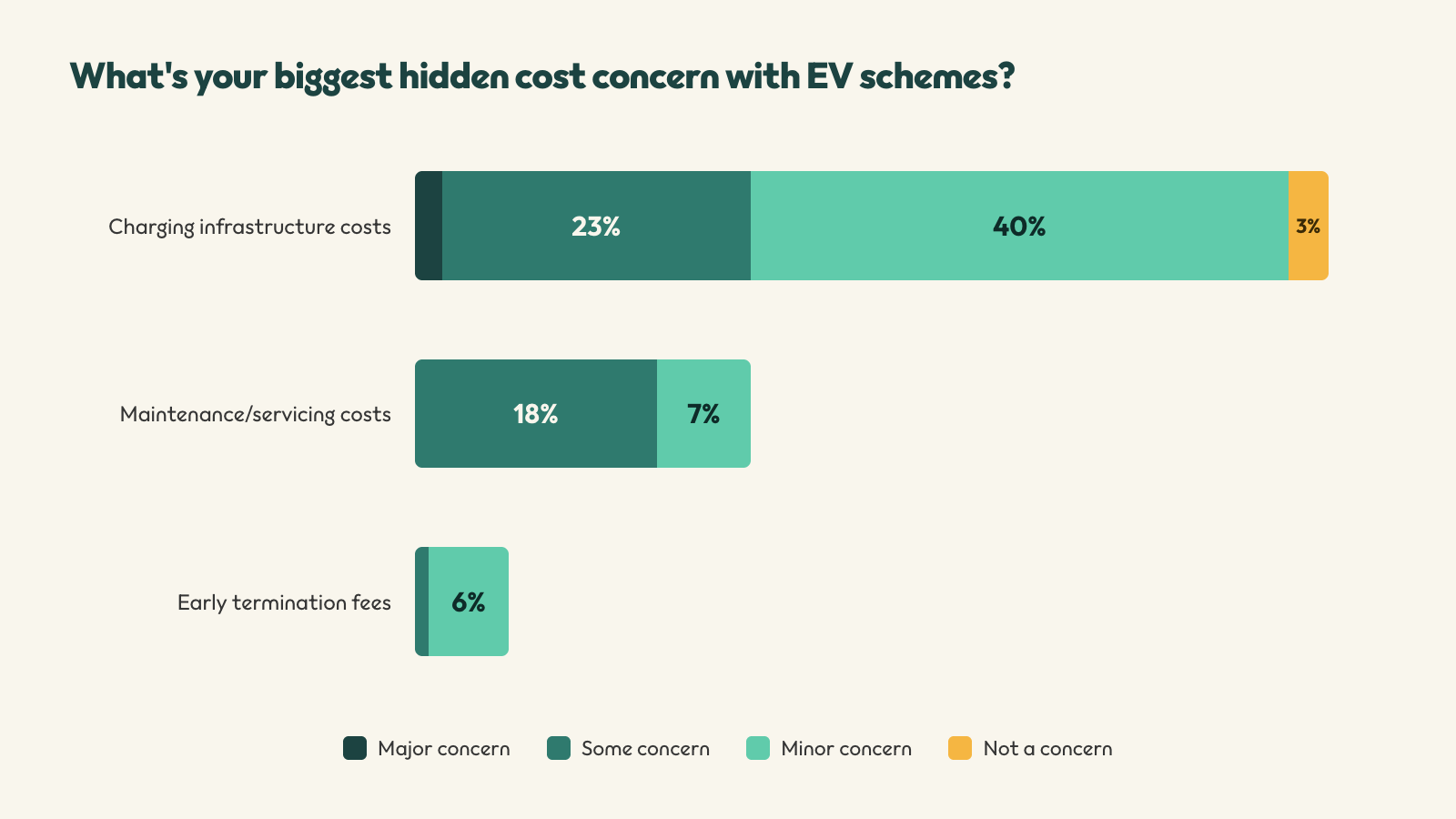
Hidden cost concerns around EV salary sacrifice schemes vary considerably, with charging infrastructure attracting the most attention. Just 2% of people leaders regard changing infrastructure costs as a major concern, while 23% consider it somewhat concerning. For 40%, changing infrastructure costs are only a minor concern; 3% do not see them as a concern at all. The distribution indicates that although infrastructure costs remain on the radar, they are rarely viewed as a significant obstacle.
Maintenance and servicing generate a more moderate level of concern. 18% of people leaders identify these costs as somewhat concerning, while 7% see them as a minor issue. This is understandable, as some industry data indicates that electric vehicles cost around 30% more to repair than petrol or diesel models and typically take 14% longer to fix. Early termination fees attract the least attention. Fewer than 1% of our audience regard them as somewhat concerning, and 6% see them as a minor concern.
What's the biggest risk to sustaining cost savings of EV salary sacrifice schemes for people leaders?
Government policy changes are the main risk to sustaining EV salary sacrifice scheme cost savings for 6% of people leaders, 48% agree this poses a significant risk, and 31% think it’s a minor risk, while rising vehicle or leasing prices pose a significant risk to cost savings for 7%, and another 7% find this a minor risk
Government risk the highest:
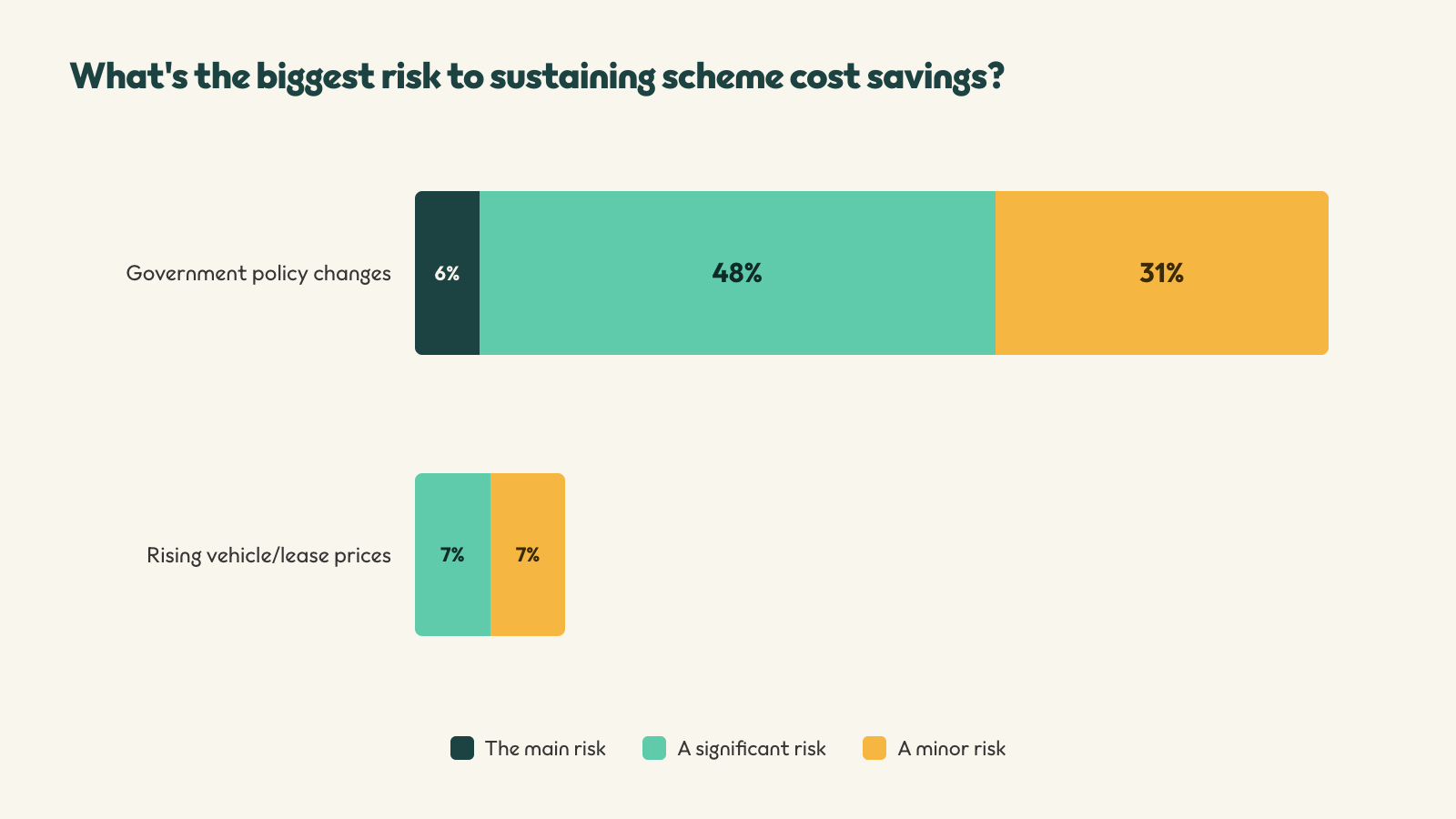
Government policy changes are the biggest concern for maintaining the long-term cost savings of EV salary sacrifice schemes. Almost half of the people leaders, 48%, view changes to government policy as a significant risk, making it the most common opinion by a wide margin. 6% of our audience considers policy changes to be the main risk to future savings, while 31% considers them a minor risk. This distribution shows that most organisations remain confident in the value of these schemes but continue to monitor future tax and regulatory decisions that could influence their financial benefits.
Rising vehicle and lease prices attract far less concern. Just 7% of people leaders identify higher vehicle or leasing costs as a significant risk, while another 7% view them as only a minor risk. Compared with concerns about government policy, increasing vehicle costs have a much smaller influence on confidence in long-term savings.
Are people leaders likely to use AI tools to calculate cost savings of EV salary sacrifice schemes?
27% of people leaders are very likely to use AI tools to calculate EV salary sacrifice schemes cost savings, 26% are somewhat likely, and 22% are not sure, but 25% are not likely to use AI tools for calculations at all
AI tools earn a majority vote:
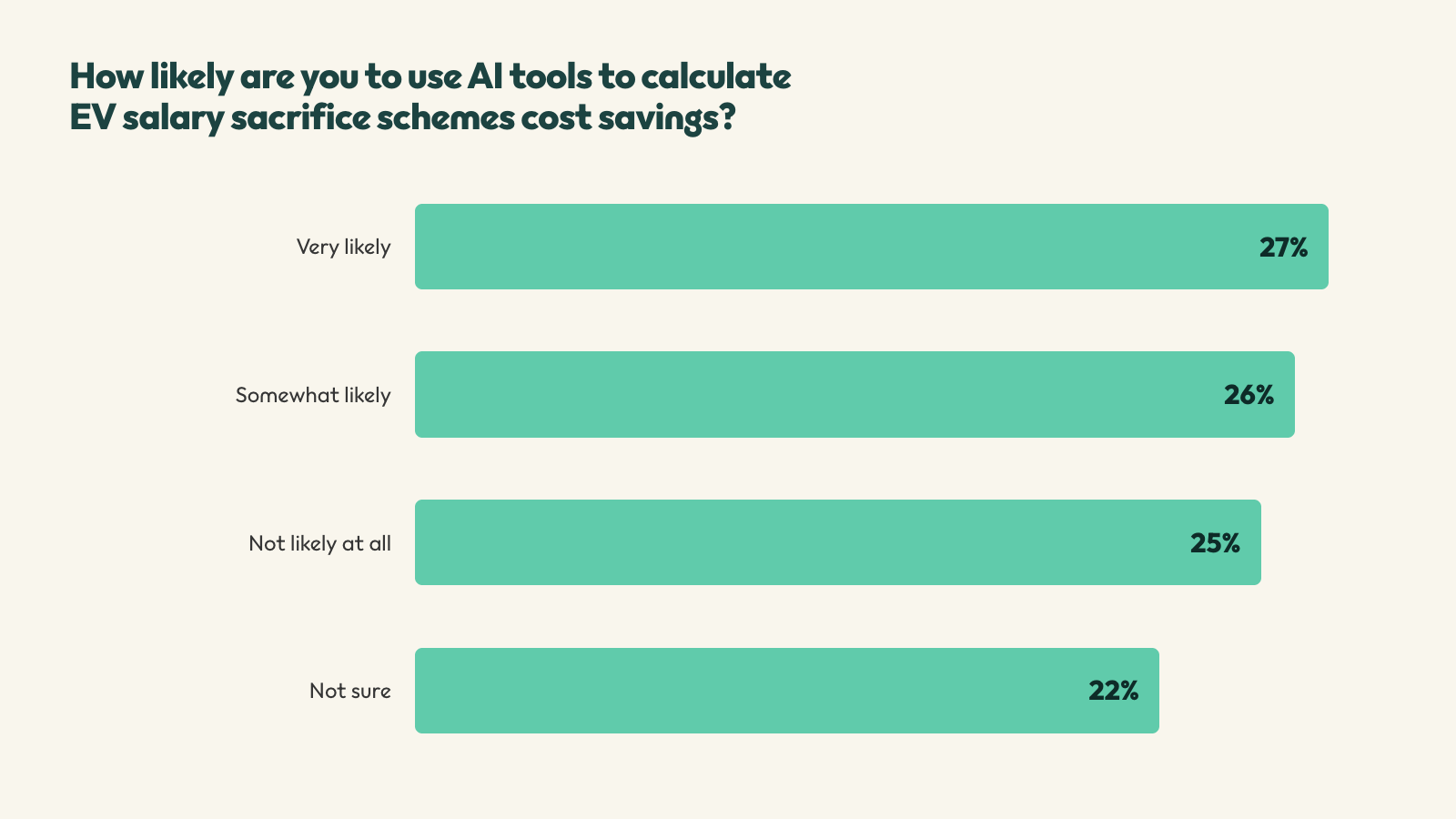
Interest in using AI to calculate the cost savings of EV salary sacrifice schemes is balanced across different levels of confidence. 27% of people leaders are very likely to use AI tools, representing the largest single group. 26% are somewhat likely, meaning that just over half are open to using artificial intelligence to estimate savings and support decision-making. This shows a growing willingness to adopt digital tools for financial planning and employee benefits.
Simultaneously, 25% are not likely to use AI tools for these calculations, while 22% remain unsure. Although there is still some hesitation, the figures show that uncertainty is relatively limited, with many organisations already considering how AI could improve efficiency and accuracy.
This trend mirrors wider business adoption, with 66% of accountants already using AI, including 63% in business finance functions and 69% in accountancy practice. As AI becomes a more familiar part of financial management, it is well placed to help employers model tax efficiencies, estimate NI savings, and compare the potential value of EV salary sacrifice schemes with greater speed and consistency.
Turning cost savings of EV salary sacrifice into long-term value
Overall, our findings show that EV salary sacrifice schemes are increasingly recognised as a valuable way to reduce costs while enhancing employee benefits. However, the financial outcomes organisations achieve depend on more than the tax advantages alone. Effective budgeting, administration, compliance, and clear communication all play an important role in maximising the value of these schemes.
As more employers incorporate EV salary sacrifice into their wider reward strategies, those that regularly review performance, understand the full cost picture, and adapt to changing market conditions will be best placed to realise long-term savings for their business and employees.
Last updated 21.07.26
